Tomrair’s Kildare Defeat847 CE
Dateline
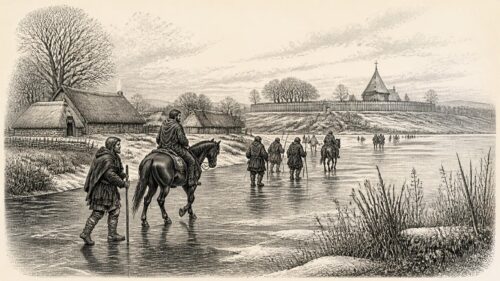
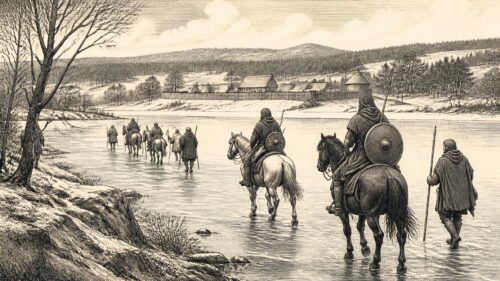
The surviving record for 847 CE begins not with a battle but with weather. The Annals of Ulster, whose annal labelled U848 corresponds to AD 847, notes a great snowfall on 1 February. It gives no duration, no depth and no tale of disaster; it is therefore unsafe to turn the notice into a ‘great winter’. Yet the entry is revealing. Snow sufficient to merit notice altered movement, grazing and work across a predominantly rural island, at a moment when armed forces, food supplies and communications already faced exceptional strain. In the same year Ireland saw a remarkable sequence of victories over Viking forces, a change at Armagh, the death of a former king turned anchorite, and a political reshaping of Munster after the passing of its formidable ruler Fedelmid mac Crimthainn.
A Year of Careful Chronology
847 must be approached with unusual care because medieval Irish annals do not all assign these events to the same numbered year. The relevant Annals of Ulster entry is explicitly synchronised to AD 847, while Chronicon Scotorum places the cluster under 848 and the seventeenth-century Annals of the Four Masters under 846. These are not rival eyewitness calendars: they are later textual witnesses to related annalistic material, affected by differing chronological systems and transmission. Modern scholarship normally places the victories discussed here in 847 CE. The safest approach is to state the year clearly while avoiding invented months, days, or a spurious order of march between the separate engagements.
Munster After Fedelmid
The death of Fedelmid, or Feidlimid, son of Crimthann, belongs firmly to 847 in modern reference chronology. He had ruled Cashel and exercised an influence far beyond Munster. A cleric as well as a king, he was remembered by the Annals of Ulster as a scribe, an anchorite and “the best of the Irish”; that warm obituary should not conceal the forcefulness of his career. Fedelmid had repeatedly used war, ecclesiastical patronage and political assemblies to challenge Uí Néill power. His death removed one of the few provincial rulers capable of matching the king of Tara in authority, while leaving Munster’s competing Éoganacht branches to negotiate a successor.
Ólchobar son of Cináed, already abbot of Emly and a member of the Éoganacht Locha Léin, emerged as overking of Munster in this unsettled setting. His selection appears to have been a compromise rather than the effortless succession of a dominant hereditary line: he came from west Munster, belonged to a dynasty different from Fedelmid’s Cashel branch, and was a churchman. That combination mattered. It gave Munster a ruler with ecclesiastical standing and enough dynastic weight to command an army, while perhaps reducing immediate rivalry among royal kindreds. The events of the year show that Ólchobar’s position was not merely ceremonial.
Four Victories, Not One Campaign
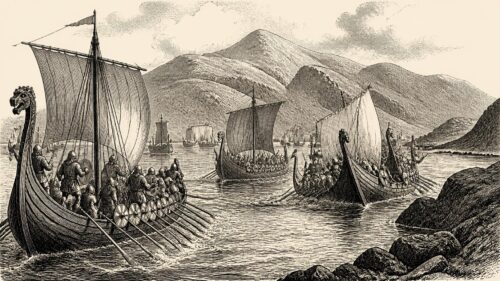
The annals record four Irish successes against groups called gentiles or “heathens”. These terse notices should not be compressed into a single national rising. Ireland had no unified standing army, and the victors were different rulers and dynastic groupings acting in different regions. Nor do the sources identify every Viking commander, ship, or destination. What they do establish is that raiders and longphort-based forces encountered determined, localised resistance in several theatres during the same year. The scale and concentration of the notices make 847 a significant turning point in the struggle between Irish powers and Scandinavian armed groups, but not an end to raiding or to Irish–Viking political cooperation.
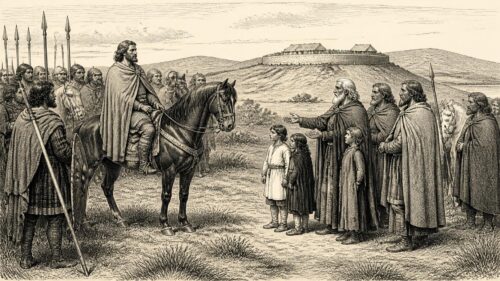
Máel Sechnaill mac Máele Ruanaid, king of Tara and leading figure among the southern Uí Néill, won a battle at Forach. The Annals of Ulster says that 700 of the enemy fell. It is impossible to verify the figure, and medieval annalists commonly employed large, rounded casualty totals to signal a decisive rout. Still, the notice identifies a clear victory for the king of Tara. Máel Sechnaill had only recently succeeded Niall Caille; success against foreign raiders strengthened his standing at precisely the time when Fedelmid’s death opened a new uncertainty in Munster. The battle was therefore both a military event and a demonstration of royal capacity.
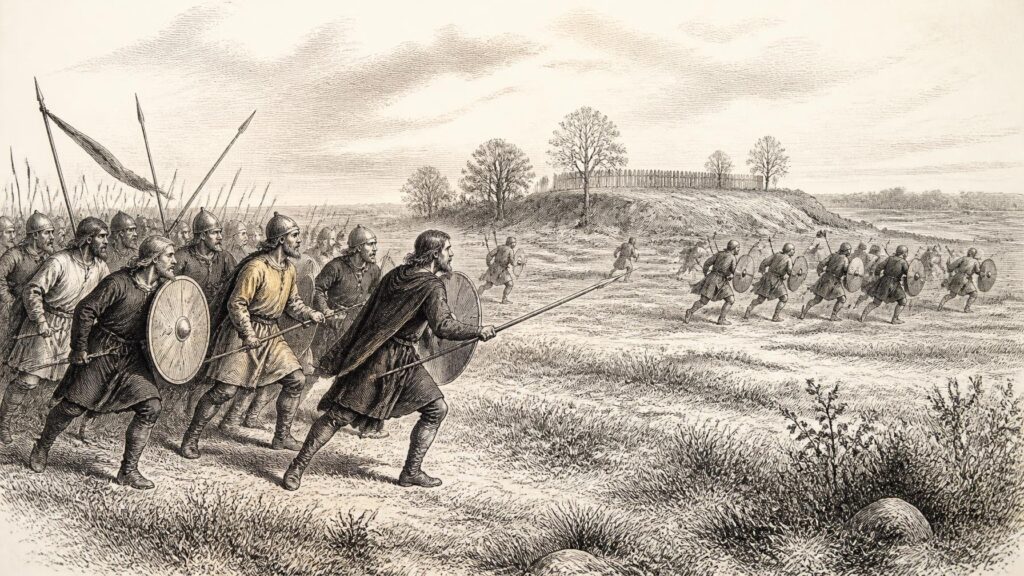
The most striking encounter occurred at Scíath Nechtain, generally associated with the Castledermot area of north Leinster. Ólchobar joined Lorcán son of Cellach and the Leinstermen against a Viking force led by Tomrair, described as an erell, or jarl, and tánaise ríg Laithlinne: heir-designate of a king of Lochlann or Laithlinn. The wording signals an opponent of high rank, though it does not permit a secure identification of either Tomrair or the overseas ruler to whom he was attached. Annals of Ulster gives 200 dead around Tomrair, whereas Chronicon Scotorum and the Four Masters give 1,200. The discrepancy is a warning against treating either number as a modern casualty count; the sure point is Tomrair’s death in a major defeat.
This alliance deserves emphasis. A Munster overking and a Leinster ruler had combined in a strategically important zone, not far from the Dublin longphort established earlier in the decade. Their cooperation demonstrates that rival Irish provinces could act together when Viking activity threatened routes, tribute-bearing lands and political prestige. It does not prove a lasting treaty or a united Irish command. Alliances were contingent, built around immediate interests, and could dissolve as quickly as they formed. Even so, Scíath Nechtain made Ólchobar’s accession visible in arms and showed that Leinster was not simply a corridor for raiding parties moving inland from Dublin.
Two further victories illustrate the breadth of resistance. Tigernach, lord of Loch Gabor, routed Vikings in the oakwood of Dísert Do-Chonna; the annal gives 1,200 dead. Elsewhere, the Éoganacht of Cashel defeated another force at Dún Maíle Tuile, where 500 were said to have fallen. Neither entry provides enough detail to reconstruct the landscape of fighting, the size of the Irish forces, or the identity of the defeated leaders. Their value lies in showing that warfare extended beyond one royal battlefield. Kings, local rulers and dynastic followings could mobilise around wooded territories, ecclesiastical places and defended routes, and could claim victories independently of the king of Tara.
War, Settlement and Livelihood
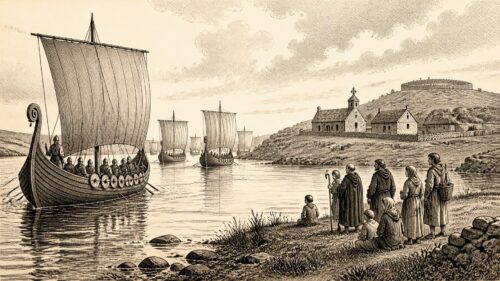
The successes of 847 did not erase Viking power. Dublin remained an important fortified settlement and maritime base, and later annals record renewed conflict, foreign fleets and Irish campaigns against it. Nor should “Vikings” be imagined as a single people acting under one command. The contemporary record distinguishes groups and leaders only unevenly, while later sources preserve traditions of shifting Scandinavian and Irish alliances. The practical reality for communities near rivers, coasts and routeways was continued uncertainty: the threat of plunder, taking of captives, requisitioning of food and livestock, and disruption of travel. Yet the same waterways also remained arteries of exchange and movement; conflict took place within, rather than outside, an interconnected Irish Sea world.
For ordinary households, the annals are frustratingly silent. They do not tell us how the February snowfall affected seed grain, fodder, prices, fishing, or the rebuilding of damaged enclosures. They do, however, preserve a landscape in which seasonal weather and warfare mattered directly to subsistence. Armies required provisions; animals required winter feed; and settlements near navigable waters faced the quickest access both to trade and to armed raiders. It would be wrong to claim that the snow caused the battles, or that the victories immediately improved rural life. The evidence supports a more modest conclusion: 847 was experienced through a combination of weather, local lordship, religious institutions and the persistent risks of armed mobility.
Armagh and the Religious Landscape
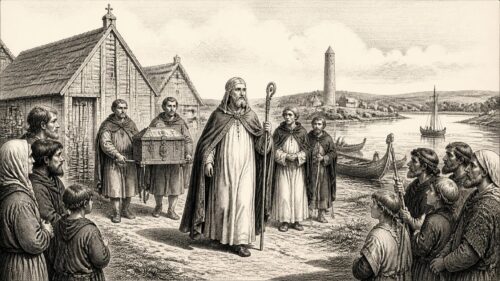
Church affairs were inseparable from politics. The annals note a change of abbots at Armagh: Diarmait replaced Forannán. Armagh was not simply a religious community but the centre of the Patrician federation of churches, a place whose relics, clerics and claims to primacy carried influence throughout Ireland. An abbatial succession could therefore have consequences for alliances and royal legitimacy. The record gives no narrative of dispute in 847, so it would be unwarranted to portray the change as a coup or as a response to Viking pressure. What can be said is that, amid royal deaths and warfare, one of Ireland’s most important ecclesiastical offices changed hands.
The deaths of Fínnechta of Luibnech, described as an anchorite and formerly king of Connacht, and Tuathchar son of Cobthach, king of Luigni, add a quieter dimension to the year. Fínnechta’s obituary encapsulates a familiar early medieval Irish pattern: secular kingship and religious vocation were not wholly separate careers. Renunciation, pilgrimage, monastic office and asceticism could coexist with aristocratic status and political memory. The year’s annals consequently preserve more than warfare. They record a society in which churches were repositories of learning and authority, rulers might become religious, and the deaths of regional kings could matter alongside the fall of a Viking jarl.
A Moment of Reversal
847 was not the year Ireland expelled the Scandinavians, nor was it a simple triumph of “Irish” over “foreigners”. It was a year in which several Irish rulers successfully checked Viking forces, while the political map was being redrawn by Fedelmid’s death and Ólchobar’s elevation. Máel Sechnaill’s victory at Forach, the allied success at Scíath Nechtain and Tomrair’s death, Tigernach’s rout, and the Éoganacht victory at Dún Maíle Tuile together changed the balance of confidence. The annals’ sparse lines cannot supply every human detail, but they preserve a genuine moment when regional leadership, military coordination and ecclesiastical continuity enabled Ireland’s political communities to push back hard against maritime raiders.
Primary Sources
- The Annals of Ulster, Year U848
- The Annals of Ulster, Year U847
- The Annals of Ulster, Year U849
- Chronicon Scotorum
- Annals of the Four Masters, Part 67
- Annals of the Four Masters, Part 68
- Vikings in Irish Chronicles, 794–902: Data
- Vikings in Ireland and Scotland
- The Vikings in Ninth-Century Ireland: Sources and Settlements
- Viking Ireland: Afterthoughts
- Fedelmid (Feidlimid) | Dictionary of Irish Biography
- Ólchobar | Dictionary of Irish Biography
- Máel-Sechnaill | Dictionary of Irish Biography
- Cerball | Dictionary of Irish Biography
- Fragmentary Annals of Ireland
- Exploring the Irish Annals
- The Chronology and Sources of the Early Irish Annals
- On Reconstructing Medieval Irish Chronicles
- The Historic Record of Cold Spells in Ireland
- Medieval Irish Chronicles Reveal Persistent Volcanic Forcing of Severe Winter Cold Events, 431–1649 CE
- CELT – Corpus of Electronic Texts
- Irish Texts at CELT