Lough Neagh’s Captive Scholars840 CE
In 840, Viking raiders operating from Lough Neagh plundered Lugbad, capturing bishops, priests and scholars, demonstrating an inland capacity to hold prisoners. Armagh was also burned, although earliest evidence does not identify those responsible. Simultaneously, Feidlimid mac Crimthainn of Munster invaded the midlands and reached Tara, challenging Niall Caille’s northern Uí Néill authority; Niall countered in contested border districts. The year exposed links between waterways, churches, learning and royal power. Annalistic chronology remains uncertain, particularly regarding Viking camps at Dublin and Linn Duachaill, conventionally dated to 841. Nevertheless, 840 marked a transition towards sustained Viking operations and intensified interprovincial rivalry.
Dateline
In 840, Ireland’s political map was shaken from two directions at once. Viking raiders operating from Lough Neagh struck an important church settlement in the north-east, while Feidlimid mac Crimthainn, king of Munster, drove a royal army into the midlands and as far as Tara. Neither development was an isolated incident. Together they reveal an island in which waterways, monasteries, royal assembly-sites and border territories had become closely connected theatres of power.
The evidence, however, requires care. Irish annals were compiled and recopied over centuries, and their year-headings do not always correspond neatly with a modern calendar. The Annals of Ulster place the raid on Lugbad and Feidlimid’s advance under their entry for 840, although that manuscript tradition also signals a chronological offset. The later Annals of the Four Masters assigns related northern events to 839 and places Viking camps at Dublin and Linn Duachaill under 840; modern scholarship normally dates those latter foundations to 841. The secure conclusion is that 840 belongs to the crucial transition from seasonal raids to sustained Viking operations, but it should not be used to claim that every famous early Viking base was founded in this calendar year.
Raiders from Lough Neagh
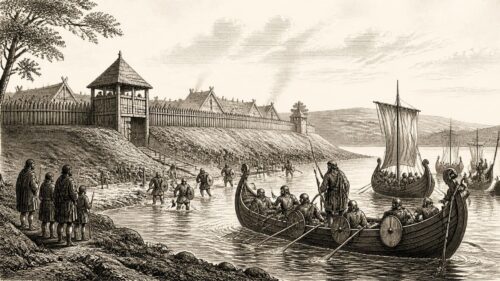
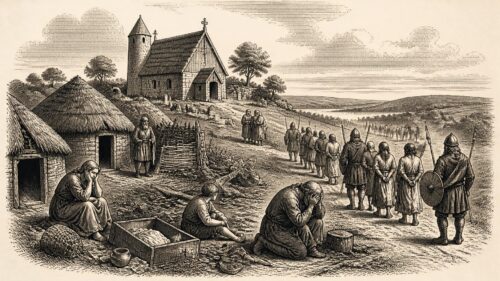
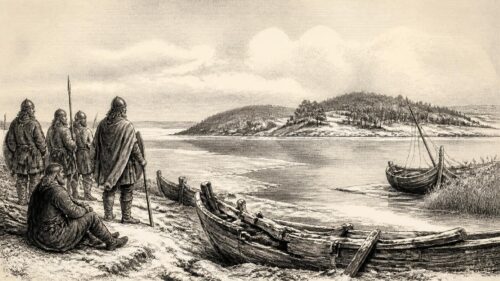
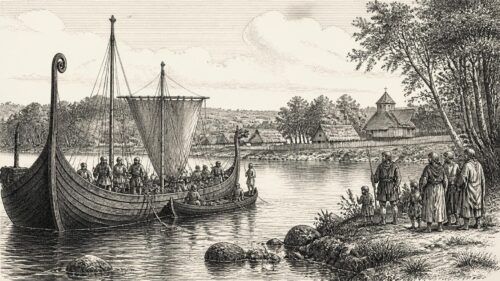
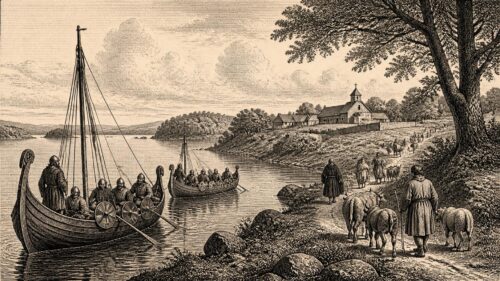
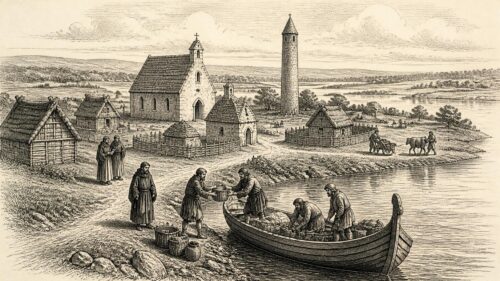
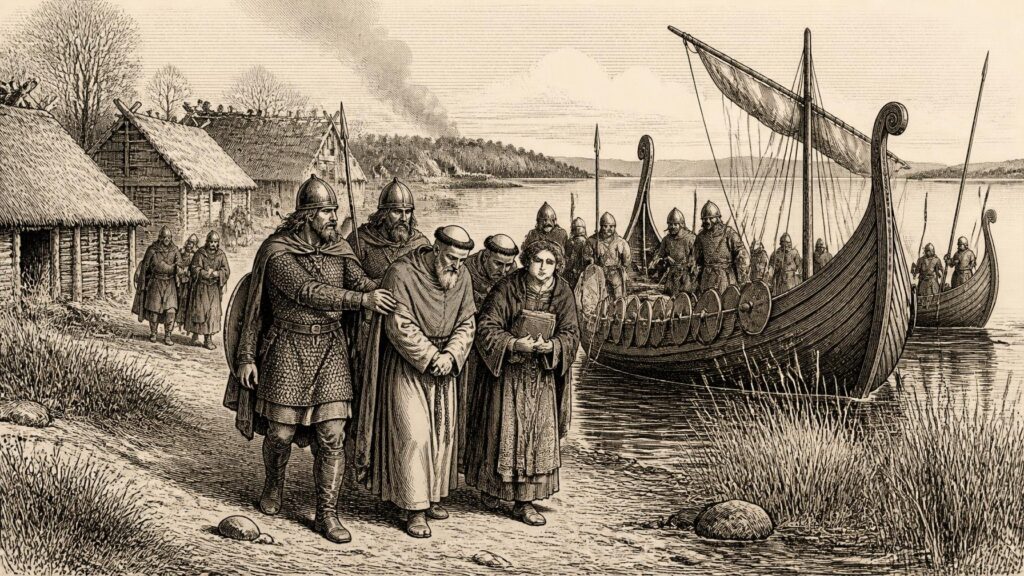
The clearest Viking event assigned to 840 is the plundering of Lugbad, modern Louth. The Annals of Ulster say that the attackers came “from Loch nEchach”, Lough Neagh, and carried away bishops, priests and scholars as captives while killing others. The wording is unusually revealing. Lugbad was not simply a storehouse of portable wealth: it was a religious community containing clerics of different rank and learned people whose skills mattered to church and society. Their seizure exposed the human consequences of raiding more sharply than a bare notice of loot or burning.
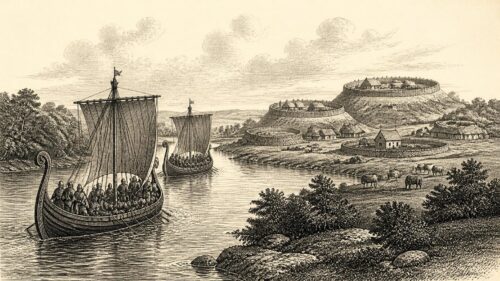
Lough Neagh gave the raiders a formidable inland position. It was a great freshwater basin linked towards the sea by the Bann and set amid the territories of Ulaid, Airgialla and the northern Uí Néill. From such a base, ships and crews could threaten communities beyond the immediate coast. The annals’ phrase “from Lough Neagh” does not precisely describe the raiders’ camp, numbers, ethnicity or route to Lugbad. Nevertheless, it demonstrates that a mobile foreign force was using the lake as an operational centre by this period. The Four Masters, drawing on a later annalistic tradition, makes the implication more explicit by saying that captives were taken back to the raiders’ fortress.
The people called “heathens” or “Foreigners” in the Irish records should not be imagined as an undifferentiated invading nation. The contemporary annalists chiefly recorded what such groups did, not where each individual came from or how their forces were organised. Yet the Lugbad attack shows that Viking activity had acquired an inland reach and a capacity to hold prisoners. Captivity could mean ransom, enslavement, forced service or exchange; the annal does not tell us the captives’ eventual fate. It does show why ecclesiastical communities feared waterborne war-bands even when they stood well away from an exposed shore.
Armagh in Ashes
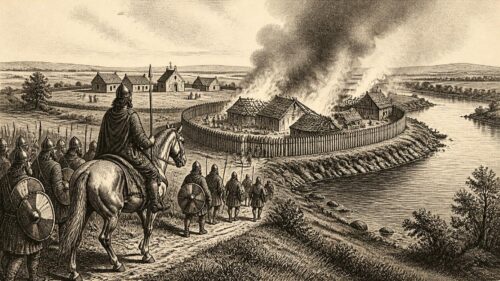
In the same annal-year, Ard Macha, Armagh, was burned “with its oratories and stone church”. This was a grave blow to Ireland’s foremost Patrician church and to a place whose authority extended far beyond its own settlement. Oratories were small places of worship, while the explicit mention of the stone church underlines the scale and symbolic weight of the destruction. A church complex was also a centre of residence, hospitality, teaching, writing, estate management and political negotiation. Fire therefore threatened far more than buildings.
Attribution needs restraint. The Annals of Ulster records the burning but does not name the perpetrators. The Four Masters attributes it to the same foreign raiders associated with the Lough Neagh attack, but that is a much later compilation. Viking responsibility is plausible in the immediate northern context, but it is not stated in the earliest surviving notice. Nor should the episode be used to suggest that Scandinavian raiders alone endangered churches: Irish kings and rival dynasties also attacked ecclesiastical settlements during this violent age. What can be firmly said is that Armagh was damaged at a moment when control of its spiritual prestige and extensive church federation mattered intensely to secular rulers.
Feidlimid at Tara
The year’s other great crisis came from the south. Feidlimid mac Crimthainn, king of Munster and leading figure of the Eóganacht of Cashel, invaded Mide and Brega, the central regions tied to Uí Néill power. The Annals of Ulster says that he halted at Temair, Tara. The Annals of Inisfallen, a source with strong Munster associations, makes the sweep still more dramatic: Feidlimid harried Leth Cuinn, the northern half of Ireland in the traditional political division, from Birr to Tara before being checked there.
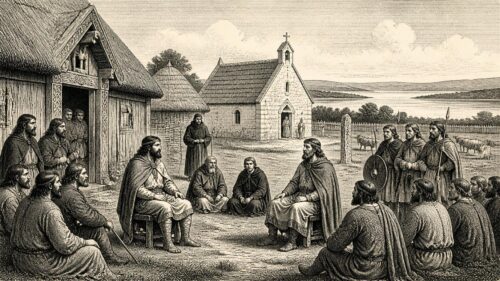
Tara was no ordinary camping-place. Its symbolic association with the kingship of Ireland made an army’s presence there a public statement about supremacy. Feidlimid did not thereby become undisputed king of all Ireland, and the annals do not say that he captured Tara or held it for long. His halt nonetheless challenged the standing of Niall Caille, king of Tara and head of the northern Uí Néill. Feidlimid’s campaign should be understood as a calculated assertion that Munster’s ruler could penetrate the political heartland of his northern rival.
The contest had a recent history. Feidlimid had become king of Munster in 820 and had built an unusually ambitious southern kingship through warfare, alliances and intervention in church affairs. Niall Caille had taken the kingship of Tara in 833, drawing strength from Cenél nÉogain in the north. A royal meeting between the two men in 838 appears to have produced no lasting settlement. By 840, open competition had returned. The issue was not a modern national monarchy but precedence: who could compel submission, exact hostages, influence Leinster and Mide, and command access to major ecclesiastical centres and ceremonial sites?
The sources preserve sharply partisan details. A verse attached to the Ulster entry praises Feidlimid as a king for whom taking Connacht’s hostages without battle and plundering Mide were the work of a single day. It is political poetry, not a timetable to be read literally. Yet its preservation conveys the reputation Feidlimid’s advance was intended to create: speed, reach and a capacity to impose terms without a pitched battle. Hostages were central to early medieval politics, providing a personal guarantee that agreements and submissions would be honoured. Their taking advertised superiority; their loss represented vulnerability.
The Annals of Inisfallen adds that Feidlimid seized Gormlaith, described there as daughter of Murchad, king of Leinster, with her female retinue, and that Indrechtach son of Máel Dúin was killed at Tara. These details must be reported as this source’s account rather than treated as independently corroborated fact. Even so, they indicate that a royal campaign could reach into aristocratic households as well as battlefields. Women of ruling families were integral to dynastic alliances, and their seizure could be a potent act of coercion and humiliation. The reference to a female train also briefly reveals the household structures that travelled with elite women.
Niall’s Counter-Move
Niall did not passively watch Feidlimid’s advance. The Annals of Ulster records that, on the same occasion, he invaded Fir Chell and Bethra, districts in the midlands. These attacks were directed at places exposed between competing spheres of influence. They were not recorded as a battle with Feidlimid, but they formed part of the same struggle to control routes, clients and resources in Mide’s borderlands. The language of “invasion” or “plundering” should be taken seriously: royal warfare commonly involved the seizure of cattle, foodstuffs and people, the destruction of settlements or crops, and the extraction of submission.
Feidlimid was checked at Tara rather than decisively crushed. The more conclusive encounter lay ahead, when he returned into Leinster in 841 and was met by Niall’s forces near Mag nÓchtair. That later defeat should not be pulled back into 840. In this year, Feidlimid’s achievement was the depth of his incursion; Niall’s was to prevent it from becoming a durable takeover of the Uí Néill heartland and to retain the initiative in the contested midlands.
Church, Learning and Uncertain Foundations
Amid warfare, the annals also record the death of Ioseph of Ros Mór, called a bishop, distinguished scribe, anchorite and abbot of Cluain Eóis and other monasteries. Such a compressed obituary is valuable evidence for the overlapping offices held by senior churchmen. A learned religious leader might supervise several communities, cultivate an ascetic reputation and be remembered particularly for writing. In 840, the loss of such figures and the capture of Lugbad’s scholars underline the dependence of Irish learning on religious institutions and the people who sustained them.
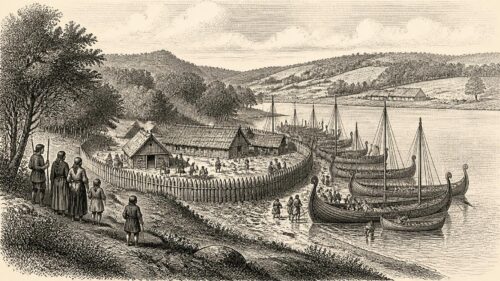
The year is often associated with the beginnings of the longphort, the defended ship-camp that became an important feature of Viking activity in Ireland. That association must be carefully phrased. The Lough Neagh raiders were evidently operating from a sustained inland base in 840. But the better-attested longphuirt at Duiblinn, Dublin, and Linn Duachaill, near Annagassan in County Louth, are conventionally dated to 841, despite the placement of their foundation under 840 in the Four Masters. Archaeology at Linn Duachaill has identified a substantial enclosing bank and ditch, occupation evidence and material linked with metalworking, ships and exchange. It confirms the significance of such camps, but it should not override the dating problem.
Thus 840 was not yet the year in which Dublin can securely be called a permanent Viking town. It was, rather, a year in which the conditions for the new phase were unmistakable: raiders based on Lough Neagh could attack inland church communities; captives could be taken in numbers and held; Armagh was vulnerable to destruction; and Irish kings still pursued their own expansive wars across the centre of the island. The future urban and commercial importance of Viking Ireland was not predetermined, but the military, geographic and political foundations of that transformation were already being laid.
Primary Sources
- The Annals of Ulster: Year U840
- The Annals of Ulster
- Annals of Inisfallen: Annal AI840
- Annals of the Four Masters: Annals M837–M840
- Annals of the Four Masters: Irish Text, Annals M839–M840
- Annals of the Four Masters
- Chronicon Scotorum
- CELT Project: Chronicon Scotorum
- Vikings in Irish Chronicles, 794–902: Introduction
- The Vikings in Ninth-Century Ireland: Sources and Settlements
- Vikings in Ireland and Scotland
- Fedelmid (Feidlimid), Dictionary of Irish Biography
- Niall Caille, Dictionary of Irish Biography
- Feidlimid mac Crimthainn: King of Munster, Oxford Dictionary of National Biography
- The Vikings in Ulaid
- The Winter Camp of the Viking Great Army, AD 872–3, Torksey, Lincolnshire
- Dublin: Archaeological Background
- Dublin: Archaeological Problems and Potential
- Excavation Report 21677: Linn Duachaill, County Louth
- Vikings in Early Medieval Ireland: Church-Raiding, Politics and Kingship
- Longphuirt, Wintersetlu, and Gorodišče: A Study of Viking-Age Military Encampments