

Imperial Entanglements
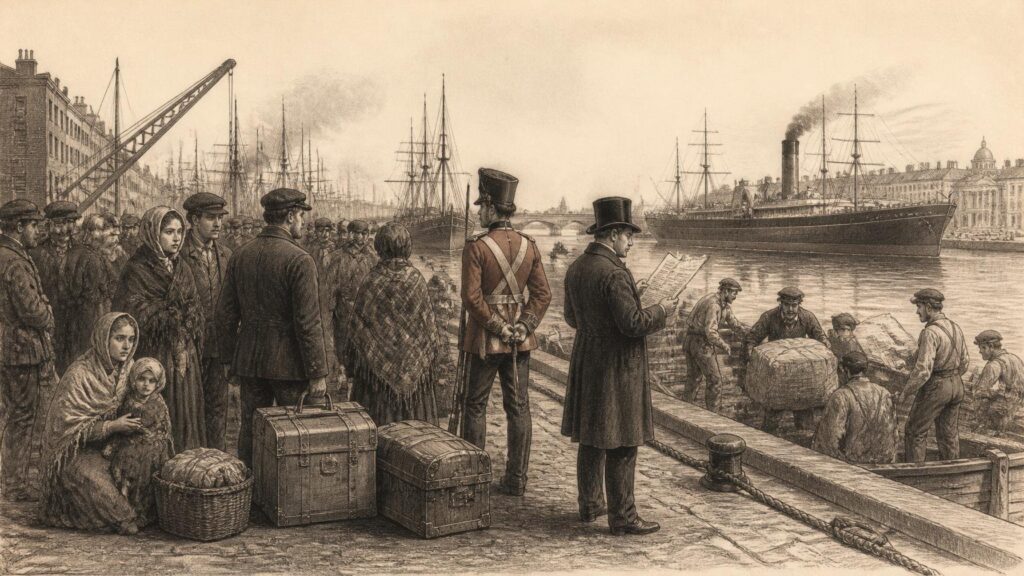
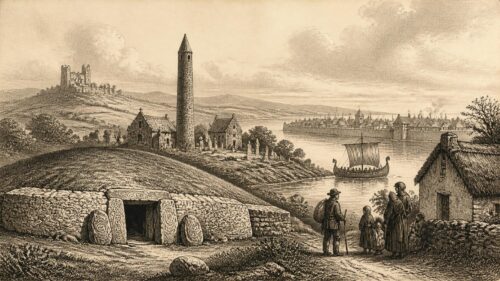
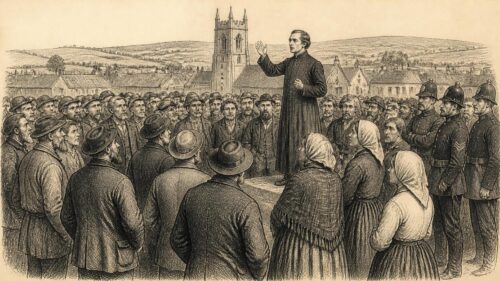
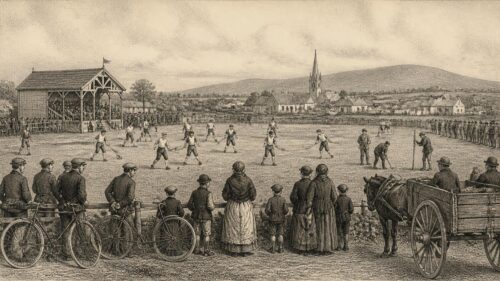
AI generated historical illustration, not a contemporary photograph.
At a Glance
Empire was not merely an external setting for Irish history. It was a structure of power experienced within Ireland and, at the same time, a field in which many Irish people acted abroad as soldiers, settlers, officials, clergy, traders, reformers and opponents of British rule. Any serious account must hold these realities together without turning either into a comforting national myth.
Imperial Meanings
The word empire has carried several meanings in Irish history. It can denote direct conquest and rule: the extension of English authority over Ireland from the later Middle Ages, its remaking through Tudor military campaigns, and its consolidation after seventeenth-century wars. It can also describe the far larger British imperial world in which Ireland was bound after the Union of 1801. That world linked the island to North America, the Caribbean, India, Africa, Australasia and other territories through state institutions, armies, commerce, churches, migration and political argument.
Neither meaning permits an uncomplicated description of Ireland as simply a colony, simply a constituent nation of the United Kingdom, or simply a partner in overseas empire. Its constitutional position altered repeatedly. Its inhabitants possessed sharply unequal rights, wealth and access to office. Protestant landowners, Catholic tenant farmers, urban merchants, labourers, Presbyterian emigrants, nationalist politicians and unionist industrialists encountered imperial structures differently. Their choices, moreover, were made in changing circumstances rather than from a single inherited disposition.
Historians consequently disagree over the best vocabulary. Colonial comparison can illuminate land confiscation, settlement, coercive government and racialised assumptions. Yet Ireland was geographically close to Britain, represented at Westminster after 1801, and deeply interwoven with British markets and institutions. To call it only a colony risks obscuring those distinctions; to call it merely an integral part of the United Kingdom can conceal the persistent inequalities and exceptional administrative arrangements that made many contemporaries speak in colonial terms. The evidence supports complexity rather than a verdict of simple equivalence.
Early Conquest
English intervention began long before a British Empire existed. The Anglo-Norman invasion of the late twelfth century created lordships and settlements, but English authority was never uniform across the island. Gaelic lordships, Hiberno-Norman families and the English crown competed, accommodated one another and fought. The effective reach of royal government contracted and expanded. By the later medieval period, the English administration centred on Dublin governed a limited area commonly called the Pale, while much of the island remained outside regular crown control.
The Tudor reconquest changed the scale and ambition of English policy. Sixteenth-century monarchs sought a more centralised kingdom, military submission of regional lords, the extension of English law, and a religious settlement aligned with the English Reformation. Henry VIII’s assumption of the title King of Ireland in 1541 was a constitutional assertion, but the decades that followed showed that title and command were not the same thing. Campaigns in Munster and Ulster were costly, destructive and prolonged. The crown often relied on garrisons, martial law, confiscation and negotiated submission.
This history matters to the later imperial story because practices of conquest and settlement developed in Ireland before Britain possessed its nineteenth-century global empire. That does not make Ireland a simple prototype for every later colony. Conditions differed greatly across continents and centuries. It does, however, explain why scholars have examined Ireland as one arena in which English rulers worked out methods of territorial incorporation, land redistribution, religious reform and military governance later recognisable elsewhere.
Plantation Regimes
Plantation was among the most consequential of those methods. Land confiscated after rebellion or war was granted to settlers expected to be loyal to the crown, Protestant in religion and capable of defending the new order. The Munster plantation followed the defeat of the Desmond rebellion in the later sixteenth century. The better-known Ulster plantation followed the collapse of Gaelic lordship after the Nine Years’ War and the departure of several leading Ulster lords in 1607. English and Scottish settlers acquired land, while towns, estates and churches were reorganised.
Plantation was neither total nor mechanically successful. Many native Irish remained on the land as tenants or labourers; some grantees failed to meet the conditions imposed upon them; local economic relationships crossed confessional boundaries. Still, the redistribution of land and the settlement of substantial Protestant communities permanently transformed Ulster and intensified divisions elsewhere. It linked property, religion, political allegiance and military security in ways that would shape Irish politics for centuries.
Popular memory sometimes compresses plantation into a story of a wholly dispossessed people and a wholly foreign population. Documentary evidence supports the scale of confiscation and the importance of state-sponsored settlement, but it also demonstrates variety: older English families, Scottish migrants, Gaelic elites who adapted, tenants of several backgrounds, and communities whose local lives did not always follow the starkest political categories. Historical explanation should not soften coercion; it should recognise how coercion created societies more complicated than official plans anticipated.
Cromwellian Settlement
The wars of the mid-seventeenth century brought a further and devastating transformation. Ireland was engulfed in conflicts connected to the Wars of the Three Kingdoms: the rebellion of 1641, Confederate Catholic government, royalist and parliamentarian campaigns, and Oliver Cromwell’s conquest after 1649. Mass violence, siege warfare, famine, disease and forced displacement scarred the country. The scale of mortality remains debated, partly because the evidence is incomplete and estimates depend on demographic assumptions, but there is no doubt that the human cost was immense.
Parliamentarian victory brought extensive land confiscation. Catholic proprietors were removed from much land, while soldiers, creditors and Protestant interests received grants. The phrase “To Hell or to Connacht” has become a powerful shorthand for this settlement. It captures the coercive movement and dispossession associated with the period, but it should not be treated as a complete literal description of every policy or every individual experience. The legislation, surveys and transfers of property reveal a complicated process, varying by region and status, rather than a single universally executed formula.
The Cromwellian settlement entrenched a Protestant landed order and gave later political disputes a material as well as religious foundation. It also became a lasting reservoir of historical memory. Nineteenth-century nationalists invoked it as evidence of colonial injustice, while defenders of the Protestant constitution viewed the post-war settlement as a safeguard against perceived Catholic political dominance. The past was therefore not inert. It was repeatedly used to explain, justify and contest power in the present.
Protestant Ascendancy
After the Williamite war of 1689–91, the Protestant Ascendancy gained a secure constitutional and social position. The defeat of the Jacobite cause confirmed the dominance of the established Church of Ireland, Protestant landowners and a parliament whose electorate and membership were restricted by property and religion. Penal legislation constrained Catholic political, educational, religious and property rights, though its severity, application and later relaxation varied over time. Presbyterians, despite being Protestant, also faced disabilities within an Anglican constitutional order.
The Irish parliament was not simply a local council. It legislated, taxed and supported imperial war, but its independence was constrained by the crown and by the constitutional relationship with England. The eighteenth-century kingdom of Ireland was thus neither wholly autonomous nor governed identically to an overseas colony. Its political life unfolded inside a wider imperial system in which Irish elites could seek influence while remaining subordinate to London in important respects.
Those elites were not detached from empire. Irish ports participated in Atlantic trade; landlords and merchants invested in imperial commerce; Irish-born men pursued careers in the army, navy, colonial administration and the East India Company. Ireland’s links to Caribbean slavery require particular care. Irish merchants, migrants and estate owners could be implicated in plantation economies, while Irish labourers also migrated under conditions of severe dependence. Such facts resist both the false claim that Irish people stood entirely outside Atlantic slavery and the equally false claim that their experiences were interchangeable with the hereditary chattel enslavement imposed upon Africans and their descendants.
Atlantic Connections
The eighteenth-century Atlantic world carried large numbers of Irish people overseas. Some crossed voluntarily in pursuit of land, trade, religious freedom or employment; others left because rents, insecurity, discrimination or economic hardship narrowed the possibilities at home. Ulster Presbyterians were particularly prominent among migrants to North America, though emigrants came from every province and social group. Irish communities became significant in colonial towns, frontier settlements and later the United States and Canada.
Migration did not mean that emigrants ceased to be part of Irish history. Letters, remittances, newspapers, family chains and political organisations connected the diaspora to events at home. Nor did every migrant share the same politics. Some Irish Protestants identified strongly with the British connection and imperial expansion. Many Catholic emigrants eventually supported nationalist causes. Others adopted local identities, fought in colonial militias, profited from settler expansion or held views shaped more by class and religion than by any abstract idea of Ireland.
The American Revolution offered an early illustration of these divided attachments. Irish-born people and people of Irish descent appeared on both sides, as did British and Irish regiments. The revolution also inspired constitutional reformers in Ireland, who argued that a kingdom contributing to imperial defence deserved greater legislative independence. The Volunteers, raised amid fears of invasion during the American war, became an important political force. In 1782, constitutional changes reduced Westminster’s formal legislative control. This period, often called Grattan’s Parliament, expanded the political room available to the Protestant Irish elite but did not create a democratic or inclusive national legislature.
Revolutionary Crisis
The French Revolution and the wider Atlantic age of revolution sharpened Irish tensions. The Society of United Irishmen initially sought parliamentary reform and cooperation across religious divisions. Influenced by American and French examples, many members moved towards republicanism and independence. The movement attracted Presbyterians, Catholics and some Protestants from the established elite, although support varied widely by locality and class. Government repression, sectarian violence and the failure of reform widened the crisis.
The rebellion of 1798 was a major watershed. It was not one uniform uprising: its leadership, local grievances, levels of organisation and patterns of violence differed between Leinster, Ulster, Wexford and other regions. The rebellion and its suppression were brutal. Folklore, family memory and later nationalist commemoration have preserved powerful stories of heroism and atrocity; many are grounded in real trauma, though individual tales must be checked against contemporary records where possible. The historical certainty is that the revolt exposed the fragility of the existing constitution and deepened elite fears of invasion and social revolution.
The Act of Union, passed in 1800 and effective from 1 January 1801, abolished the Dublin parliament and incorporated Ireland into the United Kingdom of Great Britain and Ireland. Supporters presented union as a means of security, commercial integration and eventual religious reconciliation. Opponents denounced it as the destruction of Irish legislative independence, secured through patronage and pressure. The promised Catholic emancipation did not accompany the Act, intensifying Catholic grievance. Union brought Irish representatives to Westminster, but it did not settle the question of whether Ireland was an equal partner, a subordinate kingdom, or something that functioned in important ways like a colony.
Union Governance
After 1801, Ireland became part of the metropolitan state while retaining forms of government that seemed exceptional. The lord lieutenant and chief secretary administered Ireland through Dublin Castle; coercion legislation was repeatedly used in periods of unrest; policing and judicial arrangements developed under conditions of social conflict. Ireland sent MPs to Westminster, but representation was limited by property, patronage and, before 1829, the exclusion of Catholics from parliament. The Union joined constitutions more securely than it joined political confidence.
Catholic emancipation in 1829, achieved after a mass campaign associated with Daniel O’Connell, changed the formal political order. O’Connell’s achievement demonstrated the force of constitutional mobilisation, electoral organisation and clerical support. Yet emancipation did not cure rural poverty, fix the land system or dissolve religious antagonism. O’Connell subsequently pursued repeal of the Union, insisting that Irish interests required a restored parliament. His movement showed that national politics could operate through legal, mass and non-violent means, even as official anxieties about disorder remained acute.
It is tempting to regard all Irish responses to Union as nationalist. That would erase unionist traditions, especially but not only in Protestant communities, and overlook people whose concerns centred on tenancy, employment, local patronage or religion rather than constitutional theory. Irish political life contained competing imaginations of belonging. The imperial connection could be interpreted as oppression, opportunity, protection, employment, prestige or a framework within which reform might be won.
Famine Catastrophe
The Great Famine of the 1840s made the failures of Union government impossible to ignore. Potato blight destroyed the staple crop on which millions of poorer people depended. The disaster was ecological in origin but social and political in consequence. Ireland had an unequal land system, substantial agricultural exports, limited industrial employment outside particular districts, and a governing structure whose response was shaped by economic doctrine, fiscal caution and assumptions about property and labour.
Relief measures did exist: public works, soup kitchens, poor-law relief and charitable efforts saved lives. But they proved inadequate to a catastrophe of this scale, and policy decisions could aggravate suffering. Workhouse rules, the burden placed on local rates, the ending of broad soup-kitchen provision, evictions and continuing food exports became central to later criticism. More than a million people died, while another enormous movement of people emigrated in the famine years and after. Precise totals remain estimates, but the demographic collapse is beyond dispute.
In later Irish nationalist memory, the Famine was often represented as deliberate extermination. That interpretation registers a real moral outrage at official failure and unequal power, but historians must distinguish intent from consequence. There is no documentary basis for treating the entire disaster as a centrally planned policy of annihilation. There is overwhelming evidence, however, that British governmental choices, ideological rigidity and the defence of property contributed to a preventable enlargement of suffering. The Famine permanently changed Ireland’s population, political language and relationship to the imperial state.
Military Service
Irish participation in imperial armed forces was extensive. Men from Ireland served in the British Army, the East India Company’s armies, the Royal Navy and later imperial campaigns across the world. Recruitment was encouraged by poverty, regular pay, adventure, local tradition, family connections and limited alternatives, though motives varied from person to person. Service did not imply a single political conviction. A soldier might identify as Irish, Catholic, Protestant, local, British or some combination, and those identifications could change with circumstance.
The numbers were striking. Curatorial research by the National Museum of Ireland notes that Irish recruits formed a very large share of the British Army in the nineteenth century; scholarly work similarly identifies Irish personnel as conspicuous in military and administrative networks. Irish regiments acquired reputations through campaigns from India to southern Africa, but commemoration can obscure the colonial purposes for which armies were used. Soldiers endured harsh discipline, illness, separation and death, while also enforcing imperial rule against peoples resisting conquest.
Military service therefore cannot be described solely as victimhood or heroism. Irishmen could be poor recruits entering a powerful army and agents of that army’s violence. The two conditions were not mutually exclusive. This is particularly important when considering India, where Irish officers, engineers, doctors and enlisted men helped sustain British rule. Some gained careers and fortunes unavailable at home. Others died young or returned disabled. Their personal vulnerability did not remove their place within a coercive imperial system.
Indian Connections
India offers perhaps the clearest example of Ireland’s multidirectional imperial connections. Irish people entered the East India Company’s service as soldiers and civil servants; missionaries and educators followed; Irish institutions trained engineers, surveyors and professionals; Irish-born governors, officials and police officers held influential positions. Trinity College Dublin’s historical collections document these links, including the movement of people, books and religious organisations between Ireland and the subcontinent.
Irish expertise also travelled in more institutional forms. Scholars have shown that Irish personnel and practices contributed to colonial surveying, geology, administration and the production of geographical knowledge in nineteenth-century India. Ireland could function as a source of trained professionals and as a reference point for administrators thinking about land, policing and governance. Such connections should not be exaggerated into an assertion that Irish experience determined British rule in India. They nevertheless show that the empire was made through networks broader than England alone.
There were also important points of sympathy and comparison. Indian nationalists observed Irish constitutional campaigns and revolutionary activity; Irish nationalists sometimes compared British policy in India with policy in Ireland. Yet these analogies had limits. Ireland and India differed profoundly in population, geography, sovereignty, religion, economy and the forms of colonial rule imposed upon them. Comparisons were political tools as much as analytical claims. They could create solidarity, but they could also simplify the histories of both countries.
Colonial Knowledge
The empire depended not only on soldiers but on information. Surveys, censuses, maps, ethnographic classifications, legal reports, medical research and engineering projects enabled rulers to see territories in particular ways and to act upon them. Irish-born and Irish-trained people were among those producing such knowledge. Their participation complicates any story in which Ireland appears only as an object of imperial observation.
At the same time, Irish people could be subjects of measurement and intervention. Nineteenth-century inquiries into Irish poverty, agriculture, housing, education and crime gathered vast quantities of data. These exercises sometimes supplied useful evidence for reform; they could also frame Irish society as backward, improvident or inherently defective. Such language was not identical to the racial categories used in India, Africa or the Caribbean, but it could echo imperial habits of explanation in which social inequality was attributed to the character of the governed rather than to structures of power.
Interpretation requires restraint. It is possible to identify shared administrative techniques without claiming that every Irish policy was imported from a colony or exported to one. Governments reused personnel and ideas, but policies were reshaped by local law, politics and resistance. Ireland was connected to imperial systems of knowledge, not reducible to an administrative laboratory whose only significance lay elsewhere.
Settler Worlds
Irish migrants were deeply involved in the settler societies of Canada, Australia, New Zealand and southern Africa. They cleared land, founded towns, entered colonial legislatures, joined police forces and served in militias. Some fled hardship and discrimination in Ireland; some arrived as assisted migrants, transported prisoners or imperial officials; some became prosperous landholders. Their own previous experience of British rule did not prevent participation in the dispossession of Indigenous peoples.
This point is morally and historically important. It is not an accusation against every emigrant, many of whom possessed little power and struggled simply to survive. It is a recognition that settler colonialism worked through ordinary migration as well as elite policy. Irish communities could seek security and advancement within structures that took Indigenous land and subordinated Indigenous law. A history that notices only Irish adversity abroad is incomplete.
The Irish diaspora also carried divisions overseas. Orange and nationalist organisations, Catholic and Protestant churches, newspapers and fraternal associations transported arguments about Ireland into imperial cities and colonies. Diaspora politics could influence elections, fundraising and public opinion. The Irish question was therefore not confined to Westminster or Dublin. It became an imperial question because people across the British world, often linked by family and migration, argued over Home Rule, union, rebellion and self-government.
Urban Industry
Empire left visible marks on Irish towns and cities. Dublin merchants and manufacturers traded within imperial markets, though the city did not become an industrial giant on the scale of Liverpool or Glasgow. Belfast’s nineteenth-century growth was more dramatic. Linen, shipbuilding, engineering and commerce connected the city to British and global markets. Its industrial success strengthened unionist arguments that prosperity rested on continued membership of the United Kingdom and access to imperial trade.
Imperial culture appeared in monuments, exhibitions, newspapers, schoolbooks, military ceremonies and charitable campaigns. Queen Victoria’s visits, royal jubilees and imperial wars elicited genuine enthusiasm in some places and indifference or protest in others. The public display of imperial loyalty should not automatically be dismissed as empty ritual; nor should it be mistaken for universal consent. Ireland’s political divisions meant that the same ceremony could signify loyalty to crown and empire for one observer, and an affront to national dignity for another.
Economic connections were equally uneven. Some Irish producers benefited from British markets, while rural communities remained poor and vulnerable. Imperial expansion offered careers to a minority and military employment to many, but it did not resolve structural inequalities at home. The relationship between Ireland and empire was thus not a simple tale of exploitation flowing in one direction or profit in another. Gains and losses were distributed unevenly across class, religion, region and gender.
Nationalist Opposition
Irish nationalism developed in dialogue with imperial politics. Constitutional nationalists demanded forms of self-government often compared with the responsible government enjoyed by settler colonies. Charles Stewart Parnell’s Home Rule movement did not initially seek a complete break with the crown. It sought an Irish legislature within an imperial framework. That ambition reflected both constitutional caution and a recognition that the empire provided existing models for devolved authority.
Radical nationalism took a different course. Fenianism imagined an independent Irish republic and cultivated transatlantic networks, particularly in the United States. The Easter Rising of 1916, the declaration of an Irish Republic and the guerrilla conflict of 1919–21 challenged British authority at a moment when the empire’s claims about liberty and self-determination were under global scrutiny. British policy was shaped not only by events in Ireland but by concern for imperial opinion, especially in the Dominions and North America.
Anti-imperial language was powerful but not uniform. Some nationalists saw Ireland as a small nation oppressed by a great power; others appealed to international law, republicanism, Catholic solidarity or labour politics. Unionists, meanwhile, regarded continued union as protection for civil and religious liberty and as a bond with a wider British world. These were incompatible political projects, but neither can be understood without the imperial setting in which they were argued.
Boer War
The South African War of 1899–1902 exposed Irish divisions with unusual clarity. Irish soldiers served in British forces, while Irish nationalists often sympathised with the Boer republics as fellow small peoples confronting imperial power. Public meetings, newspapers and fundraising made the war a domestic Irish issue. The conflict also sharpened questions about race, settlement and self-government which cannot be reduced to an Ireland-versus-Britain narrative.
Nationalist sympathy for the Boers drew upon genuine opposition to imperial conquest, but it was not necessarily a comprehensive rejection of settler colonialism. Boer independence itself rested on the dispossession and political exclusion of African people. This is a reminder that historical actors can oppose one form of domination while accepting another. Modern readers should resist the temptation to treat every anti-British position as automatically egalitarian.
The war’s memory later fed into Irish republican and unionist political cultures in divergent ways. Its importance lay less in a single military outcome for Ireland than in showing how an overseas conflict could become a referendum on Irish loyalties. Empire was present not only in distant territories but in Irish newspapers, meeting halls, recruitment offices and political language.
Revolutionary Crossings
The Irish revolution unfolded amid worldwide upheaval after the First World War. The Connaught Rangers mutiny in India during 1920 is a particularly revealing episode. Soldiers stationed at Jullundur and Solon refused duties in protest at British actions in Ireland. Their protest was initially non-violent, but an attempt to seize rifles at Solon ended in fatalities, courts martial and severe sentences. Private James Joseph Daly was executed in November 1920.
The mutiny defies easy classification. The men were serving soldiers of the British Empire, and many had joined for reasons that predated or exceeded republican politics. Yet their action linked military service in India to events in Ireland and was interpreted by later Irish and Indian observers as an instance of anti-imperial solidarity. It demonstrates that imperial institutions did not produce unquestioning obedience: they also created channels through which distant conflicts became connected.
Irish and Indian political relationships should not be romanticised. Direct organisational ties were limited and uneven, while each movement pursued its own aims. Still, the comparison mattered. Both peoples confronted British power, and each could see in the other a language of resistance, constitutional aspiration or revolutionary example. These crossings belong to a global history of decolonisation, even though Ireland’s route, constitutional position and eventual settlement differed markedly from India’s.
Treaty Dominion
The Anglo-Irish Treaty of 6 December 1921 ended the war between the British government and the Irish republican movement but did not establish the republic sought by many revolutionaries. It created the Irish Free State as a dominion, with constitutional status comparable to Canada, Australia, New Zealand and South Africa. Northern Ireland, created under the Government of Ireland Act 1920, could opt out, and it did so. The treaty thereby combined a major transfer of power with partition.
Dominion status was not insignificant. It supplied an elected government with extensive control over domestic affairs and offered a constitutional route toward fuller sovereignty. But it retained an oath connected to the crown and situated the Free State in the British imperial community. The treaty split the revolutionary movement and caused civil war. For supporters, it was a practical stepping stone; for opponents, it was an unacceptable compromise that abandoned the republic and acquiesced in partition.
The treaty’s imperial vocabulary was central rather than incidental. Ireland’s future was framed through the constitutional forms already used in the settler Dominions. This revealed the empire’s adaptability: it could loosen formal control while retaining association, common institutions and strategic ties. It also provided Irish governments with legal and diplomatic resources that they would use to reduce remaining constraints.
Constitutional Departure
The Irish Free State gradually widened its independence. The 1931 Statute of Westminster recognised the legislative equality of the Dominions, reinforcing the Free State’s capacity to alter its own constitutional arrangements. Governments led by Éamon de Valera removed the oath, reduced the role of the governor-general and adopted the Constitution of Ireland in 1937. That constitution created the office of president and described the state as Ireland, while leaving certain external association questions unresolved.
The Republic of Ireland Act 1948, which came into operation on 18 April 1949, declared that the description of the state should be the Republic of Ireland and ended the remaining statutory role of the king in external relations. Ireland left the Commonwealth. This was a clear symbolic and constitutional departure from the British imperial system, though practical ties with Britain and Commonwealth countries continued through migration, trade and the Common Travel Area.
Independence did not erase the imperial past. Partition meant that Northern Ireland remained within the United Kingdom, where unionist identity retained strong connections to British institutions, monarchy and military memory. In the independent state, public memory often centred on anti-colonial struggle and neglected Irish involvement in empire overseas. More recent scholarship and museum work have sought to recover those neglected histories without treating them as a reason to minimise conquest, famine, coercion or the struggle for self-government.
Contested Memory
Empire remains difficult in Irish historical memory because it disrupts familiar moral arrangements. A national story of conquest and liberation has powerful foundations in evidence: dispossession, discrimination, coercion, famine and the denial of democratic self-rule were real. But that story is incomplete if it excludes Irish participation in British imperial armies, administrations, missions, markets and settler societies. Conversely, a story emphasising Irish service abroad becomes evasive if it implies that participation cancelled the inequalities of rule within Ireland.
The most useful approach is neither accusation by ancestry nor celebration by association. Historical responsibility lies in understanding institutions, choices and consequences. An Irish soldier in India, a Belfast industrialist trading across the empire, a Catholic nun running a mission school, a landlord with Caribbean investments, a tenant emigrating to Canada, and a republican comparing Dublin Castle with colonial rule did not occupy the same position. They cannot be made to stand for one another.
Folklore and commemoration deserve attention because they reveal what communities chose to remember. Yet memory is not proof by itself. A family legend about an ancestor’s campaign, a nationalist ballad or an Orange anniversary speech may preserve a valuable emotional truth while misdating events, simplifying motives or omitting inconvenient facts. Archives, material objects, official papers, newspapers and scholarship allow such memories to be tested, contextualised and sometimes corrected.
Historical Balance
Ireland’s imperial history is best understood as an entanglement. English and later British power transformed landholding, government, religion and political possibility on the island. Ireland also supplied people, skills, capital, institutions and arguments to a global empire. Its emigrants could be marginalised newcomers and settlers implicated in dispossession; its soldiers could be recruits with few prospects and instruments of conquest; its nationalists could challenge imperial power while drawing on imperial constitutional models.
This is not a paradox to be solved by choosing one side. Empires routinely incorporate unequal peoples and enlist them in their own expansion. They produce shared institutions without equal power, and common identities without common interests. Ireland’s position within the British world was distinctive, but it was not unintelligible. The island was at once near the centre of imperial government and repeatedly treated as a problem requiring exceptional control.
That conclusion makes the subject more rather than less Irish. Empire shaped the country’s constitutional development, demographic losses, migration patterns, political movements and memories of violence. Irish people in turn helped make, administer, resist and outlast imperial structures. To recognise the whole record is not to dilute the history of Irish self-determination. It is to place that history in the wider world in which it happened.
One striking issue is the article’s refusal to cast Ireland solely as either victim or collaborator within empire. Plantation, famine policy, migration and military service reveal how coercion, opportunity and shifting identities could coexist, while Ireland’s proximity to Britain and Westminster representation distinguish it from many overseas territories. This suggests that imperial experience varied sharply between social groups and historical moments, rather than following a single national pattern. Comparing Irish Catholic soldiers, Ulster Presbyterian emigrants and merchants connected to Caribbean commerce might illuminate these differences without minimising unequal power. How might historians balance participation against conquest in Ireland’s imperial past?