Kildare’s Burning and Blockade836 CE
In 836, annalistic evidence depicts Ireland facing overlapping political, ecclesiastical, raiding and environmental pressures. Feidlimid mac Crimthainn of Munster seized and blockaded Kildare, apparently supporting Diarmait’s rival claim to Armagh against Abbot Forannán. Diarmait meanwhile carried Patrick’s law and insignia through Connacht, asserting Patrician authority. Scandinavian raiders plundered and partly burned Kildare, attacked southern Brega, devastated Connacht and defeated the northern Déisi. Connacht also suffered internal conflict at Drong. A remarkable abundance of nuts and acorns obstructed streams. Death notices for leading clerics reveal institutional continuity amid disruption, without suggesting permanent Viking settlement or Irish political unity at this time.
Dateline
For Ireland, 836 is a year best approached through the compact but unusually revealing notices preserved in the annals. Their chronology is not mechanically precise: the Annals of Ulster group the principal notices under U836, while their internal calendar heading equates that annal with AD 835, and later compilations sometimes assign the same material to neighbouring years. This article therefore follows the conventional 836 grouping while avoiding claims about particular days except where the sources themselves provide one. What emerges is not one national crisis directed from a single centre, but several simultaneous pressures: a struggle for control of the church of Patrick, armed intervention at Kildare, widening Scandinavian raiding, conflict within Connacht, and an extraordinary abundance of nuts and acorns that altered the landscape itself.
Armed Authority at Kildare
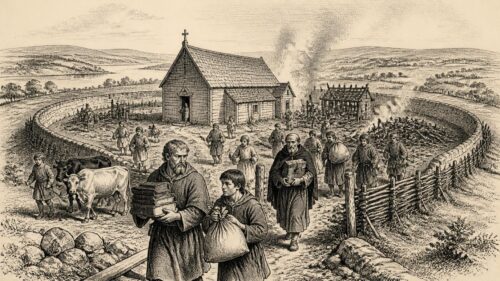
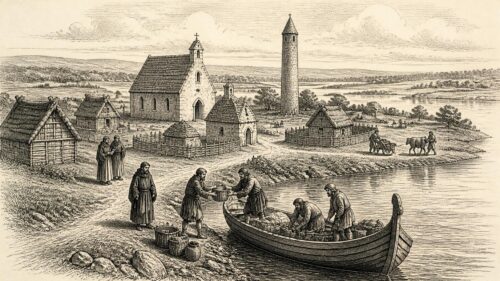
The most politically charged entry concerns Cill Dara, Kildare, the “church of the oak”. The annalist states that Feidlimid mac Crimthainn, king of Munster, seized its oratory by force of arms from Forannán, abbot of Armagh, and from “the congregation of Patrick”; they were then blockaded disrespectfully. The wording makes clear that this was no incidental raid. A Munster king had used soldiers against a major Leinster church while detaining, or at least coercively containing, the head of Ireland’s most prestigious Patrician federation. Kildare was already an important ecclesiastical settlement associated with Brigid, and its religious standing gave a military occupation consequences well beyond its immediate district.
Feidlimid’s act belongs to a contest over Armagh rather than to a simple opposition between secular rulers and churchmen. Forannán had only recently replaced Diarmait grandson of Tigernán as abbot of Armagh. Diarmait, meanwhile, was not extinguished as a claimant. Modern scholarship identifies this disputed succession as the likely setting for Feidlimid’s seizure of Kildare: the king’s support lay with Diarmait, against Forannán. The episode shows how an abbacy could be a political office of the first rank. Armagh’s successor of Patrick commanded far-reaching rights, relationships and revenues; to favour one claimant was to seek influence across provinces. Feidlimid, an exceptionally ambitious ruler of Cashel, was using ecclesiastical jurisdiction as part of the larger competition between Munster and the Uí Néill-dominated north and midlands.
Patrick’s Law on the Road
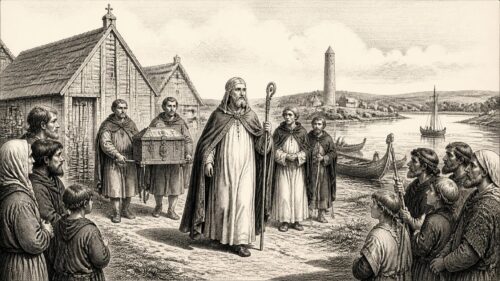
The next notice makes the rival ecclesiastical strategy visible. Diarmait travelled into Connacht with “Patrick’s law and his insignia”. This was neither a private devotional journey nor merely preaching. A saint’s law, publicly carried with the objects that represented his authority, could validate claims to protection, dues and obedience. The exact objects are not named in the Annals of Ulster, but later evidence identifies the Patrician insignia associated with Diarmait’s circuit as major relics: a crozier known as the Staff of Jesus, a bell and a gospel-book. Their progress turned holy objects into instruments of government, making the authority of Armagh physically present before kings, churches and communities in Connacht.
That journey is especially striking beside the blockade at Kildare. One contender for Armagh’s leadership was humiliated at a Leinster church; another travelled west displaying Patrick’s authority. The annals do not say what payments Diarmait collected, which rulers received him, or whether the two rivals reached any immediate settlement. They nevertheless preserve a vital reality of ninth-century Ireland: political power travelled. It moved with armed retinues, but also with clerics, legal claims, books, bells and staffs. Ireland had no unitary royal administration. Its strongest institutions instead projected influence through personal circuits, negotiated submissions and sacred guarantees.
Raiders at the Church of the Oak
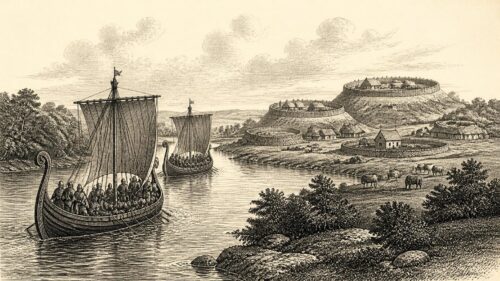
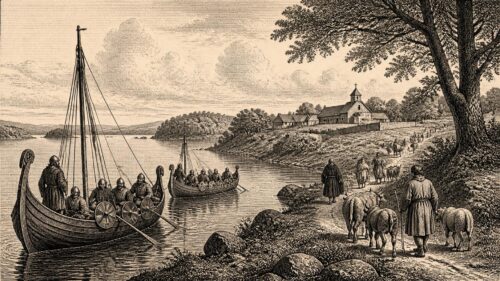
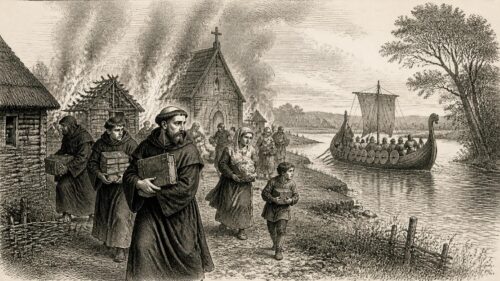
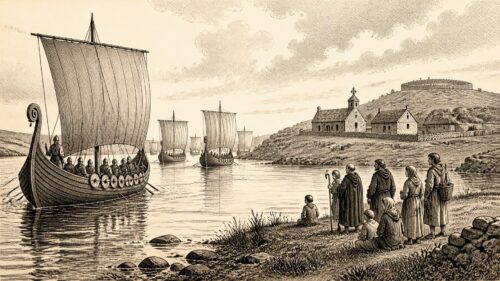
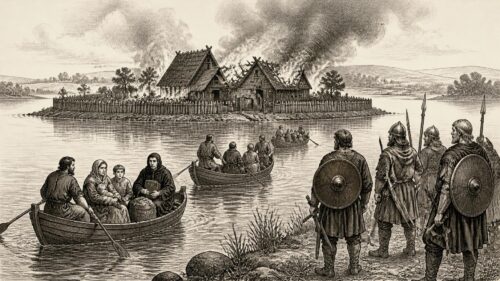
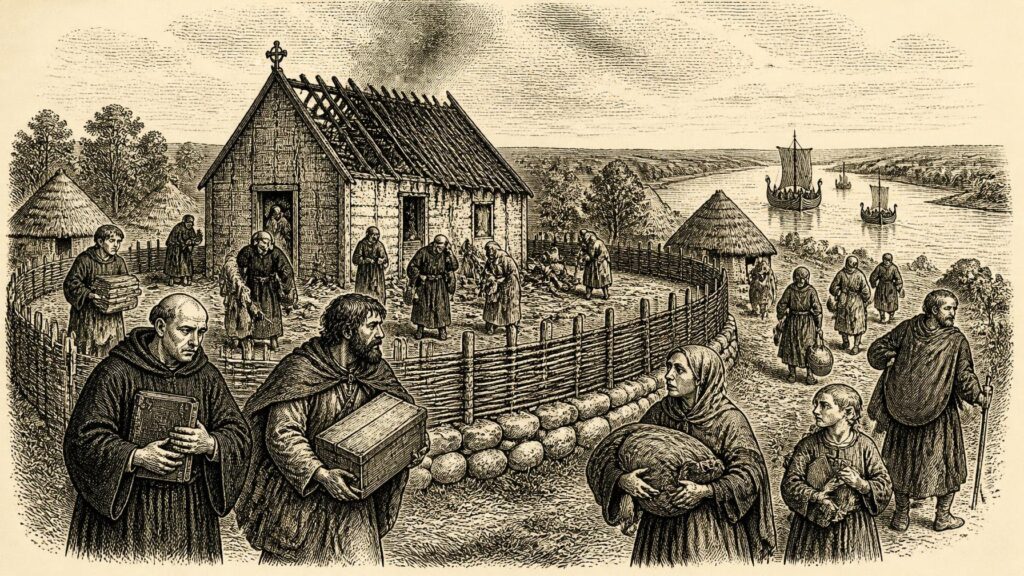
Kildare suffered a second, very different assault in the same annal grouping. “Heathens” from Inber Déa plundered the church, and half of it was burned. Inber Déa is commonly associated with the Avoca estuary at modern Arklow, but the annal merely names the harbour or river-mouth; it does not demonstrate a permanent Scandinavian base there. What is certain is the damage at Kildare. The same place that had been seized by Feidlimid’s armed force was then attacked by seaborne raiders. The sources neither explain any connection between the two events nor permit one to be invented. Yet their juxtaposition conveys the vulnerability of a prosperous church settlement caught in both Irish political rivalry and external predation.
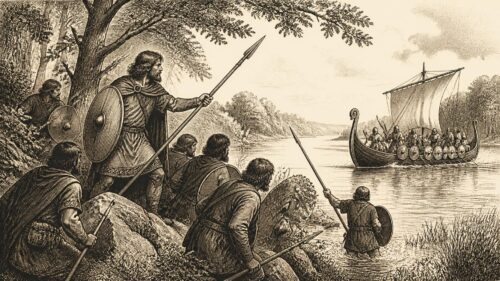
Elsewhere, the annalist records what he calls the first prey taken by the heathens from southern Brega, naming Telach Dromáin and Dairmag of the Britons. Many people were taken prisoner, many killed, and very many carried away captive. The phrase “first prey” may mark a first recorded taking from that particular district rather than the first Scandinavian raid in Ireland. Either way, it signals a geographical advance into a politically important inland zone north-west of Dublin Bay. Raiding was not confined to exposed islands and coasts. River routes and the open plains of Brega enabled attackers to reach churches, settlements, livestock and people.
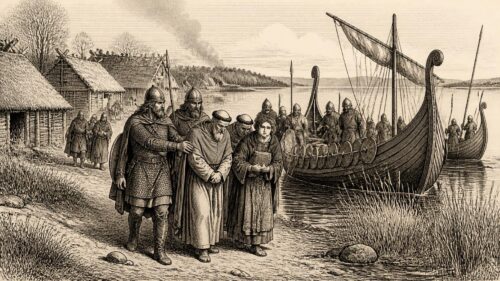
Captivity is central to the human meaning of these entries. Churches were repositories of portable wealth and centres of hospitality, labour and learning, but raids struck wider communities as well. The annalist distinguishes deaths from captives, indicating outcomes that were both lethal and disruptive. We cannot identify the prisoners’ later destinations from this notice, nor should every captive automatically be labelled a slave. Still, removal by an armed maritime force separated people from households, dependants and local obligations, while the killing and destruction of buildings imposed losses that reached beyond any immediate seizure of valuables.
Connacht Under Pressure
Connacht endured its own severe attack. The annalist describes a “most cruel devastation” of all the lands of Connacht by heathens and adds that the Déisi Tuaisceirt suffered a slaughter in battle. The breadth of that language should be read as an annalist’s emphatic judgement, not as a literal survey proving that every district was ruined. Nevertheless, it establishes a raid of exceptional perceived scale and a defeat involving the northern Déisi, a people based in the Shannon region. Scandinavian activity had become capable of affecting western Ireland, not just the eastern seaways.
The pressure on Connacht was not solely external. The same year records the battle of Drong “between the Connachta themselves”. Cellach son of Forbasach, superior of Ros Cam, and Adomnán son of Alddál were killed; Connmach the Great was victorious. The entry supplies neither a fuller cause nor a reliable modern location for the battlefield, so its political background remains obscure. Yet it is important precisely because it resists an easy story in which Irish rulers suspended their disputes in the face of raiders. Communities in Connacht faced both an outside devastation and their own violent competition for position, land and lordship. The death of a church superior among the named casualties again underlines the close entanglement of ecclesiastical and secular affairs.
A Year of Mast
Amid war, the annals preserve an environmental observation of rare vividness: there was a great crop of mast, both nuts and acorns, so plentiful that streams were blocked and ceased to run. “Mast” meant the fruit of woodland trees, especially acorns but also hazelnuts. The report should not be converted into modern measurements of rainfall, harvest yield or forest cover. It does, however, testify to an autumn in which woodland produce was conspicuous enough to enter the historical record. Acorns and nuts mattered in a mixed rural economy: they were foodstuffs, and acorns were valuable forage for pigs. Extraordinary quantities could be welcome in some respects while also clogging small watercourses and complicating movement or drainage.
This small notice broadens the view of everyday Ireland. The island’s people lived not only through dynastic politics and monastic learning, but through seasonal rhythms of grazing, woodland, water and food collection. The same annal that counted prisoners and recorded blockades noticed impeded streams. Its priorities were not those of a modern state archive, yet it caught an environmental disruption likely visible to farmers, herders, travellers and religious communities alike.
Deaths and Continuities
Obituaries frame the year with reminders of institutional continuity. Suibne son of Ioseph, abbot of Glendalough; Saergus grandson of Cuinnid, abbot of Durrow; and Forbasach, bishop and anchorite of Lusk, were said to have ended their lives happily. Dúnlang son of Cathusach, superior of Cork, by contrast, died without communion at Cashel. Such entries do not reveal private biographies, but they map a connected ecclesiastical Ireland: Glendalough in Leinster, Durrow in the midlands, Lusk near the east coast, Cork in Munster and Cashel, Feidlimid’s royal centre. The deaths of senior churchmen could affect local leadership, property and patronage, even as the surviving institutions endured raids and political coercion.
836 was therefore not simply an early chapter in an inevitable “Viking takeover”, nor a year in which Irish politics ceased to matter. Permanent longphuirt, including those at Dublin and Linn Dúachaill, are first explicitly recorded only later, in 841. In 836 the evidence instead shows mobile raiders exploiting coasts, rivers and inland plains, while Irish kings and church leaders pursued rival claims with equal seriousness. Kildare’s burning and blockade capture the year’s central paradox: a renowned church could be a sanctuary, a political prize, a store of wealth and a target—all at once.
Primary Sources
- The Annals of Ulster, Year U836
- The Annals of Ulster, Year U835
- The Annals of Ulster, Year U837
- Vikings in Irish Chronicles, 794–902: Data
- Annals of the Four Masters
- Chronicon Scotorum
- Chronicon Scotorum: CELT Edition
- Annals of Inisfallen
- Fedelmid (Feidlimid)
- Forannán
- Diarmait
- Vikings in Ireland
- The Vikings in Scotland and Ireland in the Ninth Century
- Evidence of Vikings by County in Ireland: Viking Activity in Ireland as Described in the Annals
- The Vikings in Ninth-Century Ireland: Sources and Settlements
- Kingship and the Church in Early Medieval Ireland
- The Céli Dé and Ecclesiastical Government in Ireland
- Kildare: St Brigid and a Monastic Town
- Brigid and Kildare
- List of Published Texts at CELT