Diarmait’s Relic Voyage828 CE
In 828, as calibrated in the Annals of Ulster rather than the displaced Viking material assigned to 827, Ireland’s record combines deaths, violence and religious travel. Muiredach of Leinster and several lesser kings died, alongside leading churchmen and an ecclesiastical steward, illustrating layered political and institutional authority. Conaing was treacherously killed, while Mide defeated Connacht in an otherwise unexplained battle. Diarmait, abbot of Iona, carried Colum Cille’s relics to Scotland, demonstrating maritime links within the Columban world, although no motive is recorded. The sparse evidence depicts a fragmented yet connected society shaped by rulership, warfare, churches, economy and sea routes.
Dateline
The clearest calendar-year record for 828 CE is unusually revealing precisely because it is brief. In the Annals of Ulster, the entries placed under AD 828 combine political mortality, a killing, a battle between Irish provinces and a journey by Diarmait, abbot of Í, carrying the holy relics of Colum Cille to Scotland. They do not form a continuous narrative, and no surviving source gives dates by month or season. Yet together they show an Ireland in which the death of rulers and churchmen, armed rivalry between neighbouring peoples, and the movement of sacred objects could all have consequences beyond the places immediately named.
Chronology needs particular care. The event cluster frequently cited as “U828” in the Annals of Ulster is printed by its modern editors under AD 827, reflecting a known displacement in the annal’s dating. It includes Viking attacks in the north-east and should not simply be transferred into 828 CE. This article therefore follows the annal’s explicitly calibrated AD 828 entry, conventionally numbered U829. The distinction matters: it allows 828 to be treated as a year in its own right rather than filled with dramatic incidents belonging to the preceding calendar year.
Deaths Across the Provinces
The annalist first recorded a notably wide group of deaths. Muiredach son of Ruaidrí, king of Laigin, died. His passing removed the overking of Leinster from a political landscape where authority was shared, challenged and renegotiated among branches of the Uí Dúnlainge dynasty and other powerful kindreds. The annals do not describe his succession, an inauguration or any immediate disturbance. Later king-lists associate the next phase of Leinster’s overkingship with Cellach son of Bran. That broader dynastic transition is important context, but the only securely dated statement for 828 is Muiredach’s death.
The same entry names Cinaed son of Mugrón, king of Uí Fhailgi, a kingdom west of the Leinster heartland; Cerball son of Fínnechta, king of the Delbna; and Drucán son of Tadc, king of Uí Méith. Their inclusion in a single annal notice should not be mistaken for a single disaster. Rather, it shows the annalists’ habit of gathering deaths reported from several regions. It also makes plain how politically divided Ireland remained. There was no unitary kingdom administered from a national capital. Kingship existed at several levels: local rulers governed small peoples and territories, while provincial overkings sought precedence, tribute, military followers and recognition from rivals.
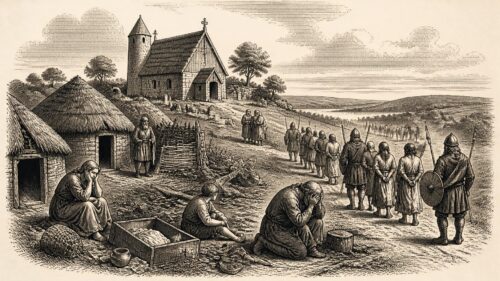
Church leaders appear alongside secular rulers, not as an afterthought but as figures of public standing. Áed son of Cellach, superior of Cell Dara, died, as did Máel Dobarchon, abbot of Cell Usaile, and Cormac son of Muirgius, superior of Sentrab. Cell Dara, modern Kildare, was among Ireland’s most prestigious churches, associated with Brigit and supported by land, clients, dependants and learned personnel. The death of its superior concerned more than worship: it raised questions of succession and stewardship over a wealthy ecclesiastical household. The annals also note Máel Umai son of Ceithernach, steward of Finnubair. His title is a useful reminder that major churches and royal centres depended upon officials who managed provisions, property and hospitality.
Violence Without Explanation
Two concise notices record conflict. Conaing son of Cellach was “deceitfully killed” by Eochu son of Cernach. The wording indicates a killing regarded as treacherous, but supplies neither location nor motive. It would be irresponsible to turn this into a known dynastic coup, feud or political assassination. It does, however, preserve the annalists’ moral distinction between open conflict and killing by deception. In an elite society shaped by kinship, fosterage, alliance and rivalry, the manner of a death could matter as much as its result.
The second report is larger in scale: the men of Mide routed the Connachta, and many fell. No battlefield, commander, cause or settlement is named. The notice nonetheless places military pressure across Ireland’s central-western zone. Mide, centred on the rich midlands and closely connected with the leading Clann Cholmáin branch of the southern Uí Néill, possessed considerable political weight. Connacht, west of the Shannon, was not a peripheral blank space but a region of competing dynasties, churches and routes. A victory by the men of Mide therefore signals a real blow, though its precise extent cannot be measured from the surviving text.
Such fighting was usually conducted by the armed followings of kings and lesser lords rather than permanent national armies. It drew on obligations of service and on resources extracted from land, cattle and dependent communities. The annal’s silence about captives, cattle, tribute or hostages means that none should be asserted for this particular campaign. Its important evidence is narrower: interregional warfare occurred in 828, and Mide emerged from this recorded encounter victorious.
Colum Cille’s Sacred Property
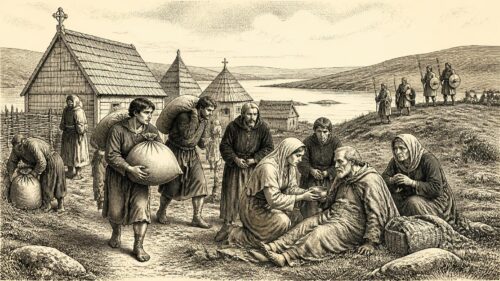
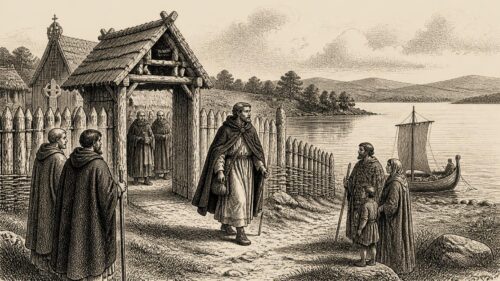
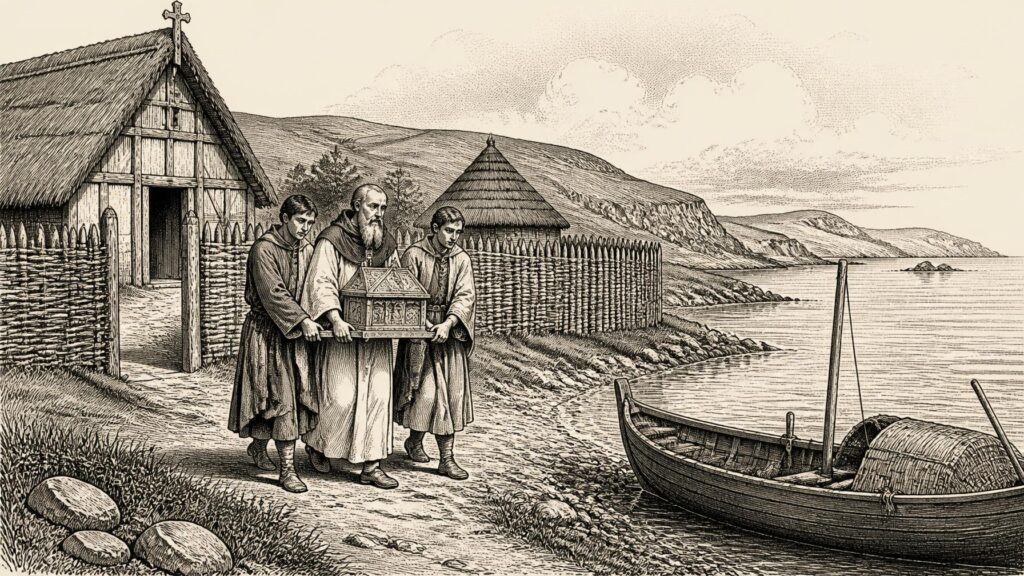
The year’s most evocative notice concerns Diarmait, abbot of Í, better known as Iona. He “went to Scotland with the halidoms of Colum Cille”. Halidoms were holy things: relics and associated sacred objects, whose value was devotional, institutional and political. Colum Cille’s cult linked Iona with churches in Ireland and Alba, and his relics embodied the authority, memory and spiritual protection of that Columban community. The annal does not specify which relics travelled, where Diarmait began his journey, where in Scotland he went, or why he carried them. Those absences should be retained rather than supplied with an attractive story.
Nevertheless, the report demonstrates that relics were portable assets of exceptional consequence. Their transfer required people, transport and trusted custody; it also connected religious communities separated by the North Channel and the Irish Sea. Sea travel was consequently not only the medium of hostile raids. It was an established route of communication between ecclesiastical institutions, royal patrons, traders, pilgrims and families on both sides of the water. In 828, Diarmait’s journey offers a rare, firmly dated glimpse of that religious maritime world.
The wider setting helps explain why later readers have associated the movement of Columban relics with insecurity. Iona had suffered attacks earlier in the ninth century, and seaborne raiding was already transforming calculations of safety around the Irish Sea. But the annal for 828 itself does not say that Diarmait fled, rescued relics or responded to a raid. The careful conclusion is that sacred objects were moved to Scotland in this year; any immediate protective motive remains plausible context, not a recorded fact.
Life Beyond the Annals
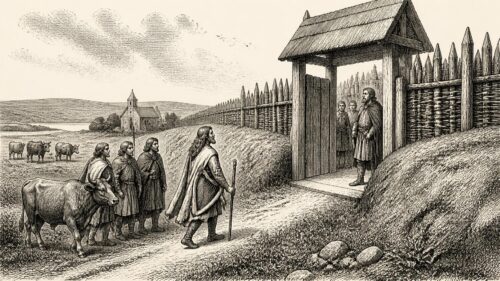
The sources say almost nothing directly about weather, harvests, prices, disease, trade or the work of ordinary households in 828. There is no responsible basis for declaring a famine, a hard winter, a prosperous trading season or a national economic crisis. Archaeology and later documentary evidence nevertheless help define the durable setting in which the recorded events unfolded. Most people lived in dispersed rural settlements, often in or near enclosed farmsteads now termed ringforts or raths. Mixed farming, especially cattle-keeping alongside cultivation, underpinned food supply, wealth and political obligation.
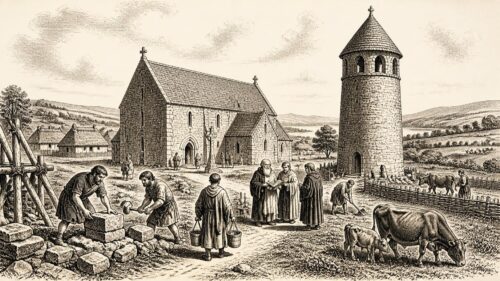
Monasteries and churches were embedded in that rural economy. They were places of prayer and burial, but also households with clergy, tenants, guests, craftsmen and agricultural resources. Kildare’s appearance in the obituary list, and the journey of an Iona abbot with Columban relics, reveal the reach of such institutions more clearly than any general description can. Learned communities preserved liturgical practice, Latin learning, genealogies and historical memory; annalistic writing itself was one product of their world.
Thus 828 was not a year of a single island-wide turning point. It was a year in which a Leinster king and several other rulers died, an unnamed treacherous killing was remembered, Mide defeated Connacht, and an abbot carried Colum Cille’s holy things across the sea. The record’s gaps are substantial, but its surviving details are enough to show a society politically fragmented yet interconnected: by warfare, ecclesiastical office, inherited authority and maritime movement.
Primary Sources
- Part 399 of The Annals of Ulster
- Part 398 of The Annals of Ulster
- The Annals of Ulster
- Annals of the Four Masters
- Part 66 of Annals of the Four Masters
- Chronicon Scotorum
- Annals of Inisfallen
- Irish texts at CELT
- Vikings in Irish Chronicles, 794–902: Data
- The Vikings in ninth-century Ireland: Sources and settlements
- Narrating and Negotiating Difference in the Insular Viking Age
- Early Viking Church Raiders And The Emergence Of Political Purpose
- The Earliest Wave of Viking Activity? The Norwegian Evidence Revisited
- The Vikings and the Fall of the Old Order
- Bran Ardchenn
- Exploring the Irish Annals
- Ringforts / Ráthanna
- The Earthen Rath or Lios
- Irish Field Monuments
- Monument Class and Scope Notes
- Archaeological Survey
- The Cambridge History of Ireland