Membership is completely free, giving members unlimited access to all available resources, services, features, and benefits without any restrictions or fees.
Welcome back. Sign in to continue enjoying unlimited access to all available resources, services, features, and member benefits at no cost.
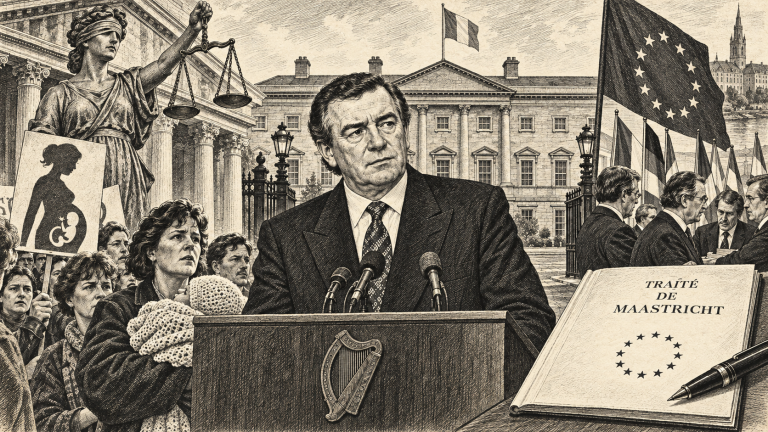
Charles Haughey resigned as Taoiseach in February after years of controversy and internal Fianna Fáil pressure. Albert Reynolds, who had challenged his leadership and had been dismissed as Minister for Finance the previous November, won the party leadership and became Taoiseach. Reynolds inherited a Fianna Fáil–Progressive Democrats coalition but immediately presented himself as a different kind of leader, promising a more direct style of government and a renewed effort to address Northern Ireland.
Dublin was officially inaugurated as European City of Culture in March 1991, succeeding Glasgow. The designation brought a year-long programme of performances, exhibitions, commissions and community projects. Ceremonies at the Mansion House, St Stephen’s Green and the National Concert Hall marked the opening, with Taoiseach Charles Haughey among those attending. The programme sought to present Dublin not merely as an historic capital but as a contemporary European city with a lively artistic life.