Delbna Bethra Ablaze826 CE
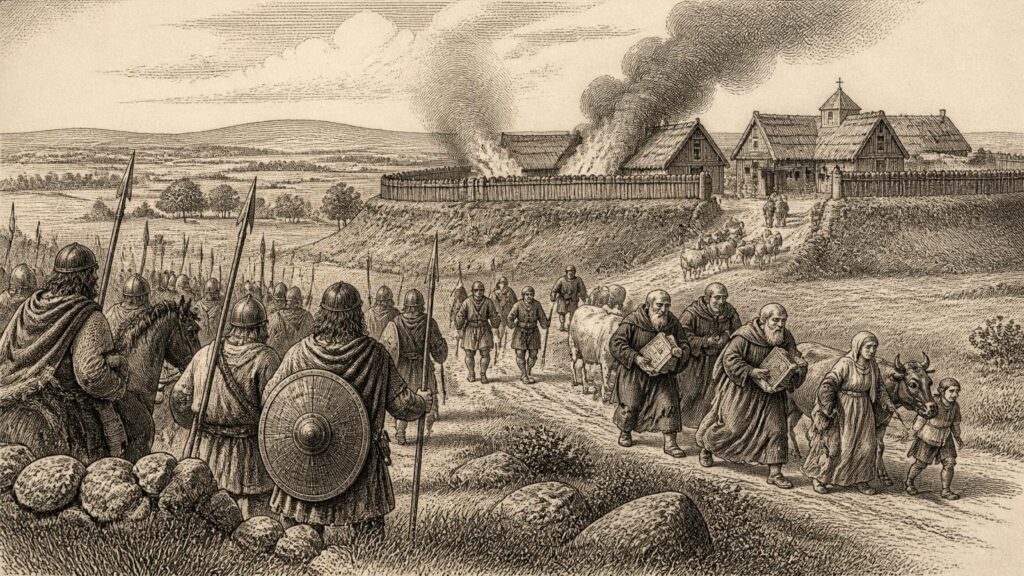
In 826, as conventionally dated despite annalistic discrepancy, Feidlimid mac Crimthainn, king of Munster, led an army into the midlands and burned Delbna Bethra, threatening Mide and estates linked to Clonmacnoise. His campaign challenged Conchobar mac Donnchada’s authority at Tara amid rivalry later followed by negotiations at Birr. Deaths of kings in Brega and Mide, and the deceitful killing and wounding of rulers in Tethba, exposed fractured local lordship. Ecclesiastical leaders died at Armagh, Clonard and Clonfert. A plague warning caused widespread fear, while Daire’s law was renewed in Connacht. No securely dated Viking raid is recorded in principal annals.
Dateline
The events conventionally assigned to 826 reveal an Ireland in which power was exercised locally, contested provincially and expressed through attacks on people, estates and religious communities. The surviving annals do not offer a continuous narrative of the year. Instead, they preserve stark notices: deaths of kings and church leaders, a deceptive killing in Tethba, a Munster expedition that burned Delbna Bethra, an ominous warning of plague, and the renewed promulgation of a law in Connacht. Read together, they show how closely political authority, ecclesiastical institutions and control of productive land were intertwined.
There is one chronological caution. The principal entry is conventionally cited under 826 in modern scholarship, although the surviving Annals of Ulster manuscript’s calendrical apparatus creates a one-year discrepancy in this portion of the text. The discussion below therefore treats these as events assigned to 826 by the standard historical convention, rather than pretending that the sources provide modern calendar dates for each incident.
A Munster Army in Delbna Bethra
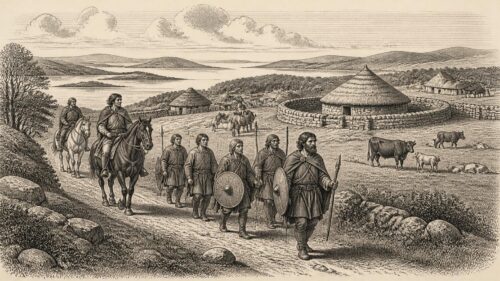
The year’s clearest act of organised violence was the burning of Delbna Bethra by Feidlimid mac Crimthainn, king of Munster. The annalist adds a significant detail: Feidlimid had a Munster army with him. This was not an isolated clash between small neighbouring groups but a campaign mounted by a provincial ruler able to lead men north from Munster into the central Irish borderlands. Delbna Bethra lay in the wider midland zone contested by Munster and the Southern Uí Néill, in what is now broadly west County Offaly and its adjoining districts.
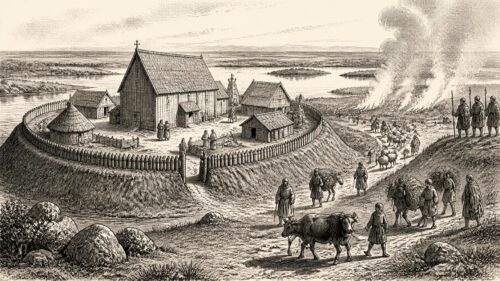
“Burning” was an exceptionally economical annalistic word, but it carries substantial consequences. It may cover the destruction of houses, storehouses, crops, fences, churches or estate buildings; the entry does not permit a confident reconstruction of which were burned. Nor does it name the dead or captives. Yet burning struck at the resources which sustained lordship: food rendered in rent, cattle kept on estates, labouring households, and the dependants of a church. Delbna Bethra contained extensive estates associated with Gallen, itself a possession of Clonmacnoise. The raid therefore likely damaged not only a border territory of Mide but interests linked to one of Ireland’s most important midland churches. That connection is an interpretation drawn from the known pattern of landholding, not an explicit statement by the annalist.
Feidlimid’s purpose was political as well as destructive. Since becoming king of Munster in 820, he had pressed beyond his own province against the predominance of the Uí Néill. His earlier attacks in the midlands and his later interventions at Armagh and Clonmacnoise demonstrate a ruler willing to use force, religious patronage and ecclesiastical disputes together. Delbna Bethra was a useful target precisely because it was a vulnerable frontier: an attack there could display Munster’s reach while challenging the authority of Conchobar mac Donnchada, king of Tara and ruler of Mide.
Pressure on Mide
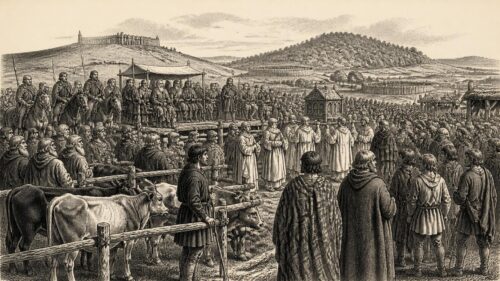
Conchobar’s position in 826 was formidable but not untroubled. He belonged to Clann Cholmáin, the leading Southern Uí Néill dynasty, and held the kingship of Tara after the death of Áed Oirdnide in 819. “High king” is a convenient modern shorthand for such a ruler, but it should not imply a unified Irish state. Conchobar’s authority depended upon personal alliances, hostage arrangements, military capacity and the recognition of other kings. Feidlimid’s campaign demonstrated that a king of Cashel could contest that authority in the heartland of Mide.
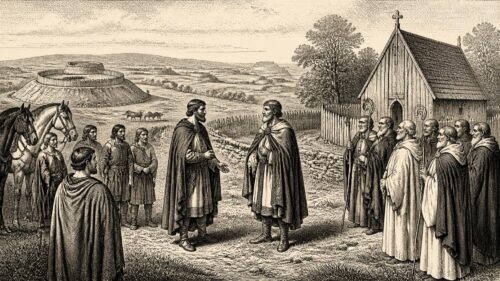
The encounter was part of an escalating rivalry rather than a final settlement. In the following year, 827, Feidlimid and Conchobar met at Birr, apparently to discuss terms between them. That later meeting gives the 826 expedition sharper meaning: armed pressure had helped make negotiation necessary. It would be mistaken, however, to say that the burning of Delbna Bethra caused the meeting, since no surviving source says so directly. What can safely be said is that the raid belonged to the immediate sequence of confrontation and diplomacy between Munster and the king of Tara.
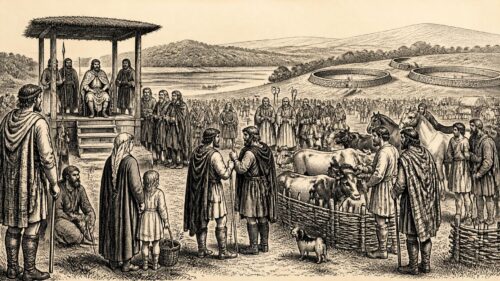
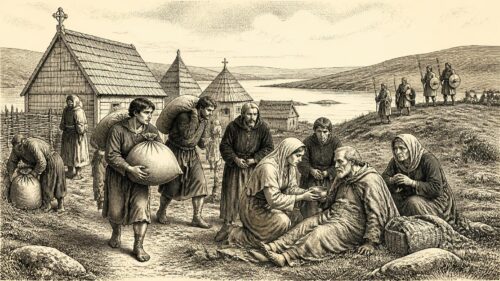
For ordinary people in the affected district, the grand contest of kings was experienced in concrete ways. An army required food, guides, animals, roads or trackways, and shelter. A raiding force could seize cattle, consume stored grain and compel local households to flee behind an enclosure or seek protection from a patron. The annals name the ruler and the territory, not the farmers, craftsmen, tenants and clerics who bore the cost. Their absence from the record should not disguise their importance: the wealth that made campaigning possible was extracted from communities like theirs.
Deaths and Fractured Lordship
The political map also shifted through death and killing. Diarmait son of Niall, king of southern Brega, died. Brega, the rich region north of the Liffey and Boyne approaches, was divided among competing branches of the Southern Uí Néill and had long been vital to any claimant seeking influence around Tara. The annals offer no cause of Diarmait’s death and no named successor, so it cannot responsibly be treated as a recorded succession crisis. Nonetheless, the loss of a regional king changed the calculations of neighbouring dynasties.
Niall son of Diarmait, king of Mide, also died. His relationship to Conchobar and the precise distribution of authority within Mide are not wholly clear. Modern reconstructions commonly see him as a lesser or subordinate king operating within a polity dominated by Conchobar. The notice is still valuable: Mide was not governed as a simple kingdom with one undisputed office-holder. Senior rulers, related kings and local dynasts could hold overlapping status, while the fortunes of each affected the security of the central plain.
Violence was sharper in Tethba, a midland region around modern Longford and Westmeath. Art son of Diarmait, its king, was “deceitfully killed”; later in the same annal Artrí son of Muirgius, also styled king of Tethba, received a mortal wound. The entries neither identify the killers nor explain whether the two men were rivals, successors or members of separate branches. They nevertheless expose the fragility of small kingships. A ruler might be slain not in open battle but through betrayal, while authority could be violently disputed within a limited territory. Such instability made places like Tethba and Delbna Bethra susceptible to pressure from stronger neighbours.
Churches, Land and Learning
Several ecclesiastical deaths recorded in 826 illuminate the institutional landscape through which power moved. Loingsech’s son, abbot of Armagh, died peacefully. Bishop Clemens, abbot of Clonard, “ended his life happily”. Ruithnél, described as both superior and bishop of Clonfert, died; Máel Dúin son of Gormgal, king of Uí Méith, died while in clerical life. These formulae should not be reduced to pious decoration. They indicate that prominent church offices were held within a society in which clerical vocation, learning, aristocratic lineage and political influence could overlap.
Armagh, Clonard and Clonfert were not remote places of prayer detached from public affairs. They headed communities with churches, cultivated land, livestock, craftsmen, guests, dependent families and networks of associated churches. Armagh’s claim to the inheritance of Patrick carried island-wide prestige. Clonard stood in Mide, close to the world of Clann Cholmáin. Clonfert, in eastern Connacht, was an important Shannon-side foundation. The deaths of their leaders thus mattered to religious observance, estate management, education and political patronage alike.
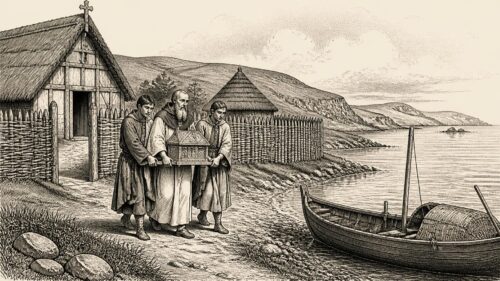
Learning remained embedded in these institutions. The annals themselves are proof of a literate culture capable of preserving names, offices and brief judgments about death, killing and law. Monastic communities copied books, trained clerics and maintained Latin and Irish written traditions, while their lay populations handled agriculture, building, transport and exchange. Nothing in the record permits us to assign a particular manuscript or school achievement to 826. But it is reasonable to see the deaths of abbots and bishops as changes in centres where worship, literacy and local economic life met.
Fear of Disease and the Reach of Law
One of the most intriguing notices is not a report of epidemic mortality. The Annals of Ulster record “great terror in all Ireland” arising from a warning of plague given by Iellán’s son of Mumu. The wording matters. It attests widespread fear generated by a prophetic or cautionary announcement, not a securely documented outbreak in which deaths can be counted. Earlier annals do record serious disease and famine in the 820s, but that broader context must not be silently converted into proof that Ireland suffered a new island-wide plague in this particular year.
Fear itself was historically meaningful. Disease threatened households dependent on seasonal labour, cattle and stored food; it also endangered monastic congregations and travelling clerics. A warning capable of being remembered in an annal suggests that spiritual interpretation was one way communities understood collective danger. Prayer, fasting, almsgiving and penitential observance may have been expected responses, but no surviving 826 entry specifies what people actually did.
The annals also state that “Daire’s law” was brought to Connacht again. Its content, promoter and practical operation are uncertain. It should not be casually identified with a modern statute or national legal code. Early Irish “laws” of this kind could involve the authority of a saint, church, community or ruler, and their proclamation could entail obligations, protections or payments. The word “again” indicates renewal rather than invention. Even in its opacity, the notice shows that Connacht was connected to wider networks of ecclesiastical and legal authority.
A Year Without a Viking Entry
Viking raids had already affected Irish coasts and churches by the 820s, but the principal annalistic record for 826 does not assign a Scandinavian attack to this year. Later compilations place battles against “foreigners” under a differently dated annal, illustrating the chronological difficulties of medieval Irish historical writing. It would therefore be irresponsible to make Vikings the centre of 826 simply because they dominate popular memory of the ninth century. The securely connected story is instead one of Irish kings, Irish church communities and Irish borderlands under strain.
826 was consequently neither a quiet interval before the Viking Age nor a year that can be reduced to a single raid. Feidlimid’s burning of Delbna Bethra brought the southern king’s challenge directly into the midlands. Death, betrayal and mortal wounding unsettled Brega, Mide and Tethba. Ecclesiastical offices changed hands at major churches, while a plague warning and the renewal of Daire’s law point to shared anxieties and enduring institutions. The year’s fragmentary notices preserve a society in which the fortunes of a farm district, a monastery and a provincial king could be inseparable.
Primary Sources
- The Annals of Ulster: Year U826 (English translation)
- The Annals of Ulster: Year U826 (Irish and Latin text)
- Chronicon Scotorum: Annals CS825–CS827
- Chronicon Scotorum: Bibliography and Editorial Information
- Annals of the Four Masters
- Fedelmid (Feidlimid), Dictionary of Irish Biography
- Conchobar, Dictionary of Irish Biography
- Feidlimid mac Crimthainn: (d. 847), king of Munster, Oxford Dictionary of National Biography
- Clann Cholmáin, Caille Follamain, Genealogical Tables
- Table 2: Kings of Mide, 766–1184
- Atoning for Killing, the Practice of Penance and the Perception of Bloodshed among the Early Medieval Irish, Fifth to Ninth Century
- Vikings in Early Medieval Ireland
- The Vikings in Ulaid
- Vikings in Ireland and Scotland
- The Annals of Inisfallen: Editorial and Bibliographical Information
- Clonmacnoise: Ancient Seat of Learning
- Clonmacnoise Monastic Site
- Early Christian Monasteries
- High Crosses
- Irish School of Illumination, c. 650–1100
- Feidhlimid mac Crimthainn and the óentú Maíle Ruain