The Frozen Boyne818 CE
In 818 Ireland experienced an exceptional winter, with rivers and lakes frozen from Epiphany to Shrovetide, enabling travel, hunting and the transport of building materials across Lough Erne. Politically, Áed Oirdnide intervened in Leinster after Muiredach son of Bran’s death, redistributing authority among Bran’s grandsons. Churchmen carried saints’ shrines through Munster and Connacht, while violence breached ecclesiastical protection. In Connacht, Uí Briúin kings defeated Uí Maine at Forath amid regional rivalry. Deaths of abbots and rulers marked shifting local power. On 21 October, fire destroyed a third of Clonmacnoise, damaging a major ecclesiastical settlement and its communities’ buildings and livelihoods.
Dateline
An Exceptional Winter
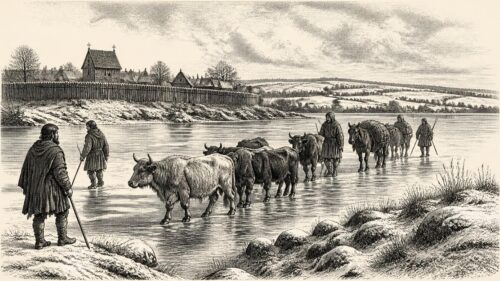
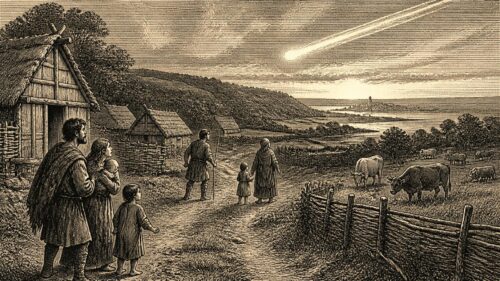
The most vivid Irish record securely connected with 818 is not a battle or a royal death, but weather. The Annals of Ulster report an extraordinary spell of ice and heavy snow extending from Epiphany to Shrovetide. In the Julian calendar then used in Ireland, Epiphany fell on 6 January. Modern historical-climate work identifies this annalistic notice with the winter of 818, while also warning that early Irish annals have chronological complications and must be read carefully. The account is nevertheless unusually concrete: the Boyne and other rivers could be crossed on foot; lakes froze; herds and hunting parties went out on Loch Neagh; and deer were hunted on the ice.
For an island with an oceanic climate, this was exceptional weather. The annalist did not merely call the winter severe: he described physical consequences that readers could recognise. Rivers ceased to be barriers, lakes became routes and familiar boundaries altered. People with livestock could move onto surfaces normally dangerous or impassable; hunters could reach deer in places where they might otherwise escape them. Such scenes should not be romanticised. Deep frost and snow could endanger animals, disrupt local food supplies and make ordinary travel harsh. Yet the report records opportunity as well as hardship: frozen water opened temporary roads.
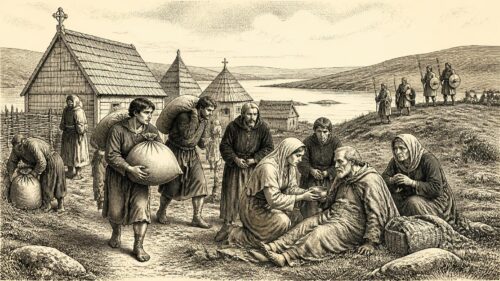
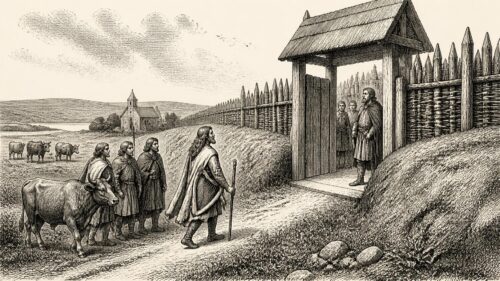
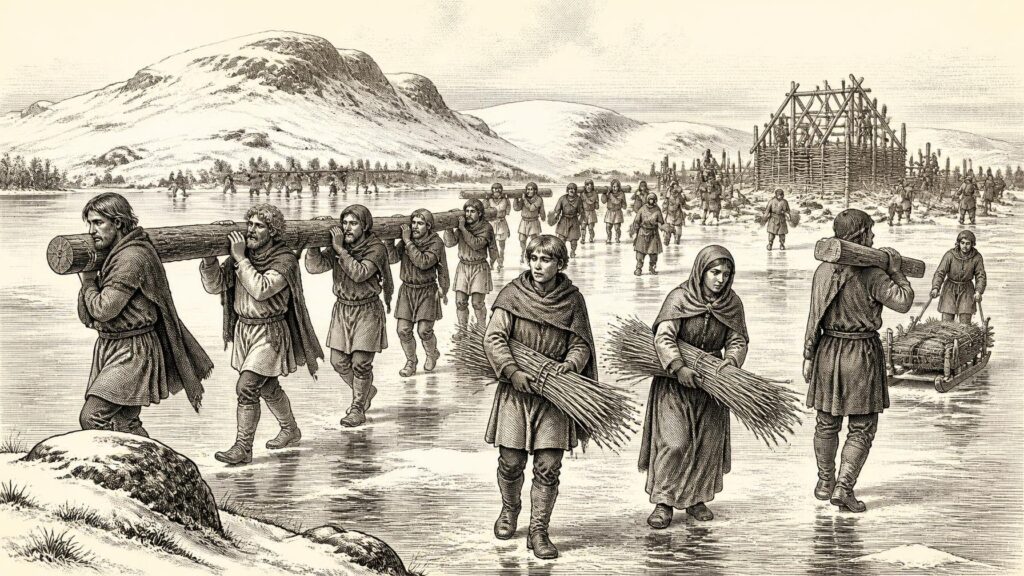
The most remarkable example concerns ecclesiastical building. A large company reportedly carried materials for an oratory from Connacht across Upper and Lower Lough Erne into Tír Ua Crimthainn. The annal does not identify the church, the materials or the precise route with sufficient certainty to reconstruct the undertaking in detail. It does show, however, that a religious community or its patrons could mobilise substantial labour, and that the frozen lakes were thought strong enough to bear both people and a burden which would normally have required boats or a much longer land journey. In 818, climate briefly changed the practical geography of northern and western Ireland.
Leinster Recast
Political events recorded in the same annalistic year show a kingdom under outside pressure. Muiredach son of Bran, described as one of the two kings of Leinster, died. His title matters. Leinster was not a unitary state with an uncontested monarch, but a field of competing dynasties, especially branches of Uí Dúnlainge. Muiredach belonged to Uí Muiredaig, associated with the Maistiu district in modern County Kildare. He had shared authority with another Muiredach, son of Ruaidrí of Uí Fháeláin, under an arrangement imposed earlier by Áed Oirdnide, the powerful king of Tara.
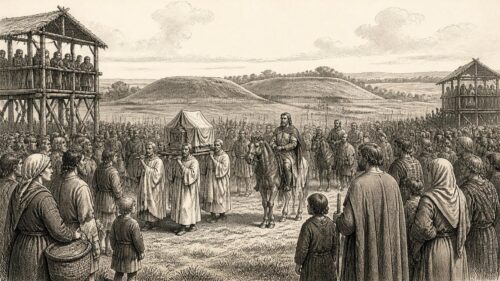
The death of Muiredach son of Bran therefore removed one of the figures through whom Áed’s influence in Leinster had been exercised. The annals also state that Áed came with forces to Dún Cuair and divided Leinster between the two grandsons of Bran. It is prudent not to turn this compressed sentence into a detailed campaign narrative: no battle, treaty terms or exact succession arrangement is supplied. But its political purpose is clear enough. Áed intervened in Leinster’s dynastic order and treated the distribution of authority there as a matter within his reach. Kingship in early ninth-century Ireland was exercised through armed followings, kinship, hostages, assemblies and negotiated submission rather than through fixed borders or a permanent bureaucracy.
Dún Cuair, probably near Rathcore in County Meath, was an apt place for such a demonstration. It lay on the approaches to Leinster and had previously served as a gathering point for Uí Néill pressure on the province. The episode belongs to a wider, firmly dated pattern in Áed Oirdnide’s reign: he had divided the Leinster kingship between the two Muiredachs in 805, and his forces would again ravage Leinster in the following annalistic year. The events of 818 are thus best understood not as the creation of a stable settlement, but as one intervention in an enduring contest between the king of Tara and Leinster’s ruling kindreds.
Churches, Protection and Movement
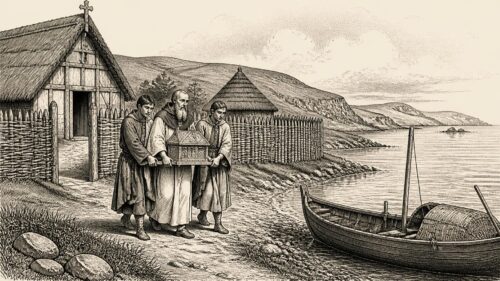
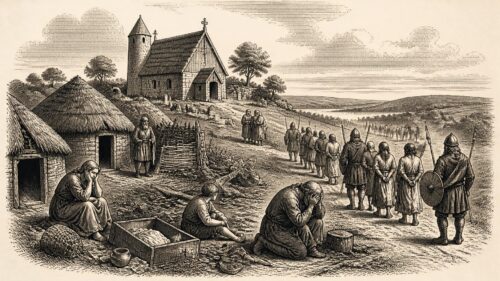
Church institutions appear throughout the record, not as secluded places outside politics but as landholders, centres of authority and custodians of powerful saints’ objects. Cuanu, abbot of Lugmad, modern Louth, went into exile in Munster carrying Mochta’s shrine. The annal gives no reason for his departure, and it would be unsafe to attribute it to a Viking attack or to identify a particular local feud. What can be said is that the shrine travelled with the abbot. A saint’s relic-container embodied the standing of a church community; taking it away helped preserve religious continuity and could also carry claims, patronage and legal protections into a new region.
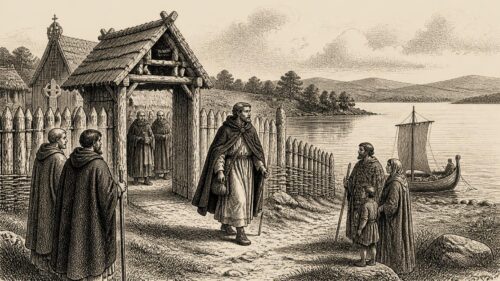
Artrí, the superior of Armagh, likewise travelled, bringing Patrick’s shrine to Connacht. This was part of a longer pattern of Armagh’s engagement with the west, rather than a casual devotional journey. By the ninth century Armagh’s claim to pre-eminence rested heavily on its association with Patrick. A circuit made the saint’s presence visible to rulers, churches and lay communities far beyond Armagh itself. Although the annal for 818 mentions the shrine rather than explicitly naming Patrick’s law, later evidence shows Artrí active in the promulgation of that law. His Connacht journey can therefore responsibly be seen as an assertion of Armagh’s religious and political reach, without claiming that a specific law was proclaimed on this occasion.
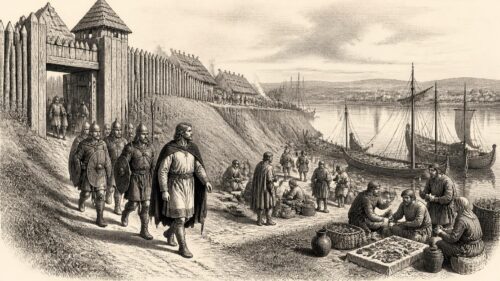
The year also exposes the vulnerability of ecclesiastical protection. The superior of Cell Mór Enir was dishonoured, while Dub Innrecht, its prior, was killed by the Leinstermen despite being under the superior’s protection. The wording does not explain the offence or identify all parties involved. Its inclusion in the annals is important in itself: the killing was framed as a breach of recognised sanctuary or surety. Church leaders could offer protection, but their standing depended on secular rulers and armed groups honouring it. Another terse notice says that Cellach son of Fogartach plundered a vessel to the detriment of Conchobor son of Muiredach, a son of Leinster’s king. The uncertain wording prevents firm conclusions about the craft or cargo, but it is a reminder that waterways were avenues of communication, transport and conflict as well as obstacles overcome in winter.
Connacht’s Contest at Forath
In Connacht, the battle of Forath was fought in the territory of Delbna Nuadat. The Uí Maine, led by their king Cathal son of Murchad, were defeated with many nobles. The victors were two kings of Uí Briúin, Diarmait son of Tomaltach and Máel Cothaid son of Fogartach. This is one of the year’s clearest notices of organised conflict, but its brevity sets limits. The sources do not state the immediate cause, the battlefield’s exact location, the total casualties or what settlement followed.
Even so, the alignment is revealing. Uí Maine was a major Connacht people centred broadly east of the Shannon, while Uí Briúin dynasties competed for predominance within Connacht. The battle occurred after the death in 815 of Muirgius son of Tomaltach, a strong Connacht overking. That earlier death did not automatically cause the conflict, but it forms essential background: succession and rivalry among Connacht’s leading groups were plainly unsettled. Artrí’s journey with Patrick’s shrine and the battle of Forath should not be presented as directly connected, since the annals do not link them. Together, however, they show Connacht in 818 as both a theatre of elite competition and a province important enough to draw Armagh’s attention.
Fire at Clonmacnoise
Several deaths round out the record: Cellach son of Scannlán, abbot of Cell Fhoibric; Cernach son of Congalach, king of Cnogba; and Rechtabra grandson of Andola, abbot of Daiminis. Their notices are short, but they demonstrate the annals’ concern with the succession of local kings and heads of churches. These offices anchored regional power. An abbot could administer land, retain dependants and represent a saint’s community; a king’s death could rearrange alliances even when the annalist offers no narrative of the aftermath.
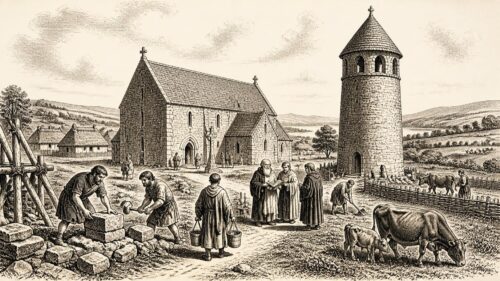
The most precisely dated event came on 21 October, when a third of Clonmacnoise was again burned. The word ‘again’ indicates that fire was not unprecedented there, though it does not tell us which earlier blaze the annalist had in mind. Nor does the entry name an attacker. It should therefore be described as a fire, not automatically as a raid. Yet the loss was serious. Clonmacnoise, on the Shannon, was among Ireland’s foremost ecclesiastical centres, with churches, housing, workshops, store buildings, agricultural interests and a large scholarly community. Burning a third of such a settlement meant damage to structures, goods and livelihoods as well as to a place of worship.
818 survives in fragments: a frozen Boyne, labour across iced lakes, a Leinster succession managed under pressure, shrines carried between provinces, a Connacht battle and fire at Clonmacnoise. The entries do not yield a continuous national story, and Ireland had no single government capable of producing one. They do, however, reveal a connected island. Kings, clerics, herds, hunters, builders and travellers all moved through landscapes shaped by water, kinship and the authority of saints. That winter, the ice made those connections startlingly visible.
Primary Sources
- The Annals of Ulster (English translation)
- Chronicon Scotorum, Part 78: Annals CS818–CS822
- Chronicon Scotorum: Introduction and Editorial Notes
- Annals of the Four Masters, Volume 1 (English translation)
- Annals of the Four Masters, Volume 1 (Irish text)
- Annals of the Four Masters, Part 65
- Annals of Inisfallen (English translation)
- CELT: List of Published Texts
- Artrí, Dictionary of Irish Biography
- Áed Oirdnide, Dictionary of Irish Biography
- Dúnlaing, Dictionary of Irish Biography
- Bran Ardchenn, Dictionary of Irish Biography
- Patrick (Patricius, Pátraic, Pádraig), Dictionary of Irish Biography
- Ciarán, Dictionary of Irish Biography
- Medieval Irish Chronicles Reveal Persistent Volcanic Forcing of Severe Winter Cold Events, 431–1649 CE
- Medieval Irish Chronicles Reveal Persistent Volcanic Forcing of Severe Winter Cold Events, 431–1649 CE (UCC PDF)
- Medieval Irish Chronicles Reveal Persistent Volcanic Forcing of Severe Winter Cold Events, 431–1649 CE (Harvard DASH record)
- The Céli Dé and Ecclesiastical Government in Ireland
- The Cult of St Moling and Buile Shuibhne
- Three Hundred Years of Weather Extremes from the Annals of Connacht