Dúnadach at Umall813 CE
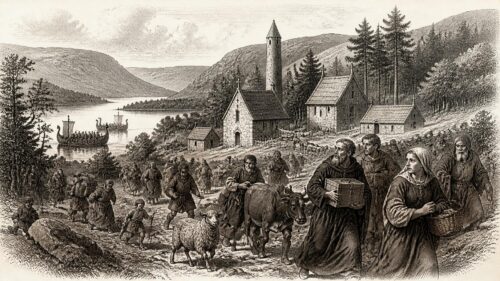
In 813, Dúnadach, king of Umall in modern County Mayo, and Coscrach son of Flannabra were killed when heathen seaborne raiders defeated local forces. The annals provide no details of the battle, loot, or lasting conquest, but place it amid western coastal fighting following Irish resistance in 812. The year also saw Daire’s law promulgated among the Uí Néill, probably protecting cattle, a vital economic resource. Obituaries for rulers and church leaders illustrate dispersed political and ecclesiastical authority. These events depict Ireland as a landscape of vulnerable coasts, regional kingdoms, valuable herds and religious communities, rather than a unified state.
Dateline
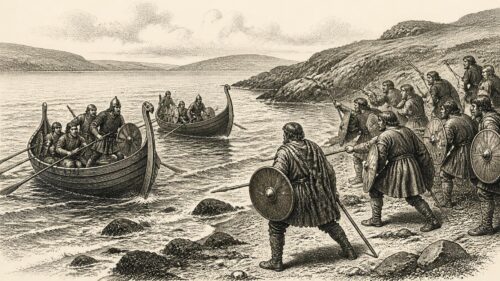
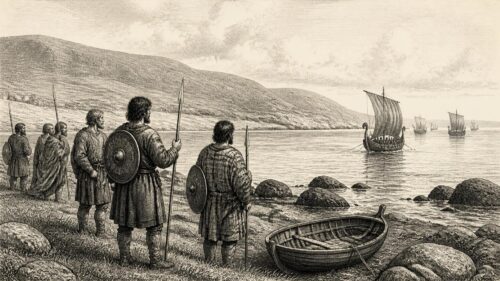
The clearest Irish event assigned to 813 is a defeat on the Atlantic seaboard. The Annals of Ulster record “the slaughter at Umall by the heathens”, naming among the dead Coscrach son of Flannabra and Dúnadach, king of Umall. Chronicon Scotorum preserves substantially the same notice. It is a short entry, but an unusually consequential one: a local ruler was killed while his people confronted seaborne raiders, conventionally described as Vikings in modern histories. No exact day, battlefield or account of the fighting survives. Yet the loss of a king makes this more than an isolated clash. It was a sharp demonstration that even a coastal community capable of resisting raiders could be struck again and overwhelmed.
A Reverse on the Western Coast
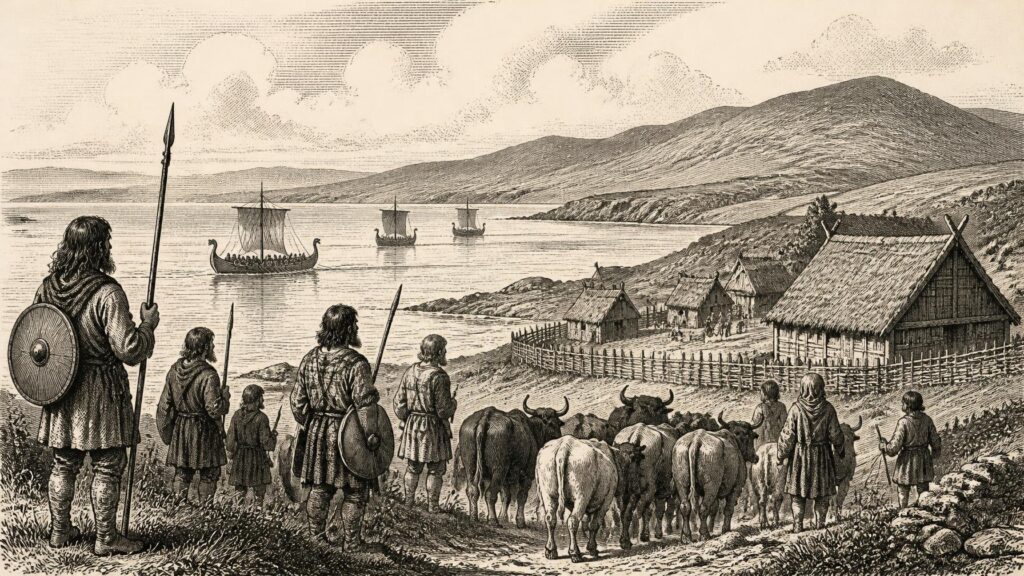
Umall lay in the region of modern County Mayo, around the bays, islands and inlets of Ireland’s western coast; its name survived in the later barony of Burrishoole, though early Umall was more extensive. Its position beside Clew Bay gave local communities access to fisheries, sea routes and island pasture, but also exposed them to vessels arriving from the Atlantic. The annalist’s word for the attackers, gentiles, literally “heathens”, identifies them through a Christian moral vocabulary rather than by a Scandinavian ethnic name. It nevertheless belongs to the earliest Irish record of Viking activity.
The encounter followed a striking sequence. In the annal for 812, the men of Umall were credited with a slaughter of heathens, while the same year’s record reports heathens defeating the neighbouring Conmaicne. A Frankish royal annal likewise states that a fleet landed in Ireland in 812, suffered losses in battle against the Irish and departed in shameful flight. These notices cannot securely be combined into a single campaign or attributed to precisely the same ships. They do, however, show fighting along or near the western coast in successive years. The reversal of 813 may have come during a renewed raid, a retaliatory expedition, or an attempt by raiders to secure food and valuables after an earlier setback. The sources do not say which.
Dúnadach’s title, “king of Umall”, matters. Early medieval Ireland was not a unitary kingdom governed by a permanent national administration. It was a patchwork of over-kingships and smaller peoples, each with its own rulers, client communities, churches and obligations. A king such as Dúnadach led a local polity, upheld alliances and tribute relationships, and was expected to protect its interests. His death, alongside Coscrach, may have left Umall’s political leadership weakened at precisely the moment when coastal defence had become urgent.
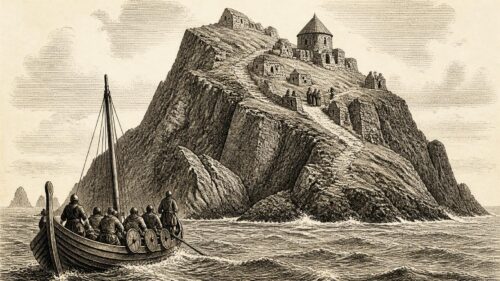
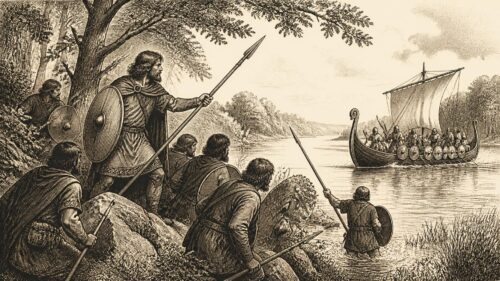
Nothing in the evidence permits a reconstruction of the battle’s weapons, numbers or tactics. It would be unsafe to picture a large Viking army landing on a known beach, or to claim that Umall was conquered. The raiders of this early phase were usually recorded in brief, episodic notices, and no permanent Scandinavian settlement in Umall is documented for 813. What is securely visible is violence across water: ships enabled mobile groups to choose vulnerable shores, while local rulers and their followers tried to meet them with the resources at hand.
Raiding, Cattle and Coastal Livelihoods
The raid had implications beyond the deaths named in the annals. Western coastal communities depended on mixed farming, cattle, dairying, fishing and access to seasonal pasture. Cattle were wealth as well as food: they could be exchanged, used to meet obligations and taken as plunder. Boats, livestock, metalwork, captives and provisions were all potential targets for sea-borne raiders, although the annal does not specify what was taken at Umall. The result called a “slaughter” tells us of fatalities, not automatically of devastation across the entire district.
That distinction is important. The early ninth-century Viking raids were serious and frightening, but they did not yet produce the longphuirt, or fortified ship-bases, that the annals begin to mention in Ireland only decades later. Nor did they eclipse conflict among Irish kingdoms. In the years immediately before 813, the annals also recorded killings, dynastic warfare and raids undertaken by Irish rulers. Foreign raiding therefore entered an already competitive political landscape; it did not create violence from nothing. Its novelty lay in the capacity of armed seafarers to appear at distant coasts, withdraw quickly and return in a later season.
Daire’s Law Among the Uí Néill
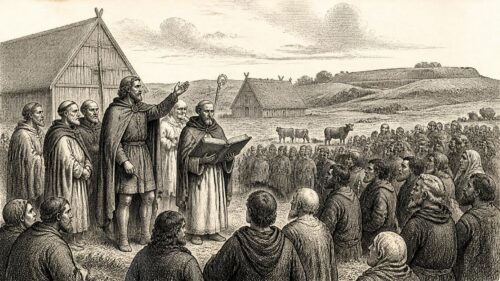
A second entry in the Annals of Ulster records that “Daire’s law” was promulgated among the Uí Néill in 813. This was not a statute in a modern parliamentary sense. Early Irish laws associated with saints or revered founders were proclaimed, renewed and carried through networks of churches, rulers and communities. The annal gives neither the person who proclaimed this law nor the route taken, and it does not explain how compliance was enforced. Those omissions should be respected.
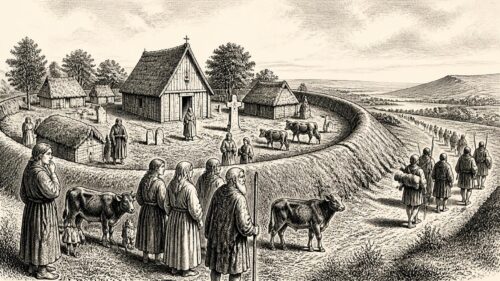
Later evidence identifies Daire’s law with protection for cattle, especially against theft or killing. Its promulgation is therefore particularly resonant beside the fighting at Umall. In a society where herds were central to subsistence, status and political exchange, restricting attacks on cattle addressed a practical source of hardship as well as a moral wrong. The law had already been proclaimed in Connacht in 812, according to the preceding Ulster annal, and it would be brought to Connacht again in 826. In 813, its extension among the Uí Néill indicates that religiously framed regulation could travel across major political territories.
The Uí Néill were not one homogeneous state. They were a powerful web of related dynasties in the north and midlands, within which the high kingship was contested and negotiated. Áed Oirdnide, a member of the northern Uí Néill, was still over-king of Ireland in 813, though the annal does not connect him personally with Daire’s law. The proclamation should thus not be inflated into proof of a centrally administered island-wide reform. It does show, more modestly but importantly, that ecclesiastical authority, legal custom and royal power could meet in public acts intended to shape ordinary conduct.
Churches as Learned Communities
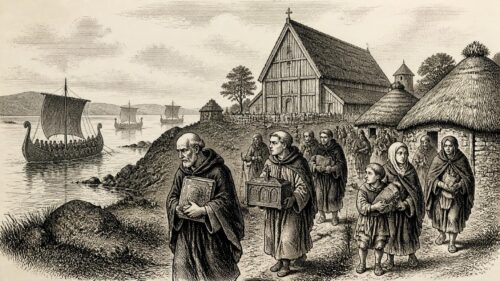
Most of the Ulster annal’s Irish notices for the year are obituaries, and together they reveal the density of ecclesiastical life. Conall son of Daimthech, superior of Treóit, died. Feradach son of Scannal, described as a scribe, priest and abbot of Achad Bó, “ended his life happily”. Cellach son of Echaid, superior of Cell Tuama, also died, as did Congaltach son of Eitguin, prior of Cluain Ferta. Such entries are terse, but their accumulation is revealing: churches were not marginal refuges from secular life. They were places of worship, landholding, schooling, writing, hospitality and political connection.
Feradach’s unusually full description is especially valuable. A scribe was a trained maker and reader of texts in Latin and Irish, but the office was not necessarily detached from practical authority. He was also a priest and abbot, combining learning, sacramental office and leadership of a religious community. Achad Bó, now Aghaboe in County Laois, was one of the many ecclesiastical centres whose influence depended on people, land and patronage as much as on buildings. The annal’s approving phrase about Feradach’s end is a conventional Christian judgement, not evidence for the details of his final days.
The titles superior, abbot and prior likewise should not be treated as interchangeable modern job descriptions. Early Irish ecclesiastical communities had varied structures, and an important church could include clerics, scholars, dependants, tenants and lay workers as well as ascetics. Cluain Ferta, associated with St Brendan and situated near the Shannon in what is now County Galway, was a well-connected religious centre. The death of its prior, Congaltach, reminds us that institutional continuity relied on offices below the most visible abbatial rank.
One secular obituary completes the year’s compact picture of authority: Laegaire son of Cú Gamna, king of Cenél Cairpri, died. The annal does not name a successor or describe a dispute, so none should be imagined. But alongside Dúnadach’s death at Umall, it underlines the fragility of local kingship. Rule rested on living kin-groups and personal leadership; sudden deaths could alter calculations of alliance, tribute and protection.
What 813 Can—and Cannot—Show
813 was not a year for which the surviving Irish record offers a single island-wide turning point. It instead preserves a concentrated set of local facts: a king slain resisting heathen raiders in Umall; the renewal of a cattle-protecting law among the Uí Néill; and the deaths of rulers and churchmen whose titles disclose a landscape of many centres of power and learning. These events belong together without needing to be forced into one narrative. They show an Ireland of exposed coasts, valuable herds, resilient religious institutions and regional polities confronting dangers both old and new.
The annal under the heading for 813 also places the death of Carolus—Charlemagne—beside Irish events. Charlemagne’s death is independently dated to 28 January 814, so it should not be counted as an event of calendar year 813. Its presence is a useful warning that annal headings and modern calendar dates do not always align perfectly. For Ireland itself, the securely dated emphasis remains the loss at Umall and the promulgation of Daire’s law: one recording the cost of violence on the western shore, the other an attempt to restrain a form of violence fundamental to everyday survival.
Primary Sources
- The Annals of Ulster, Year U813
- Chronicon Scotorum, Annals CS810–CS814
- The Annals of Ulster, Year U812
- Annals of the Four Masters, Volume 1, Annals M812–M820
- Annals of the Four Masters, Irish text, Annals M812–M814
- Vikings in Irish Chronicles, 794–902: Data
- Vikings in Irish Chronicles, 794–902: Introduction
- The Vikings in ninth-century Ireland: Sources and settlements
- The Vikings in ninth-century Ireland: Sources and settlements (full text)
- Vikings in Ireland and Scotland
- Vikings in Early Medieval Ireland: Church-Raiding, Politics and Kingship
- Vikings in Early Medieval Ireland: Church-Raiding, Politics and Kingship
- Vikings in Early Medieval Ireland: Church-Raiding, Politics and Kingship (review)
- Monastic Identity in Early Medieval Ireland
- Monasticism In Early Ireland
- Literacy and Identity in Early Medieval Ireland
- Isle of the Saints: Monastic Settlement and Christian Community in Early Ireland
- Reassessing the Irish ‘monastic town’
- The Idea of the Three Orders of Society and Social Stratification in Early Medieval Ireland
- Exploring the Irish Annals
- CELT: List of Published Texts
- Muirchú's Life of Patrick