

Victorian Ireland
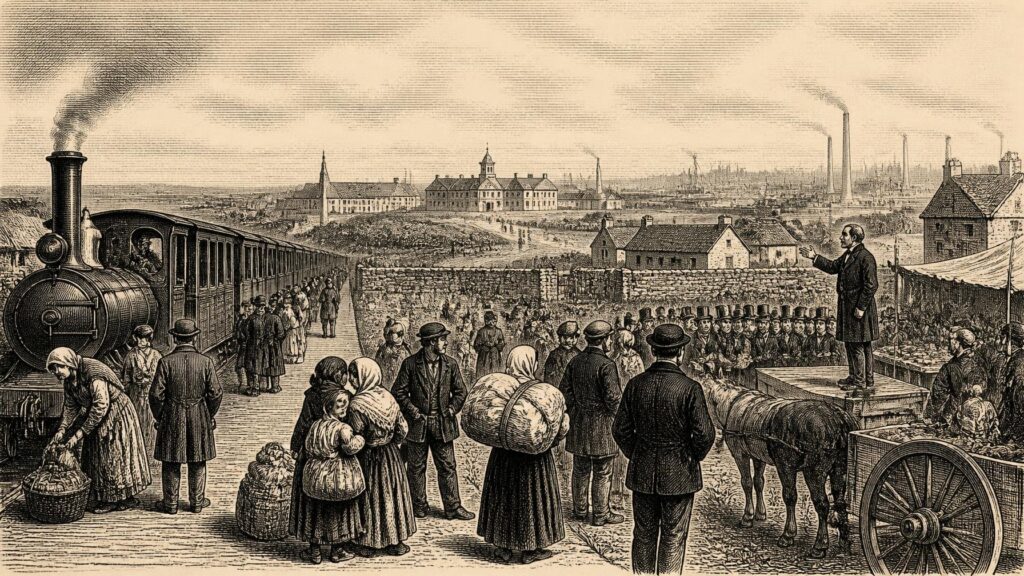
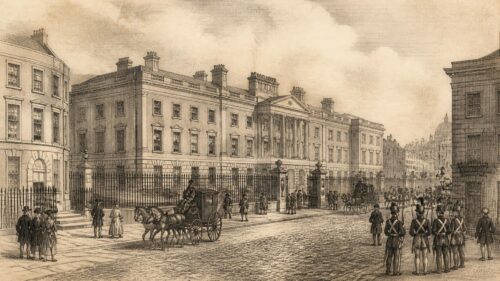
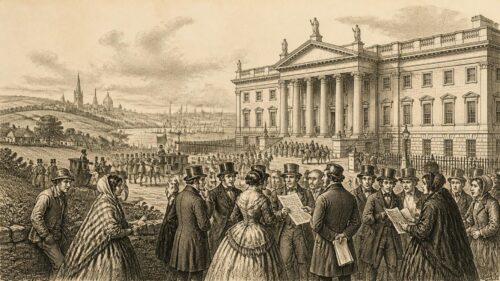
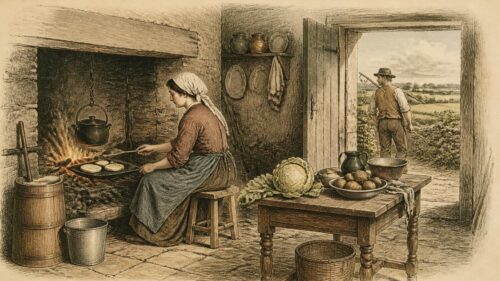
AI generated historical illustration, not a contemporary photograph.
At a Glance
Victorian Ireland was not a uniform place, nor was it simply Britain’s neighbouring famine country. Between 1837 and 1901, the island endured demographic collapse and enduring emigration, but also developed new industries, expanded its communications, altered its systems of local government and poor relief, and generated political movements whose arguments survived the century itself. Its history belongs within the history of the United Kingdom, the British Empire and the Atlantic world, yet it also has an unmistakably Irish character: one shaped by land, religion, language, regional inequality and the unresolved constitutional consequences of the Union.
Imperial Setting
Victoria came to the throne in June 1837, thirty-six years after the Act of Union had abolished the Irish parliament and incorporated Ireland into the United Kingdom of Great Britain and Ireland. The island returned members to Westminster, while much of its executive administration was conducted from Dublin Castle under a lord lieutenant and chief secretary appointed by the British government. This was not colonial government in a simple legal sense: Ireland was part of the United Kingdom, Irish MPs sat in the imperial parliament, and Irish soldiers, officials, merchants and emigrants participated widely in imperial life. Yet the unequal distribution of political power, the absence of an Irish legislature and the prominence of English and Scottish landowners in parts of Ireland meant that many contemporaries experienced the Union as an imposed and remote arrangement.
To call the period “Victorian Ireland” is therefore useful, provided it does not conceal this tension. The term locates Irish history in the reign that framed it, but it should not imply that the island shared a single Victorian experience. A Presbyterian industrial family in Belfast, a Catholic smallholder in Mayo, a Dublin professional, a Church of Ireland clergyman, a linen-mill worker, a land agent and an Irish-speaking labourer in the west encountered radically different forms of authority and opportunity. Regional difference was fundamental. The north-east was increasingly urban, commercial and industrial; much of the west and south remained dependent on small-scale agriculture; Dublin retained its administrative and cultural importance but did not become an industrial city on Belfast’s scale.
Victorian political language itself travelled unevenly. Respectability, self-help, improvement, free trade, empire, sanitary reform and parliamentary government were familiar concepts in Ireland, especially in towns and among the middle classes. They existed beside older local loyalties, religious identities and forms of dependence rooted in the land. The century’s great Irish disputes were consequently not merely disputes between “tradition” and “modernity”. They concerned competing versions of modernity: a centralised British state promising law and improvement; landed power claiming property and order; tenant movements demanding security; unionists defending the constitutional link; and nationalists seeking forms of Irish self-government.
Queen Victoria’s own visits illustrate the ambiguities. She visited Ireland in 1849, during the Great Famine, and again in 1853, 1861 and 1900. Public receptions could be enthusiastic, particularly in loyalist and urban settings, and the monarchy had genuine admirers across religious lines. But ceremonial loyalty did not settle the Irish question. The pageantry of royal visits could coexist with destitution, resentment of absentee authority and demands for political change. Later nationalist memory often treated Victoria principally as a symbol of imperial rule; contemporary responses were more varied, and should not be reduced to either universal affection or universal hostility.
Pre Famine
At the beginning of Victoria’s reign, Ireland was a predominantly rural society with a population larger than it would be again for well over a century. The 1841 census recorded 6,528,799 people. Much of that population lived in small communities and relied directly or indirectly upon agriculture. The potato was central to the diet of many poorer households because it could produce a high calorific yield on small plots. This reliance did not mean that Ireland produced nothing else. Grain, cattle, butter, pork and other goods entered commercial markets, and towns supplied services, trade and manufacturing. But the division between a commercially oriented export economy and a poor population dependent on a narrow food base created profound vulnerability.
Landholding arrangements were equally important. Estates varied greatly in size, management and tenure, and it is misleading to describe every landlord as identical or every tenant as equally insecure. Nonetheless, a large proportion of occupiers lacked long-term certainty. Tenants commonly invested labour in drainage, buildings and reclamation while landlords retained significant control over rent and possession. In Ulster, customary practices often gave tenants stronger expectations regarding improvements and compensation than existed elsewhere, although those arrangements were neither universal nor beyond dispute. Elsewhere, subdivision, cottier tenancy and dependence upon seasonal work could leave families exposed to a bad harvest, a rent increase or loss of employment.
In 1838 Parliament introduced an Irish Poor Law, modelled in important respects on the English legislation of 1834. Ireland was divided into poor-law unions, each centred upon a workhouse administered by guardians under central supervision. The system was designed to deter dependence as much as to relieve it. Indoor relief in a workhouse was deliberately more unattractive than ordinary labour, and families entering were normally separated by sex and age. Such assumptions reflected Victorian attitudes towards poverty and discipline, but they met an Irish society where need was much more widespread than the system’s designers allowed for.
The National Archives of Ireland notes that the original system envisaged relief for about one per cent of the population. That calculation proved disastrously inadequate. The workhouse was not a universal refuge, nor was it intended to be. It became, however, a central institution of the Victorian Irish state. Its surviving minute books, admission registers, correspondence and medical records make the poor law unusually visible to historians. They preserve names and administrative decisions that can counter broad generalisation, though they also record people at their most desperate moment, not the whole texture of ordinary life.
Before the blight, reformers, officials and religious leaders were already debating population, education, tenancy and poverty. National schools, established in the 1830s, had begun to expand elementary education. The Catholic Church was strengthening its institutional presence after Catholic Emancipation, while the established Church of Ireland remained entwined with political authority and the collection of tithes remained controversial. These developments matter because the famine did not strike an unchanging peasant world. It struck a society already being measured, regulated and argued over by an increasingly interventionist state.
Famine Crisis
Potato blight appeared in Ireland in 1845. It returned with greater severity in subsequent years and turned an already precarious social order into a catastrophe. The Great Famine was not caused by one factor alone. The organism responsible for potato blight damaged a crop on which many poor households depended. But hunger and death were magnified by poverty, unequal access to land and food, inadequate relief, administrative decisions, market structures and the ideological commitments of the governing authorities. The disaster must therefore be understood as both an environmental calamity and a human catastrophe within a particular political economy.
Government relief changed over time. Public works schemes offered wages, often for labour on roads and other projects; soup kitchens later provided more direct food relief; poor-law institutions were expanded; and charitable bodies, religious organisations and international donors assisted in many places. There was no single official response, and it is inaccurate to say that no relief was offered. Yet the response was inconsistent, often delayed, and constrained by assumptions that public aid should not undermine markets, landlords or personal responsibility. The ending of the soup-kitchen system and the increased reliance on local poor rates placed immense burdens on distressed districts.
Workhouses, designed for a far smaller pauper population, became overcrowded. Disease spread through institutions and communities already weakened by hunger. Fever, dysentery and other illnesses killed people whose deaths cannot be separated neatly from famine conditions. The poor-law records are indispensable evidence here, but they do not yield a perfectly complete national tally. Deaths occurred in homes, on roads, in hospitals, in crowded lodging houses and aboard emigrant vessels as well as in workhouses. Historians consequently debate totals and emphases, but there is no serious doubt about the scale of mortality and displacement.
The famine’s moral and political meaning has remained contested. Nineteenth-century British officials and later defenders of policy often stressed crop failure, the practical limits of government and the scale of the emergency. Irish nationalist writers emphasised official indifference, the continuation of food exports and the coercive character of state policy. Modern scholarship generally resists simple explanations. It recognises the biological trigger and the enormous administrative challenge, while also judging that policy choices worsened suffering. The word “genocide” is used by some commentators and rejected by others. It should not be employed as a substitute for analysis. The documentary record establishes devastating failure and suffering; the legal and conceptual label remains a matter of historical and political argument.
The famine also transformed relations between class, religion and state. Landlords faced rate demands, tenant arrears and estate insolvency. Some assisted tenants to emigrate or supported relief; others pursued eviction or clearance. Clergy of several denominations organised aid while also competing for influence. Local officials had to decide who qualified for assistance. For the poor, the experience could mean hunger, an unwanted workhouse admission, the breaking of a household, a journey to a port, or departure from Ireland altogether. Such individual experiences cannot be compressed into a single national story.
Population Rupture
The demographic record makes the scale of change unmistakable. The census total fell from 6.53 million in 1841 to 5.11 million in 1851. It continued downwards through every Victorian census: 4.40 million in 1861, 4.05 million in 1871, 3.87 million in 1881, 3.47 million in 1891 and 3.22 million in 1901. The decline began in famine mortality, but it was sustained by emigration and by a changed pattern of marriage and household formation. Ireland’s nineteenth-century population loss was not a brief interruption followed by recovery. It became a defining feature of the post-famine age.
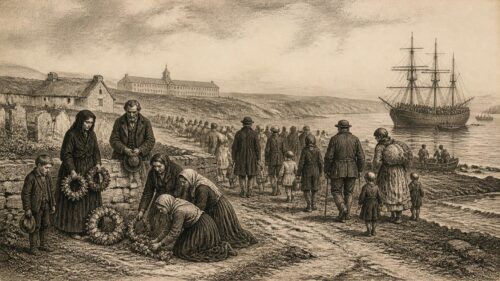
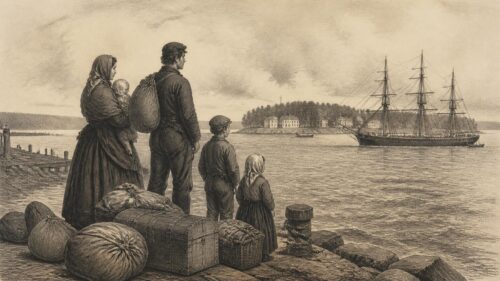
Emigration had existed before the famine and continued after the worst years of hunger. People went to Britain, the United States, Canada, Australia and other destinations. Their reasons differed. Some fled immediate destitution; others left because land no longer offered a viable future; some followed kin; others sought wages, domestic service, industrial work, education or adventure. The familiar image of the starving emigrant is historically real, but insufficient. Post-famine migration was also a durable family strategy, supported by remittances, letters and chain migration.
The passage itself could be dangerous, particularly in the famine years, and the phrase “coffin ship” survives as a powerful symbol of suffering. It should be used carefully. Conditions varied by vessel, route, season, regulation and the health of passengers. The phrase is valuable as a reminder that many migrants died in transit or soon after arrival, but it cannot describe every Atlantic crossing. Folklore and family memory have often enlarged particular migration tales, sometimes preserving emotional truth while obscuring dates or particulars. Where passenger lists, correspondence and parish evidence survive, they should take precedence over later embellishment.
Emigration changed those who remained. It could reduce pressure on small holdings and raise the bargaining position of some labourers, but it also depleted communities of young adults and altered gender balances. Remittances could pay rents, finance passages or support parents at home. The loss of Irish speakers from western districts contributed to linguistic change, though Irish survived vigorously in many places. Villages and townlands did not simply empty in a single moment; rather, their age structure, household size and prospects altered across decades.
The census is powerful evidence, but it requires interpretation. Population totals do not by themselves distinguish famine deaths from later migration, nor do they reveal private motives. They do show that the Victorian era remade the island’s demographic scale. The Ireland of 1901 was not merely the Ireland of 1841 after a period of hardship. It was a smaller society, increasingly linked to overseas kin and marked by a collective memory of loss that later political movements could invoke.
Changing Countryside
Post-famine rural Ireland did not stand still. The collapse of the smallest holdings, consolidation of farms and continued emigration changed the social landscape. In some districts there were fewer cabins and fewer labourers; in others, stronger farmers became more prominent. Cattle, dairying and commercial agriculture assumed greater importance in many regions. The consequences were uneven. A household that acquired a viable farm might gain security and status, while a landless labourer or a family with no prospect of inheritance faced limited options.
Griffith’s Valuation, published between 1847 and 1864, is one of the most valuable sources for tracing this landscape. It lists occupiers, immediate lessors and property valuations across Ireland, while associated maps and later revision material can illuminate changes in possession. It was created for fiscal and administrative purposes, not as a social survey, and its categories must not be mistaken for a complete portrait of wealth or family life. Still, its detail allows historians and local researchers to see the texture of farms, houses, offices, mills, churches and townlands at a moment of profound transition.
Eviction remains one of the period’s most emotionally charged subjects. Documentary evidence confirms that eviction occurred, including during and after the famine, and that it could be traumatic and politically consequential. The reasons ranged from rent arrears and estate restructuring to clearance for pasture, conflict with tenants and the logic of insolvency proceedings. Numbers and circumstances differed markedly by estate and district. Later nationalist narratives sometimes presented eviction as an uninterrupted, universally uniform campaign. That interpretation captures a genuine structure of insecurity but can flatten differences between individual cases. Conversely, the existence of conscientious landlords does not erase the coercive power available to property owners.
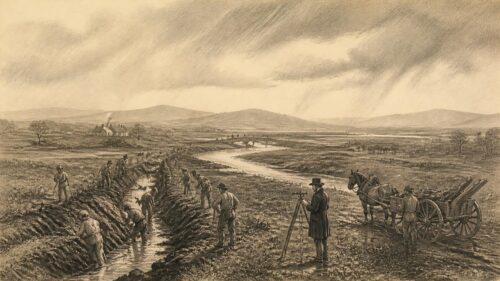
Improvement had a double meaning. Landlords and officials used it to describe drainage, road building, new housing, better breeds and more efficient estates. Tenants could value many of the same practical changes, but they also asked who paid for improvements and who benefited from them. If a tenant’s labour increased a holding’s value, should the landlord claim the gain through higher rent? That question lay at the heart of the later land agitation. It was not an antique survival. It was a modern argument about investment, rights and the distribution of economic reward.
Rural society also contained considerable associational life. Fairs, markets, churches, schools, secret societies, agricultural organisations and later branches of national movements formed networks of information and pressure. Violence occurred in some agrarian disputes, including intimidation, attacks on property and assaults. It should neither be romanticised as spontaneous resistance nor treated as proof that all tenant grievance was criminal. The countryside was a contested political arena in which constitutional campaigning, local custom, clerical influence, coercive policing and clandestine action could overlap.
Urban Contrasts
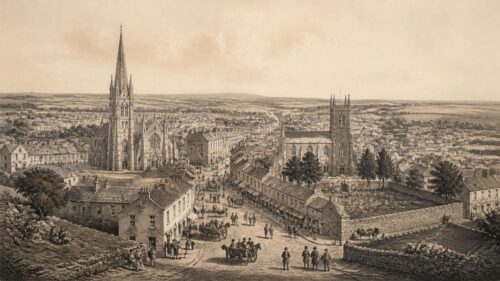
Victorian Ireland included vigorous towns and cities, although urbanisation proceeded unevenly. Dublin was still the largest city for much of the century, a centre of administration, commerce, publishing, law, education and culture. It possessed imposing Georgian streets and institutions, but its grandeur existed alongside extensive overcrowding and poverty. The decline of the Irish parliament after 1800 had affected elite employment and metropolitan prestige, yet Dublin was never simply a city in decay. It remained a place of theatres, newspapers, medical schools, charitable institutions, railway termini and political meetings.
Belfast’s trajectory was more dramatic. Its growth was tied to linen, engineering, shipbuilding, trade and the development of the port. The town’s population and physical scale expanded rapidly; by the late nineteenth century Belfast had acquired city status and had overtaken Dublin in population. The city’s factories, yards, warehouses, churches, terraces and commercial buildings embodied an industrial capitalism more comparable to northern British cities than to the agrarian districts of Connacht or Munster.
This prosperity was not evenly distributed. Linen manufacture drew heavily on women’s labour, often poorly paid, and industrial work brought long hours, hazards and irregular employment. Skilled male employment in shipbuilding and engineering could offer better wages and a strong occupational identity, but it was also exposed to trade cycles. Belfast was a city of employers and labourers, merchants and domestic servants, skilled artisans and casual workers. Its wealth should not obscure crowded housing, ill health or sectarian tension.
Religious identity became particularly significant in urban politics. Belfast had large Protestant and Catholic populations, with uneven residence and employment patterns. Industrial expansion attracted migrants from rural Ulster and beyond, including many Catholics seeking work. Competition for jobs and housing interacted with constitutional loyalties, Orange organisation, nationalist mobilisation and memories of earlier conflict. Rioting and intimidation were recurrent features of the city’s later Victorian history. They were not inevitable expressions of ancient hatred; they arose within changing urban conditions and were often encouraged or exploited by political actors.
Other towns also mattered. Cork was a significant port and commercial centre. Limerick, Waterford, Derry and many county towns linked rural hinterlands to national and international markets. Railway lines, telegraphy and improved steamship connections narrowed distances, although access remained unequal. A Victorian travelling across Ireland could encounter new stations, hotels, shops and newspapers, then move within a short distance into districts of acute rural poverty. The contrast was not incidental. It was one of the central facts of the age.
Religious Worlds
Religion was inseparable from Victorian Irish public life, but it should not be treated as a fixed map of hostile blocs. Roman Catholics formed the majority of the population, while Anglicans, Presbyterians, Methodists, Quakers and other communities exercised considerable influence in particular districts and institutions. Religious affiliation shaped schooling, marriage, charity, political allegiance and social networks. It could generate solidarity and practical support as well as rivalry.
The disestablishment of the Church of Ireland in 1869 was a major constitutional reform. For generations, the established church had held a privileged legal position despite representing a minority of the population. William Ewart Gladstone’s government presented disestablishment as an act of justice and a means of easing Irish grievance. The change did not dissolve religious difference, but it removed one prominent symbol of Protestant ascendancy and altered the church’s financial and institutional position.
The Catholic Church expanded its organisational reach across the century. New churches, convents, schools and devotional practices reinforced clerical authority. Bishops and priests were not politically uniform, and relations between clergy and nationalist activists could be cooperative or tense. In many rural communities the parish priest was an influential intermediary, able to mobilise opinion and mediate disputes. Yet Catholic laypeople were not passive recipients of direction. They made choices about migration, schooling, politics, work and religious practice that could diverge from clerical preference.
Presbyterianism held particular strength in Ulster, where it contributed to the social and civic culture of the industrial north-east. Its historical relationship with unionism was close but not automatic. Earlier Presbyterian radical traditions and later liberal sympathies remind us that denominational affiliation did not mechanically determine politics. Church of Ireland communities were likewise diverse, including wealthy landowners, professionals, clergy, farmers and labourers. The shorthand of “Protestant” and “Catholic” is necessary in explaining political blocs, but it can conceal class and regional variation.
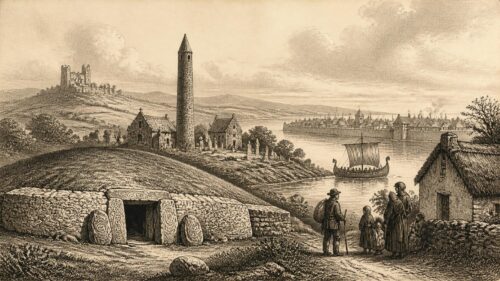
Popular belief also extended beyond formal institutions. Holy wells, wakes, local saints, seasonal customs and stories of fairies or ghosts continued in many districts. These are part of the historical record, especially where recorded by folklorists in later decades, but they require careful treatment. A later collected tale may preserve a nineteenth-century motif without proving a particular Victorian event. Folklore can reveal how people imagined place, danger, death and obligation; it is not automatically literal evidence for the occurrence of supernatural or legendary claims.
Fenian Challenge
The failure of the Young Ireland rebellion in 1848 did not extinguish separatist nationalism. In the 1850s Irish republicans organised the Irish Republican Brotherhood, commonly known as the Fenians, alongside a related movement in the United States. They rejected reliance on Westminster and sought an independent Irish republic. Their existence demonstrated that constitutional reform did not contain all political aspirations in Victorian Ireland.
The Fenian movement depended on secrecy, transatlantic connections and recruitment among men who felt excluded from political power. British authorities responded with surveillance, arrests, informers and legislation. The planned rising of 1867 failed militarily, but Fenianism had consequences beyond the battlefield. It kept the possibility of physical-force nationalism alive; it alarmed the state; and it influenced later activists, including those who would combine separatist sentiment with land agitation or parliamentary methods.
Fenianism should not be confused with mass opinion. Many Irish people did not support insurrection, and many Catholic clergy condemned secret revolutionary societies. Nor were all advocates of Irish self-government republicans. Nonetheless, executions, imprisonments and the treatment of prisoners created potent symbols. The Manchester executions of 1867, in particular, became central to nationalist commemoration. Public memory transformed such episodes into moral lessons about sacrifice and injustice, sometimes simplifying the complex circumstances in which they occurred.
State coercion was a recurring feature of the Victorian Irish administration. Special legislation, the Royal Irish Constabulary, resident magistrates, prisons and Dublin Castle’s bureaucracy gave the government formidable powers. It would be wrong, however, to imagine the state as omnipotent. It relied on local information, cooperation from officials and landlords, and the credibility of its courts. In many areas, state authority was filtered through local relationships. The very need for repeated coercive measures suggested the limits of consent.
The significance of the Fenians lies partly in what they made possible. They helped establish a political vocabulary in which Ireland was a nation entitled to sovereignty, not merely a province seeking administrative reform. That vocabulary would later compete and overlap with constitutional nationalism. The division between physical force and parliamentary action was real, but never perfectly sealed. Individuals, ideas and sympathies moved across it.
Land Conflict
The Land War of 1879 to 1882 arose from immediate economic hardship and from much older grievances about tenure. Poor harvests, falling agricultural prices and distress in western districts created a new crisis. Michael Davitt, Charles Stewart Parnell and others connected tenant protection with national politics. The Irish National Land League demanded what became known as the “three Fs”: fair rent, fixity of tenure and free sale. The formula expressed a powerful claim that tenants possessed interests in their farms that deserved legal recognition.
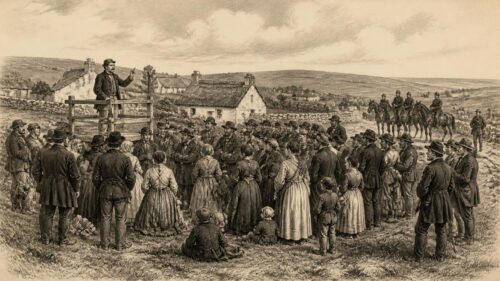
At Irishtown in County Mayo in 1879, Davitt addressed a gathering that became emblematic of the agitation. Meetings, branches, newspapers, clergy and local organisers spread the movement. Parnell’s parliamentary ability gave it a national platform, while Davitt brought a radical social vision shaped by his own experience of eviction, migration and Fenianism. Their alliance was productive but not without tension. Parnell was a landowner and constitutional politician; Davitt was more inclined towards transforming ownership itself.
The word “boycott” entered the English language during this campaign. Captain Charles Boycott, an agent in County Mayo, became isolated after a dispute with tenants on Lord Erne’s estate. Local people refused to deal with him, and the episode was widely reported. The story has acquired a near-mythic status, but its basic documentary outline is clear. It showed the power of organised non-cooperation and gave a name to a tactic that could avoid direct violence while exerting great pressure.
The Land League campaign included public meetings, rent strikes, legal challenges and social ostracism. It also coincided with intimidation and violence in some localities. Historians should avoid two opposite distortions: depicting the movement as wholly peaceful and constitutional, or treating its entire support as a product of criminal terror. The agitation drew on real and widespread tenant grievance, while coercion and fear sometimes operated within it. Government policy mixed relief, reform and repression. This combination reflected the state’s difficulty in separating economic distress from political mobilisation.
Gladstone’s Land Act of 1881 created a Land Commission and gave tenants important new rights, including the opportunity to seek judicially fixed rents. It did not satisfy all demands, and conflict continued. Yet it marked a decisive shift away from an older doctrine of unrestricted landlord control. Later land purchase legislation would carry the process further, allowing many tenants to become owners. The settlement was gradual and incomplete during Victoria’s reign, but the balance of rural power had been altered.
Parnell Ascendant
Charles Stewart Parnell became the dominant Irish political figure of the 1880s. A Protestant landlord from County Wicklow, he led a predominantly Catholic nationalist parliamentary movement. That fact alone complicates crude assumptions about religion and political identity. Parnell’s authority rested on parliamentary discipline, electoral organisation, his association with land reform and his ability to make Irish votes matter at Westminster.
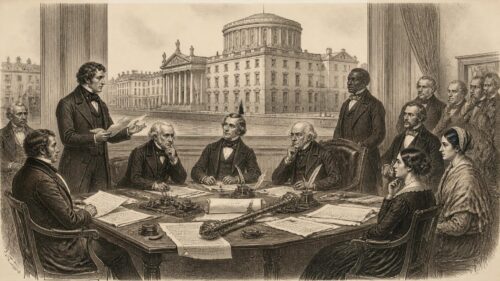
The extension of the franchise and redistribution of seats in 1884 and 1885 created a more democratic electoral landscape, though women remained excluded from parliamentary voting. The Irish Parliamentary Party developed mechanisms of discipline that made it unusually cohesive by Victorian standards. MPs pledged to follow the party line; local organisations turned elections into contests over national as well as local issues. Parnell’s use of obstruction in the House of Commons angered opponents but forced attention upon Irish business.
Home Rule did not mean independence. Its advocates generally sought an Irish legislature responsible for domestic matters while retaining a connection to the Crown and the wider United Kingdom. The precise constitutional arrangements were debated, and opponents argued that an Irish parliament would threaten imperial unity, Protestant interests and property rights. Supporters answered that self-government would make administration more legitimate and relieve Westminster of Irish obstruction. Both sides used the language of liberty, security and constitutional tradition.
Gladstone converted to Home Rule in 1886 and introduced the first Home Rule Bill. Its defeat in the Commons split the Liberal Party and helped create the Liberal Unionist alliance with Conservatives. The bill’s failure was a turning point. It demonstrated that a major British statesman could accept Irish self-government as compatible with the Union, but it also consolidated organised unionism, especially in Ulster. Constitutional division now acquired a sharper territorial dimension.
Parnell’s fall after the O’Shea divorce case in 1890 fractured the nationalist movement. The crisis involved moral judgement, party calculation, clerical influence and the harsh demands of Victorian public respectability. It cannot be explained solely by private scandal or solely by British hostility. Parnell retained devoted followers, but he lost the broader coalition necessary for leadership. He died in 1891, leaving Home Rule weakened but not extinguished. In later memory, he became both a tragic national hero and a contested figure whose image changed with political need.
Unionist Resistance
Unionism was not simply a refusal of change. Its supporters defended the Union for economic, constitutional, religious and imperial reasons. Many believed that Ireland’s prosperity, security and access to markets depended upon remaining fully within the United Kingdom. In Ulster, industrial employers and skilled workers often feared that a Dublin parliament dominated by agrarian interests would threaten commerce and Protestant civil equality. Elsewhere, landowners and professional unionists worried about property, religious institutions and their political position.
Protestant fears of Home Rule were not invented after the fact. They were rooted in historical memory, including the experience of Catholic emancipation, disestablishment, land reform and the changing electoral balance. Nationalist assurances that a Home Rule parliament would protect minorities did not persuade everyone. The phrase “Home Rule is Rome Rule”, increasingly prominent in unionist rhetoric, expressed fear that Catholic clerical influence would become political domination. It was also a partisan slogan, designed to mobilise anxieties and reduce complex constitutional questions to a religious warning.
Unionism possessed substantial popular as well as elite support. Orange lodges, churches, newspapers, employers and civic bodies helped create a political culture in which loyalty to the Crown and opposition to Home Rule were mutually reinforcing. Belfast’s industrial economy gave this culture a powerful urban base. Yet Ulster was not politically homogeneous. Catholics, nationalists, liberals and labour activists lived and organised there, while some Protestants supported forms of reform or Irish self-government. The later map of partition should not be projected too confidently backwards onto the whole Victorian period.
Government policy after 1886 sometimes sought to reduce nationalist grievance through land purchase, local reform and economic measures while rejecting Home Rule. Critics later called this approach “killing Home Rule with kindness”. The phrase captures a genuine political strategy but can exaggerate coherence. Conservative governments were concerned with order and unionist support as well as reform. Measures could improve conditions or redistribute power in limited ways without resolving the constitutional question.
The core Victorian conflict was thus not Ireland against Britain in a single undifferentiated sense. It was also a conflict among Irish people who envisaged different futures: independent republic, devolved parliament, continued Union, tenant proprietorship, labour reform, religious protection or imperial integration. These positions sometimes overlapped, but they could not all be reconciled.
Cultural Renewal
The later Victorian decades saw renewed interest in Irish language, literature, music, folklore and sport. This was not a simple recovery of an untouched ancient culture. Irish culture had continued through the famine and post-famine years in speech, song, storytelling, religious practice and local custom. What changed was the creation of new voluntary organisations and publications that made cultural activity a self-conscious national project.
The Gaelic Athletic Association was founded in 1884, promoting organised Irish games such as hurling and Gaelic football. The Gaelic League followed in 1893 with the aim of preserving and extending the Irish language. These bodies were not initially identical with separatist politics, and their memberships included people of differing constitutional views. Over time, however, they became important spaces in which Irish national consciousness could be cultivated. Clubs, classes, competitions and newspapers created practical habits of association.
Douglas Hyde, a Protestant scholar and later the first president of Ireland, was among the leading advocates of language revival. His role underlines the cultural movement’s early breadth. The language question also had social complexity. For many families, English promised access to work, migration and education; for others, Irish remained the language of home and community. Revivalists sometimes mourned language shift as a national loss, while speakers themselves could regard bilingualism or English acquisition as necessary strategies. Neither view invalidates the other.
Folklore collection and literary revival brought local tradition into print. Such work preserved songs, tales and vocabulary that might otherwise have been lost, but collection could also reshape what it recorded. Editors selected, translated and framed material for educated readers. A printed folktale is therefore evidence both of oral tradition and of the collector’s intervention. The same caution applies to romantic depictions of the western peasantry: they may reveal urban nationalist longing as much as rural reality.
Cultural renewal mattered because it supplied nationalism with more than political demands. It offered symbols, practices and emotional attachments. A language class, a hurling club or a literary society could make “Ireland” feel present in daily life. Yet Victorian Ireland also remained culturally connected to Britain and the wider English-speaking world. Irish readers consumed British newspapers and novels; Irish writers worked in London; Irish musicians and performers travelled widely. Cultural nationalism developed within, not outside, these entanglements.
Women’s Lives
Women’s experiences are essential to any account of Victorian Ireland, although surviving public records often describe them through male-headed households, employers, clergy or institutions. Women worked in domestic service, agriculture, textile production, shops, schools, religious orders and family businesses. Their labour was sometimes paid directly and sometimes absorbed into household survival. In rural districts, women’s work in dairying, poultry, field tasks and domestic production was economically significant even when official statistics obscured it.
Emigration profoundly affected women. Young women left for domestic service and other employment in Britain and North America, frequently using networks of relatives and neighbours. Their wages and remittances could support family members in Ireland. Migration also changed marriage patterns. In a society where farms increasingly passed to a single heir and where dowries or household resources mattered, many women faced constrained choices. The high proportion who remained unmarried in later nineteenth-century Ireland has often been interpreted as evidence of social conservatism; it also reflects economic structures and the consequences of emigration.
Industrial Belfast offered paid employment to large numbers of women and girls, especially in linen-related work. Such employment could provide income and urban independence, but conditions were often hard, wages lower than men’s and prospects limited. Factory work did not dissolve gender hierarchy. Employers, moral reformers and clergy regularly attempted to regulate women’s behaviour, dress and leisure as well as their labour.
Education expanded opportunities, particularly through teacher training and religious institutions. Women entered public debates through philanthropy, temperance, education, writing and later suffrage activism. Their political citizenship remained restricted: they could not vote in parliamentary elections, though some women possessed limited municipal and poor-law voting rights under property qualifications. Campaigns for women’s suffrage gathered strength toward the end of the century, linking Irish activists with wider British and international movements.
The image of Victorian Irish womanhood was often idealised by clergy, nationalists and imperial commentators alike. It could depict women as pure mothers, faithful daughters, rural guardians of tradition or self-sacrificing emigrants. These images are historical evidence of social ideals, not transparent accounts of women’s lives. Court records, workhouse registers, letters and employment records show a more varied reality: women negotiating work, family obligation, poverty, migration and personal agency under restrictive conditions.
State Reform
The Victorian state in Ireland grew more visible through records, inspections, police, schools, poor-law administration and infrastructure. This did not mean that it became universally trusted. Rather, the state’s presence became woven into daily life: a family might encounter it through the workhouse, a school inspector, a valuation surveyor, a constable, a court, a vaccination programme or a railway timetable.
Sanitary and medical administration developed unevenly. Poor-law unions acquired wider responsibilities in health, housing and sanitation as the century progressed. Workhouse hospitals became an important part of local medical provision, increasingly serving people beyond the resident poor. Such institutions could offer care where little existed before, but they carried the stigma of the poor law and were often associated with overcrowding and hardship. Progress in administration should not be confused with equality of access or quality.
The Local Government Act of 1898 was another significant change. It transferred functions previously exercised by grand juries to elected county and district councils. The reform broadened local political participation and weakened the long-standing dominance of landlord and magistrate interests in county government. It did not create national self-government, but it trained new groups in public administration and gave political organisations fresh arenas for competition.
Railways and telegraphs altered communications. Lines connected Dublin, Belfast, Cork, Limerick, Derry and many smaller towns, facilitating travel, trade, newspapers and the movement of people. They also enabled state power: police, troops and officials could travel more quickly, while national organisers could address meetings across a wider territory. Technology did not erase regional isolation, particularly in poorer western districts, but it changed the practical scale on which politics and commerce operated.
Victorian reform was therefore double-edged. It could mean schools, elected councils, better information and improved transport. It could also mean surveillance, discipline and a bureaucratic system whose ultimate authority lay outside Ireland. This dual character helps explain why reform did not settle the constitutional dispute. Administrative modernisation made Ireland more governable in some respects, but it also supplied nationalists with evidence that Irish people were capable of managing their own affairs.
Enduring Legacies
When Queen Victoria died in January 1901, Ireland had been transformed. The population was roughly half its 1841 level. The countryside had moved, though unevenly, towards tenant ownership. Belfast had become a major industrial city. The Church of Ireland had been disestablished. Local government had been democratised to a degree. Home Rule was embedded in parliamentary politics, while unionist resistance to it had become organised and intense. Cultural revival had created institutions that would influence a new generation.
It would be misleading to describe these changes as a steady march towards independence. The constitutional future remained unresolved, and a majority in important parts of Ulster did not seek separation from the United Kingdom. Nor did the land settlement abolish class conflict or emigration. The decades after 1901 would bring another Home Rule crisis, labour militancy, revolutionary separatism, partition and state formation. Those outcomes were not inevitable in 1901, but the political languages and institutional networks that shaped them had deep Victorian roots.
The period’s historical reputation has often been dominated by famine. That emphasis is justified: the Great Famine was a catastrophe of extraordinary scale and a central source of modern Irish memory. Yet famine alone cannot explain Victorian Ireland. It cannot explain Belfast’s industrial confidence, the changing character of rural property, the growth of mass electoral nationalism, or the cultural organisations that outlived the Union. A fuller account must hold suffering and transformation together.
Documented evidence supports the broad outline: census totals demonstrate long demographic decline; poor-law and valuation records reveal the workings of administration and property; parliamentary and newspaper records trace political mobilisation; surviving buildings, maps and business archives record urban expansion. Interpretation begins when historians weigh causation, responsibility and meaning. Was reform primarily a concession wrested from below, an effort to preserve the Union, or both? Did cultural revival resist anglicisation, create a modern nationalism, or do both at once? Reasonable scholars may differ, provided they distinguish argument from fact.
Victorian Ireland remains compelling because it resists easy summaries. It was a land of workhouses and railways, eviction notices and tenant purchase, factory chimneys and shrinking villages, royal ceremony and republican conspiracy. Its people did not inhabit a single national experience. They lived within overlapping local, religious, class, imperial and diasporic worlds. The tensions among those worlds gave the era its hardship, creativity and lasting political force.
One of the article’s compelling themes is its refusal to treat Victorian Ireland as a single experience. Famine, emigration and land insecurity reshaped rural districts, while Belfast’s industrial growth and Dublin’s administrative role created different opportunities, loyalties and political languages. This regional contrast complicates accounts of Ireland as either simply colonial or simply integrated within the United Kingdom. It also suggests that later constitutional divisions drew upon economic and social patterns as well as religious identity. How far do you think the contrasting experiences of rural western communities, Dublin, and industrial Belfast best explain the political identities in modern Ireland?