Trian’s Relic Circuit794 CE
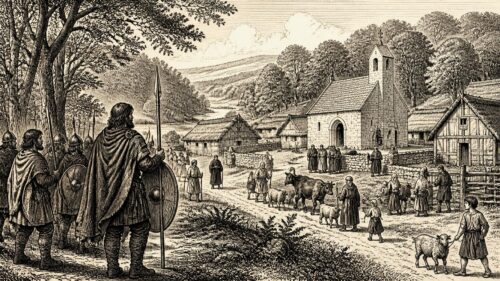
In 794, Irish annals record interconnected religious, political and maritime developments, while remaining sparse about causes and outcomes. The relics of Trian travelled on circuit, extending ecclesiastical authority among communities. Donnchad of Mide led forces supporting Leinster against Munster, while Áed son of Niall invaded Mugdorna Maigen, illustrating regional rivalry rather than national unity. Deaths of senior figures at Armagh, Bangor, Clonmacnoise, Tuaim Gréine and Cluain Bairenn marked significant ecclesiastical transitions, including female leadership. Reports of Scandinavian devastation around Britain warned Irish communities of mounting seaborne danger, preceding securely recorded attacks on Irish islands in following years and transforming horizons.
Dateline
For Ireland, 794 CE is preserved less as a single dramatic episode than as a compact annalistic dossier: a sacred object set on circuit, a royal expedition in support of Leinster, a northern incursion, the deaths of senior church figures, and an alarming report from across the Irish Sea. The year’s evidence is unusually revealing precisely because it is so terse. It shows an island whose political and religious institutions were active and interlinked, while the maritime world to the east was becoming markedly more dangerous.
There is a chronological caution at the outset. Early Irish annals were compiled, copied and synchronised over centuries, and their year-headings do not always align simply with a modern calendar year. The events conventionally assigned to 794 are treated here as belonging to that year, while the limits of the evidence are kept in view. The annals seldom describe motives, numbers, routes or consequences unless these mattered to a later compiler. They record that something happened, not a full narrative of how it unfolded.
A Relic on Circuit
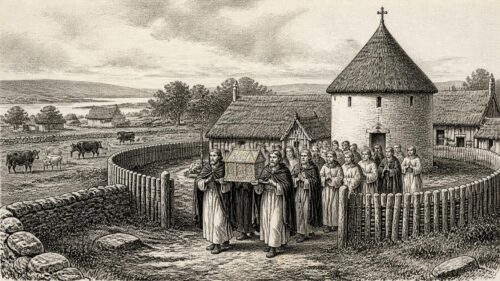
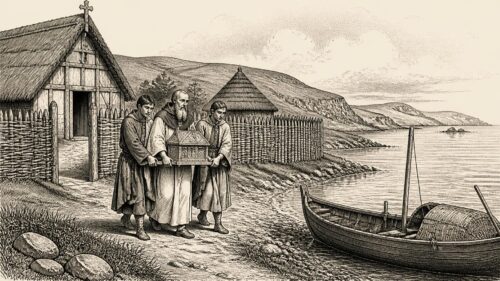
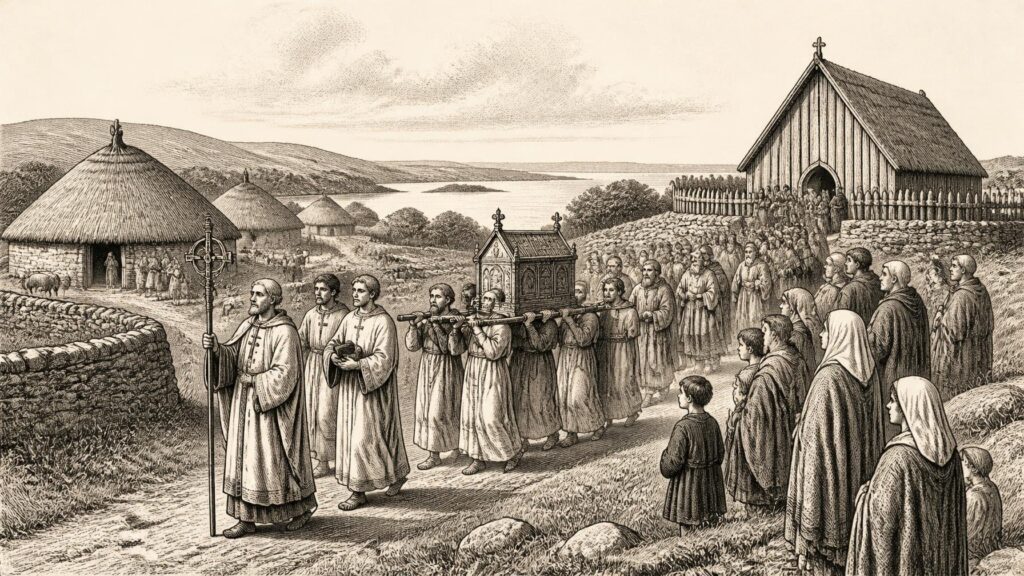
The most distinctive Irish notice for the year is brief: the relics of Trian were “taken on tour”. That small statement opens onto a large religious and social world. A relic was not merely an object kept inside a church. It might be a saint’s bodily remains, a bell, book, staff, garment, or another object closely associated with a holy founder. Its authority rested on the saint’s continuing presence and on the institutional claims of the church which guarded it.
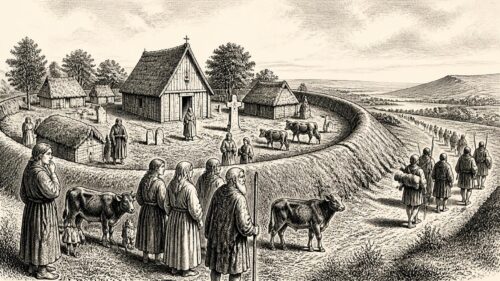
In this instance, the annal does not identify Trian securely enough to permit a confident reconstruction of the saint, shrine, community or route. It would be wrong to invent a procession through named districts, or to suppose that a particular dispute caused the journey. Yet the action itself was meaningful. Bringing relics out on circuit made sanctity mobile. Clergy and lay people could meet the sacred object; oaths might be affirmed in its presence; protection, reconciliation, dues or obedience could be sought beneath its authority. Such circuits also connected a church to dependent communities beyond its immediate enclosure.
For ordinary households, therefore, the year’s religious life was not confined to distant monastic churches. A travelling relic could bring a major ecclesiastical institution into local landscapes of farms, minor churches and royal estates. It was a public act of devotion, but also an exercise in communication and influence. In a society where status, kinship and lordship structured public life, a saint’s relic could operate as a force recognised across those boundaries.
Donnchad’s Support for Leinster
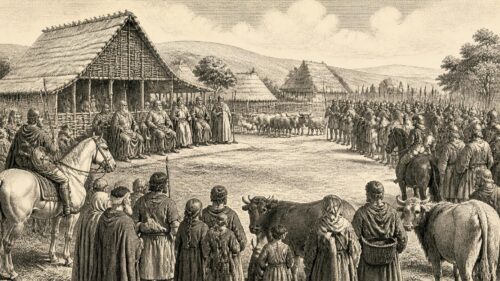
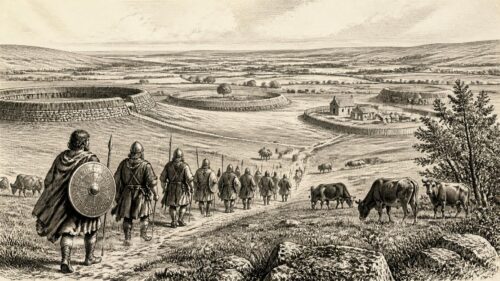
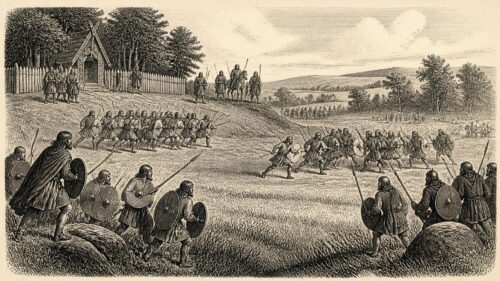
The annals also record that Donnchad led a hosting to assist the Laigin, the people of Leinster, against the men of Munster. A hosting was not an impersonal national army. It was a gathering of a king’s followers and subordinate rulers: mounted elites, fighting men, attendants, clerics and suppliers, sustained from the resources of the territories through which they travelled. The entry gives neither battlefield nor result, and it should not be turned into a named battle. What is firm is that Donnchad intervened on Leinster’s side in a conflict with Munster.
Donnchad is normally identified with Donnchad mac Domnaill of Clann Cholmáin, the powerful ruler based in Mide whom later king-lists counted among Ireland’s high-kings. His involvement illustrates what such superiority could mean in practice. Authority was demonstrated not only by receiving homage but by mobilising support beyond one’s own core territory, choosing allies and confronting rivals. The record does not show an all-Ireland state directing a unified policy. Instead, it shows overlordship being made real through personal leadership, military obligation and negotiated alliance.
Leinster’s position mattered greatly. Its plains, routes and ecclesiastical centres lay between the midlands, the Irish Sea coast and Munster. A contest involving Leinster and Munster could disturb the balance among several dynasties, while offering a Mide ruler an opportunity to appear as protector, arbiter or superior. The language of assistance is important: Donnchad was entering an existing struggle, not necessarily beginning it. Politics in 794 were regional, competitive and flexible, with relationships tested through armed movement as well as assemblies and marriage ties.
Pressure in Mugdorna
A second political notice records the invasion of Mugdorna Maigen by Áed son of Niall. The annal does not tell us why Áed attacked, what was taken, or whether the local population submitted, fought or made terms. It nevertheless reveals another level of Irish politics: pressure exerted upon a smaller people or territory by a leader from the wider Uí Néill world.
Áed son of Niall was a member of the northern Uí Néill and would soon become a central figure in Irish kingship. In 794, however, the entry should be read on its own terms. It records an incursion, not a later coronation programme projected backwards. The juxtaposition with Donnchad’s Leinster expedition is instructive. In the same year, ambitious rulers could seek influence in different directions: one joining a southern alliance, another raiding or invading a northern territory. There was no political quiet behind the celebrated churches and royal genealogies.
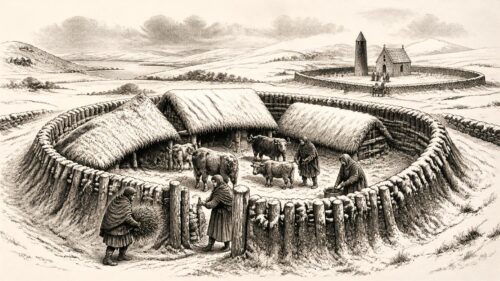
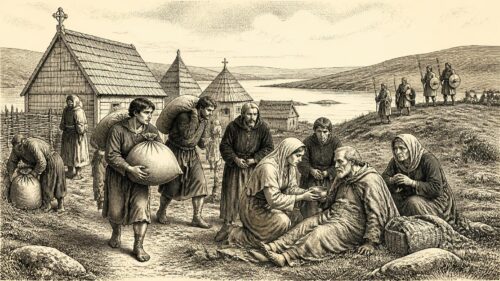
For those living in a district such as Mugdorna Maigen, an invasion could mean far more than a clash between elite warbands. Livestock, food stores and hostages were fundamental currencies of power. A force on the move required provisions and could threaten crops, homesteads and dependants even if no major battle followed. The silence of the annal on these consequences does not prove that devastation occurred; it does remind us that the surviving record generally follows rulers and institutions rather than the vulnerable people who bore the costs of conflict.
Deaths in the Ecclesiastical Network
Several notices mark the passing of leading churchmen and women. Airechtach, abbot of Armagh, and Affiath, bishop of Armagh, were said to have died peacefully on the same night. Tomás, abbot of Bangor, and Ioseph, abbot of Clonmacnoise, also died. Cathnia, abbot of Tuaim Gréine, and Lerben, female superior of Cluain Bairenn, were likewise commemorated. This is not a random list of pious deaths. It maps a network of major and lesser ecclesiastical centres extending from Armagh and Bangor in the north-east to Clonmacnoise on the Shannon and communities elsewhere in the island.
The paired deaths at Armagh are especially striking. Armagh’s abbot and bishop held distinct offices, though Irish ecclesiastical life did not conform neatly to later diocesan assumptions. An abbot could command lands, clients and learned personnel as well as religious prestige; a bishop supplied sacramental authority. Their deaths on the same night created an exceptional moment of transition at a church closely associated with Patrick and one of the island’s foremost centres of authority.
The record of Lerben matters too. A female superior appears in the annals not as an anonymous nun but as head of a recognised community. Women’s religious houses could possess land, retain connections with powerful families and participate in the same ecclesiastical culture of commemoration, learning and patronage as male foundations. The sparse wording does not tell us how Cluain Bairenn chose its successor, but it confirms that women’s leadership formed part of the institutional landscape of 794.
These deaths also suggest continuity beneath political movement. Monasteries and churches were not isolated refuges from secular affairs. They were landholders, places of worship, repositories of books and relics, and centres where aristocratic families placed kin in religious office. A change of abbot or superior could therefore affect property, alliances, local patronage and the standing of a community. The annals preserve the names because such transitions mattered.
Heathens Across the Sea
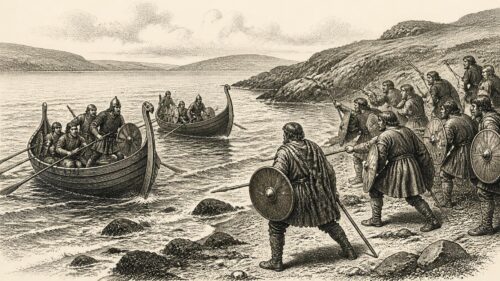
One entry looks beyond Ireland: “the devastation of all the islands of Britain by heathens”. Its wording is sweeping and should not be read literally as a complete survey of every island around Britain. It is, however, a powerful contemporary-style report of widespread seaborne violence. The “heathens” were Scandinavian raiders, now beginning to appear in Insular written sources with increasing insistence.
This was not yet an annalistic report of a raid on Ireland in 794. The first securely recorded attacks on Irish islands belong to the following years, and they should not be pulled back into this calendar year. But the news from Britain was directly relevant. Ireland and western Britain were linked by sea-lanes used by churchmen, pilgrims, scholars, traders and political exiles. Communities around the Irish Sea shared saints’ cults, manuscripts and kin connections; their coasts were also exposed to the same mobile raiders.
The year therefore stands at a threshold, though not in the simplistic sense of an old Ireland suddenly replaced by a Viking Ireland. In 794, Irish rulers were still preoccupied with familiar rivalries, and churches still expressed their reach through relics and office-holding. Yet reports from the eastern sea warned that ships carrying hostile strangers could strike islands and coastal religious sites. The danger had entered the horizon of Irish record-keepers before it entered their island’s annals as a direct assault.
A Year of Connections
What 794 most clearly reveals is connection: relics moving between communities; a Mide ruler aiding Leinster; Áed son of Niall imposing pressure on Mugdorna Maigen; leading figures dying in churches distributed across the island; and disturbing intelligence crossing the sea from Britain. Ireland was not politically unified, but neither was it a collection of sealed local worlds. Roads, rivers, coastal routes, ecclesiastical dependencies and royal followings carried people, authority and news.
The surviving notices are too slight to furnish a continuous story of twelve months. They do, however, preserve the things contemporaries or later annalists considered worth fixing in memory. Sacred power was put into motion. Kings mobilised allies. Church communities faced succession. Across the sea, raiders were remaking the security of the maritime world. In that combination, Trian’s unlocated relic circuit becomes an apt emblem for 794: an Ireland bound together by movement, belief and obligation, on the eve of a much harsher age of seaborne attack.
Primary Sources
- The Annals of Ulster
- The Annals of Ulster, Year U794
- Vikings in Irish Chronicles, 794–902: Data
- Annals of the Four Masters
- The Annals of Tigernach
- Chronicon Scotorum
- Chronicon Scotorum
- Annals of Inisfallen
- List of Published Texts at CELT
- Exploring the Irish Annals
- Ireland in the Viking Age
- The Earliest Wave of Viking Activity: The Norwegian Evidence Revisited
- Clonmacnoise Monastic Site
- Clonmacnoise, County Offaly
- Irish School of Illumination, c. 650–1100
- On Insular Bells and Tomb-shaped Shrines
- A New Jerusalem ‘At the Ends of the Earth’: Interpreting Charles Thomas’s Excavations at Iona Abbey 1956–63
- Saints and Seaways in the Viking Age
- Early Medieval Ireland: Archaeology, History and Society
- County Kildare Urban Archaeology Survey, 1986
- Observations on Two Ancient Irish Works of Art Known as the Breac Moedog and the Soiscel Molaise