Dún Ganiba’s Connacht Victory799 CE
In 799, as conventionally dated despite annalistic chronological differences, Ireland’s fragmented politics intertwined warfare, dynastic rivalry, ecclesiastical authority and environmental hardship. Muirgius son of Tomaltach won the internal Connacht battle of Dún Ganiba, while Ailill of Uí Maine died. At Finnabair in Tethba, Murchad son of Domnall defeated forces including two Cenél Cairpri kings. Clann Cholmáin kinsmen killed Abbot Blathmac and treacherously slew Domnall son of Donnchad. Heavy snowfall killed people and cattle. Numerous abbots died, and Gormgal promulgated Patrick’s law in Connacht, affirming church influence. No Viking raid was recorded; domestic conflict and vulnerability dominated the year across Ireland.
Dateline
A Year in the Annals
The events conventionally placed in 799 show an Ireland of competing dynasties, powerful churches and precarious rural livelihoods. They survive chiefly in the Irish annals, terse records compiled and copied in ecclesiastical settings. Their chronology needs care: the section labelled U799 in the Annals of Ulster carries an AD 798 heading in the surviving manuscript tradition, while modern historical convention generally places these entries in 799. The Annals of Inisfallen, using a different chronological framework, also records part of the same political crisis under 799. What follows therefore concerns events responsibly associated with 799, rather than pretending that every occurrence can be assigned to a modern calendar day.
No single ruler governed Ireland as a unified state. Kingship was layered: local dynasties defended their own territories, provincial rulers sought tribute and obedience, and the leading branches of the Uí Néill competed for primacy in the Midlands and beyond. Churches were not outside this world. Major ecclesiastical communities controlled land, cattle, dependants, learning and prestige; their abbots could be drawn into the struggles of royal kindreds. In 799, violence in Connacht and Tethba, killings within the southern Uí Néill, and the extension of Patrick’s law all reveal these close connections between power, property and sacred authority.
Muirgius Wins in Connacht
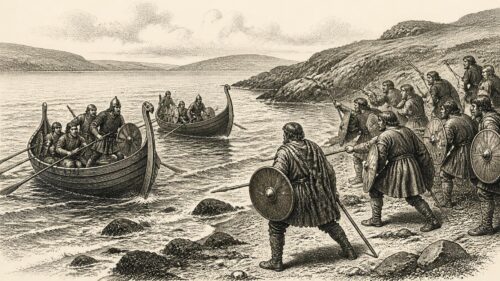
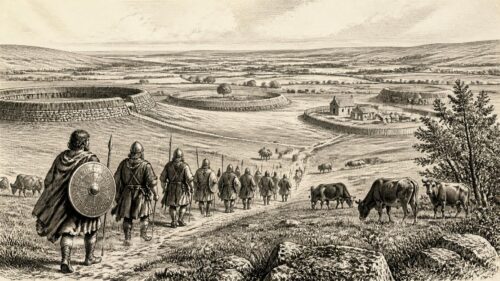
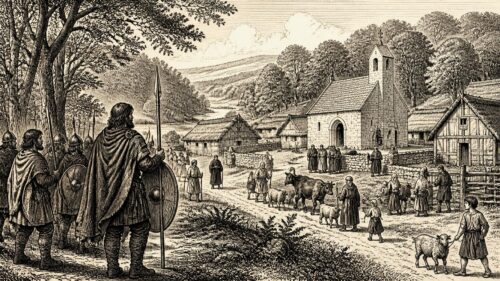
The most prominent military notice is the battle of Dún Ganiba, fought “between the Connachta themselves”. Coscrach son of Donn, Gaiscedach and many others were killed; Muirgius son of Tomaltach emerged victorious. The entry does not identify every party, explain the immediate cause or securely locate Dún Ganiba. Its importance lies instead in what the annalist chose to preserve: this was not a raid by an outside invader, but a serious internal conflict among the peoples of Connacht.
Muirgius was already a significant ruler in the province. His victory should not be inflated into proof that he commanded all Connacht without challenge, but it plainly strengthened his position at a moment when provincial authority depended on winning support from subordinate peoples and royal branches. In early medieval Ireland, a battle could settle access to tribute, cattle, clients and hostages as much as it decided prestige. The recorded deaths of named warriors and the unnamed “many others” hint at the cost borne by households whose political loyalties had placed men in the field.
Another Connacht development followed: Ailill son of Innrechtach, king of Uí Maine, died. Uí Maine occupied a strategically important zone in the east of the province, between Connacht and the Shannon corridor. The annals give no cause of death and do not explicitly connect it with Dún Ganiba. It would be unsafe to do so. Yet the coincidence of a major Connacht battle, a provincial victor and the death of a regional king makes 799 a year in which authority in the west was visibly being tested and redistributed.
Bloodshed in Tethba
Further east, the battle of Finnabair took place in Tethba, the region broadly corresponding to parts of the central Midlands. Here the annalist’s list of casualties is unusually pointed: Fergus son of Ailgal, Coscarach son of Ceithernach, and two kings of Cenél Cairpri, Dub Innrecht son of Artgal and Murchad son of Connmach, were slain. Murchad son of Domnall was victor. The loss of two kings of Cenél Cairpri indicates not a minor encounter but a destructive contest among politically weighty groups.
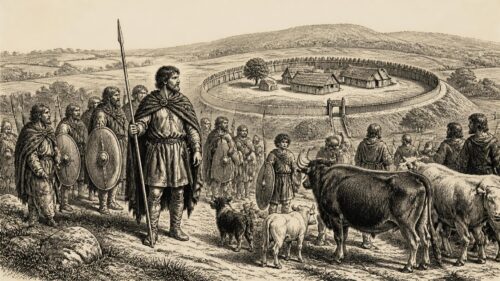
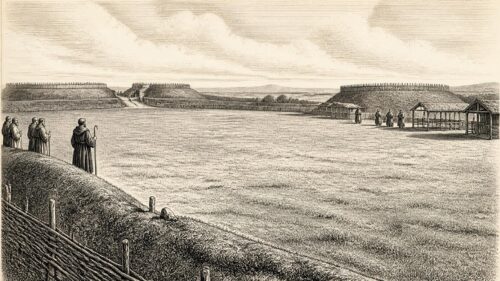
Tethba mattered because it lay close to the heartlands contested by branches of the southern Uí Néill, amid routes linking the Shannon basin, Mide and north Leinster. Control of such a borderland could bring access to land, food renders and communications, while exposing local rulers to the ambitions of stronger neighbours. The annal does not say that this battle was ordered by a high king, nor does it permit a neat map of alliances. It does show that political power was fragmented even within the wider orbit of Uí Néill influence. Kings were not merely distant names in genealogies: they could die with their followers in a single localised defeat.
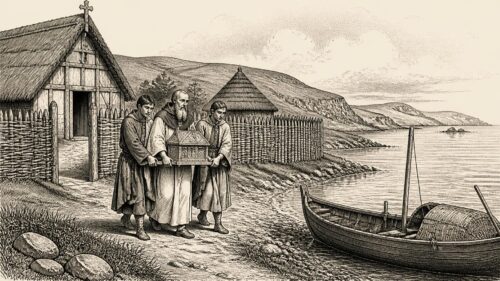
Violence also reached the church. Blathmac son of Guaire, abbot of Cluain Fhata Baetáin, was killed by Máel Ruanaid and Follamán, sons of Donnchad. The notice identifies the perpetrators, a remarkable degree of precision, but supplies neither motive nor aftermath. Their family belonged to the powerful Clann Cholmáin of Mide. An abbot’s killing by men of this standing demonstrates that ecclesiastical office did not guarantee immunity. Monastic communities were centres of prayer and learning, but they were also endowed institutions woven into aristocratic kinship, inheritance and regional politics.
A Dynasty Divides
The same annalistic sequence records the treacherous killing of Domnall son of Donnchad by his own kinsmen. The Annals of Inisfallen similarly records Domnall’s slaying, though it names Cellach as victor. Taken together, the sources establish the killing but caution against reconstructing a detailed narrative beyond their words. Domnall, Máel Ruanaid and Follamán were members of the same ruling kindred. The phrase “by his kinsmen” is therefore especially stark: the danger to a royal claimant could come from within his own household and lineage.
Such killings were not aberrations in a system where several eligible males might contend for authority. Succession was shaped by seniority, military following, negotiated support and the ability to control resources; it was not automatic primogeniture. Treachery, in the annals’ moral vocabulary, condemned an unlawful or dishonourable breach of relationship, but it also records a political fact. In 799 the descendants of Donnchad were fighting over power in the Midlands, while their actions touched an abbot and culminated in the death of one of their own. The political map was made not only through battles between provinces, but through violent rearrangements inside dynasties.
Snow, Cattle and Vulnerability
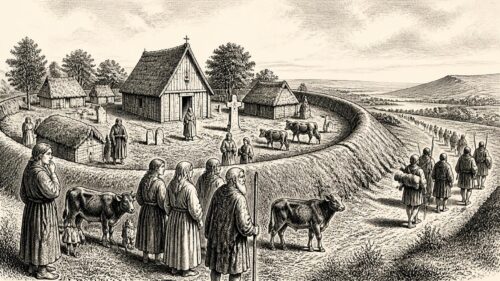
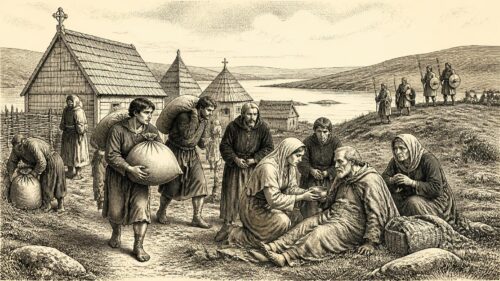
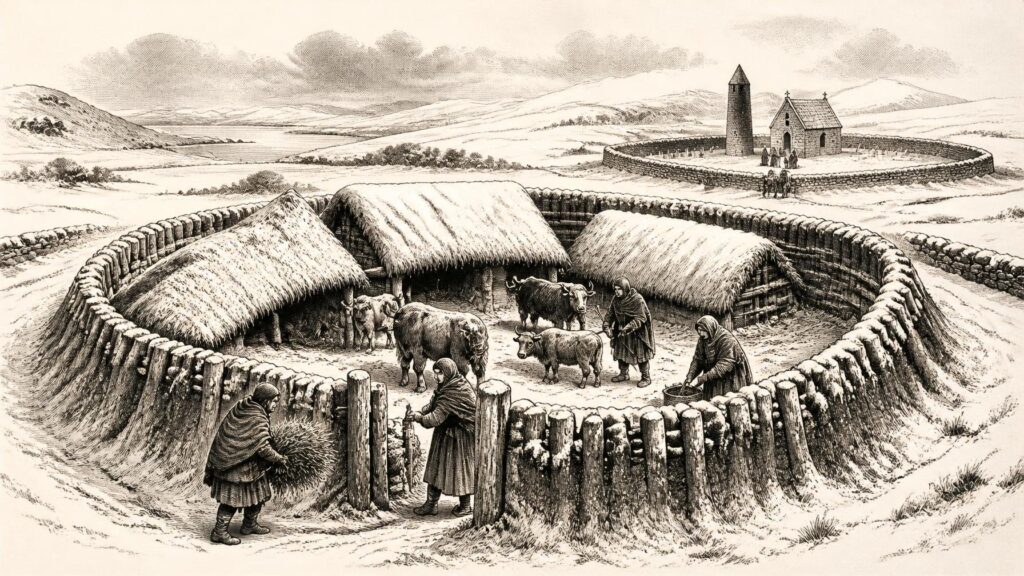
Amid these elite conflicts, one short entry opens a window onto the wider population: there was a great snowfall in which many people and cattle perished. No duration, season or locality is given, so the scale cannot be measured. Nonetheless, the annalist considered the losses significant enough to record beside battles and royal deaths. This was an agrarian society in which cattle were central to wealth, food, social rank and the payment of dues. Their loss could mean less milk and dairy produce, fewer animals for breeding or exchange, diminished capacity to meet obligations, and hardship extending beyond one winter.
The impact would not have been borne evenly. Better-resourced households and churches may have had greater stores, dependants and herds, but they also had larger obligations. Small farmers, labourers and the unfree were less able to absorb a failure of fodder or stock. Archaeology and early Irish law alike point to a mixed farming world of livestock, crops, food processing and managed enclosures rather than an economy of cattle alone. Even so, the annal’s pairing of human and bovine deaths captures the close relationship between environmental shock and survival. It is evidence for a severe episode, not proof of an island-wide famine or a long climatic decline.
Churches, Learning and Patrick’s Law
The obituary list for 799 is strikingly long. Feradach, abbot of Rechru, died, followed by Anaile of Clonmacnoise, Ceithernach of Glendalough, Siadal of Cell Achad, Fiannachtach of Ferns, Suibne of Cell Delge and Breislén of Béirre. These notices do not mean that every community was in crisis: annals commonly marked the deaths of important churchmen. Yet their geographical range—from island and coastal foundations to major inland centres—shows the density of ecclesiastical networks across Ireland.
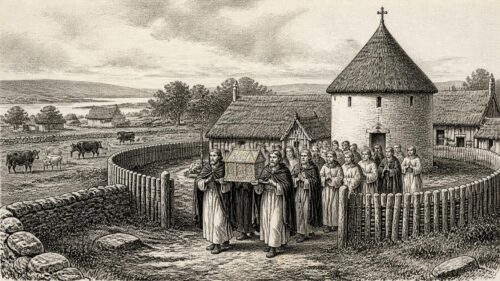
Clonmacnoise and Glendalough were more than isolated places of devotion. Communities such as these maintained worship, hosted clerics and lay workers, managed agricultural resources, preserved texts and trained literate personnel. Their leaders’ deaths mattered because an abbot’s office carried institutional as well as spiritual authority. In an age without towns in the later medieval sense, large churches could act as hubs of production, exchange, hospitality and learning. The year’s notices reveal that religious life was embedded in ordinary economic and political structures, even while it claimed a distinct sacred purpose.
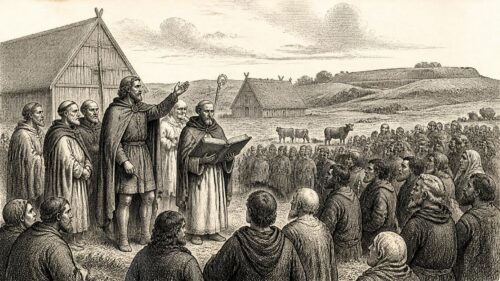
That purpose appears most clearly in the promulgation of Patrick’s law in Connacht by Gormgal son of Dindathach. Gormgal would later be remembered as abbot of Armagh and Clones. “Patrick’s law” should not be imagined as a surviving modern-style statute book. It was a church-backed legal and devotional authority associated with Patrick’s cult, the protection of clergy and the claims of Armagh. Its proclamation in Connacht was a public act: religious legitimacy, legal obligation and institutional influence were being asserted together. The entry is particularly telling after Muirgius’s victory at Dún Ganiba. Whether or not the two events were directly coordinated, both concern the ordering of Connacht—one by force of arms, the other through the authority of Patrick and his church.
The annals also mention the “hand-clapping” on St Michael’s Day, called the “fire from heaven”. The wording is enigmatic and should not be turned into a confidently identified natural phenomenon. It does, however, preserve the memory of a notable Michaelmas observance or gathering, showing how the liturgical year structured public time and collective attention. Dúnfhlaith, daughter of the former northern ruler Flaithbertach son of Loingsech, also died, a reminder that aristocratic women appear in the record chiefly at moments of death, marriage, patronage or dynastic consequence rather than through a full account of their lives.
After the Raids Began
799 came only a few years after the earliest recorded attacks by Scandinavian raiders on Irish and Irish Sea ecclesiastical sites. The annals do not record a Viking raid in this particular year. That absence matters. It would be misleading to make the newcomers the explanation for every disturbance in Ireland. The dominant recorded events of 799 were internal: Connacht fought within itself; Tethba saw the killing of kings; a leading Midlands dynasty turned on kin; churches lost abbots and advanced Patrician authority; and severe snow threatened people and herds.
The year therefore offers a corrective to a simplified picture of the early Viking age. Ireland was already politically active, regionally varied and capable of acute violence before Scandinavian raiding became more frequent and transformative. Its communities faced hazards from warfare, succession disputes and weather, while its churches remained indispensable centres of authority and memory. In the annalists’ compact record, Dún Ganiba’s victory, the snow’s losses and Patrick’s law belong to the same historical landscape: an island whose power was local, contested and deeply dependent on land, cattle and sacred institutions.
Primary Sources
- The Annals of Ulster, U799
- CELT Project: The Annals of Ulster
- Annals of Inisfallen, AI790–AI799
- CELT Project: Annals of Inisfallen
- Chronicon Scotorum
- Irish Texts at CELT
- Irish Annals Edition Directory
- Chronological Synchronisation of the Irish Annals
- The chronology and sources of the early Irish annals
- The Dating of the Irish Annals
- Patrick (Patricius, Pátraic, Pádraig)
- Early Medieval Ireland: Archaeological Excavations, 1930–2009
- Early Medieval Dwellings and Settlements in Ireland, AD 400–1100. Vol. 1: Text
- Early Medieval Archaeology Project: The Early Medieval Church
- The Archaeology of Livestock and Cereal Production in Early Medieval Ireland, AD 400–1100
- Adapting to the Little Ice Age in Pastoral Regions: An Interdisciplinary Approach to Climate History in North-West Europe
- Medieval Irish Chronicles Reveal Persistent Volcanic Forcing of Severe Winter Cold Events, 431–1649 CE
- A Short History of Extreme Weather Events at Christmas in Ireland
- Early Christian Monasteries
- Irish School of Illumination, c. 650–1100
- Catalogue of Viking Raids on Irish Churches in the Annals, 795–1015
- Vikings in Irish Chronicles, 794–902: Introduction
- The Vikings in Ninth-Century Ireland: Sources and Settlements