Ciarán’s Connacht Safeguard788 CE
Dateline
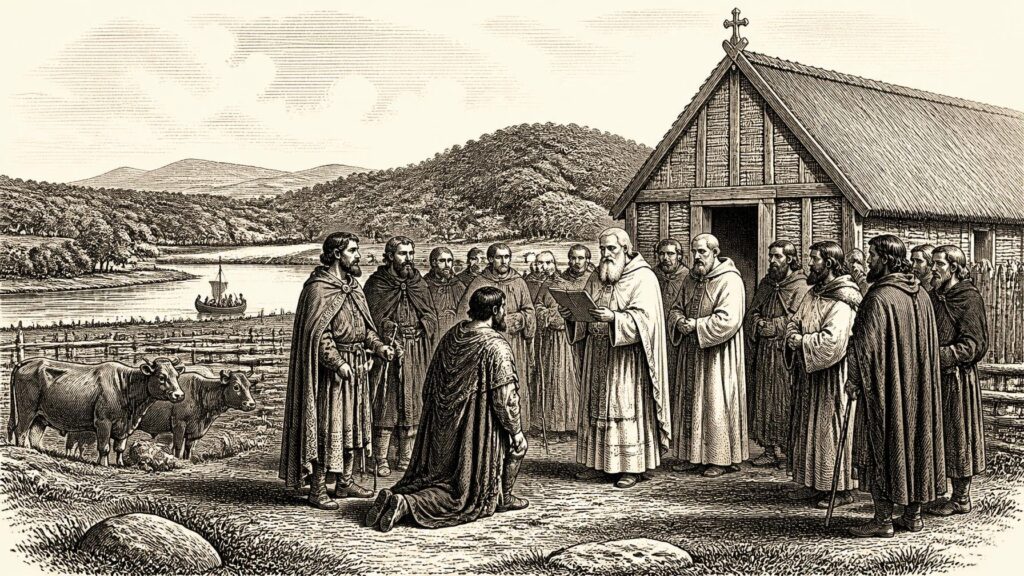
The most consequential Irish notice securely placed in 788 is not a battle or a royal accession, but a brief statement of authority: “Ciarán’s law in force in Connacht.” In an island divided among many kingdoms, dynasties and ecclesiastical federations, such a line signals a major public act. It points to the standing of the saint of Clonmacnoise, to the ability of Connacht’s rulers and clerics to cooperate, and to the practical value of religious protection in a society where cattle, tribute, land and people were vulnerable to seizure.
Dating the Year Carefully
Medieval Irish annals require particular care with dates. The entries discussed here stand under the annal numbered 788 in the Annals of Ulster, whose surviving chronological apparatus is displaced by a year in this period. Modern synchronisation places that annal’s events in the calendar year 788 CE. The source itself supplies one precise date: a red moon was seen on 18 February. For the other events, 788 is the responsible annual date, but neither month nor day is recorded.
The annal is concise and selective. It preserves deaths, an unusual heavenly phenomenon, the extension of a saint’s law and the burning of an important northern church settlement. It does not give the deliberations behind the law, identify those responsible for the fire, or describe how ordinary households responded. These silences matter. They prevent a full narrative, but the surviving notices nonetheless show an Ireland in which kingship, ecclesiastical power and local security were deeply entwined.
A Law Across Connacht
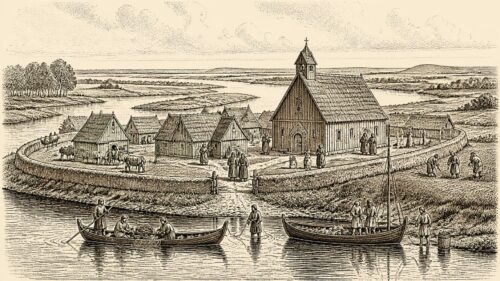
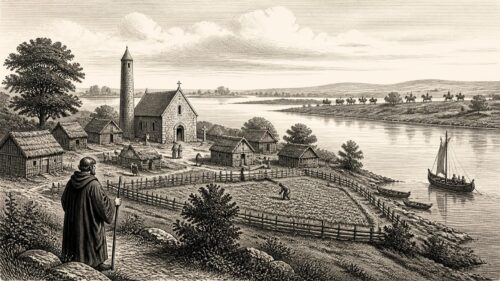
The phrase “Ciarán’s law” almost certainly refers to Ciarán of Clonmacnoise, the sixth-century founder whose community stood beside the Shannon at one of Ireland’s great crossing points. By the eighth century Clonmacnoise was much more than a secluded religious house. Its position on river and land routes gave it access to travellers, pilgrims, royal patrons, craftworkers and trade. Its saint’s reputation could therefore be invoked far beyond the immediate enclosure.
In early medieval Irish usage, a saint’s cáin, conventionally translated as “law”, was not simply a book of rules. It could combine religious sanction, legal privilege, protection for persons and property, and obligations that produced income through dues, fines or tribute. Its force depended on recognised guarantors: ecclesiastics who proclaimed the saint’s claims and rulers who accepted responsibility for enforcing them. The terse annal does not specify the provisions of Ciarán’s law in 788. It would be unsafe to say that it protected a particular class of people, imposed a known payment, or followed a particular assembly. Yet its application “in Connacht” plainly indicates a regional rather than purely local reach.
This was politically meaningful. Connacht was not a single centrally administered state, but a province containing rival dynasties and lesser lordships. A law acknowledged across it offered a framework in which an ecclesiastical community’s lands, dependants, livestock and travelling representatives could claim special protection. It also linked authority to the saint rather than solely to one transient ruler. For secular leaders, patronage of such a law could display piety, secure association with a prestigious church and create a shared language for settling obligations. For Clonmacnoise, it affirmed that its spiritual and material interests extended westward into Connacht.
The notice should not be mistaken for evidence that Connacht had become peaceful or politically unified. Religious law operated within, not outside, a competitive world of lordship. Its importance lay precisely in the attempt to regulate that world: to make attacks, breaches of sanctuary or failures of obligation subject to consequences endorsed by both sacred and secular authority.
Deaths and Regional Power
The annal also records the death of Máel Dúin, son of Áed Allán, described as king of In Fochla. The designation places him among the northern political landscape shaped by the powerful Uí Néill kindreds. His father, Áed Allán, had been king of Tara earlier in the century, so Máel Dúin’s death marked the passing of a man with an imposing dynastic inheritance, even though the annal gives no account of succession or conflict. In early Irish politics, the death of a king could open an immediate contest among eligible male kin; silence about the outcome does not mean that the transition was uneventful.
Another royal death was that of Guaire, son of Dúngalach, king of Uí Briúin Chualann. His people occupied a strategically important eastern Leinster territory, within reach of the routes connecting the Irish Sea coast, the Wicklow uplands and the plains around Dublin. The entry preserves his title but not the circumstances of his death. It is a useful reminder that power in 788 was dispersed. The king of Tara, Donnchad Midi of Clann Cholmáin, was the most prominent overking in Ireland, but his position did not erase the authority of provincial kings, local dynasts or church leaders.
Cernach, son of Cathal, also died in this year, though the annalist gives him no title. That lack of explanation is itself revealing. Annals were written for audiences who could often identify people and their significance without a modern historian’s supporting biography. In Cernach’s case, the surviving record does not permit a responsible reconstruction of his role.
Fire at Daire Calgaid
The year ends in the annal with “the burning of Daire Calgaid”, generally identified with the ecclesiastical settlement at Derry. The wording tells us only that a destructive fire occurred. It does not name attackers, say whether the fire was accidental, or list losses. Fire was one of the gravest hazards facing settlements whose churches, dwellings, workshops, stores and enclosures relied heavily on timber, thatch and other combustible materials. A blaze could destroy food reserves, books, liturgical equipment and housing as well as buildings.
Daire Calgaid was no insignificant rural church. Its very inclusion in a compact annal indicates a place with a reputation extending beyond its immediate district. But the entry must not be turned into a dramatic raid without evidence. It is best understood as a firmly dated disaster whose cause and human cost are unknown. For its community, recovery would have required labour, timber, livestock, food and patrons able to support rebuilding.
The Red Moon of February
On 18 February, according to the annalist’s Roman dating, the moon became red “like blood”. The description is vivid but not necessarily supernatural. A reddened moon is compatible with a lunar eclipse, and astronomical evidence is one reason why the chronology of this section of the Annals of Ulster can be checked with unusual confidence. The annalist recorded what observers saw; no contemporary Irish explanation accompanies the notice.
For people accustomed to reading the heavens within a Christian moral universe, an extraordinary sky could invite reflection or fear. Yet the source does not say that the phenomenon foretold the deaths, Ciarán’s law or the burning at Daire Calgaid. Modern interpretation should resist creating that connection. Its value is both human and chronological: a memorable sight seen in Ireland, and a rare fixed point for dating the year’s entries.
Churches as Communities
Several ecclesiastical deaths complete the picture. Échtgal, abbot of Muicert, died; so did Mac Óc, abbot of Saigir, and Colum, son of Faelgus, bishop of Lothra. Bishop Dub dá Tuath, who was also abbot of Ráith Áeda, “rested”. Their titles show the variety of senior religious office. An abbot could lead a substantial community whose influence was based on land, client relationships, teaching, worship and inherited saintly prestige. A bishop’s title did not necessarily correspond to the later diocesan structures familiar today, while one individual could hold both episcopal and abbatial status.
These notices are not merely clerical obituaries. Each death affected an institution embedded in local society. Churches required food, labour, tenants, craftsmen and secular protectors; they educated clergy, received guests, preserved texts and organised worship. Leadership changes could consequently affect property, alliances and the balance between rival ecclesiastical families. The annal does not name successors, but its repeated attention to abbots and bishops demonstrates how central religious communities were to the political and economic fabric of Ireland.
A Year of Authority and Vulnerability
Seen together, the entries for 788 reveal neither an island at peace nor a single national drama. They show overlapping jurisdictions. Connacht accepted the authority of Ciarán’s law; northern and eastern kings died; prominent church leaders passed away; Daire Calgaid burned; and a striking February moon was entered into the historical record. The surviving evidence is fragmentary, but it preserves a clear impression: in eighth-century Ireland, protection, prestige and political legitimacy were repeatedly negotiated through the institutions of kingship and the church.
Primary Sources
- The Annals of Ulster, Part 358
- The Annals of Ulster: Irish and Latin Text
- CELT Project: The Annals of Ulster
- The Annals of the Four Masters, Part 62
- CELT Project: Annals of the Four Masters
- Chronological Synchronisation of the Irish Annals: Introduction
- Chronological Synchronisation of the Irish Annals
- Irish Chronicles and Their Chronology
- Fiachnae
- Donnchad Midi
- Ciarán
- Clonmacnoise Monastic Site
- Clonmacnoise Visitor Guide
- Clonmacnoise Monastic Site Highlights
- Irish School of Illumination, c. 650–1100
- High Crosses
- Exploring the Irish Annals
- Annals of Tigernach
- CELT Project: Annals of Inisfallen
- Cáin Adomnáin and the Laws of War
- Cáin Adomnáin and the Laws of War: Full Text
- Early Irish Law
- Ciarán's Church and His Lands: A Study of the History and Development of Clonmacnoise
- Annals of Tigernach, National Library of Wales Archives and Manuscripts