Inis na Ríg Standoff783 CE
In 783, Irish annals recorded political rivalry, regional warfare, ecclesiastical change and royal deaths across a connected but divided island. Donnchad, southern Uí Néill ruler, and Fiachna of Ulaid met at Inis na Ríg, yet neither would enter the other’s sphere, exposing limits to high-kingship. Battles occurred among northern Uí Néill groups and at Carn Conaill in Connacht, while Áth Truim was burned. Church leaders died, including Flann of Inis Caín Dega, killed by poison; Dúnchad of Uí Maine adopted religious observance. Relics reached Tailtiu, demonstrating ecclesiastical authority and mobility. The notices reveal shifting local power rather than unified rule.
Dateline
The Irish annals place an unusual concentration of events in 783: a royal meeting that exposed the limits of high-kingship, fighting in the north and west, the burning of an important settlement, a killing by poison, a ruler’s religious retirement, the deaths of kings and churchmen, and the arrival of relics at Tailtiu. None is given a day or season. Yet together they offer an unusually sharp view of Ireland as a landscape of many competing powers, linked by roads, rivers, sea-routes and ecclesiastical networks.
The dating requires one caution. The principal near-contemporary annalistic tradition assigns these notices to the year labelled 784 in the Annals of Ulster, but explicitly equates that annal-year with AD 783. Later compilations preserve several of the same events under differing year-numbers. The events discussed here are therefore securely connected with the calendar year 783 in the modernised chronology, while the precise order in which they unfolded cannot be recovered.
A Meeting Neither King Would Enter
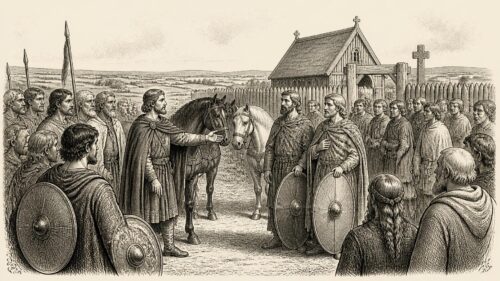
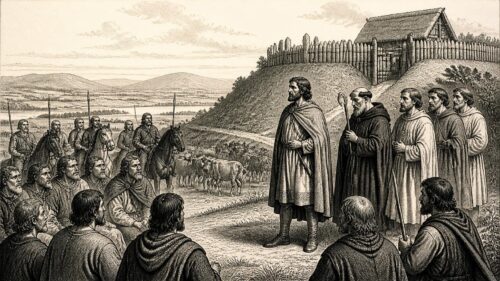
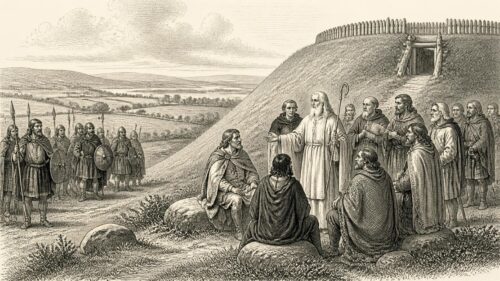
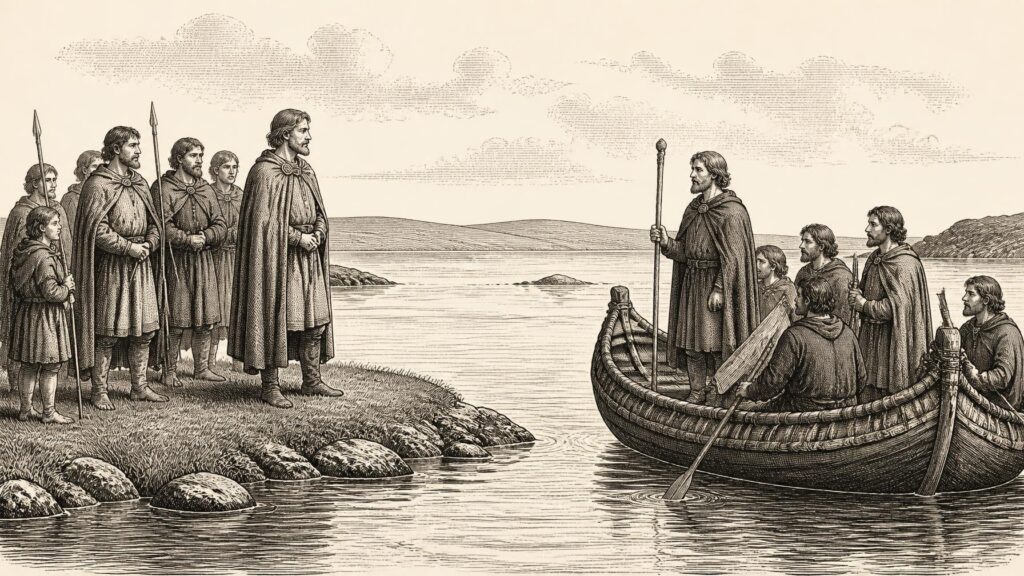
The year’s most memorable episode was a rígdál, or royal meeting, between Donnchad son of Domnall and Fiachna son of Áed Róin at Inis na Ríg, ‘the island of the kings’, in eastern Brega. Donnchad was the dominant ruler of the southern Uí Néill and is conventionally counted among the high kings of Ireland. Fiachna was the leading king of Ulaid, whose Dál Fiatach dynasty was then a formidable force in the north-east. Their encounter took place not in either man’s royal centre but at an island location off the Brega coast, probably selected to make a meeting possible without conceding precedence to the other.
The annalist’s brief prose notice is followed by a small, pointed verse: Donnchad would not go out on the sea, and Fiachna would not come ashore. The verse should not be treated as a transcript of a failed conversation. It does, however, preserve the political logic of the occasion. In a society where submission could be demonstrated by entering another ruler’s territory, the choice of ground mattered. If Fiachna landed, he might appear to acknowledge Donnchad’s superiority; if Donnchad boarded a vessel, he might do the same. The island meeting thus became an impasse enacted in public.
We do not know what settlement or alliance was proposed. Nor can the encounter safely be called a peace conference: the sources neither report war between the two men that year nor record agreed terms. Its importance lies in what it reveals. The claims attached to the high kingship did not make Donnchad an unquestioned sovereign over the island. Authority was exercised through relationships with provincial kings, kin-groups and churches, and even the staging of diplomacy could expose a balance of power rather than settle it.
War at the Edges of Power
While the two major rulers tested one another in Brega, conflicts occurred in several regions. Donnchad son of Áed Muinderg won a battle over the Cenél Bogaine, a branch of the northern Uí Néill associated with the Donegal region. The record gives neither the battlefield nor the number of dead, but the victory belongs to a continuing contest for precedence among northern kindreds. It should not be inflated into a war for all Ireland. Its immediate meaning was local and dynastic: a leader from the Cenél Conaill had imposed himself upon a rival branch of the wider northern political world.
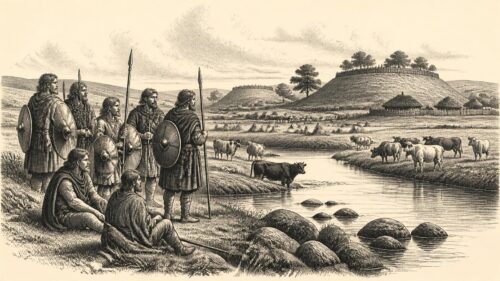
In Connacht, Tipraite defeated the Uí Fhiachrach at Carn Conaill in Aidne, in the south of the province. The annals name the victor and the defeated, but offer no narrative of causes, casualties or consequences. Carn Conaill nevertheless carried political weight as an established meeting and battle landscape. The earlier, celebrated battle fought there in the seventh century had lodged the place deeply in historical memory. In 783 its name again marked an armed contest over lordship in Aidne and Connacht. The coincidence of a known place-name and a terse annal-entry should not persuade us that this was a replay of the older conflict; it was a separate encounter, recorded with frustrating economy.
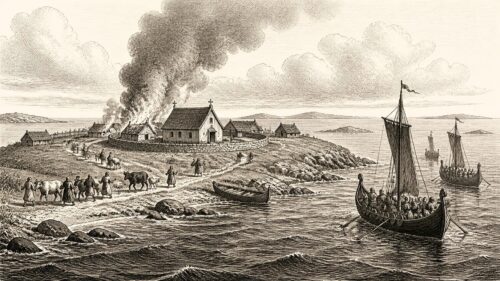
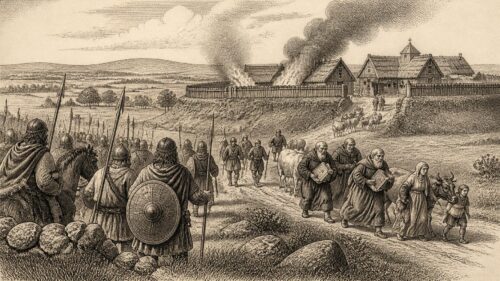
The burning of Áth Truim, generally identified with Trim in modern County Meath, is still more opaque. The annal gives no attacker, no stated motive and no list of losses. Even so, a burning at a ford-settlement in fertile central Ireland was unlikely to be trivial. Áth Truim was an ecclesiastical centre as well as a place of crossing and local power. Fire could destroy dwellings, stores, workshops and wooden church buildings as well as inflict immediate human loss. The silence over responsibility is a reminder that annals preserve selected outcomes, not complete reports. We can establish that Áth Truim was burned in 783; we cannot responsibly supply a raid, a feud or an identified aggressor.
Churches, Learning and Vulnerability
The year’s notices show churches as institutions embedded in political society, rather than remote refuges from it. Rechtnia, abbot of Clonmacnoise, died. Clonmacnoise stood beside the Shannon and major overland routes, and was already a religious, economic and intellectual centre with an extensive lay as well as clerical population. Its abbot’s death mattered to a community whose estates, hospitality, scholarship and patronage connected it to rulers across the midlands. The annal does not identify Rechtnia’s successor or describe a contested election, so none should be assumed; it records a change in leadership, not a crisis.
Other deaths reveal the geographical reach of ecclesiastical administration. Ciarán, associated with Ráith Maige Aenaig and Tech Mo-Fhinnu, died; Conall, abbot of Lusca in Brega, died; and Cernach son of Suibne, steward of Armagh, also died. A steward was responsible for the practical management of a major church’s resources and household. These concise obituaries point to communities sustained by land, labour, food-renders, learned personnel and relations with local dynasties. Such institutions produced manuscripts and trained clerics, but their daily life also depended upon agriculture, livestock, craftwork, transport and the disciplined organisation of people.
The death of Flann, described as both a learned bishop and abbot of Inis Caín Dega, was violent: he was killed by poison. This is one of the rare moments when the annals specify a method of murder, but they name neither the killer nor the motive. It would be unwarranted to turn the notice into a story of doctrinal dispute or factional intrigue. What can be said is that learning and ecclesiastical rank offered no immunity from the rivalries of the secular world. The wording also values Flann’s learning explicitly, a small indication of the prestige attached to scholarship within the Irish church.
Another ruler moved in the opposite direction, from secular office towards a religious life. Dúnchad son of Dub dá Tuath, king of Uí Maine in the Connacht–midlands borderland, ‘took the pilgrim’s staff’. In annalistic language this normally marks the assumption of penitential religious observance, often involving pilgrimage or withdrawal from kingship. The entry does not tell us where he went, whether he travelled abroad, or who succeeded him. It does show that late eighth-century kingship and religious renunciation were not sealed-off alternatives. A king could seek status, salvation or security through a formal change of life, and the annalist considered that transformation important enough to record.
Relics at Tailtiu
Religious movement also took a public form when the relics of ‘Erc’s son’ came to the civitas, or principal settlement, of Tailtiu. The source does not identify the saint more fully, describe the reliquary, name those who carried it, or explain the occasion. That restraint matters. It is tempting to attach the entry to a named fair, a royal campaign or a particular church, but none of those details appears in the 783 notice.
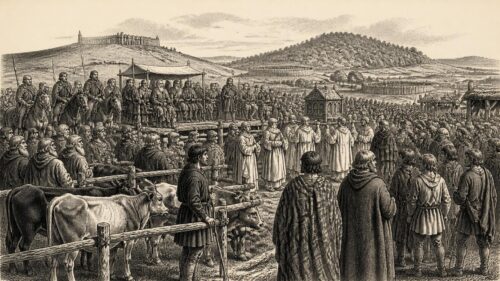
Its setting is nonetheless significant. Tailtiu, in the heart of Brega, was an exceptionally important assembly-place in the political imagination of early medieval Ireland. Bringing relics there made sacred objects mobile participants in a public landscape also associated with royal authority and large gatherings. Relics were not merely devotional possessions: they embodied the standing of the church that guarded them, attracted protection and offerings, and could strengthen relationships between ecclesiastical communities and secular patrons. The entry records an arrival, not the response of a crowd, but it demonstrates how religion travelled along the same routes and through the same contested territories as kings and warbands.
Deaths Across Ireland
The annal’s long death-list gives 783 a striking sense of turnover. Máel Dúin son of Aengus, king of Cenél Laegaire in Meath, died, as did Áedgal, king of Umall in the west, Coisenmech of Uí Echach Ulad in the north-east, and Cú Gamna of Cenél Cairpri. Innrechtach son of Dúnchad and Máel Caech son of Cuscraid Menn are listed without offices that modern readers can securely reconstruct. Their inclusion nonetheless suggests that rank was recognised across a wide hierarchy of regional lordship.
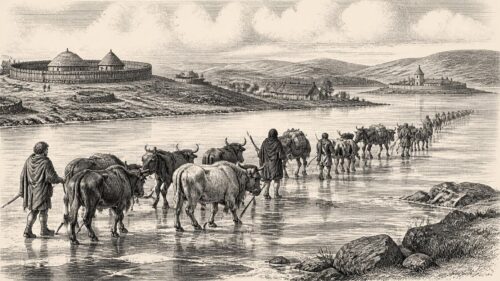
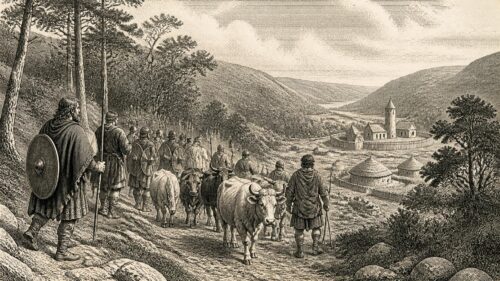
For ordinary people, these changes were not distant court news. A new ruler or abbot could alter demands for food-renders, military service, hospitality, legal support and protection. Families worked chiefly in dispersed rural settlements, raising cattle and sheep, growing crops, managing woodland and making the goods required for homes, churches and warfare. Most of that ordinary labour went unrecorded. It appears indirectly in the institutions capable of sustaining abbots, royal households and travelling relics, and in the damage implied by the burning of Áth Truim.
Thus 783 was not a year defined by one island-wide battle or a single national decision. It was a year in which political rank had to be continually displayed, defended and negotiated: on an island off Brega, at Carn Conaill in Aidne, among northern Uí Néill kindreds, in a burned midland settlement, and through the authority of churches and their relics. The annals leave much unknown, but their surviving notices make one point plain. Ireland’s many regions were connected, yet no ruler or institution could take that connection for granted.
Primary Sources
- The Annals of Ulster, Year U784 (AD 783)
- The Annals of Ulster
- Annals of the Four Masters, Annal M779
- Annals of the Four Masters, Volume 1: English Translation
- Annals of Inisfallen
- The Annals of Tigernach
- Chronicon Scotorum
- Exploring the Irish Annals
- Irish Historical Studies: The Annals Attributed to Tigernach
- The Battle of Carnn Chonaill
- Genealogies from Rawlinson B 502
- Medieval Trim: History and Archaeology
- Clonmacnoise Visitor Guide
- Clonmacnoise Monastic Site
- How Did Early Church Sites Differ from One Another? A Comparative Approach within the Kingdom of Fir Maige, Ireland
- Theme and Variations: Christianity and Regional Landscapes in Early Medieval Ireland
- Water-Power as a Factor of Industrial Location in Early Medieval Ireland: The Environment of the Early Irish Water Mill
- Animals and the Economy of Medieval Ireland: A Zooarchaeological Analysis of the Faunal Remains from Caherconnell Cashel, Co. Clare
- Irish School of Illumination, c. 650–1100
- The Medieval World, University College Cork
- Built to Last: The Role of the Church in Irish Dynastic Politics, 600–1100
- The Annals of Inisfallen, edited by Seán Mac Airt: Review
- Digital Atlas of Cork/Corcaigh: General Abbreviations