Ráith Ailinne’s Seven Days770 CE
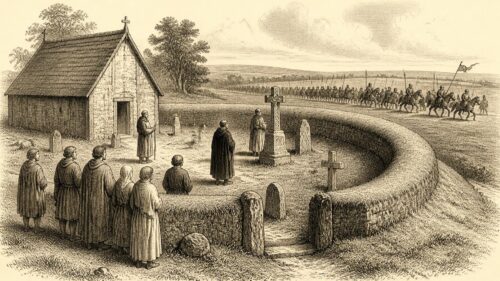
In 770, Donnchad Midi led a Uí Néill army into Leinster, where King Cellach mac Dúnchada avoided a decisive battle. Donnchad occupied Ráith Ailinne for seven days and burned Leinster’s borders, demonstrating coercive power rather than conquering the province. Leinster was already divided: Cellach had defeated rival groups at Áth Orc. Subsequent fighting brought a Leinster victory over southern Brega at Bolg Bóinne, while the Ciannachta defeated Uí Téig at Áth Cliath, with heavy losses and drownings. Annals also record ecclesiastical deaths and Feidlimid of Cashel’s possible birth, illustrating fragmented authority, warfare’s rural disruption, and limited surviving evidence in Ireland.
Dateline
For Ireland in 770, the fullest story is not of a single decisive battle but of pressure, evasion and retaliatory violence across Leinster. The principal evidence is terse and must be handled carefully. The Annals of Ulster, whose annal headed U770 carries an inconsistent AD 769 annotation, records a sequence conventionally treated by modern historians as belonging to 770; the Annals of Inisfallen independently place Donnchad’s harrying of Leinster and the battle of Bolg Bóinne under 770. Neither source provides a day, month or season. They preserve outcomes and names, not a campaign diary. Yet their notices allow an unusually vivid glimpse of how overkingship was attempted and resisted in eighth-century Ireland.
Donnchad’s Leinster Expedition
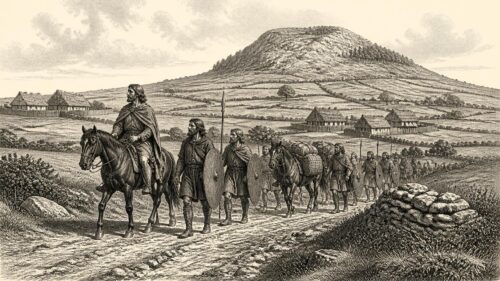
Donnchad mac Domnaill, usually known as Donnchad Midi, was the leading figure of Clann Cholmáin in Mide and a rising power among the southern Uí Néill. His political position in 770 requires precision. Later king-lists and modern reconstructions connect him with the kingship of Tara, but the evidence does not permit a simple picture of an uncontested “high king” commanding a unified Ireland. The immediate fact is clearer: Donnchad led an army identified as that of the Uí Néill into Leinster, whose overking was Cellach mac Dúnchada of the Uí Dúnlainge.
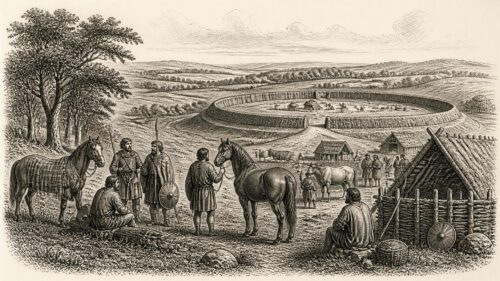
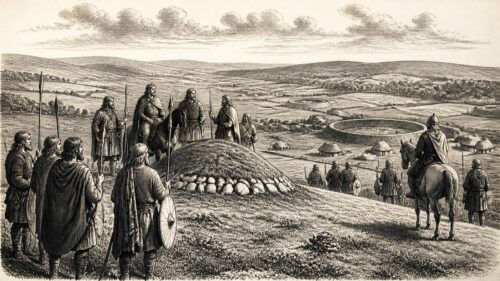
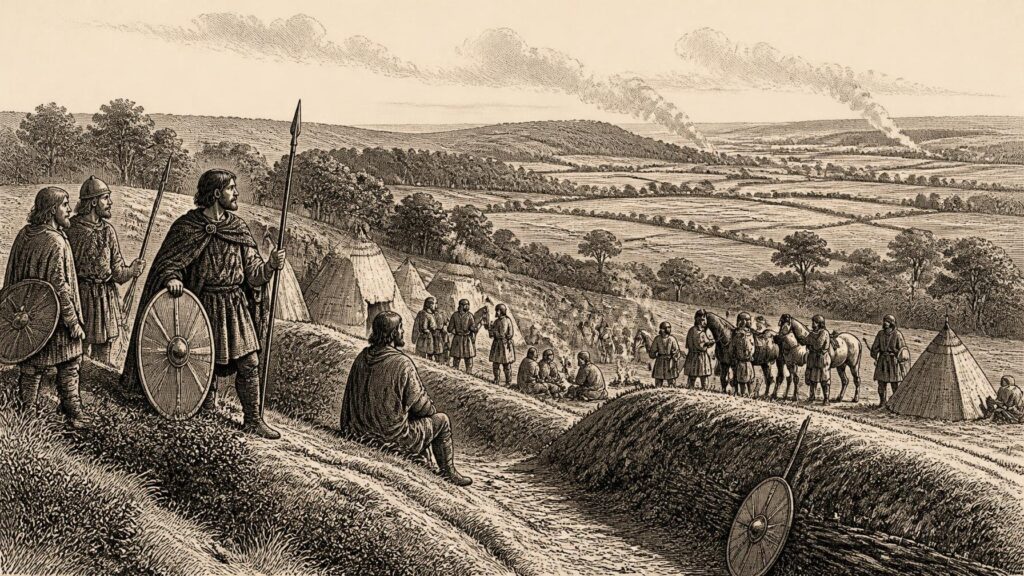
The Annals of Ulster calls the initial episode an “encounter” between Donnchad and Cellach. It does not describe a pitched battle between their armies. Instead, it says that the Leinster men eluded Donnchad and went to Scé Nechtain, a place whose location is not securely established. Donnchad’s force then remained for seven days at Ráith Ailinne, the royal hill at Knockaulin in present-day County Kildare, and burned the confines of Leinster. The wording matters. This was not a conquest marked by the seizure of a capital or the killing of a rival king. It was coercion by armed occupation, destruction and the public display of a superior military following.
Ráith Ailinne gave that display particular force. Long before the eighth century, Knockaulin had been a major ceremonial complex, with striking prehistoric earthworks and timber constructions. By Donnchad’s day its older associations with Leinster kingship evidently still carried political weight. Camping there placed an invading Uí Néill army at a landscape deeply connected with Leinster’s own authority. The annal does not say that Donnchad held an inauguration, assembly or ritual there, and none should be imagined. What it does establish is that the site was sufficiently important for the annalist to name it when recording the week-long devastation.
Cellach’s Divided Leinster
Leinster was not a single obedient bloc behind Cellach. Earlier in the same annal, Cellach won a battle at Áth Orc against other Leinster interests. Cinaed son of Flann, identified as king of Uí Fhailge, fell there with his brother Cellach, Cathnia son of Béc, and many others. Uí Fhailge occupied territory in the central midlands, while Cathnia was associated with the Fothairt. The casualty list shows that authority within the province was contested before Donnchad’s expedition made the wider crisis worse. Cellach was therefore both Leinster’s overking and an active participant in conflicts among its constituent peoples.
The episode at Áth Orc helps explain why the Uí Néill intervention could be so damaging. An overking depended on the armed service and loyalties of subordinate dynasties, but the annals reveal those dynasties fighting one another. Nor does Cellach’s avoidance of Donnchad’s host prove weakness or cowardice. In a landscape of dispersed settlements, woods, rivers and local fortifications, refusing a set-piece battle could preserve men and limit an invader’s opportunity for a spectacular victory. Donnchad could burn borderlands and demonstrate force; he could not compel the Leinster king into the kind of battle the record might have celebrated.
Bolg Bóinne and Áth Cliath
The violence did not end at Ráith Ailinne. At Bolg Bóinne, the men of southern Brega suffered an overthrow. The Annals of Ulster names four of their dead: Flaithbertach son of Flann son of Ragallach, Uarchride son of Báeth, Snédgus son of Ainfthech, and Cernach son of Flann Foirbthe. The Annals of Inisfallen presents the same result from a broader political angle, calling it a Leinster victory over the Uí Néill. The two notices are compatible: southern Brega was a southern Uí Néill power, and Leinster had inflicted a serious local reverse upon it.
Another encounter, at a place called Áth Cliath, was more ambiguous. There the Ciannachta defeated Uí Téig, and the annalist notes a great slaughter among the Laigin. But victory carried its own cost: a number of the Ciannachta drowned in a full tide while returning. This compact notice is a reminder that warfare involved movement as much as combat. Forces had to cross tidal waters and fords, keep together after fighting, and bring themselves home through dangerous terrain. It also demonstrates that “the Uí Néill” and “the Laigin” were useful political categories, but inadequate descriptions of every alliance. Bregan groups, Ciannachta, Uí Téig and several Leinster lineages pursued interests that did not always coincide with those of the leading kings.
Viewed together, the events of 770 produced no simple winner. Donnchad’s week at Ráith Ailinne exposed Leinster to organised destruction and proclaimed Uí Néill claims to superiority. Cellach survived, however, and Leinster forces or allies defeated southern Brega at Bolg Bóinne. Meanwhile, a separate victory by the Ciannachta brought heavy Leinster losses at Áth Cliath. The year illustrates a political order in which authority was negotiated through hostings, tribute demands, alliances and reprisals rather than exercised through permanent central administration.
What Burning Meant
For people living in the affected districts, “burning the confines” was not an abstract constitutional statement. It could threaten houses, stored food, fences, crops, livestock enclosures and the productive margins on which local communities depended. The sources do not specify what was destroyed, how many people were displaced, or whether famine followed; those details must not be supplied by imagination. Even so, an army remaining for seven days was a substantial burden on a rural province. It needed food, animals, guides and secure routes. Its ability to burn widely suggests both organised manpower and the vulnerability of scattered agricultural communities to a mobile royal host.
There is no securely dated evidence for a new settlement, market, church foundation, weather crisis or overseas raid in Ireland in this calendar year. That silence is instructive. The annals preferentially record kings, clerics, battles and exceptional deaths, not the routine work of farming households, craftspeople or traders. Their attention to political violence should not be mistaken for a complete account of life. Most people in 770 were living through seasonal agricultural work and local obligations that went unrecorded, though the campaign may have disrupted them sharply in Leinster.
Churches, Learning and a Recorded Birth
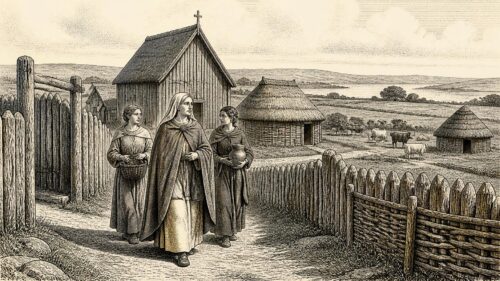
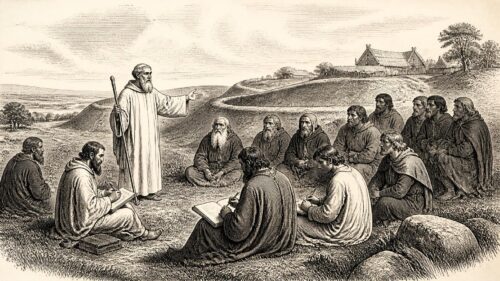
Ecclesiastical institutions appear in the year’s record through deaths rather than through a major religious event. The Annals of Ulster notes Artgal, abbot of Clochar Mac nDaiméni; Folachtach, abbot of Cluain Moccu Nóis; Bishop Crunnmael of Cell Mór Enir; Connmach, abbot of Cluain Dochra; and an abbot of Fobar. Such entries show the geographical reach of churches and monasteries as recognised centres of authority, learning and commemoration. They do not reveal the circumstances of each death, nor do they prove that a particular book, school or building was created in 770. Their importance lies in the institutional network implied by the annalist’s expectation that these men and communities were worth naming.
The Annals of Inisfallen also records the birth of Feidlimid son of Crimthann, the future king of Cashel. This is a retrospective notice, entered in an annal compiled long after the event, and modern scholarship rightly treats 770 as a possible rather than certain birth year. No day or place is given. Still, its presence shows how later historical memory connected a major Munster ruler to this troubled Leinster year. In 770 itself, Feidlimid was only a child—or perhaps not yet born, if the entry is early. The securely visible story remains the struggle between Donnchad, Cellach and the many regional forces caught between them.
Primary Sources
- The Annals of Ulster
- The Annals of Ulster, Year U770
- CELT project: The Annals of Ulster
- Annals of Inisfallen
- Annals of Inisfallen, Part 33
- The Annals of Tigernach
- CELT project: Annals of Tigernach
- Annals of the Four Masters, Part 60
- Donnchad Midi
- Cellach
- Fedelmid (Feidlimid)
- Dún Ailinne: Excavations at an Irish Royal Site, 1968–1975
- 1970:049 – Dún Áilinne (Knockaulin td.), Kildare
- 2016:527 – Dún Áilinne, Kildare
- Landscapes of Kingship in Early Medieval Ireland, AD 400–1150
- Built to Last: The Archaeology of the Early Medieval Church in Ireland
- Chronicon Scotorum: Bibliography
- Manuscripts with Irish Associations
- About the Project | Irish Manuscripts on the Continent
- About the Project | Insular Manuscripts
- Early Irish Manuscripts Project
- Protection and Designation of Monuments