

Civic Confidence
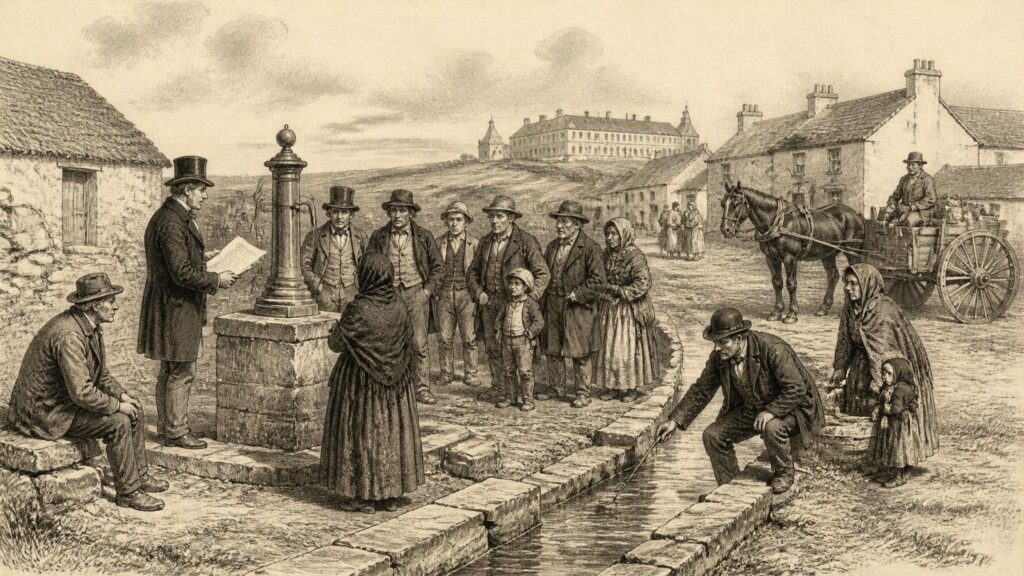
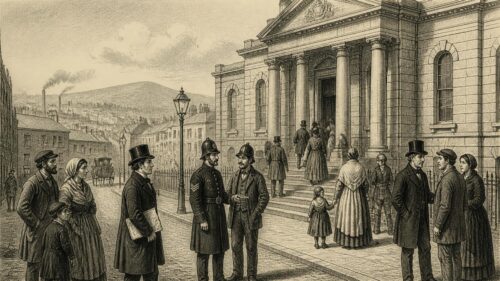
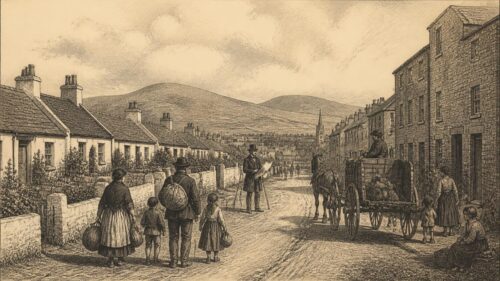
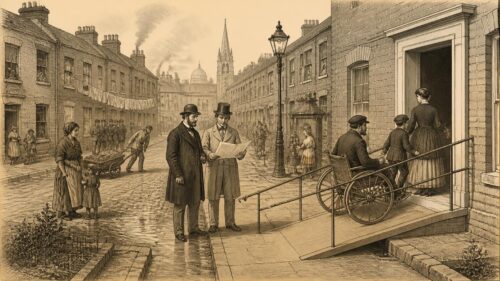
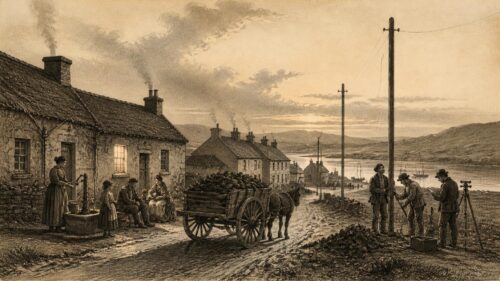
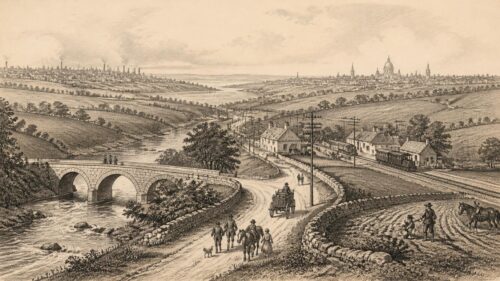
AI generated historical illustration, not a contemporary photograph.
At a Glance
Public services in Ireland have never been only mechanisms for delivering relief, light, water, health care or official decisions. They have been among the most intimate forms of government: the workhouse gate, the dispensary doctor, the sanitary inspector, the rate collector, the electricity line crossing a field, and the household bill. Each encounter invited a judgement. Was authority competent, fair, humane and answerable? Could it be approached without shame? Would it listen locally, or merely impose decisions made elsewhere? The historical record does not supply a single Irish answer to those questions. It does, however, show that confidence in public provision was made and unmade in practical circumstances. Services gained legitimacy when they were dependable, intelligible and visibly shared; they lost it when relief came with coercion, when rules concealed unequal power, or when citizens were asked to bear burdens without convincing participation.
Public Encounters
“Public services” is a modern umbrella term, but the underlying historical experience is much older. In Ireland, people met public authority through systems of poor relief, policing, roads, education, health, registration, sanitation, housing, utilities and taxation. These systems did not arrive together, nor did they operate under one political order. Nineteenth-century institutions developed within the United Kingdom of Great Britain and Ireland, often under strong central supervision. After 1922, the Irish Free State inherited parts of that machinery while seeking to establish its own legitimacy. The later Republic expanded some services, altered others, and relied increasingly on departments, local authorities and semi-state bodies.
Trust is therefore best treated as a historical problem rather than a measurable sentiment transported backwards from the present. Few nineteenth-century Irish people were surveyed about confidence in institutions. Yet their conduct, petitions, electoral choices, attendance at meetings, resistance, correspondence and use of services provide evidence of how authority was understood. Official records also reveal what administrators thought required supervision, persuasion or reform. A complaint about a polluted water supply, a dispute over a poor rate, or a neighbourhood campaign for electrical connection was not automatically a declaration of distrust. It was, however, evidence that the terms on which a service claimed legitimacy were being tested.
There is an important distinction between use and confidence. A family could depend upon a dispensary because no other medical help was affordable, while resenting its rules or fearing the social consequences of applying. A rural household might welcome electricity while objecting to the cost of connection. A person might seek relief from a public body because of urgent need, not because that body was regarded warmly. Historical interpretation must resist the temptation to read every expansion of provision as popular approval, or every protest as rejection of the service itself.
The surviving record is uneven. Administrative papers are often fuller than the voices of people who received services, particularly the poor, women, children, migrants and institutionalised people. The destruction of the Public Record Office in the Four Courts in June 1922 inflicted a profound loss on the archival inheritance. Nevertheless, local minute books, poor law records, hospital material, legislation, parliamentary debates, newspapers, oral testimony and institutional inquiries permit a substantial reconstruction. They show not a simple movement from neglect to trust, but repeated bargains between citizens and institutions.
Colonial Framework
By the early nineteenth century, Irish public provision was already a mixture of local initiative, charitable activity and state-directed administration. County infirmaries, fever hospitals and dispensaries supplied important forms of medical assistance. Their reach varied sharply by place and resources. Charitable institutions could be valued for immediate help, but they could also be dependent on donors, denominational interests and local influence. The line between public obligation and private philanthropy was not always clear, and that ambiguity mattered. A service presented as charity could imply gratitude and deference rather than a right that could be claimed.
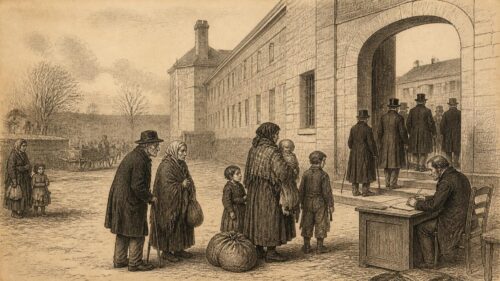
The Poor Law changed the scale and character of official welfare. The Irish Poor Law Act of 1838 initially divided the country into 130 unions, each centred upon a workhouse and governed by a board of guardians. It was designed to address destitution through institutional relief, with central oversight from the Poor Law Commissioners. The architecture of the system carried a moral argument. Relief was deliberately made austere, intended to distinguish the supposedly deserving needy from those whom administrators believed should be deterred from dependence. This was not a neutral service design. It made assistance conditional upon submission to an institution widely experienced as humiliating.
Trust could scarcely flourish where relief required the breakup of ordinary domestic life. Workhouse rules separated men, women and children into wards. For people facing hunger, homelessness, sickness or old age, admission could be indispensable. Yet necessity and dignity existed in tension. The National Archives material on poor law records documents an administrative system that expanded well beyond basic relief; it also preserves evidence of the people caught within it through minutes, registers and correspondence. Such documents should not be read as transparent accounts of individual feeling, but they make clear that official aid was administered through classification, inspection and control.
It is tempting to describe the workhouse simply as an object of universal hatred. That formulation captures something real, especially during and after the Great Famine, but it is too blunt for every locality and every individual. The evidence supports a stronger, more precise conclusion: the system acquired enduring associations with stigma and coercion because its practices made destitution publicly legible and institutionally regulated. Its reputation shaped later Irish social policy. When new schemes were proposed, policymakers had to contend with the memory that public aid could expose, separate and discipline those it purported to assist.
Famine Burdens
The Great Famine placed the Poor Law under pressures for which it had not been designed. The National Archives notes that the original Irish system had been intended for roughly one per cent of the population, while by March 1851 nearly four per cent of the population had been driven into workhouses. Those figures indicate institutional overload, but they do not begin to encompass the mortality, displacement and social disintegration associated with the catastrophe. Workhouses became places where public administration confronted hunger on a vast scale and, frequently, failed to provide humane security.
The Famine cannot be reduced to a story of one service system. Relief involved workhouses, outdoor assistance, public works, charitable organisations, landlords, local officials and central government. Responsibilities were divided, disputed and repeatedly altered. That fragmentation made it harder for people to know who was accountable for what occurred. A service can lose credibility not only through inadequate resources, but through opacity: an affected community may see rules and officials everywhere while finding no institution that accepts responsibility for the result.
Historical evidence also shows that the local experience of relief varied. Boards of guardians were not abstract agencies; they consisted of people who made decisions in specific unions and communities. Their scope was limited by legislation, finance and central direction, but local conflict, priorities and personalities mattered. This is a recurring Irish pattern. Citizens often judged public institutions through the conduct of identifiable local officers, councillors, doctors, clerks and inspectors. Trust was interpersonal as well as constitutional, and a remote state could be represented by a familiar face at a gate or desk.
Folklore and family memory have kept the workhouse vivid in Irish culture. Such memories are historically significant as evidence of later remembrance, but they cannot all be used as proof of particular nineteenth-century events without corroboration. The documented record is already sufficient to explain why the workhouse became a powerful symbol. It was a public institution at the point where poverty, authority and shame met. Its legacy helps explain later political sensitivity about universalism, local access, means testing and the language used to describe those who need support.
Sanitary Authority
During the later nineteenth century, public service increasingly entered the spaces of water, waste, disease prevention and housing. This was an important transition. The poor law unions were gradually given responsibilities beyond relief, including health and sanitary functions. The Public Health (Ireland) Act 1878 established rural sanitary districts from the areas of poor law unions outside urban sanitary districts, while the Public Health (Ireland) Act 1896 provided a route for complaints when authorities failed in duties concerning sewers, water supply or enforcement. These statutes demonstrate that public health was becoming an enforceable administrative responsibility, not merely an aspiration.
Sanitary work demanded a particular form of trust because it required intrusion. Inspectors could examine dwellings, identify nuisances, press for drainage or water works, and report conditions that householders might prefer to keep private. At the same time, communities had strong reasons to demand effective action. Cholera and other infectious diseases did not respect property boundaries, while contaminated water and inadequate drainage made public neglect physically dangerous. Trust in sanitary authority could therefore involve accepting regulation as a shared protection, provided that the rules were applied consistently and that authorities themselves fulfilled their obligations.
The historical record makes clear that effectiveness was uneven. The legislation gave powers, but powers required money, expertise and political will. Rural districts frequently had dispersed populations and limited rate bases. Improvement could seem urgent to residents yet expensive to those liable for local taxation. The dispute was not simply between modernity and backwardness. It concerned distribution: who would pay, where investment would go first, and whether one district’s welfare would be financed at another’s expense. Public confidence depended upon whether those choices seemed equitable as well as technically defensible.
Sanitary officers were consequential figures in this world. Their reports, preserved in local authority archives, can reveal both the practical work of disease prevention and the official gaze directed towards poor households. They are valuable evidence, but they are not neutral. An inspector’s description of overcrowding or disorder may record real hazards while also reflecting class assumptions. For historians, the task is to hold both truths together: sanitary administration could improve collective health, and its language could stigmatise the people living amid conditions that public policy had often failed to remedy.
Democratic Transfer
The Local Government (Ireland) Act 1898 marked a major reorganisation of local governance. It created elected county and district councils and transferred the business of rural sanitary authorities to rural district councils. The Act also connected public-health powers to more representative local institutions. This did not make local government fully autonomous. Central regulation and financial constraints remained potent. It did, however, enlarge the political space in which ratepayers and electors could contest decisions about roads, sanitation, hospitals and local expenditure.
Representation could strengthen confidence because it made officeholders visible and removable. It could also expose services to faction, patronage and sectarian or class division. There is no historical basis for assuming that elected local government was automatically either purer or more corrupt than appointed administration. Rather, democratic structures changed the grounds on which legitimacy was argued. Residents could claim that a council had failed them not merely as subjects of administration but as members of a political community entitled to influence it.
That change was especially significant because local government had become a service state in miniature. Poor law unions and their successor bodies dealt with dispensaries, public health, burial grounds, water, sewerage, housing and poor relief. The routine character of this work should not obscure its political importance. A repaired road or a functioning pump could make government tangible. Conversely, rate demands, delayed works or uneven enforcement could turn distant constitutional questions into local grievance. Public service history is often written through national legislation, but its authority was felt in towns, villages and rural districts.
The evidence does not permit a simple calculation of how much the 1898 settlement increased popular trust. What can be said is that it created new institutional expectations. Once councils existed, citizens could expect meetings, accounts, representation and decisions that could be challenged in public. Accountability was imperfect, but it became more concrete. This is one reason why records of local government are so valuable: minutes and reports preserve not only administrative outcomes but traces of argument over what a public body owed to those who funded and depended upon it.
State Foundations
Independence did not begin with an empty administrative landscape. The Irish Free State inherited personnel, laws, buildings, local bodies and social problems from the preceding order. Its governments faced an immediate difficulty of legitimacy: they had to demonstrate that a new state could provide ordinary administration as well as national sovereignty. The Ministers and Secretaries Act 1924 supplied the legal framework for government departments. The Department of Local Government and Public Health became central to the management of services that touched daily life.
In the 1920s, much of the old poor law structure in southern Ireland was dismantled outside Dublin. Workhouses were closed, repurposed or, in some cases, destroyed amid revolutionary and civil conflict. The replacement of outdoor relief by home assistance was intended partly to reduce the stigma associated with the older system. Yet institutional language does not itself erase institutional memory. The National Archives survey of hospital archives observes that home assistance retained associations with the Poor Law and that officers continued to determine whether applicants were genuinely in need. The practical question remained: was assistance a right of citizenship, or a discretionary judgement about moral and economic deservingness?
This distinction mattered profoundly for trust. A universal service can still be criticised for poor quality, but a discretionary and means-tested service also asks people to expose their circumstances to official scrutiny. It can produce fear of refusal, embarrassment and a sense that the applicant, rather than the social condition, is on trial. Such feelings cannot be assumed in every individual case. They are, however, consistent with the institutional design and with the durable Irish political language surrounding the Poor Law legacy.
The early independent state also confronted the limits of its own resources. A historical account should avoid measuring the 1920s solely against later expectations of welfare provision. Governments operated after war, partition and fiscal constraint, in a country with extensive poverty and emigration. Yet scarcity does not remove questions of trust; it intensifies them. When a state cannot meet every need, confidence depends heavily on candour about limits, consistency in allocation and the ability of ordinary people to understand how decisions are reached.
Electric Modernity
Not all public services carried the inherited moral burden of poor relief. Electricity offered a different, though not uncomplicated, image of public provision. The Electricity Supply Board, established in the early years of the State, represented technical capacity, national planning and the promise of modern life. Its Rural Electrification Scheme, launched in 1946, was one of the most consequential extensions of public infrastructure in twentieth-century Ireland. ESB Archives records that the first phase ran from 1946 to 1965 and organised the twenty-six counties into 792 rural areas.
Electricity could make state capacity visible in a direct and affirmative manner. Poles, wires, switches and lit homes were material signs that a national institution had reached places previously excluded from urban amenities. The scheme did not simply deliver a commodity. It altered domestic labour, farm work, communications and expectations of comfort. Oral-history projects concerning women’s experiences of rural electrification show why its effects should not be described only in engineering terms. For many households, electrical appliances changed the time and physical effort required for domestic work, although they did not automatically redistribute that work between women and men.
Yet the Rural Scheme was not a gift without negotiation. ESB’s records describe demonstrations, exhibitions and local campaigns designed to persuade households to sign up. Charges, costs and anticipated demand mattered. Some areas were more attractive economically than others, and the extension of supply into remote places raised persistent questions of subsidy. The public service was trusted not merely because it was state-owned, but because local participation, practical demonstration and eventual connection linked national planning to visible benefit. Where cost seemed excessive or the prospect of connection uncertain, confidence could be conditional.
This case suggests a useful historical interpretation. Trust grew where citizens could see a relationship between contribution, participation and benefit. Rural electrification did not abolish inequalities between town and country, nor did it resolve every dispute about public spending. But it offered a powerful contrast to the punitive reputation of the workhouse. Here, public authority appeared not primarily as an examiner of need, but as a builder of shared capacity. The distinction was never absolute, but it was politically important.
Welfare Boundaries
The post-war decades brought further debates about health, welfare and the proper scale of public responsibility. Administrative reorganisation in 1946 and 1947 separated health and social welfare from local government at departmental level. The aspiration to create wider security encountered financial constraints, professional interests and political disagreement. Ireland’s health system developed through a mixed arrangement of public, voluntary and private provision rather than a wholly universal national service. This history helps explain why access, eligibility and payment remained central to public argument.
Public trust cannot be inferred merely from the existence of hospitals, county homes, schools or welfare offices. Institutions may be indispensable and still be feared. The history of residential and institutional care provides the clearest warning against equating administrative reach with public legitimacy. State bodies, local authorities, religious organisations and voluntary institutions could have overlapping responsibilities, with accountability blurred between them. Later investigations and survivor testimony have demonstrated that official systems of care could fail people whose dependence on those systems was greatest.
The point is not to flatten different institutions into one story of failure. Many public servants, nurses, doctors, teachers and local officers performed demanding work in difficult circumstances, and many people received real assistance. But trust worthy of the name requires more than goodwill. It requires routes for complaint, records that can be examined, meaningful oversight and the possibility that those harmed will be heard. Historical evidence from institutional care underscores how dangerous it is when vulnerable people cannot safely challenge authority or when public responsibility is dispersed across bodies able to deny full ownership of a problem.
For this reason, transparency belongs within the history of service provision. Archives are not simply repositories for later scholars. They are part of accountability. The loss of public records in 1922 remains a major obstacle to understanding the Irish past, while later debates about access to records show the continuing tension between confidentiality, administrative practice and public knowledge. A state that preserves and opens appropriate records makes it more possible for citizens to test official claims. That does not guarantee trust, but it permits informed judgement rather than enforced reliance.
Water Conflict
The dispute over domestic water charges in the 2010s shows how long historical patterns continued to matter. Water is a basic collective service, but it is also a household necessity, a local infrastructure problem and a source of charges that people can see immediately. The controversy was shaped by the economic crisis, by concern about investment and conservation, and by arguments over public ownership and democratic authority. It cannot be explained simply as resistance to payment. The official Expert Commission and the Oireachtas committee both identified a lack of trust among significant sections of the public in the charging regime and emphasised the need for stronger governance and engagement.
This episode is historically revealing because it brought several older questions together. Who controls an essential service? Is the public being asked to pay twice through taxation and direct charges? Are decisions transparent? Is the institution sufficiently accountable to communities? Does centralisation improve competence at the price of local voice? Such questions would have been recognisable, in different forms, to nineteenth-century ratepayers debating sanitary works or to rural households considering the expense of electricity.
The eventual political settlement treated domestic water provision as a service to be funded through general taxation, while maintaining regulatory arrangements and seeking more secure long-term investment. That outcome should not be romanticised as a final restoration of confidence. It does show, however, that legitimacy can be rebuilt when governments acknowledge that technical infrastructure requires social consent. Engineering, finance and environmental policy are essential; they cannot substitute for clear explanation, fair burden-sharing and institutions through which citizens believe they can be heard.
There is a temptation to describe water protests as an expression of a timeless Irish distrust of the state. The evidence does not support such a national stereotype. Irish people have repeatedly demanded effective public action: against disease, for housing, for electricity, for welfare, and for safe water. The recurrent issue has been the character of that action. Distrust has often been directed not at the existence of public provision but at arrangements perceived as unfair, opaque, punitive or detached from everyday experience.
Historical Lessons
The history of public services in Ireland offers no formula by which trust can be manufactured. It does offer several durable lessons. First, delivery matters. A public body that cannot supply water, maintain sanitation, provide access or explain a decision will struggle to command confidence, however worthy its stated purpose. Second, fairness matters. Charges, eligibility tests and enforcement become politically explosive when they appear to distribute risk downward while sheltering the powerful. Third, proximity matters. Local knowledge and participation can make services more responsive, though local control also requires safeguards against exclusion and favouritism.
Fourth, dignity matters. The Poor Law legacy demonstrates that assistance which humiliates those who need it can damage confidence for generations. This is not an argument against rules or assessment. Public resources require administration. It is an argument that the manner of administration is itself historical and political. People do not experience a service solely through its budget or statutory purpose. They experience it in the language of forms, the conduct of staff, waiting times, eligibility decisions, physical settings and whether they are treated as a problem or as a member of the public.
Finally, accountability matters. The most durable confidence is not blind faith in benevolent officials. It is confidence that public institutions can be questioned, corrected and, where necessary, changed. Representative councils, legislation, accessible records, public inquiries and organised civic pressure have all formed part of that process in Ireland. Their record is imperfect, but they have created routes through which authority can be challenged without abandoning the idea of collective provision.
Public services are therefore a useful lens for Irish history because they bring the state down from the level of constitutions and cabinets into the ordinary world of illness, hunger, household work, pipes, wires and payments. They reveal both care and coercion, achievement and failure. Above all, they show that trust was never bestowed once and for all. It was a practical verdict, revised whenever an institution entered a person’s life and asked to be believed.


One compelling theme is the contrast between services experienced as rights and those experienced as conditional, intrusive or stigmatising. The article suggests that Irish confidence was shaped not by whether water, welfare, sanitation or electricity arrived, but by clarity, local accountability and the dignity afforded to users. Rural electrification appears to have made state capacity beneficial, whereas the workhouse legacy complicated later assistance. This comparison raises a question about how institutions earn legitimacy. To what extent should contemporary public-service design prioritise universal access, local participation and decision-making in order to avoid reproducing the mistrust associated with means-tested forms of support?