

Seeking Shelter
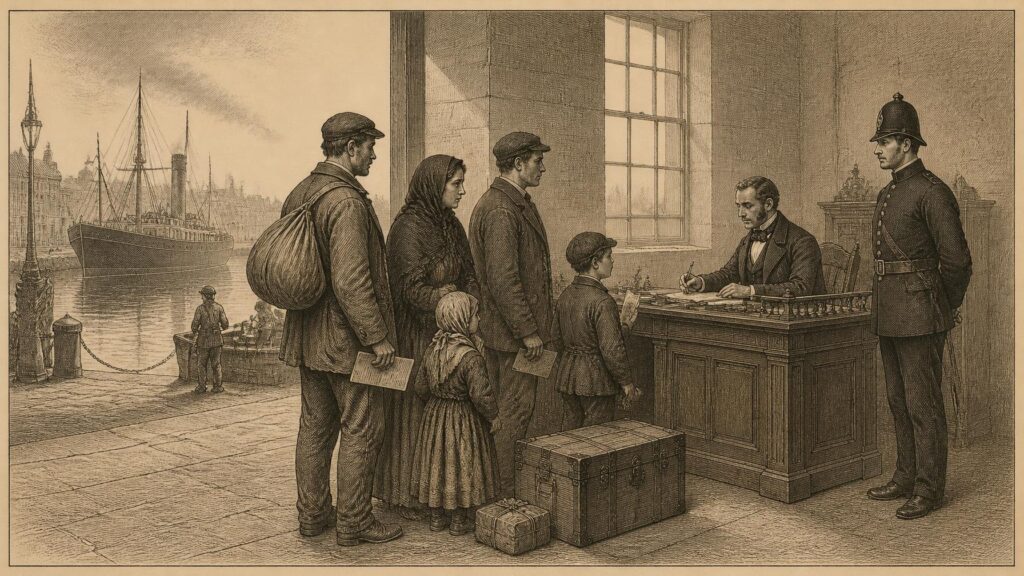
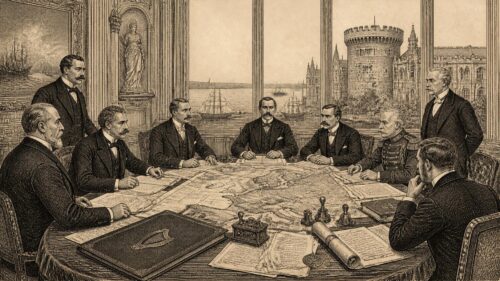
AI generated historical illustration, not a contemporary photograph.
At a Glance
Irish asylum law has never been a settled inheritance. It has been repeatedly remade as the State moved from broad executive control over “aliens” towards a legal system shaped by the Refugee Convention, European measures, constitutional adjudication and hard arguments about dignity, accommodation and the limits of administrative power.
Legal Inheritance
The history of asylum reform in the Irish State begins, paradoxically, with legislation that did not use the modern language of asylum at all. The Aliens Act 1935 was enacted in the Irish Free State to provide for the control of non-citizens. It was a short statute, but its constitutional and administrative significance was large. Rather than establishing an individual procedure through which a person might seek protection from persecution, it empowered the executive to regulate entry, residence, exclusion and deportation through orders. The accompanying Aliens Order of 1935 required most non-citizens arriving from outside Great Britain or Northern Ireland to obtain leave to land, and permitted deportation where the Minister considered it conducive to the public good.
This was not unusual in inter-war Europe. Immigration law was commonly regarded as an aspect of sovereignty, public order and external relations. Ireland was a young state with a small civil service, significant emigration of its own population and a close, though changing, relationship with Britain. Its governing assumptions were accordingly concerned with admission and exclusion, not with the later proposition that an individual fleeing persecution possessed a claim to an impartial determination process. The Act’s vocabulary is revealing: it dealt in the category of the “alien”, a legal outsider whose presence was subject to ministerial control.
It would be wrong, however, to treat the 1935 statute as a complete description of Ireland’s attitude to people in flight. Law is only one part of a country’s response to displacement. Charitable bodies, churches, voluntary associations and private households could and did offer help to particular newcomers. Yet such acts belong to the history of relief and hospitality, not necessarily to a system of enforceable asylum rights. Folklore often turns a nation’s memory of emigration into an assumption that it must always have offered a generous refuge in return. Documentary evidence gives a more qualified picture. The State possessed extensive machinery for controlling non-citizens long before it possessed a dedicated refugee-status procedure.
That distinction matters. Modern debate often treats asylum as a branch of immigration administration, while critics insist that it is fundamentally different because it concerns a person who may face persecution or serious harm if returned. The tension between those views has informed Irish reform ever since. The older legal inheritance supplied the language and instruments of control; the later international regime introduced duties of protection. Irish asylum history is largely the story of making those two bodies of law coexist.
Convention Commitment
The post-war international settlement transformed the terms of debate. The Convention relating to the Status of Refugees was agreed at Geneva in 1951, in the shadow of the displacement, denationalisation and persecution that had marked the preceding decades. Its central figure was the refugee: a person outside their country and unable or unwilling to seek that country’s protection because of a well-founded fear of persecution for specified reasons. Equally important was the principle of non-refoulement, the prohibition on returning a refugee to a territory where life or freedom would be threatened on a Convention ground.
Ireland acceded to the Convention on 29 November 1956, with the accession taking effect on 27 February 1957. The State made several reservations and declarations. Among them was an understanding that the original temporal language in the Convention referred to events in Europe or elsewhere before 1 January 1951. It also reserved its position on wage-earning employment, undertaking not to give refugees treatment more favourable than that given to aliens generally. These details are a useful corrective to retrospective simplicity. Ireland joined the international refugee framework, but it did so through the legal categories and reservations of its time.
Accession did not immediately create a modern domestic asylum system. International obligations and domestic procedures develop at different speeds. For many years Ireland received comparatively small numbers of people seeking asylum, while its public and political culture remained deeply marked by outward migration. The country’s experience of emigration later became a powerful moral reference in discussion of refugees, but it did not itself write the law. Nor should the history of Irish people abroad be conflated with the legal definition of a refugee. Economic migration, family movement, exile, labour recruitment and flight from persecution may overlap in human experience, but they carry different legal consequences.
The 1967 Protocol removed the original Convention’s geographic and temporal limits for participating states. Ireland acceded to it in 1968. Together, the Convention and Protocol supplied the international frame against which later Irish law would be judged. They did not answer every difficult question. They did not automatically decide how an application should be registered, how quickly a decision should be made, what accommodation should be offered during a claim, or how appeal rights ought to operate. Those questions became pressing only when the number and complexity of claims exposed the inadequacy of relying on general immigration powers and ad hoc administrative arrangements.
The Convention commitment nonetheless marked a change of principle. It meant that state discretion over entry and removal could no longer be understood as unlimited where a person claimed a fear of persecution. The task of reform would be to translate that principle into institutions, rules and remedies capable of functioning in ordinary cases rather than merely in diplomatic or exceptional ones.
Procedural Beginnings
The Refugee Act 1996 was the decisive legislative response to that task. Its long title stated that it was intended to give effect to the 1951 Convention, the 1967 Protocol and the 1990 Dublin Convention, which allocated responsibility for examining asylum applications among participating European states. The Act therefore joined three strands: international refugee protection, domestic administrative structure and Ireland’s developing place in European co-operation.
It created offices and procedures that had previously been absent from statute. A Refugee Applications Commissioner was to investigate applications, while a Refugee Appeal Board was to provide an appellate stage. The Act contained a prohibition on refoulement and set out rights attaching to a person recognised as a refugee. It also supplied a legal definition of refugee based upon the Convention. In historical terms, its importance lay not only in the rights written into particular sections, but in its insistence that the determination of refugee status should occur through a recognisable process rather than through the undifferentiated exercise of immigration control.
The date on the cover of an Act is not always the date at which it transforms everyday administration. The Refugee Act was enacted on 26 June 1996, but its provisions came into force in stages. Some sections commenced in 1997; the core provisions establishing the determination and appeal arrangements came into operation on 20 November 2000. That prolonged commencement is significant. It reveals the gap between parliamentary enactment and administrative capacity. A statute may promise a system, but offices must be staffed, regulations made, forms devised, interpreters arranged, accommodation found and decision-makers trained before the promise becomes an operating institution.
The Act also reflected a wider European development. Ireland had joined the European Economic Community in 1973, and by the 1990s asylum had become increasingly entangled with shared European rules about responsibility, borders and procedural standards. The Dublin Convention was named after the city in which it was signed in 1990. This created a curious reversal in public imagination. Dublin was not merely the location of Irish government; it became the name attached internationally to a system seeking to identify which European state should examine an asylum claim. That association gave Ireland a distinctive symbolic place in the emerging European asylum architecture.
Interpretation should remain cautious. The 1996 Act was not a finished liberal settlement, nor was it simply an instrument of restriction. It sought to make protection claims administratively manageable while recognising obligations against return to danger. Its architecture contained both impulses. Subsequent controversy arose partly because those impulses could collide: a process designed to decide claims efficiently might become slow; a system designed to establish responsibility might leave applicants in prolonged uncertainty; and a legal right to remain pending a decision might not settle what everyday life during that wait should look like.
Systemic Strain
The implementation of the 1996 Act coincided with a changed Ireland. During the later 1990s and early 2000s, the State experienced economic growth and increased immigration, including a rise in applications for asylum. The administrative issue was no longer abstract. It involved people who needed somewhere to live while their claims were examined, and a public service confronting greater demand than its earlier arrangements had anticipated.
In 2000 the State introduced what became known as Direct Provision: accommodation, food and a modest personal allowance for people seeking asylum. Its immediate rationale was practical. Applicants who could not support themselves required shelter and subsistence, and government wished to organise provision centrally. Yet a temporary administrative response acquired a much longer life. The label “Direct Provision” came to denote not merely a payment or accommodation arrangement, but a whole social experience of waiting within a legal process.
Historical evidence shows why the issue became central to asylum reform. A person may have a right to lodge an application and a right not to be returned while it is considered, but those formal protections do not settle the conditions in which years may be spent. Accommodation affects family life, privacy, food, education, health, access to transport, participation in local communities and the ability to prepare a claim. The design of reception was therefore not a peripheral welfare question. It became an important practical expression of the asylum system’s values.
Advocates, residents, researchers and official review groups criticised long stays, institutional living and restrictions that they regarded as incompatible with autonomy and dignity. Governments and officials, meanwhile, emphasised the State’s duty to provide safety and basic support while claims were pending, the operational difficulty of meeting fluctuating demand, and the need to prevent a reception system from becoming detached from the administration of immigration law. These positions were sometimes presented as mutually exclusive, but historically they arose from the same structural problem: an asylum process that took longer than its designers had intended.
The language of “crisis” can obscure this history. There were genuine pressures at particular moments, but Direct Provision was not an accident that lasted a few weeks. It became embedded because the wider procedure repeatedly struggled to deliver prompt, final decisions. The State later introduced changes including more opportunities for independent living, cooking facilities in some centres, national standards and revised allowances. Official reports and policy statements recognised the need for a replacement approach. The important historical point is that reception reform followed from, and in turn exposed, the shortcomings of decision-making reform.
This area also requires care in distinguishing evidence from generalisation. Not every centre was identical, and individual experiences differed according to location, family circumstances, health, length of stay and available local support. Nor is it accurate to suggest that all public discussion came from one source. Residents themselves, legal organisations, voluntary groups, inspectors, parliamentary committees and government-appointed advisory bodies all helped make reception conditions a matter of national concern.
European Influence
European law steadily altered the setting in which Irish asylum policy operated. The original Dublin Convention was succeeded by European Union instruments that sought to allocate responsibility among member states and, over time, to establish common minimum standards for reception, qualification and procedures. Ireland’s participation was shaped by the special arrangements it secured in European treaties, which gave it choices about opting into some justice and home-affairs measures. This meant that Irish asylum law was neither wholly external to European development nor mechanically identical to that of every other member state.
The European dimension mattered in several ways. First, it supplied rules concerning responsibility for claims, including the use of information and, later, biometric systems. Second, it encouraged common understandings of subsidiary protection, a form of protection for people who did not meet the Convention refugee definition but faced a real risk of serious harm if returned. Third, it brought attention to procedural guarantees: personal interviews, interpretation, legal assistance, remedies and the treatment of vulnerable applicants. Each development required Ireland to consider whether domestic legislation and administration were adequate.
The distinction between refugee status and subsidiary protection is particularly important. Refugee status is rooted in the Convention grounds of race, religion, nationality, political opinion or membership of a particular social group. Subsidiary protection developed within the European legal order to address other grave risks, including threats arising from indiscriminate violence in armed conflict. The existence of two forms of protection complicated the older Irish structure, because a person might need to make or pursue related but separate arguments under different routes.
In the years before 2015, that complexity could produce a sequence of applications, decisions and further consideration of permission to remain. Such arrangements had legal logic, but they could also lengthen uncertainty. A reforming case for a unified process grew from this experience. The question was not whether every claim would become easy to decide. It was whether the State could assess all relevant grounds in a coherent order, with fair procedures, rather than requiring applicants to move through successive gateways.
European influence did not erase national choices. The Oireachtas retained the task of legislating, Irish courts continued to interpret constitutional rights, and the State remained responsible for the institutions that received and decided claims. But European measures supplied both a framework and a pressure for change. They also illustrate a larger truth about modern Irish history: migration law, once framed primarily through national executive control, became an arena in which domestic, international and European legal sources continuously interacted.
Constitutional Challenge
Courts became especially important where statutory rules met the lived consequences of delay. The best-known modern example is N.H.V. v Minister for Justice and Equality, decided by the Supreme Court in May 2017. The case concerned the prohibition on an asylum applicant seeking or entering employment while an application was pending. The claimant had spent years in the system. The Supreme Court held that, insofar as the absolute prohibition continued without temporal limit in circumstances where the State had failed to make a decision within a reasonable period, it was incompatible with the constitutional right to seek employment.
The decision did not establish an unrestricted entitlement to work from the moment an application was made, and it did not remove the State’s power to regulate access to employment. Its historical importance is more precise. The Court rejected the proposition that a person’s status as a non-citizen and applicant for protection placed them wholly outside the Constitution’s concern. It recognised that prolonged exclusion from employment could have serious consequences for autonomy, self-respect and participation in society.
The case also demonstrates why legal history cannot be told only through Acts of the Oireachtas. Reform arises through legislation, administration, litigation and political response. In N.H.V., the court identified a constitutional defect in an absolute bar as applied to a person left for an extended period without an effective decision. The legislature and executive then had to design a lawful replacement. Labour-market access for eligible applicants subsequently became part of the framework, subject to conditions and waiting periods.
There is a temptation to narrate such judgments as sudden victories in which courts simply impose humanity upon an indifferent system. That is too simple. The judgment arose from the interaction of an individual case, legal representation, constitutional doctrine, the realities of delay, European norms and the institutional capacity of the State. Nor did it resolve the other problems experienced by applicants. Employment permission may reduce dependence and isolation, but it does not in itself secure affordable housing, end backlogs, guarantee recognition of qualifications, or eliminate the vulnerability created by an uncertain immigration status.
Still, N.H.V. changed the terms of Irish debate. It made clear that the period awaiting an asylum decision was not legally empty time. A person in that position remained a bearer of constitutional interests. In historical perspective, this was a notable movement away from the older image of the “alien” as an object principally of executive control. It did not abolish control. Rather, it required that control to be exercised within legal boundaries attentive to the effects of prolonged administrative delay.
Single Procedure
The International Protection Act 2015 was enacted on 30 December 2015 and brought the central new process into operation at the end of 2016. It repealed the Refugee Act 1996, subject to transitional provisions, and introduced what was widely called the single procedure. Under this approach, an applicant makes one application through which the State considers refugee status, subsidiary protection and, where appropriate, permission to remain.
The reform had an intelligible historical purpose. Under the earlier framework, related questions could be examined in separate stages. The newer model sought to bring them together, reduce duplication and deliver a final outcome more efficiently. The Office of the Refugee Applications Commissioner was absorbed into a dedicated Protection Office within the Department, while the earlier appeal body was reconstituted as the International Protection Appeals Tribunal. The statutory language shifted from a system centred chiefly on “refugee” applications towards the broader category of “international protection”.
That change in terminology was more than cosmetic. It acknowledged that the Irish system now had to determine more than one recognised form of protection. It also reflected the extent to which European qualification rules had become part of the legal setting. The 2015 Act retained the importance of the Refugee Convention while embedding it in a wider statutory structure concerned with serious harm, procedural sequencing, family members, permissions and appeals.
Official accounts described the single procedure as a means to improve efficiency and reduce the time applicants spent in the system. That was an objective, not a guarantee. A single route can avoid repeated processes, but fair decision-making still requires reliable country information, careful interviews, competent interpretation, assessment of credibility, consideration of vulnerability and access to appeal. The tension between speed and care did not disappear. In asylum law, delay can inflict hardship, but rushed decisions can expose people to grave danger or generate avoidable litigation.
The 2015 reform should therefore be understood as a major administrative consolidation rather than a final answer to every problem. It furnished a more coherent statutory architecture, but its success depended on staffing, resources, training, accommodation capacity and the changing number of applicants. It also existed alongside continuing public concern about Direct Provision and access to work. The history of asylum reform repeatedly shows that procedural innovation cannot be separated from the material circumstances in which applicants live.
Recent Settlement
The most recent major turning point occurred with the International Protection Act 2026. Enacted on 22 April 2026 and commenced on 12 June 2026, it gave effect in Irish law to major elements of the European Union’s Migration and Asylum Pact. The Act represents a substantial replacement of the 2015 framework and illustrates the speed with which this field continues to change. Any historical account that ends with the 2015 Act is now incomplete.
The 2026 legislation provides for screening on arrival, including identity and security checks and the collection of biometric data. It establishes a framework for faster processing, including an accelerated border procedure for defined categories of cases, and creates the Tribunal for Asylum and Returns Appeals. It also provides for an Office of the Chief Inspector of Asylum Border Procedures. The Act’s stated ambition is a procedure that is fair, sustainable and efficient, operating consistently with the new European arrangements.
These developments continue a familiar Irish pattern. Reformers promise that clearer procedures and fixed stages will reduce delay; critics ask whether acceleration, screening and border processes provide enough time and support for people to explain complex claims, particularly where trauma, language, disability or lack of documents are involved. Neither concern is trivial. The State has a legitimate interest in a system capable of reaching timely decisions, identifying the responsible authority and implementing outcomes. Applicants have a profound interest in protection from return to danger, effective access to advice and a hearing that is genuinely individual.
The 2026 Act should not be assessed solely by the rhetoric of novelty. It is part of a longer movement from the discretionary powers of the 1935 Aliens Act, through Convention-based recognition under the 1996 Act, to the integrated procedure of 2015 and the European Pact framework of 2026. Its new institutions and timeframes may prove durable, or they may generate further adjustment through litigation, regulations and administrative practice. History advises caution about assuming that a comprehensive statute ends controversy.
Accommodation remains essential to that assessment. The formal title of an Act cannot determine whether a person can find safety, maintain family life, travel to appointments or begin rebuilding a life while a claim is pending. Likewise, an appeal tribunal’s title cannot itself secure access to justice. The operation of the new settlement will depend upon practical provision as much as upon legislative design.
Historical Meaning
The history of asylum law reform in Ireland is not a simple ascent from exclusion to welcome, nor a simple story of sovereignty defeated by international obligation. It is a history of repeated negotiation. The 1935 regime gave wide practical scope to executive control over non-citizens. The Refugee Convention introduced binding moral and legal limits, especially against return to persecution. The Refugee Act 1996 created institutions for determination and appeal. Direct Provision exposed the human consequences of waiting. European measures broadened categories of protection and recast procedural expectations. The Supreme Court insisted that constitutional rights could not be indefinitely suspended by administrative delay. The Acts of 2015 and 2026 attempted, in different ways, to consolidate and accelerate the system.
Documented evidence supports that sequence. Interpretation is needed to explain its significance. One reasonable interpretation is that Irish asylum law has moved from a predominantly territorial conception of state power towards a more layered constitutional order, in which executive authority is constrained by international commitments, European rules, statute and judicial review. Yet the earlier concern with territorial control has not vanished. It remains present in screening, responsibility rules, removal provisions and debates over border procedures.
There is no need to resort to national myth to understand the subject. Ireland’s long history of emigration may help explain why refugee questions carry particular emotional force, but it does not predetermine legal outcomes. The more dependable historical lesson is institutional. Humanitarian commitments become meaningful only when translated into workable procedures, adequately supported decision-makers, accessible legal safeguards and decent conditions during unavoidable periods of uncertainty.
Asylum law thus offers a concentrated view of modern Ireland. It reveals a state adapting to international law, European integration and demographic change while confronting enduring questions about who belongs, who decides, how quickly a decision should be made and what obligations arise before a decision is final. Reform has been continual because the subject itself joins competing imperatives that cannot be permanently dissolved: protection and control, speed and accuracy, national authority and shared rules, public administration and individual dignity. The history of seeking shelter in Ireland remains unfinished.


The article shows how delays made Direct Provision more than temporary shelter, turning reception conditions into a measure of asylum law’s practical fairness. Its narrative also suggests that reforms, from statutory determination to the 2015 single procedure and the 2026 Pact framework, seek speed without abandoning safeguards against return to danger. Yet faster decisions alone may not resolve concerns about privacy, autonomy, legal assistance and accountability during the process. The comparison between formal protection rights and everyday waiting is especially striking. What evidence and experiences should guide Ireland in judging whether its evolving asylum system reconciles decision-making with dignified accommodation?