

Dear Living
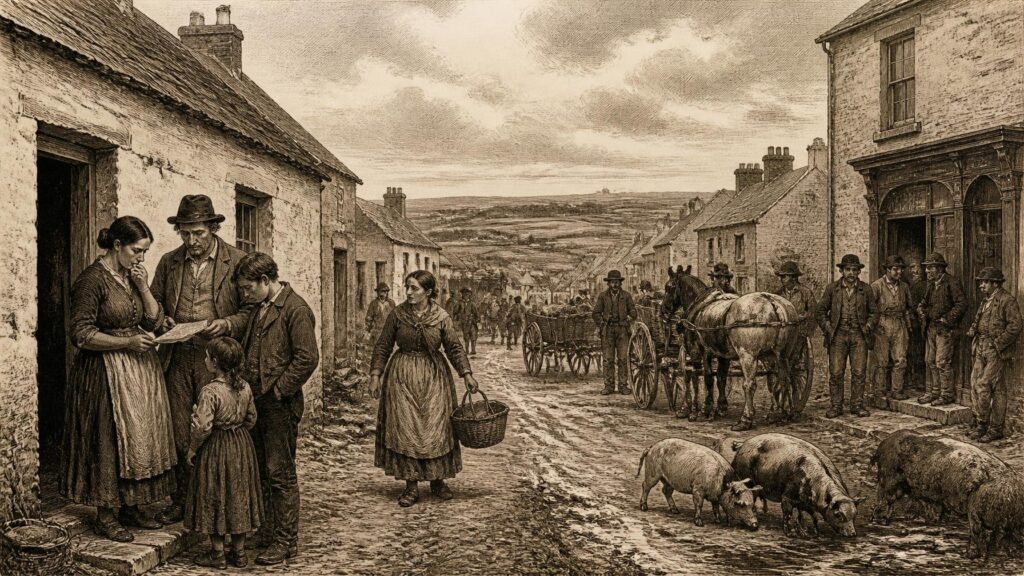
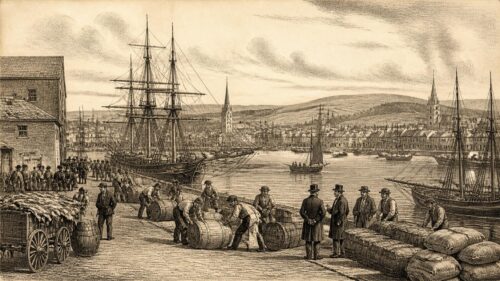
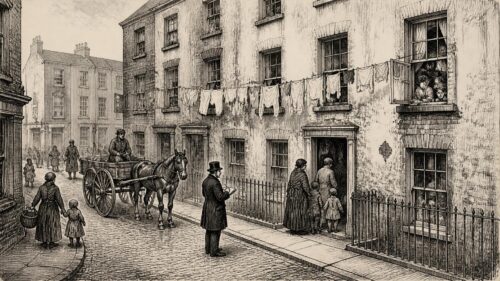
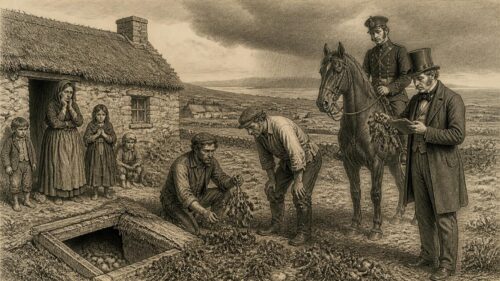
AI generated historical illustration, not a contemporary photograph.
At a Glance
The phrase “cost of living” is modern in tone, but the political argument beneath it is old in Ireland. Long before household budgets were expressed through consumer-price indices, people measured pressure through rent day, the price of meal, the availability of turf or coal, the pawn ticket, the grocer’s book, the workhouse test and the prospect of emigration. These were not merely private anxieties. They determined who could remain on the land, raise children in a city room, refuse an employer’s terms or claim that a government had failed in its most basic duty.
Measuring Want
Cost-of-living politics concerns the relationship between means and necessities. It is therefore wider than inflation. A household may suffer when food becomes dearer, but also when employment is irregular, rents consume income, credit is punitive, housing is unsafe, or public provision is absent. In Irish history these burdens rarely arrived singly. The labourer without steady work might confront a bad harvest; the small tenant might face rent arrears while the price of livestock fell; the city worker might receive a nominal wage rise only to see it absorbed by rent, fuel and bread.
Historical evidence is uneven. Wage books, official inquiries, poor-law records, estate papers, newspapers and parliamentary debates often preserve the language of officials, employers and reformers more readily than that of the people who endured hardship. They can show prices, eviction proceedings, relief rules and housing statistics, but they cannot fully recover every household decision: a meal missed, a garment pawned, a daughter sent into service, or a family’s quiet reliance on neighbours. For that reason, a careful history must not turn every remembered hardship into a universal condition.
Yet the surviving record is abundant enough to establish a central fact. Questions now treated separately as housing, energy, food security, employment, welfare and debt repeatedly converged in Ireland. Their convergence made them political. People sought not simply charity but changes in power: lower or more secure rents, better wages, land ownership, municipal housing, food controls, pensions, public works and social insurance. Arguments about affordability became arguments about authority.
Rural Burdens
In the early nineteenth century, much of Ireland was organised around a precarious rural economy. Access to land was the decisive condition of survival for many families. Holdings could be small, subdivided and dependent on crops vulnerable to weather and disease. A tenant’s outgoings did not end with rent. There were local charges, debts, seed, tools, subsistence purchases and the obligations of family life. The gap between possessing land and securely living from it could be narrow.
The ending of the Napoleonic Wars brought a sharp reversal. Wartime demand and elevated agricultural prices had benefited some producers and landlords, but post-war price falls destabilised rural incomes. Research on pre-Famine pawnbroking identifies the collapse in agricultural prices after 1815, industrial decline, banking disruption and the poor harvest of 1822 as mutually reinforcing causes of worsening insecurity. The spread of pawnshops was not merely a commercial curiosity. It is documentary evidence that more households needed short-term credit against their possessions in order to bridge an immediate shortage of cash.
Pawning should not be read simply as proof of destitution. It could be a routine form of household finance, used by people who expected seasonal work, a remittance or a sale to restore their position. Nevertheless, the rapid enlargement of pawnshop networks in new places suggests that insecurity had widened. The political importance lay in the lack of alternatives. A household whose survival depended upon small loans was exposed to interest, to the loss of useful goods and to the judgement of local creditors. It also had little power when confronted by a landlord, employer or shopkeeper.
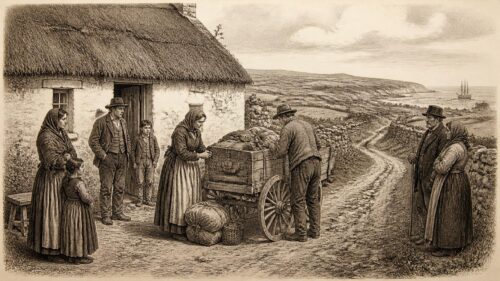
Emigration supplied another response to this condition. It was neither an uncomplicated escape nor a single event with one cause. Irish people emigrated for opportunity, kinship and ambition as well as necessity. Still, the scale of departures after the post-war slump indicates the economic pressure built into rural life. For many families, migration became a strategy for distributing risk across the Atlantic and Irish Sea. Remittances could sustain those left behind, while the prospect of departure could influence local labour markets and family expectations.
There is a temptation to imagine a timelessly poor Ireland, defined only by misery. That is inaccurate. Conditions varied greatly by region, class, occupation, gender and life stage. North-east industrial districts differed from heavily agrarian western districts; better-off farmers differed from labourers and cottiers; access to a relative abroad could transform a household’s prospects. The enduring point is not that every person endured the same deprivation, but that economic insecurity was structurally common enough to become a public question.
Famine Reckoning
The Great Famine made subsistence, prices, land tenure and relief matters of life and death. Potato failure began in 1845, but the catastrophe cannot be reduced to a single crop disease. Dependence on the potato had developed within a society marked by unequal access to land, limited industrial employment outside particular regions, weak household reserves and a political system in which decisions affecting Ireland were made at Westminster. A blight became a social disaster because so many people had little capacity to withstand it.
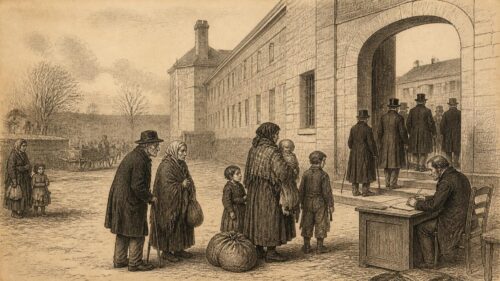
Government policy during the Famine has remained a subject of searching historical debate. The evidence establishes relief efforts, public works, soup kitchens and Poor Law administration, but also demonstrates the insufficiency and harshness of measures as need escalated. Relief was often framed through tests of deservingness and deterrence. Workhouse admission, outdoor relief and emigration were administrative answers to mass distress, but they did not remove the underlying imbalance between necessity and resources.
The Famine permanently altered how Irish people understood economic security. Death and emigration reduced the population with terrifying speed; holdings changed; labour relations shifted; and whole communities acquired memories of eviction, hunger and departure. Such memories became politically potent in later decades. They did not dictate every later choice, and they should not be used as a simple explanation for all Irish nationalism. But they supplied a moral vocabulary in which a family’s inability to pay rent or buy food could be interpreted as a failure of the prevailing social order.
Folklore and family tradition often preserve vivid stories of famine hardship: a particular eviction, a coffin ship, a hidden cache of food, a landlord’s cruelty or a neighbour’s generosity. These accounts are valuable as cultural memory, but their details require corroboration before being treated as evidence of a specific event. The larger historical conclusion does not depend on romanticised anecdotes. Contemporary records, demographic change and relief documentation confirm a catastrophe whose consequences outlasted the emergency itself.
Land Politics
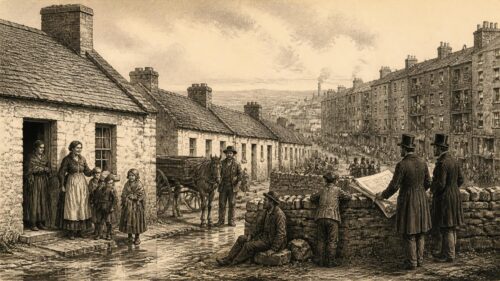
After the Famine, rural Ireland did not become free of economic pressure. The population decline and consolidation of holdings altered the countryside, but tenant insecurity survived. In the late 1870s, poor harvests, bad weather and falling agricultural returns made existing rents difficult to meet, particularly in marginal areas. The Land League translated that hardship into a national programme: fair rent, fixity of tenure and free sale. Each demand addressed the cost of remaining on the land.
This was cost-of-living politics in an especially direct form. Rent was not simply a bill. It was a claim on the product of labour and land. If rents remained fixed while incomes fell, tenants carried the full risk of market and weather. Land League agitation asserted that landlords should share that risk. Its campaigns combined meetings, rent resistance, electoral pressure, public spectacle and social ostracism. The word “boycott”, drawn from this period, remains a reminder that economic action and political language could become inseparable.
The Land Act of 1881 created land courts empowered to establish judicial rents, and rent reductions followed. Later legislation moved more decisively towards tenant purchase. These changes did not instantly resolve rural poverty, nor did they benefit all groups equally. Agricultural labourers, landless people and the rural poor could remain excluded from the security gained by purchasing tenants. Still, the transformation of ownership altered the political landscape. It weakened landlord power and made the household farm a core unit of Irish social and political imagination.
Interpretatively, the Land War shows why affordability debates cannot be confined to shop prices. A rent that cannot be met is a cost-of-living issue even when prices are stable. The political solution sought was not a temporary rebate but a redistribution of security: legal rights, regulated rents and eventually ownership. That pattern would recur in new settings, above all in the city.
Urban Pressures
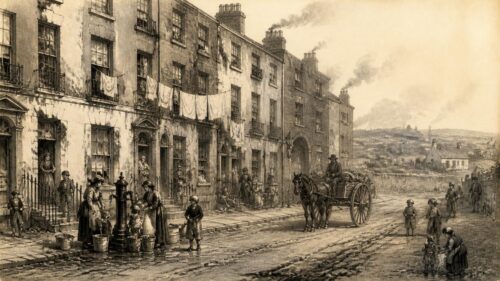
Dublin exposed another side of the same problem. The city was a major port and commercial centre, but it contained some of the worst housing conditions in the United Kingdom. Families occupied subdivided Georgian houses, often in overcrowded rooms with poor sanitation and unreliable access to basic comfort. The 1913 housing inquiry, prompted in part by the collapse of tenement houses on Church Street, recorded housing conditions that official language itself struggled to soften.
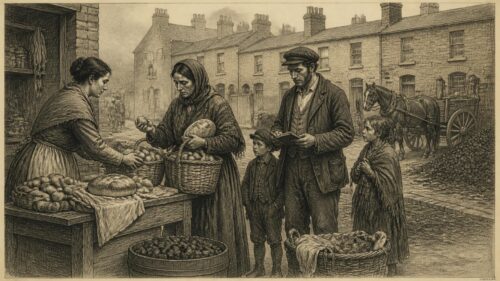
The housing crisis was bound to employment. Casual labour, low wages and irregular hours made a family’s weekly budget dangerously fragile. Educational material assembled from contemporary evidence gives a typical 1913 unskilled Dublin labourer’s budget in which weekly expenditure stood close to weekly wages. Rent, fuel and light, bread, tea, sugar, milk, fats, vegetables and occasional meat left a narrow balance. In a week without work or with a rise in fuel prices, the calculation failed. It was then that borrowing, pawning and cutting consumption became unavoidable.
This evidence needs reading with care. A “typical” budget is an analytical reconstruction, not a complete diary of every household. It cannot show every second income, informal exchange or charitable meal. Nonetheless, it conveys the reality that made a small wage increase politically meaningful. When income was precarious, an extra shilling could be the difference between rent paid and rent delayed, fuel bought and fuel forgone.
The Dublin Lockout of 1913 therefore cannot be reduced to a dispute over union recognition alone. The immediate conflict concerned the Irish Transport and General Workers’ Union, employer resistance and the right to organise. But the background was a city in which employment discipline rested upon vulnerability. Workers demanding higher wages and recognition were demanding leverage against an economy that allowed employers to make hunger and homelessness immediate consequences of dissent.
Labour Conflict
When William Martin Murphy and allied employers locked out workers in the autumn of 1913, the dispute spread far beyond a single company. More than twenty thousand workers were affected. The struggle brought police violence, international attention, relief funds, soup kitchens and bitter disagreements within labour and nationalist politics. It also demonstrated the limits of solidarity when workers’ households had few reserves. A prolonged stoppage could be morally inspiring and materially ruinous at the same time.
The Lockout’s popular memory often centres on James Larkin’s oratory, mounted police and the drama of “Bloody Sunday”. Those images matter, but they can obscure the quieter economy of survival: women organising food, union officials tracking payments, families seeking support, and children living through hunger and uncertainty. National Library records of lockout payments and requests for assistance show that the confrontation involved painstaking financial administration as well as rhetoric. A movement capable of protest also had to keep people alive.
In January 1914, after British trade-union backing was withdrawn, Larkin advised workers to return on the best terms they could obtain. It would be misleading to call this a simple defeat or a simple victory. Employers had resisted union power; workers had suffered severely; but labour organisation, working-class political consciousness and the connection between housing, wages and dignity had acquired a permanent place in public debate. The Lockout’s historical significance lies partly in that enlargement of what Irish politics could be about.
The evidence does not support an uncomplicated story in which labour politics displaced national politics. The two overlapped, competed and at times ignored each other. Yet the coincidence of the housing inquiry, the Lockout and the Home Rule crisis in 1913 makes a larger point. Constitutional futures were being argued in the same city where families faced immediate questions of rent, food and work. Independence would later be judged, in part, by whether it changed those conditions.
National Promises
The revolutionary years and the establishment of the Irish Free State raised expectations that political sovereignty might bring social security. The First Dáil’s Democratic Programme spoke in expansive terms about the nation’s resources and the welfare of its people. But ideals declared during revolution were difficult to implement amid war, partition, damaged finances and restricted administrative capacity. The new state inherited poverty, housing shortages, uneven development and a large dependence on emigration.
In the 1920s, governments generally pursued fiscal restraint. This was not an accidental absence of policy; it reflected a belief that balanced public finances, limited taxation and monetary stability were essential to the young state. The consequence was that social provision remained constrained. For households facing low pay or poor housing, the distinction between necessary prudence and official indifference could appear thin. Politics turned on whether the state ought to protect its budget first or its citizens’ purchasing power first.
The Fianna Fáil government elected in 1932 offered a contrasting economic programme, using tariffs and industrial policy to foster domestic employment. Protection gave political meaning to the price of goods: a dearer imported item could be represented as the cost of Irish jobs and national development. Critics countered that tariffs and the Anglo-Irish Economic War imposed burdens on consumers and farmers. Both positions contained elements supported by the historical record. Protected manufacturing employment rose during the 1930s, but the gains were neither uniform nor sufficient to abolish hardship.
There was no single national experience of these policies. Farmers hit by falling export returns and land-annuity conflict did not necessarily see matters as urban workers did. Consumers benefited from employment in some protected sectors but could face higher prices or limited choice. The lesson is not that protection was either wholly misguided or wholly successful. It is that political disputes about prices in independent Ireland became disputes about whose living standards would carry the cost of national economic strategy.
War Scarcity
The Emergency of 1939 to 1945 sharpened the problem. Neutral Ireland faced disrupted trade, shortages and rationing. Fuel, imported foodstuffs, transport and manufactured goods all became matters of administrative control and household improvisation. Rationing could distribute scarcity more equitably than unrestricted markets, but it could not create abundance. Families with gardens, farms, cash reserves or strong local networks managed differently from households dependent on wages and shops.
Real wages fell sharply in the early war years, while housing difficulties persisted. Later evidence shows that overcrowding remained widespread well after independence: in 1946, thousands of households containing six or more people occupied one room, particularly in Dublin. Such figures make clear that political freedom did not automatically supply affordable homes. Housing required sustained municipal finance, construction, rent policy and the willingness to acknowledge that slum conditions were not merely private misfortune.
Post-war reform gradually changed the framework. Differential rents in local-authority housing reduced the barrier that had prevented some poor families from accepting rehousing. The expansion of public housing, rising incomes, education and later welfare development improved conditions for many. This was significant progress, but it was not evenly shared and should not be described as a final settlement. Ireland’s later prosperity would bring different pressures of property, credit and uneven access.
Changing Measures
By the later twentieth century, the language of economic pressure changed. Statistics on prices, earnings, unemployment and national income became more central to public argument. This made comparisons possible, but it also risked narrowing the meaning of living standards. An average wage may rise while rents rise faster for tenants; national income may increase while a household pays heavily for childcare, transport, health care or education. The history of the cost of living is therefore a warning against mistaking aggregate wealth for shared security.
Emigration remains part of this story. It could relieve pressure on local employment, send remittances and enable social mobility, but it also represented the loss of people whose lives might otherwise have been built in Ireland. The long history of Irish emigration should not be romanticised as national adventurousness. For many it was an active choice; for others it was the consequence of an economy unable to provide a reliable livelihood. That ambiguity belongs at the centre of Irish economic history.
Evidence also suggests that expectations changed. Earlier generations often judged a government against the avoidance of hunger, eviction and the workhouse. Later citizens increasingly judged the state against secure housing, decent employment, public services and a standard of life comparable with neighbouring European countries. These are different benchmarks, but both rest on the same principle: citizenship carries an expectation that ordinary work and ordinary family life should make ordinary necessities attainable.
Present Echoes
Recent Irish debate over rents, food, energy and childcare is not a replay of the nineteenth century. Contemporary Ireland is wealthier, more urbanised and equipped with institutions, welfare measures and forms of representation unavailable to earlier generations. It would be careless to collapse historical distinctions or to equate modern hardship directly with famine, tenement life or the Lockout.
Nonetheless, the echoes are real. Present arguments still ask who bears economic shocks, whether wages keep pace with unavoidable costs, whether public policy should subsidise households or lower structural costs, and whether access to a home can be treated as a market outcome alone. They also revive an old Irish political tension between temporary relief and lasting reform. A fuel payment, rent support or tax reduction may meet an urgent need; regulation, public building, wage bargaining and service provision seek to alter the conditions that create it.
The documented history points to no automatic remedy. Governments have sometimes acted too slowly, employers and landlords have sometimes shifted risk downward, and popular movements have sometimes achieved reforms that official policy had resisted. But history does provide perspective. Ireland’s cost-of-living politics has never been only about the price of goods. It has concerned security, power and the right to remain: on the land, in the city, in a home, and in the country itself.
The article shows that Irish affordability disputes repeatedly concerned risk, rather than prices alone: whether landlords, employers, consumers or the state should absorb shocks caused by falling incomes, scarcity and insecure housing. Comparing Land League demands for rent security with urban campaigns for wages, tenement reform and public housing suggests that durable relief often required changes in power, not merely temporary assistance. Tenants, labourers, farmers and households supported by remittances experienced hardship profoundly differently. To what extent does this history indicate that contemporary cost-of-living policy should favour housing rights, social provision and income security over measures focused chiefly on prices?