

Connected Countryside
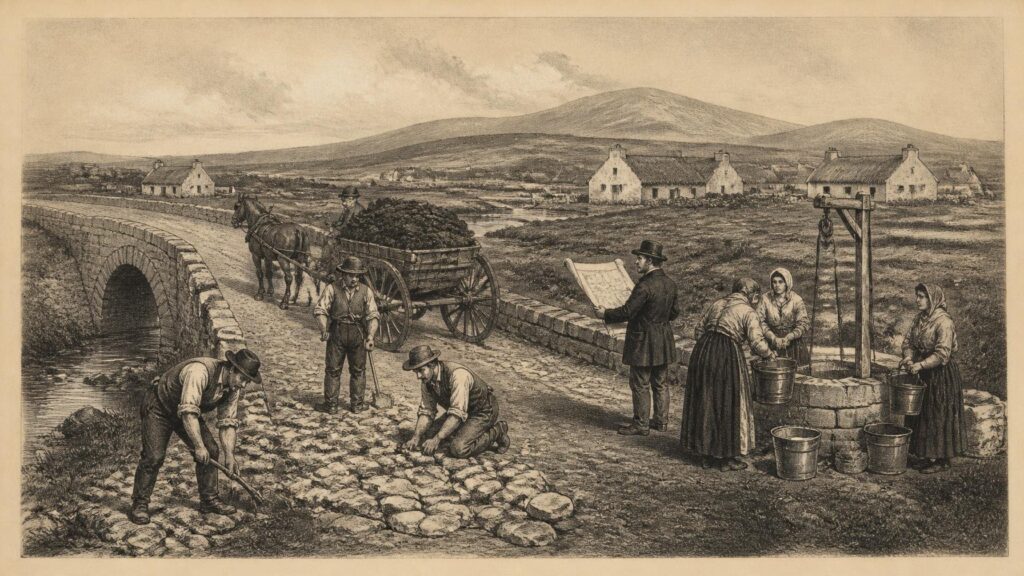
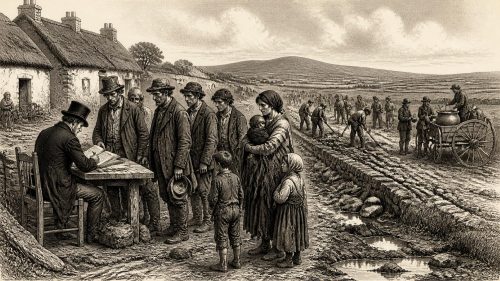
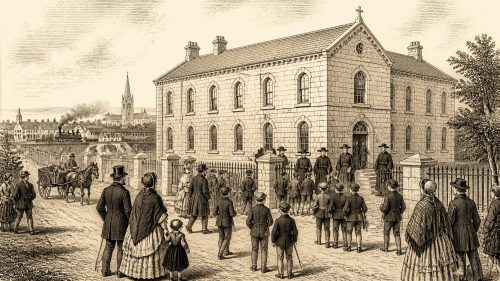
AI generated historical illustration, not a contemporary photograph.
At a Glance
In Ireland, rural services were never simply an accumulation of pipes, poles, road surfaces and public buildings. They determined whether a family could carry produce to market, obtain clean water, send a letter, reach a doctor, keep children in school, or remain in an isolated district without surrendering entirely to distance. The countryside was connected slowly and unevenly, through a mixture of local taxation, state loans, public employment, voluntary labour and political pressure. Its infrastructure reveals not only changing technology, but changing ideas of citizenship, public responsibility and rural life itself.
Rural Premise
For much of Irish history, the word “rural” did not describe a single condition. A farming household close to a market town, railway station or navigable river lived within a very different practical world from a family on a mountain road, an Atlantic island, a bog margin or a scattered western townland. The difference was not merely geographical. It was also institutional. Roads, piers, bridges, drainage channels, dispensaries, schools, postal routes, water arrangements and later electric lines depended on decisions taken by landlords, grand juries, boards of guardians, county councils, civil servants, engineers and local committees. The history of infrastructure is therefore a history of who could persuade an authority that a road, pump or line was worth paying for.
It is tempting to imagine an older rural Ireland as self-sufficient, linked only by narrow lanes and neighbourly custom. That image contains a grain of truth but can conceal the extent to which country people depended on shared facilities. A bridge over a river, a culvert through wet ground, a pier for boats, a fair-day road or a public well could shape the economy of a whole locality. Such facilities also exposed inequalities. A work that served a landlord’s demesne, a military route or a commercial port might receive priority over one that chiefly served smallholders. Conversely, roads intended to open a district to commerce could create employment, encourage new settlement and alter the value of land. Infrastructure made rural society, but it was not distributed neutrally.
The surviving record is unusually rich. Grand-jury presentments, county-surveyor reports, Board of Works correspondence, maps, local-authority minutes, parliamentary debates and engineering files document projects at both national and minute local scale. The National Archives describes the Office of Public Works collection as containing records on roads, harbours, inland navigation, drainage and civil buildings from the nineteenth century onward. Such material makes it possible to see public works not as an abstract process but as a succession of requests, estimates, objections, inspections and payments.
Roads Before
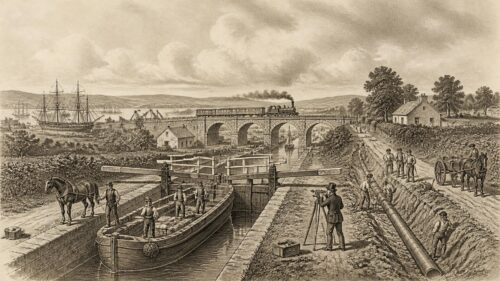
Roads were among the earliest and most visible forms of rural public provision. Ireland had long possessed tracks, paths and routes used for droving, pilgrimage, fairs and local travel, but a road capable of carrying wheeled traffic in difficult weather required sustained expenditure. In the eighteenth and nineteenth centuries, responsibility commonly rested with county grand juries, bodies dominated by substantial property holders. From 1765, grand juries could levy a cess within baronies for road construction and repair through the presentment system. This system endured until the local-government reforms at the end of the nineteenth century.
Presentments were practical instruments, but they were also political documents. They recorded proposed works, contractors and sums raised locally. Their survival reminds us that roads did not appear automatically with modern government. Someone had to put forward a proposal; a local body had to approve it; ratepayers had to bear part of the charge; an engineer or surveyor had to assess the work. Roads and bridges were thus public in the sense that they were funded for common use, but access to the decision-making process was far from equally shared. Before the extension of elected local government, the rural poor had little formal control over the systems that shaped their daily movement.
Postal communication encouraged improvement. The National Archives notes that the Post Office received authority in 1805 to set road-design standards, reflecting the importance of dependable routes for mail coaches. By 1840, private coach networks linked many provincial towns; Charles Bianconi’s services, begun in Tipperary in 1815, were part of a broader transformation in which passengers, letters, small goods and news moved more regularly through the country. These developments should not be overstated: a mail-coach road serving towns was not necessarily a convenient lane for every townland. Yet regular communication changed rural expectations. A district poorly served by a road could now be measured against places where market, post and coach connections were more reliable.
The familiar boreen has consequently acquired a larger cultural meaning than its physical dimensions suggest. In later memory it could stand for intimacy, remoteness and a world before mechanised traffic. But rural lanes were also working infrastructure. They carried turf, lime, livestock, carts, people walking to school and women travelling with household goods. Their condition mattered especially in wet weather, when a short distance could become an exhausting journey. Historical evidence does not support a universal picture of impassable isolation; some districts were comparatively well connected. It does support the conclusion that access varied dramatically between regions, and that the maintenance of small roads was as consequential as the construction of celebrated main routes.
State Works
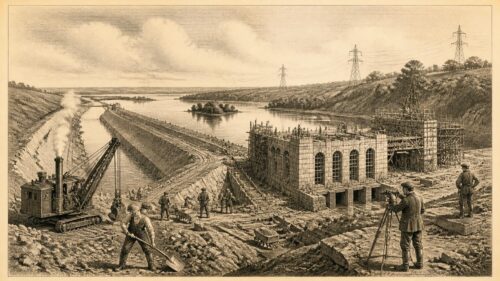
The establishment of the Board of Works in 1831 marked an important enlargement of central involvement in Irish infrastructure. Formally created as the Commissioners of Public Works in Ireland, it brought together functions previously dispersed among several bodies. It acted both as an administrative authority and as a lending agency, offering loans and grants for works considered capable of generating income or public benefit. Its inherited and expanding responsibilities embraced roads, bridges, inland navigation, drainage, fisheries, piers, harbours and later a wide range of public buildings.
This did not mean that the state had assumed complete responsibility for rural welfare. The Board’s system depended heavily on loans, local contributions and schemes that could be justified in fiscal or productive terms. Nevertheless, it created a more coherent machinery through which public money and engineering knowledge could reach remote districts. Board records include roads and bridges in counties Cork, Kerry and Limerick, drainage proposals, harbour improvements and maps prepared to support applications. Engineers such as Richard Griffith reported on individual works in a language that joined physical construction to economic expectation: better roads might enable lime or manure to travel farther, encourage house building, assist farm drainage and stimulate trade.
That language deserves cautious reading. Engineers and officials often described works in optimistic terms because they were seeking authority and funding. Roads could indeed make markets easier to reach, but they could not by themselves resolve low incomes, insecure tenure, scarce employment or unequal landholding. Infrastructure was a condition for development, not a guarantee of it. Still, the reports demonstrate that nineteenth-century public works were imagined as more than charity. They were expected to reorganise local economies by reducing the friction of distance and by making commercial exchange more predictable.
The Great Famine exposed both the necessity and the limits of public works. The Board of Works administered relief schemes involving road building and related labour. Heritage Ireland states that at the height of the Famine such works employed half a million people. The scale was immense, yet employment on roads could not meet the needs created by crop failure, hunger, disease and displacement. Famine roads have sometimes been treated in popular memory as pointless monuments to administrative failure. That judgement captures a genuine moral criticism when labour was exacted from starving people for poorly planned works, but it should not become a universal description. Some schemes produced useful roads and bridges; others were inadequate, delayed or badly suited to emergency relief. The documentary record requires distinction rather than a single verdict.
Local Power
The Local Government (Ireland) Act of 1898 was a decisive institutional change. It established elected county councils and transferred much of the administrative work previously associated with grand juries into a new system of local government. The Act came into force in 1899, opening a political arena in which tenant farmers, traders and other local representatives gained a larger role in decisions about rates, roads and public services. The Irish Statute Book preserves the Act’s provision that a council be established in every administrative county and entrusted with its administrative and financial business.
The reform did not create democracy without constraints. Central oversight remained important, local resources differed sharply, and rate-based finance could limit what poorer counties could do. Yet the new councils changed the language through which rural needs were expressed. A road might now be discussed not only as a landowner’s concern or a grand-jury presentment, but as a matter raised by elected representatives accountable to a wider local electorate. County councils acquired responsibility for roads and related works, while rural district councils dealt with housing, sanitation and parts of the public-works burden. Cork City and County Archives summarises the remit of rural district councils as housing, rural sanitation, roads and public works, alongside the provision of labourers’ dwellings.
This was more than an administrative rearrangement. It helped form habits of local political action. Ratepayers petitioned, councillors demanded inspections, county surveyors reported on conditions, and minutes recorded disputes over priorities. The records can appear dry, full of resolutions and costs, but they reveal a changing conception of public obligation. A defective bridge, a neglected road or an unsanitary housing cluster could be presented as an issue for collective decision rather than solely a private inconvenience. That principle was never applied perfectly, but it was a significant departure from the narrower structures that had preceded it.
The new system also preserved old tensions. Main roads could absorb money while lesser roads remained poor; a county-wide policy could seem remote to a townland; and local representatives could favour visible works over less conspicuous maintenance. Infrastructure remained a field in which political influence mattered. The point is not that local government solved inequality, but that it gave rural inhabitants and their representatives additional means of contesting it. The documents of county and rural district councils are valuable precisely because they show policy as an accumulation of local arguments rather than as a programme delivered intact from Dublin.
Water Burdens
Water supply demonstrates particularly clearly how distance and domestic labour shaped rural life. In towns, piped water and public sanitation developed unevenly from the nineteenth century, but the countryside often continued to rely on wells, springs, rivers, pumps and carried water long after urban systems had advanced. The Public Health (Ireland) Act 1878 empowered rural sanitary authorities to provide water, construct waterworks and wells, acquire water rights, contract for supply and maintain public wells. It also recognised that the costs of sewers, water supply and public wells might be charged as special expenses within a contributory place.
Legal authority was not the same as universal service. Sparse settlement, difficult terrain, limited local revenue and the cost of laying mains made rural provision expensive. The issue was not simply whether water existed in the landscape, but whether a safe, regular supply could be brought close to the house and maintained. Carrying water from a well or stream imposed a repeated burden, generally absorbed within household labour and often remembered particularly in relation to women. A National Archives guide to twentieth-century sources records a 1945 parliamentary discussion in which speakers described the hardship experienced by rural women required to carry water over long distances.
Such testimony is documentary evidence of complaint and aspiration, not proof that every household faced identical hardship. Some homes had good wells close at hand; others depended on more distant or unreliable sources. Contamination was another concern, especially where human and animal activity affected shallow wells or surface water. Water supply therefore joined domestic work, public health and rural retention. An inadequate supply could make housekeeping arduous, restrict dairying or other farm activity, and reinforce the attraction of towns where taps, drains and other amenities were more readily available.
After independence, the uneven inheritance of water and sanitary provision remained. The Local Government Act 1925 made each county, apart from urban portions, a rural sanitary district or county health district, with the county council acting as sanitary authority. This simplified some administrative arrangements but did not abolish the practical problem of scattered settlement. In the middle decades of the twentieth century, rural water was increasingly understood as a national developmental question: if country homes were to retain families, they required amenities comparable in principle, if not immediately in scale, to those of towns.
Community Water
One response was the group water scheme. The model combined public grant assistance with local initiative, allowing neighbouring households to organise a shared source, treatment and distribution system where a conventional public network was unavailable or slow to arrive. The Environmental Protection Agency’s research on group water schemes identifies their history as an important example of community infrastructure: rural areas often lacked piped water until the middle and later twentieth century, and local schemes became a distinctive means of supplying it.
The attraction of the model was practical. A group could make a scheme viable where individual households could not afford private works and where a large regional network was too costly. It also reflected the traditions of co-operation found in parts of rural Ireland, though such traditions should not be romanticised. Community action required meetings, subscriptions, negotiation over routes and sources, technical advice, and agreement on maintenance. It could generate local pride and control, but it could also expose disagreements about payment, management and quality. “Self-help” was never a substitute for engineering, finance or regulation; it worked because it was combined with each of them.
The gendered significance of piped water should be emphasised without reducing women’s experience to a single story. The arrival of a tap inside or near a house could reduce the physical labour of carrying water, facilitate washing and food preparation, and make sanitation more manageable. It did not automatically redistribute domestic work, but it altered the time and effort required to perform it. In this respect, water infrastructure was as socially transformative as more conspicuous projects. A pipeline might be invisible from the road, yet it changed the rhythms of household life every day.
Its history also offers a corrective to the idea that rural modernisation was delivered only by large state agencies. State policy, local-authority involvement and grant systems were essential, but rural residents themselves frequently organised and sustained services. That mixed character remains historically important. It shows that public infrastructure can be neither wholly centralised nor wholly private: it may emerge from an arrangement in which communities undertake responsibilities that government supports, regulates and gradually reshapes.
Electric Transformation
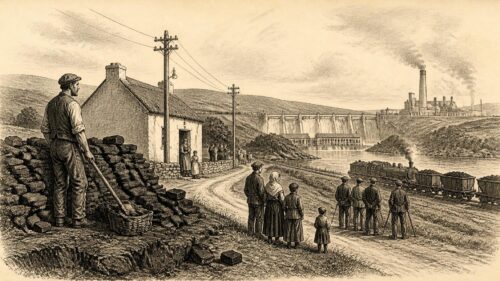
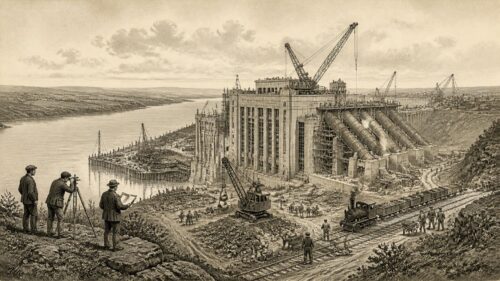
If piped water altered domestic labour quietly, electricity arrived with an unusual degree of public ceremony and memory. The Electricity Supply Board’s Rural Electrification Scheme began in 1946. ESB Archives records that its first phase ran from 1946 to 1965 and divided rural Ireland into 792 areas, commonly based on parish boundaries, across ten districts. By 1964, more than 50,000 miles of line had been strung and over one million poles erected. The scale indicates a deliberate effort to make a national system reach beyond the towns and larger villages already closer to the grid.
The scheme was not simply a matter of engineers extending wires outward in a smooth sequence. Each area had to be surveyed, householders canvassed and costs considered. Take-up mattered because a line serving more consumers offered a better financial case than one serving only a few isolated houses. This introduces an important qualification to celebratory accounts. Rural electrification was a public commitment, but it was also governed by calculations of cost, expected demand and subsidy. Households at the edge of settlement could wait longer, and the most remote places continued to pose the most difficult economic question.
The first pole was erected at Kilsallaghan in County Dublin on 5 November 1946, and the first lights were switched on at nearby Oldtown in January 1947. RTÉ Archives describes the scheme as bringing extensive social and economic change, while noting contemporary anxieties as well as enthusiasm. Oral recollections commonly stress the brightness of electric light after oil lamps and candles, the arrival of appliances, and fears among some older people about unfamiliar wires and current. Such memories are valuable evidence of experience, but they must be handled as memory rather than treated as statistical proof. They reveal how technological change was felt within households and communities.
Electricity transformed farming as well as homes. It made pumping, lighting, refrigeration, machinery and communications easier to use, although benefits varied with farm size, income and the purchase of equipment. In the home, it reduced dependence on lamps, candles and manually heated irons; in time it enabled electric cookers, kettles, washing equipment and radios. Yet electricity did not abolish poverty or isolation. An electric connection did not ensure that a family could afford every appliance, nor did it create employment in an area losing population. Its importance lies precisely in the fact that it widened possibilities while leaving wider economic pressures intact.
Uneven Access
The phrase “quiet revolution”, often associated with rural electrification, captures the deep change in daily routines but can make the process sound inevitable. It was not. ESB Archives material makes clear that rural electrification required state backing and difficult choices about subsidies. The financial problem was fundamental: extending a network through sparsely settled territory demanded heavy capital expenditure, while many potential consumers had limited incomes. A system designed solely around immediate profitability would have left many homes unconnected. The scheme’s historical significance rests partly on the decision that access to modern power could be treated as a social and national objective.
The same pattern recurred across rural services. Roads brought market access but were costly to maintain. Water supplies improved health and household convenience but demanded source protection and technical oversight. Housing schemes could replace unhealthy dwellings but required land, credit and administration. Telephones, postal services and buses reduced isolation but depended on routes, staffing and sufficient users. In each case, low population density created a permanent difficulty: the service was most expensive where it was often most needed. This was not an Irish peculiarity, but Ireland’s dispersed settlement pattern gave it particular force.
There is also a need to distinguish the history of the twenty-six counties of the Republic from that of Northern Ireland. The island contained different governmental systems after partition, and policies were not identical. Rural electrification, water administration and local government developed within separate jurisdictions, even where geographical needs looked similar. An account that refers simply to “Ireland” must therefore state its scope. This article concentrates chiefly on the institutions and programmes of the Irish state and its earlier all-Ireland predecessors, while recognising that rural communities in Northern Ireland followed their own administrative path under the Northern Ireland government and later arrangements.
Folklore and local recollection add texture to this history. Stories of a first electric bulb, a miraculous well, a road built “in famine times”, or a parish that fought for a bridge can preserve genuine local feeling. They should not be dismissed merely because they are transmitted orally. But neither should they be confused with dated administrative evidence. The strongest historical account allows the two forms to speak differently: records establish what was authorised, built or funded; memory shows how people later interpreted the meaning of those changes.
Historical Measure
The long development of rural services complicates any simple tale of backwardness followed by progress. Older communities possessed their own systems of mutual aid, local knowledge and adaptation to landscape. Wells, paths, fords, small piers and shared labour were not signs of absence. But they were often insufficient when population, commercial expectations, public-health standards and technological possibilities changed. The central historical question is not whether rural people waited passively for modernity. It is how they used existing resources, petitioned for improvements, organised collectively and contested the allocation of public money.
Infrastructure also deserves to be read as a record of labour. Roads required stone breaking, drainage, ditching, surveying and maintenance. Water schemes required digging, pipe laying and repair. Electrical networks required surveyors, pole erectors, linesmen, fitters and contractors. Much of this work was physically demanding and locally visible, even when the institutions behind it were distant. The rural landscape still bears its traces in bridge parapets, old pump houses, abandoned railway alignments, milestone routes, concrete poles and small reservoirs. These objects are historical evidence, though their original function should be established from records rather than guessed from appearance alone.
For Emerald Archives, the most useful conclusion is that rural infrastructure belongs at the centre of Irish social history. It joins the household to the state, the parish to the county, and the landscape to the wider economy. A water main or electric line may appear technical, yet each embodied decisions about taxation, need, entitlement and the value assigned to rural residence. Roads, sanitation and power did not simply serve a pre-existing countryside; they helped produce the connected countryside that later generations inherited.
The record remains unfinished in one important sense. Many historical schemes were designed around the continuing occupation of dispersed homes and farms, but rural population change, environmental regulation and new communications technologies have repeatedly altered the terms of service provision. That does not diminish the achievement of earlier generations. Rather, it explains why their works require continued maintenance, interpretation and debate. Ireland’s rural infrastructure is not merely a relic of nineteenth- or twentieth-century policy. It is an active inheritance, built through unequal conditions, collective effort and a persistent refusal to accept that remoteness should mean exclusion.
The article’s treatment of group water schemes is especially revealing because it presents rural connection as neither purely state provision nor simple self-help. Shared schemes could lessen the domestic burden of water collection and support families remaining locally, yet they also depended upon subscriptions, technical expertise, regulation and agreement among neighbours. This suggests that infrastructure’s social effects arose from governance as much as from pipes themselves. Comparing water schemes with roads or electrification, how far did community-led provision widen rural equality, and when might it have transferred disproportionate financial or organisational responsibilities onto already disadvantaged communities in Ireland’s remote districts?