

Shelter Politics
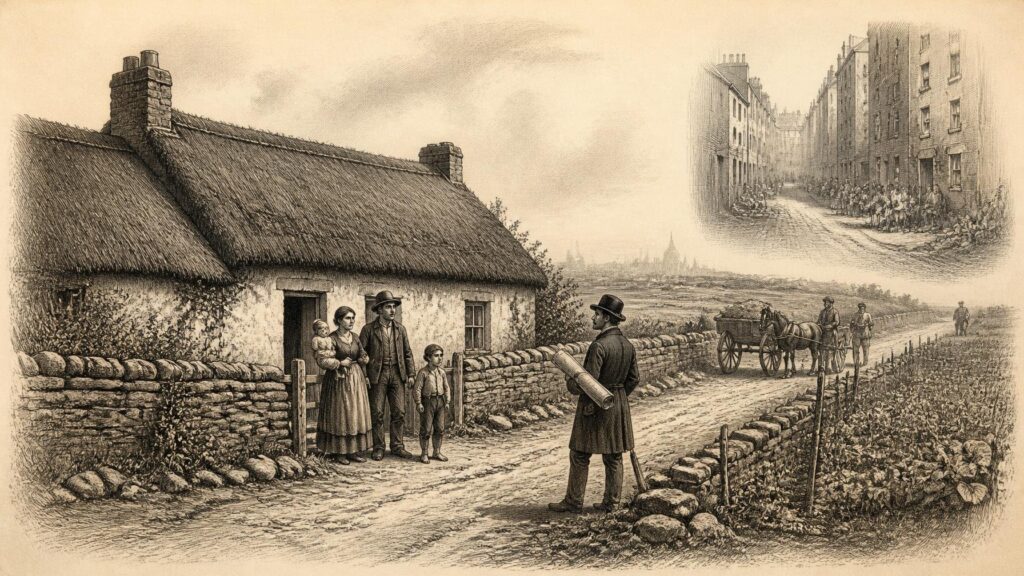
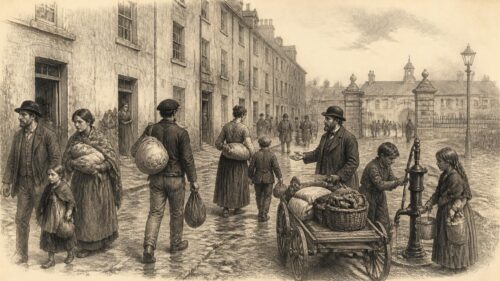
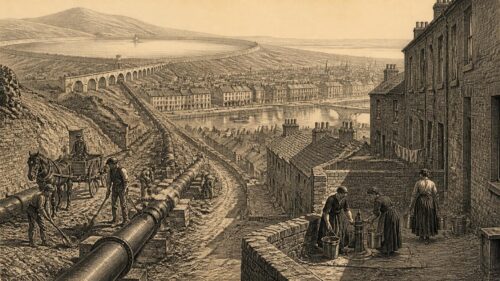
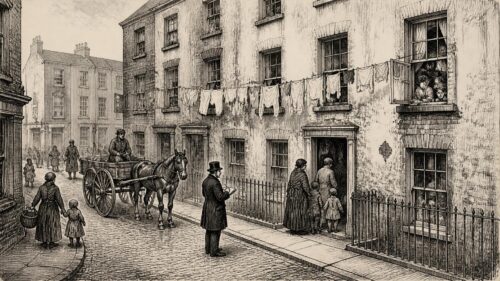
AI generated historical illustration, not a contemporary photograph.
At a Glance
Housing in Ireland has never been merely a matter of bricks, rents and roofs. It has been a question of health, land, class, family survival, local power and citizenship. From the workhouse system of the nineteenth century to municipal estates, suburban cottages and legislation addressing homelessness, policy repeatedly decided who could remain in a community, who might be moved from it, and on what terms a secure home could be claimed.
Poor Relief
Workhouse Logic
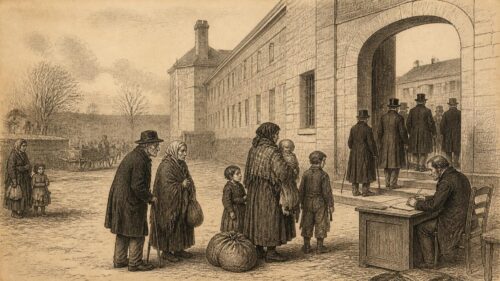
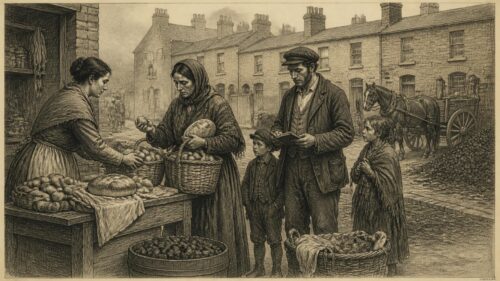
Before housing became a distinct field of public policy, inadequate shelter was treated principally as an aspect of poverty. The Irish Poor Law, introduced in 1838, created a system of unions and workhouses financed locally through the rates. It did not establish a general right to a house, nor was it designed to prevent the loss of one. Rather, it made institutional relief available to people judged destitute, subject to rules intended to ensure that relief was less attractive than independent labour. The workhouse was therefore both refuge and warning: a place where food and shelter could be obtained, but at the price of separation, discipline and stigma.
This distinction matters to the history of homelessness. A person without a secure dwelling might be accommodated by kin, lodged casually, sleep in a shed, occupy a room with another family, enter a charitable institution, or seek Poor Law relief. Such experiences were not always counted or named as homelessness in the modern sense. Nineteenth-century records more often used the languages of destitution, vagrancy, pauperism, overcrowding and insanitary housing. The absence of a familiar category does not mean that housing insecurity was absent; it means that the state and local authorities understood it through other administrative and moral frameworks.
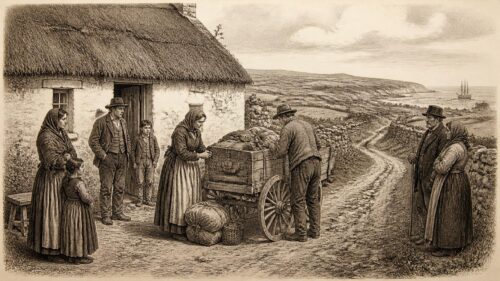
The Great Famine exposed the limits and cruelty of this framework. Workhouses became overwhelmed, while eviction, migration, disease and death transformed the geography of the country. It would be misleading to treat the Poor Law as a housing programme: it was a relief system intended to manage extreme want. Yet its boards of guardians, their buildings and their rate-funded administrative machinery later became important to the development of local public action. In rural districts especially, the institutions created to regulate poverty would help furnish the machinery through which new cottages could eventually be provided.
Historical interpretation must be careful here. It is tempting to tell a simple story in which the workhouse gave way steadily to enlightened housing provision. The documents suggest something more complicated. Public authorities did become more willing to intervene in living conditions, particularly where disease, social unrest and electoral pressure made inaction costly. But the old assumptions endured: that relief should distinguish the deserving from the undeserving, that local ratepayers should control expenditure, and that people in need could properly be moved, supervised or classified by officials.
Rural Cottages
Political Pressure
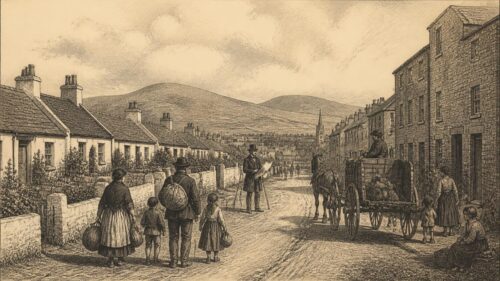
The Labourers Acts, beginning in 1883, marked a decisive departure. They enabled rural sanitary authorities to provide cottages and plots for agricultural labourers. This was not an incidental improvement in housing conditions but one of the earliest large-scale public housing interventions in the British Isles. Research based on the legislation and local records shows that, by the years before the First World War, tens of thousands of cottages had been built across Ireland. The precise totals vary according to date and method of counting, but the scale is beyond doubt: roughly fifty thousand cottages are commonly identified for the wider programme before partition.
The cottages answered a particular social problem. Agricultural labourers often occupied poor-quality cabins, had insecure tenancies, and depended heavily upon local employers and landowners. A cottage with a garden or allotment could improve sanitation and domestic comfort, but it also altered the balance of power. It gave a labouring family a more durable foothold in the countryside. The scheme was shaped by agrarian politics, nationalist agitation, public-health ideas and changing attitudes to state intervention. It was not devised solely from benevolence. Its supporters could see it as social improvement, rural stabilisation, a means to reduce conflict, or a practical way of retaining labour in districts marked by emigration.
The programme was administered locally, and that local character was consequential. Boards and later councils had to identify sites, manage loans, select tenants and collect rents. In some places the result was energetic construction; in others, local opposition, cost, weak administration or disputes over eligibility delayed progress. The cottage was therefore never simply a gift bestowed from above. It was a political object, fought over by labourers, landlords, ratepayers, officials and elected representatives. The rules of allocation could protect need, but they could also reproduce local influence.
Documentary evidence supports the importance of the cottages, but it does not justify romanticising them. Their whitewashed walls, small gardens and roadside settings became powerful emblems of rural Ireland. Folklore and family memory often invest them with a settled, almost timeless quality. In fact, they were products of legislation, loans, surveys, standard plans and public health concerns. Their appearance in the landscape can conceal the conflicts that preceded them. Nor did every labouring family obtain one. Those left in substandard accommodation, or in places where schemes were slower or fewer, remind us that public provision was uneven.
Nevertheless, the Labourers Acts established a durable principle: housing could be a public responsibility rather than merely a private transaction or charitable undertaking. They also linked a dwelling to land, household independence and long-term settlement. That connection would continue to influence Irish policy. In the decades after independence, governments often treated owner occupation, small-scale domesticity and the dispersal of working families into houses with gardens as social goods in themselves. The roots of that preference lay partly in this rural experience.
Urban Tenements
Public Health
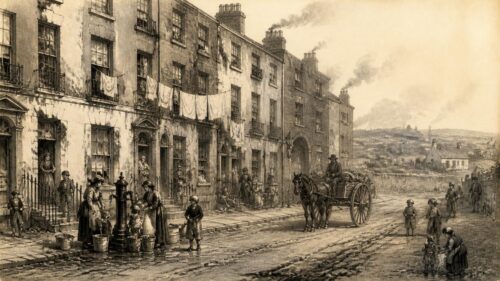
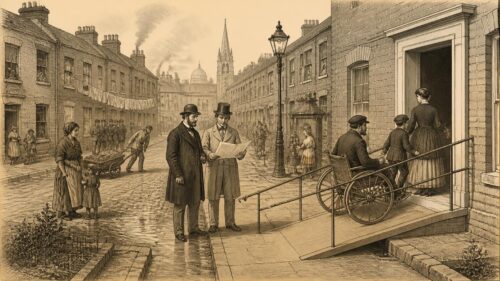
If the rural cottage represented an ambitious response to labourers’ housing, Dublin’s tenements revealed the depth of the urban crisis. Large eighteenth- and nineteenth-century houses, particularly on the north side of the city, had been subdivided into rooms and occupied by multiple households. The resulting conditions varied, and not every tenement was identical, but overcrowding, poor sanitation, damp, structural decay and high infant mortality were recurrent features in official inquiries and contemporary reporting. Housing had become inseparable from public health.
Dublin Corporation did build municipal housing from the late nineteenth century, including schemes intended for artisans and labourers. Yet early provision was small beside the scale of need, and some schemes themselves drew criticism for their construction, environment or management. This is a central lesson of the period: the state’s entry into housing did not automatically end bad housing. It created new questions about design, density, rents, maintenance and location. A dwelling might be newer than a tenement room and still fail to meet the social needs of a household.
The Church Street collapses of September 1913 brought the issue into sharp public view. A public inquiry followed, and the 1914 report on housing conditions documented grave disrepair and overcrowding. Dublin City Council’s archival material records that the inquiry identified thousands of tenement houses that were decayed or approaching unfitness for human habitation. It also exposed an uncomfortable conflict of interest: a number of Corporation members were themselves landlords of slum property. That detail is historically significant because it shows that housing failure was not simply an impersonal shortage. It was connected to ownership, political representation and the willingness of authorities to regulate people within their own institutional orbit.
The famous image of Dublin as a city of tenements can itself be misleading if handled carelessly. It is a useful shorthand for a real housing catastrophe, but it can turn residents into anonymous symbols of misery. Tenements contained families, lodgers, older people, workers, widows, children and newcomers; they supported networks of care as well as exposing people to disease and insecurity. Oral memory and popular writing sometimes stress neighbourliness, resilience and distinctive street culture. Those experiences may be genuine, but they should not be used to soften the documented evidence of structural danger, overcrowding and unequal access to decent accommodation.
The urban problem also sharpened the question of what counted as a remedy. Should families be rehoused near employment and established support networks in central flats? Should they be moved to lower-density suburban estates? Should local authorities clear unhealthy areas, regulate landlords, subsidise construction, or all of these at once? These debates, often presented as technical planning choices, carried profound consequences for family life and the social geography of the city.
Revolutionary Housing
Free State
The years surrounding independence did not suspend the housing crisis. The new Irish Free State inherited old dwellings, uneven local capacity, restricted finances and pressing demands from urban tenants and rural households. It also inherited legislation from the United Kingdom, including the Housing (Ireland) Act 1919. That Act extended the framework for working-class housing and required a more active role from local authorities. But legal powers did not guarantee immediate construction. Political instability, the aftermath of war, shortages and financial constraints shaped what could be achieved.
In the 1920s, housing policy oscillated between direct public provision and assistance to private building. Grants and loans could stimulate new construction, while municipal schemes sought to address the needs of poorer households. This mixture reflected a long-running Irish tension. Governments wanted improved housing, but many also wished to encourage a property-owning population and avoid assuming unlimited responsibility for construction and management. The result was not a single coherent model but an evolving settlement between local authorities, private builders, owner occupiers and tenants.
Urban conditions remained severe. Scholarly research on the Irish Free State’s housing policy notes that surveys conducted in 1929 revealed a substantial requirement for new homes, slum clearance and replacement dwellings. Legislation in the early 1930s placed stronger emphasis on clearance and increased state contributions, especially where local authorities rehoused people displaced by demolition. In administrative terms, this was a major acknowledgement that clearance created an obligation: an unsafe dwelling could not simply be condemned without considering where its occupants would go.
Yet rehousing was not frictionless. A new house might be too expensive for a household previously paying a low, though exploitative, rent in a tenement. A move might lengthen the journey to work, school, relatives or informal employment. Selection rules could favour those deemed respectable, stable or capable of paying rent. The record of overcrowded families declining offers because rents were beyond their means is especially revealing. It demonstrates that housing policy cannot be judged solely by the number of dwellings completed. Affordability and access determine whether physical supply becomes actual security.
The Free State’s policies should therefore be understood neither as neglect alone nor as a completed social revolution. They expanded public action and helped build new estates. They also embedded a tendency to divide households into categories: those suitable for subsidised home ownership, those eligible for local-authority tenancy, and those whose poverty remained to be managed by relief, charity or temporary accommodation. This division would remain central to later debates about homelessness.
Suburban Remedy
Displacement Costs
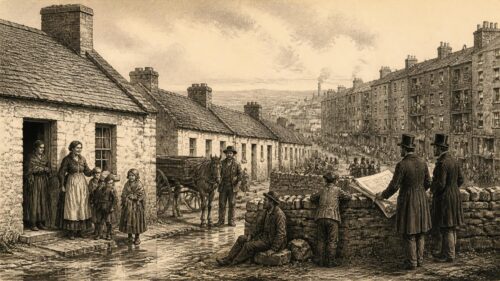
From the 1930s through the post-war decades, local-authority building transformed many Irish towns and cities. In Dublin, Corporation schemes such as Marino, Cabra, Crumlin, Ballyfermot and later Ballymun became part of the physical and social fabric of the capital. The dominant answer to the inner-city tenement problem was increasingly suburban: houses or flats on newly developed land, usually at lower densities and often with more modern services than the rooms they replaced.
This remedy brought genuine improvements. Families gained access to separate rooms, sanitation, gardens or yards, and housing that was generally less dangerous than the decayed buildings from which many had come. The decline in the prevalence of very large households living in one room, recorded in mid-century census-based material, indicates a significant improvement over time. Differential rents, introduced for Corporation housing in 1950, were also important because they tied rent more closely to capacity to pay. For households excluded by flat rents, this could make rehousing practicable.
But suburbanisation was also a policy choice with costs. It could remove poorer residents from central neighbourhoods without supplying equivalent local employment, transport, shops or social facilities. Some estates were well planned; others developed faster than their amenities. In Dublin, the balance between central flats and suburban cottages was bound up with class. Research on the 1930s observes that the tendency to house poorer households in central flats and somewhat better-off workers in suburban houses could reinforce social segregation. Architecture and tenure thus became methods of sorting the population.
The physical collapse of Dublin tenements did not end in 1913. A fatal collapse in 1963 again demonstrated how long unsafe accommodation had endured and intensified the pressure for rapid rebuilding. The subsequent turn towards high-rise construction, especially Ballymun, should not be read only as an architectural fashion. It was also an emergency response to a backlog of need. High-rise blocks offered a way to house large numbers quickly, but they carried demanding requirements for management, maintenance, services and community infrastructure. Where these were inadequate, the promised solution could generate fresh difficulties.
The historical record cautions against treating low-rise housing as inherently humane and high-rise building as inherently disastrous. Outcomes depended on workmanship, maintenance, tenant participation, neighbourhood resources and the wider allocation of public investment. The more reliable conclusion is that rapid construction cannot substitute for sustained stewardship. Housing is a long-term public commitment, not merely a completed building contract.
Ownership Policy
Changing Tenure
Post-war Irish housing policy was strongly associated with home ownership. State grants, local-authority loans, tenant-purchase measures and other supports encouraged households to acquire homes. This preference had political appeal. It could be presented as independence, security, family advancement and a bulwark against poverty. It also aligned with the earlier rural association between a home, a plot of land and social respectability.
There were real benefits for many purchasers. Ownership could provide a degree of permanence unavailable in insecure private renting, and it helped many families accumulate an asset over time. Yet a historical account must distinguish individual gains from the distributional effects of a policy. Programmes that reduced the public rental stock through sales might make sense for a tenant able to buy, but they could narrow the pool of dwellings available to households with low incomes or unstable employment. Parliamentary evidence from the late 1980s reflects official concern that one surrender-grant approach, initially seen as economical, had severe social consequences in some estates and contributed to concentration of disadvantage.
This does not mean that owner occupation caused homelessness in any simple fashion. Homelessness has many causes: eviction, family breakdown, ill health, violence, institutional discharge, unemployment, addiction, migration and a shortage of affordable homes can all matter. But the historical development of tenure matters because it affects the options available when a household cannot buy and cannot sustain market rent. A system heavily organised around ownership can leave a residual group dependent on a limited social rented sector, emergency services or informal arrangements.
By the later twentieth century, housing policy increasingly used the language of affordability, supply and finance. These were necessary concerns, but they could obscure the older question of power. Who owns the land? Who sets rents? Which authority has a duty to act? Who is entitled to remain in a neighbourhood when property values rise or buildings are cleared? Irish history shows that such questions recur even when the institutional vocabulary changes.
Homeless Recognition
Service Responses
For much of Irish history, people without secure shelter were addressed through Poor Law institutions, religious organisations, voluntary bodies, hostels and informal family support rather than through a dedicated homelessness policy. Charitable and voluntary action was indispensable, especially in Dublin. The emergence of organisations serving homeless young people in the 1960s and 1970s reflects both civic commitment and a gap in public provision. Their histories should be respected, but charity should not be confused with a guaranteed entitlement to housing.
A major legal change came with the Housing Act 1988. For the first time in Irish housing legislation, homelessness was expressly addressed in statutory form. Local authorities were required to have regard to homeless people in assessing housing need and gained powers to provide accommodation or financial assistance. This was a turning point in recognition. It did not abolish homelessness, and it did not create an unconditional legal right to a permanent home for every person in need. It did, however, place homelessness inside the formal responsibilities of housing authorities rather than leaving it solely to welfare administration and voluntary intervention.
That shift is important historically because it changed the public meaning of homelessness. Earlier systems often treated people without homes as marginal cases of individual misfortune, moral failing or extreme poverty. The 1988 framework more clearly connected homelessness to the housing system itself. Later policy has continued to combine emergency accommodation, local-authority functions, voluntary-sector services, private rented supports and housing-led approaches. Such arrangements recognise that homelessness can involve health and social needs, but they also risk allowing temporary provision to substitute for secure housing.
The evidence supports a guarded conclusion. Statutory recognition represented progress in administration and public responsibility. Yet it also shows the limits of recognition without sufficient affordable and permanent homes. Emergency beds can prevent immediate danger; they do not by themselves resolve the loss of a tenancy, the separation of a family, or the insecurity of a person repeatedly moved between temporary placements. Historical continuity lies not in the identical form of housing distress, but in the repeated tendency for those with least economic power to be offered conditional, temporary or institutionally managed shelter.
Historical Judgement
The history of Irish homelessness and housing policy is not a straight march from workhouse to welfare state, nor an unbroken story of official failure. It contains important achievements: rural cottages on a remarkable scale, the gradual acceptance of public responsibility for housing, municipal rebuilding, rent reforms, and the eventual statutory naming of homelessness. These measures improved the lives of many people, sometimes profoundly.
It also contains exclusions and contradictions. Clearance could displace as well as rescue. New estates could relieve overcrowding while separating households from livelihoods and kin. Home ownership could enhance security while diminishing the stock available to those unable to purchase. Charities could provide humane help while exposing the absence of an enforceable public guarantee. Policy repeatedly defined housing need, but it also defined eligibility, respectability and priority.
The strongest historical interpretation is therefore one of contested responsibility. Irish governments and local authorities did not stand outside the housing problem; their laws, loans, building programmes, rent systems and land decisions helped make the housing system that people inhabited. Equally, tenants, labourers, reformers, voluntary organisations and local communities shaped that system through agitation, evidence, electoral pressure and everyday persistence. Housing history belongs not only to ministers and planners, but to the families who resisted eviction, endured crowded rooms, accepted or refused a new tenancy, and insisted that shelter was more than relief from destitution. It was the foundation from which ordinary life could be lived.
One striking theme is the persistence of housing as a mechanism for sorting citizens: from workhouse discipline to cottage allocation, tenement clearance, suburban rehousing and owner-occupation policies. The article shows that improvements in physical conditions could still produce exclusion when rents were unaffordable, communities were disrupted, or eligibility rules privileged households considered respectable. Its refusal to present a simple narrative of progress is valuable. It suggests that security depends not only on building numbers, but also on tenure, location, affordability and power. How should we assess Ireland’s housing reforms when material improvements and forms of displacement or exclusion occurred simultaneously?