

Cultural Continuities
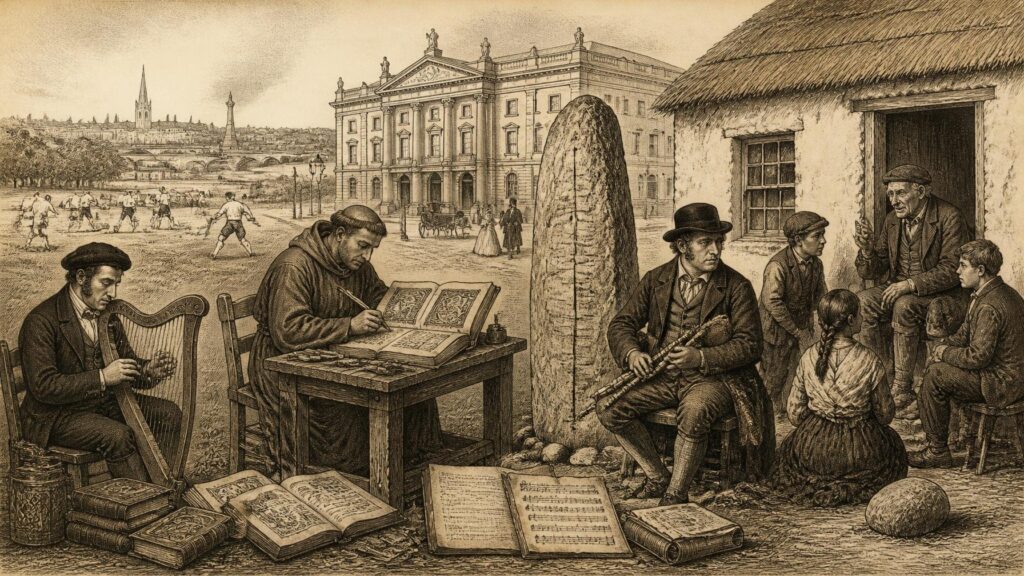
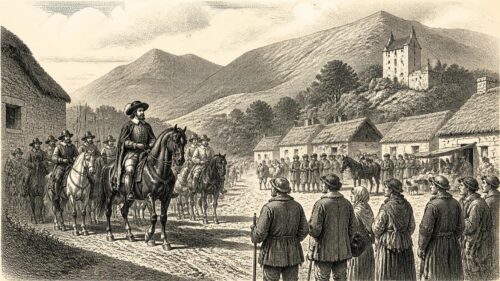
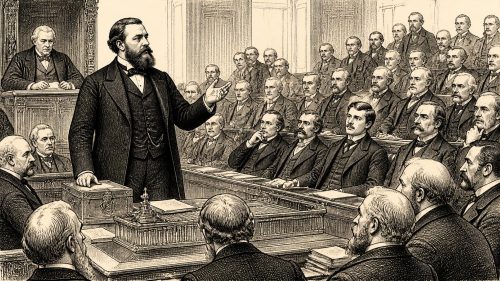
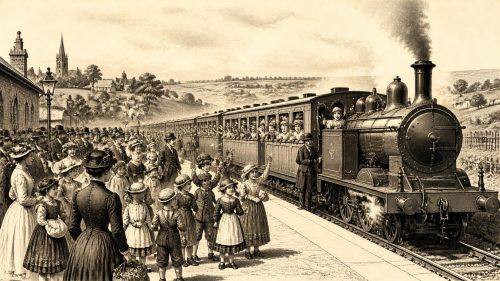
AI generated historical illustration, not a contemporary photograph.
At a Glance
Irish cultural history is not a procession of fixed national emblems, nor a simple survival from an undisturbed ancient past. It is a record of making, loss, preservation, argument and renewal: a history in which languages, stories, performances, games, manuscripts and institutions have repeatedly been altered by conquest, migration, religious change, political aspiration and contact with the wider world. Its milestones matter not because they establish one uncontested definition of Irishness, but because they show how people in Ireland, and Irish communities abroad, have continually debated what should be remembered, spoken, played, written and passed on.
Living Inheritance
To speak of Irish cultural milestones requires a preliminary caution. Culture is not a single possession held equally by every person on the island. Ireland has long contained Irish and English speakers, Catholics and Protestants, people of varied regional identities, Travellers, migrants and communities shaped by links with Britain, Europe, North America and beyond. The history of culture therefore cannot be reduced to a march towards a predetermined national identity. It includes shared practices, but also disagreement over ownership, authority and representation.
Nor should the word “Irish” be used carelessly as though it had always carried the same political meaning. Medieval learned culture flourished in Irish and Latin long before the modern nation-state. Later, cultural activity developed under English and then British rule, within a society whose inhabitants held sharply different constitutional loyalties. After partition, cultural institutions and experiences also unfolded under separate jurisdictions in the Irish Free State, later Ireland, and Northern Ireland. A serious historical account must keep these changes in view.
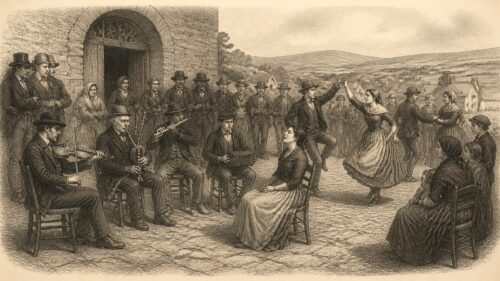
Yet continuities are real. The Irish language, storytelling, song, instrumental music, visual art, drama, sport, religious observance and local custom have supplied ways in which communities recognised kinship with a place or a past. Such inheritances have rarely remained unchanged. Their endurance has depended on adaptation: the copying of an old text into a new manuscript, the transformation of oral narrative into print or recording, the teaching of a dance in a hall rather than at a hearth, or the performance of a tune before emigrant audiences far from Ireland.
For this reason, the decisive moments in Irish cultural history are often not merely acts of creation. They are moments of transmission. A carved stone, a vellum book, a school copybook, a theatre programme and a sound recording can each be a cultural milestone because each carries practices beyond the lifetime of an individual performer or speaker. The institutions which collected and interpreted such material have been important, but they have also shaped the archive. What survives is not identical with everything that was once lived.
Earliest Marks
The earliest securely visible evidence for a vernacular writing tradition in Ireland is found not in romantic tales of druids but in ogham inscriptions. These inscriptions, generally cut along the edges of standing stones, employ a distinctive system of strokes and notches. Their language represents an early form of Irish, and their survival offers material evidence that language, names and commemoration could be fixed in a durable public form. Dates for individual stones and the broader development of ogham remain matters for specialist study; it is wiser to speak of late antique and early medieval contexts than to assign falsely exact prehistoric origins.
Ogham has acquired a powerful imaginative place in modern culture. It is often presented as a mysterious “Celtic alphabet” or as proof of an unbroken ancient wisdom. The stones themselves support more modest, though still remarkable, conclusions. They attest to literacy, naming and memorial practice. Their inscriptions do not by themselves confirm every later story attached to them. Distinguishing the inscription from modern symbolism is not an attempt to diminish ogham; it is a way of respecting the particular historical achievement it records.
Christianity altered the cultural landscape of Ireland, bringing new ecclesiastical networks and a Latin literary culture. Rather than extinguishing vernacular expression, this encounter created conditions in which Latin and Irish could interact. The surviving early medieval textual tradition contains religious, legal, grammatical, genealogical, historical and imaginative material. Its very breadth unsettles the old caricature of an isolated island devoted only to sanctity or myth. Ireland participated in a wider Christian world while producing learned traditions with distinct local forms.
The phrase “island of saints and scholars” belongs chiefly to later commemoration and popular shorthand. It should not be treated as a complete description of early medieval life. It can conceal political conflict, social hierarchy and the movement of people and ideas across the Irish Sea and continental Europe. Nevertheless, the quantity and variety of medieval Irish learning that survives in manuscripts make clear that literacy and scholarship were central cultural forces. The important point is not that Ireland stood outside Europe, but that its learned communities were part of Europe while cultivating Irish-language intellectual traditions of exceptional richness.
Medieval Worlds
Medieval manuscripts are among the most consequential monuments of Irish culture. They preserve texts whose composition, copying and reshaping took place across centuries. Some are celebrated for ornament and illumination; others matter chiefly for the words they preserve. The modern viewer may be drawn first to the visual splendour of a manuscript page, but books were also working objects. They were read, copied, glossed, rearranged and used to establish authority in matters of genealogy, law, history, devotion and poetry.
The Book of Kells has become the best-known emblem of this inheritance, but Irish manuscript culture cannot be understood through a single masterpiece. Later compilations, including great books associated with learned families and ecclesiastical patrons, preserve prose, poetry, genealogies, historical material and grammatical learning. The Book of Uí Mhaine, written in the late fourteenth century for Muircheartach Ó Ceallaigh, is one important example. Such manuscripts reveal a culture of compilation in which old and contemporary material could be gathered into new constellations. Preservation was never purely passive: every selection and copying decision remade the inheritance.
The relationship between oral and written culture was similarly complex. Irish tradition contains tales of heroic figures, otherworldly journeys, saints, kings and local places. Some narratives were recorded in manuscripts long after their earliest imagined settings; others were repeatedly reshaped by scribes and storytellers. Folklore may preserve clues to older beliefs or social memories, but it is not a transparent window on a remote past. A nineteenth- or twentieth-century story about an ancient hero tells historians much about the teller’s world as well as about the supposed antiquity of the hero.
That distinction is particularly important with figures such as Cú Chulainn, Fionn mac Cumhaill and Brigid. Their cultural afterlives are immense, and they have inspired literature, political imagery, devotional practice and commercial design. Yet the evidential status of every associated episode differs. Some stories exist in medieval textual witnesses; others are later folktales, local traditions or modern inventions. The power of folklore lies not in its literal verification but in its capacity to show how communities gave meaning to landscape, memory and moral experience.
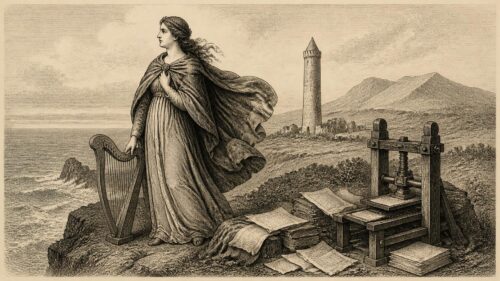
Music also formed part of this medieval cultural imagination, although surviving evidence is uneven. The harp became a compelling sign of Ireland in poetry, visual representation and later nationalism. It is tempting to describe it as an eternal national emblem, but symbols have histories. Instruments, repertories and modes of patronage changed. The harp’s endurance as an emblem owes much to later revival, collecting and institutional use, as well as to older musical practice. A milestone is therefore not simply the existence of an instrument, but the repeated decision to make it stand for a cultural inheritance.
Colonial Fractures
The centuries of English and British expansion in Ireland transformed cultural conditions without producing a uniform result. Political power, landholding, law, religion and education all affected which languages and cultural forms could command status. English became increasingly important in administration, commerce and social advancement. Irish continued to be spoken widely for a long period, but its public standing and demographic strength were increasingly vulnerable. The decline was not the product of one single policy or event; it arose through a long convergence of economic pressure, migration, schooling, social aspiration and political inequality.
The nineteenth century brought an especially severe rupture. The Great Famine caused death, displacement and emigration on a vast scale, with especially grave consequences in many Irish-speaking districts. It is historically inadequate to say that the Famine alone “killed” the Irish language, because language shift had begun earlier and continued through later generations. But it deepened the crisis by devastating communities in which Irish was strongest and by binding survival, mobility and opportunity to English-speaking worlds.
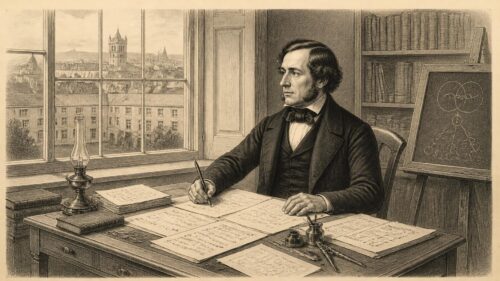
Print culture expanded in the same century, creating new possibilities for newspapers, pamphlets, fiction, political argument and popular entertainment. Irish culture was not simply overwhelmed by English culture; it was also remade through bilingual and English-language production. Writers, antiquarians, translators and collectors sought out Irish manuscripts, songs and local traditions. Their efforts preserved materials that might otherwise have vanished, but collecting could involve unequal relationships. A learned editor or metropolitan publisher decided what was worthy of transcription, standardisation or publication, while local speakers and performers were often treated as sources rather than as interpreters in their own right.
The idea of a pristine, wholly Gaelic Ireland lost to modernity emerged with special force during this period. It could be emotionally and politically potent, particularly in the wake of famine and displacement. Yet it was always selective. It could obscure the long history of cultural exchange, the place of Protestant antiquarians and writers, the presence of urban workers, and the reality that Irish people had for generations lived in more than one language. Cultural loss was genuine; a single uncomplicated past was not.
These tensions shaped later revival. Those who wished to restore Irish language, music, games and literature did not begin with an untouched inheritance. They worked from fragments, archives, living practices and idealised reconstructions. The achievement of the revival lay partly in making those materials newly usable. Its limitation lay partly in treating particular rural, Catholic or Gaelic forms as the sole authentic expression of an entire people.
Revival Institutions
From the closing decades of the nineteenth century, cultural organisations gave the idea of Irish renewal durable public form. The Gaelic Athletic Association, founded in 1884, encouraged the organisation and promotion of games such as hurling and Gaelic football. The Gaelic League, founded in 1893 by Douglas Hyde and Eoin MacNeill among others, placed the language at the centre of a broad programme of cultural restoration. Literary societies, publishers, collectors, choirs, teachers, artists and theatre-makers created an energetic associational world in which culture became a public cause.
This was a significant milestone because it shifted cultural practice from private inheritance and local custom into organised national networks. Classes, competitions, periodicals, festivals and branches made it possible to learn Irish, play games, perform music or debate literature with strangers who shared a cultural ambition. The organisations were not identical in purpose. The GAA, the Gaelic League and literary revivalists worked through different media and attracted people with different politics. Their common historical importance lies in the way culture became a means of collective mobilisation.
The revival was not politically neutral, even when organisations formally declared non-partisanship. It influenced the language, symbols and outlook of many people who later participated in revolutionary politics. The National Library of Ireland rightly identifies cultural activists, including those associated with the GAA, Gaelic League and Irish Literary Revival, as contributors to the intellectual formation of many involved in 1916. That connection should not be exaggerated into a claim that cultural revival automatically caused rebellion. The movements included people of divergent constitutional views and religious backgrounds. Culture offered a vocabulary through which political possibilities could be imagined; it did not dictate one political outcome.
Nor was the revival merely backward-looking. It used modern means: voluntary associations, newspapers, commercial printing, public lectures, urban venues and international contacts. Its leaders and critics argued intensely about language, class, gender, rural life and the relation between Ireland and the wider world. Writers such as James Joyce resisted versions of cultural nationalism that they considered restrictive, even while drawing deeply on Irish places, speech and history. The revival therefore produced both a canon and a counter-canon.
The language question demonstrated the movement’s achievement and difficulty. Irish was made a subject of mass teaching and an emblem of public identity, while native speakers in the Gaeltacht continued to carry living linguistic traditions. These were not always the same thing. Classroom competence, standardised grammar and official policy could help secure the language’s position, but they could not automatically reproduce the everyday social conditions in which a minority language thrives. The distance between symbolic honour and habitual use would remain one of modern Ireland’s central cultural questions.
Theatre Arguments
The founding of the Abbey Theatre in Dublin in 1904 marked a turning point in the institutional history of Irish drama. Established as a national theatre by W. B. Yeats and Lady Gregory, it provided a permanent stage on which Irish subjects, speech and social tensions could be presented to a public that was not merely local. Its first performances included new work by Yeats and Gregory. The theatre’s importance lay not simply in prestige but in its assertion that drama could be a serious arena for national self-examination.
That examination was frequently uncomfortable. J. M. Synge’s The Playboy of the Western World provoked disturbances in 1907, demonstrating that claims to represent “the people” could quickly become disputes over dignity, morality and ownership. Some objectors believed the play insulted Irish women or caricatured rural life; others defended artistic freedom and the play’s language. The episode is often reduced to a colourful anecdote about theatrical riots. Its deeper importance is that it exposed a recurring problem in cultural nationalism: who has authority to portray a community, and can a national theatre criticise the nation it serves?
The Abbey’s story also complicates any claim that cultural revival was culturally narrow or socially harmonious. Its repertoire, patrons, performers and audiences brought together people of differing backgrounds. It could foster national feeling, but it could also reveal fracture: between urban and rural experience, between public morality and artistic experiment, between revolutionary hope and post-revolutionary disappointment. Its archive records disputes over censorship and controversy as well as artistic success.
Irish writing in English made another set of cultural milestones possible. Yeats, Synge, Lady Gregory, Joyce, Samuel Beckett, Elizabeth Bowen, Flann O’Brien and many others cannot be fitted easily into a single nationalist narrative. Their work has been read internationally, but its force often depends on a close engagement with Irish speech, institutions, memory and place. English-language Irish literature was not evidence of cultural failure. It became one of the principal means through which Ireland interpreted colonial inheritance, religious authority, urban life, exile, family and modernity.
The publication of Joyce’s Ulysses in 1922, outside Ireland, is especially suggestive. Its modernist scale and difficulty did not make it less Irish. Its Dublin was intensely particular, built from streets, advertisements, habits, politics and remembered voices. Yet its publication abroad also reminds us that Irish cultural history cannot be confined to the island. Censorship, migration, publishing networks and diasporic readerships shaped what could be written, circulated and received.
State Memory
Independence created new opportunities for cultural policy, but it also created pressures to convert a diverse revival into an official national culture. The Irish Free State inherited a language already weakened as a community vernacular and made Irish central to education and public symbolism. The state supported distinctive national institutions, commemorations and artistic projects. Such measures helped establish cultural infrastructure, yet official endorsement could turn living traditions into tests of loyalty or respectable display.
Irish was constitutionally and symbolically elevated, but language revival could not be measured solely through official status. The Central Statistics Office’s 2022 census results show both resilience and difficulty. Nearly 1.9 million people aged three and over reported that they could speak Irish to some degree, while far fewer used it daily outside education. The figures demonstrate that the language remains a major element of public knowledge and identity, but also that ability, fluency and regular social use are not interchangeable. Cultural history is clearest when it admits this complexity rather than claiming either triumph or extinction.
State-building also affected memory. Public commemoration could honour revolutionary sacrifice, rural virtue, the Irish language and Catholic moral authority, while marginalising experiences that fitted less comfortably: Protestant traditions, working-class radicalism, women’s independent political work, Traveller culture, LGBTQ lives and the cultural history of Northern unionism. The omissions were neither total nor permanent, but they mattered. They influenced school curricula, monuments, broadcasting and the stories through which citizens were invited to imagine the nation.
Folklore collecting was among the most ambitious cultural projects of the twentieth century. The Irish Folklore Commission, established in 1935, sought to record traditions that collectors feared might disappear. Its Schools’ Collection, assembled between 1937 and 1939, enlisted more than 50,000 children in 5,000 primary schools in the twenty-six counties of the Irish Free State. The result was approximately 740,000 pages of material concerning oral history, stories, customs, games, crafts and local knowledge.
This was an extraordinary act of preservation, but it should be read critically as well as gratefully. Teachers, official questionnaires, transcription practices and institutional priorities influenced what children recorded and what entered the bound volumes. The collection is not an unmediated transcript of “the folk.” It is evidence of tradition, certainly, but also evidence of 1930s schooling, state culture and relationships between generations. Its later digitisation has made it possible for communities and researchers to revisit a vast archive that was once accessible chiefly through specialist institutions.
Diaspora Exchanges
Emigration has been one of the strongest forces in Irish cultural history. It carried language, music, religious practice, political argument and family memory abroad; it also returned altered versions of each. The Irish diaspora did not simply preserve a frozen homeland. In Britain, North America, Australia and elsewhere, emigrants formed associations, newspapers, parishes, music sessions and political organisations. They adapted customs to new cities and new neighbours. The result was not culture diluted by distance, but culture remade through distance.
Traditional music offers a vivid example. Tunes and instruments travelled with performers, while recordings, radio, competitions and touring later multiplied their reach. Uilleann piping, now inscribed by UNESCO on the Representative List of the Intangible Cultural Heritage of Humanity, is practised in Ireland and among communities abroad. Its history includes transmission from player to learner, but also the work of organisations, instrument makers, archives and recordings. A tradition remains living not because it avoids technology, but because practitioners find ways to use technology without abandoning skill, repertoire and social relationship.
The harp and hurling likewise became powerful diasporic signs. Their meanings have never been entirely innocent. Symbols can unite people, but they can also imply that only one lineage is fully entitled to belong. A more capacious historical view recognises the cultural importance of Gaelic games and traditional music without treating them as the sole measures of Irishness. Irish identities have also been articulated through Protestant hymnody, marching traditions, Ulster Scots language and music, English-language urban culture, Traveller performance, immigrant creativity and many other forms.
Partition intensified the need for this broader view. Cultural life in Northern Ireland was shaped by constitutional conflict, segregation and competing historical narratives, but it was never reducible to them. Writers, musicians, artists and community groups worked within a society where the labels “Irish” and “British” could be politically charged and personally overlapping. The peace process did not erase those histories, but it created further space to consider culture as a field of encounter rather than a weapon of possession.
Plural Republic
Late twentieth- and early twenty-first-century Ireland has seen renewed attention to histories once pushed to the margins. The recovery of women’s writing, the study of Traveller traditions, the public discussion of institutional abuse, changing religious practice, migration and the recognition of more diverse family and sexual identities have altered the cultural record. These changes do not replace older inheritances. They revise the terms on which inheritance is understood.
Contemporary Irish culture is consequently multilingual and transnational in ways that are not wholly new but are now more visible. Irish and English remain central, while Polish, Lithuanian, Arabic, Chinese, Portuguese and many other languages are heard in Irish towns and cities. This diversity should not be framed as a threat to historical culture. It offers a reminder that culture is made through participation, not merely descent. The Irish language itself has drawn learners and speakers from backgrounds beyond inherited Gaeltacht or family connections.
Archives and museums have a particular responsibility in this setting. They can preserve endangered materials and make them accessible, but they can also reinforce old hierarchies by deciding whose documents count. The National Library of Ireland’s manuscript holdings, the National Folklore Collection and theatre archives make possible a richer history precisely because they contain more than a polished official story. They preserve correspondence, drafts, recollections, recordings and local testimony through which the past can be questioned.
The most responsible use of such collections is neither reverence nor dismissal. Documents are evidence, but each document has a maker, a purpose and a route of survival. Folklore is not inferior to written history, though it demands different questions. A legend may not verify an event, yet it can show how a community understood danger, landscape, ancestry or loss. A census can count reported language ability, yet it cannot by itself describe the intimacy of a household conversation. A theatre archive can record a controversy, yet it cannot fully capture the experience of a startled audience.
Continuing Practice
The most enduring Irish cultural milestone may therefore be the refusal of culture to remain settled. Ogham stones, medieval manuscripts, revival societies, the Abbey stage, school folklore notebooks, music sessions and contemporary bilingual publishing all testify to continuity. But the continuity is not one of sameness. It is a chain of choices made under changing conditions: to retain a word, copy a poem, teach a tune, defend an unpopular play, gather a grandparent’s memory, or create new art from an inherited form.
Historical evidence supports the importance of these acts, while also requiring restraint. We can document the survival of early Irish writing, the manuscript tradition, the nineteenth-century language shift, the organisations of the cultural revival, the founding of the Abbey, the Schools’ Collection and modern efforts to safeguard musical practice. We should not claim that every modern custom descends unchanged from antiquity, nor that every national symbol has a single uncontested meaning. Folklore and patriotic memory have their own truths, but they must be distinguished from demonstrable fact.
Viewed in this way, Irish culture is neither a museum piece nor a slogan. It is a continuing argument conducted in many accents, languages and art forms. Its great moments have often arisen from danger and uncertainty, but also from imagination: the conviction that what is fragile can be carried forward, and that inherited culture becomes most valuable when it remains open to scrutiny, participation and change.
Most compelling is the article’s distinction between cultural survival and cultural transmission. Ogham, manuscripts, folklore, Irish-language teaching and the harp gain meaning not merely through age, but through later decisions to copy, collect, standardise, perform and symbolise them. This complicates authenticity: revival may protect vulnerable practices while also privileging particular rural, Catholic or Gaelic versions of Irishness over other experiences, including those of diaspora and minority communities. The article suggests that archives and institutions influence which heritage becomes visible. How might contemporary Irish cultural institutions safeguard inherited traditions while allowing diverse communities to reinterpret, question and broaden this contested inheritance?