Mag Itha’s Second Encounter733 CE
In 733, Áed Allán of Cenél nEógain again fought Cenél Conaill at Mag Itha in the Finn valley, killing Conaing of Fánad and many others, strengthening his northern position. The annals place this conflict within wider rivalry among Northern Uí Néill dynasties, without proving an immediate all-Ireland kingship. Elsewhere, Dúngal violated sanctuary on Tory Island, while succession and deaths exposed instability in Dál Riata. Killings, defeats and contested authority at Tailtiu and Tlachtga reflected regional insecurity. Obituaries from Clonmacnoise and Armagh, Donnchad Midi’s birth, and a remarkable cow recorded at Delg Inis reveal intertwined political, ecclesiastical, maritime and pastoral worlds.
Dateline
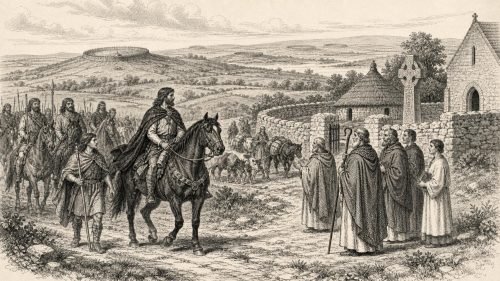
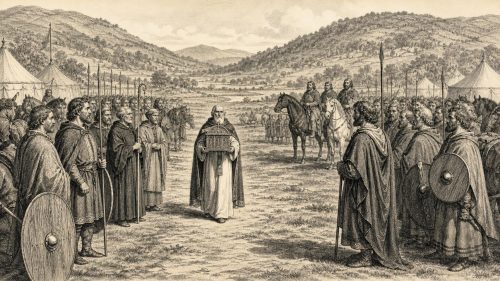
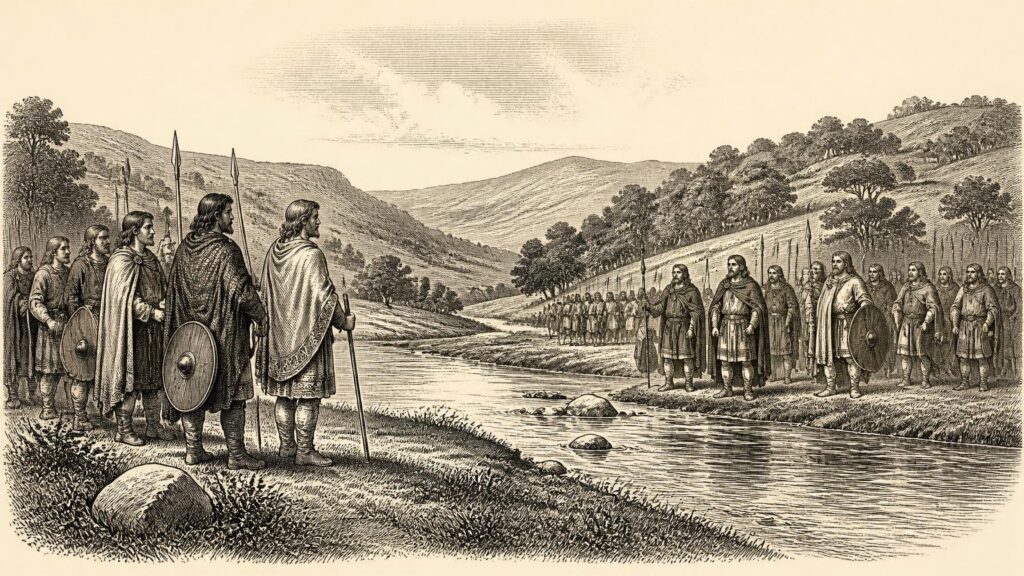
In 733 CE, a further violent encounter between Áed Allán son of Fergal and the Cenél Conaill was recorded at Mag Itha, in the Finn valley of north-western Ireland. Conaing son of Congal son of Fergus of Fánad, together with “many others”, fell. The entry is exceptionally brief, but its wording matters: this was not presented as an isolated clash, but as another meeting in a continuing struggle between two great branches of the Northern Uí Néill. Other notices assigned to the same year range from a violation of sanctuary on Tory Island to deaths at Tailtiu and Tlachtga, from a succession in Dál Riata to the birth of a future king of Tara. Taken together, they show an island divided among many local rulers, yet connected by dynastic rivalries, church networks and sea routes.
A Battle in the Finn Valley
The most securely dated Irish political event of the year is the fighting at Mag Itha. The Annals of Ulster and the Annals of Tigernach, though preserved in later manuscripts, both place an “another encounter” there between Áed son of Fergal and the Cenél Conaill. Mag Itha lay in the fertile lowlands around the River Finn, in what is now eastern County Donegal and the vicinity of the Tyrone border. It was a strategic borderland: associated with Cenél Conaill interests, but close to the expanding power of Cenél nEógain. Control of such plains meant access to cattle, grain-producing land, roads and river crossings, as well as influence over dependent communities.
Áed Allán was the leading figure of Cenél nEógain, whose principal homeland lay further north and east. His opponents, the Cenél Conaill, were their Uí Néill kindred and rivals, associated above all with Tír Chonaill. Both dynasties claimed descent from Niall Noígiallach and competed for primacy in the north and, at times, for wider authority in Ireland. This shared ancestry did not lessen the rivalry; rather, it supplied the language in which claims to precedence were made. The death of Conaing of Fánad is the one named casualty in 733, but the annals’ reference to many more dead signals that the losses were not confined to a duel between aristocrats.
It would be unsafe to reconstruct the battle’s tactics, size or exact site. No contemporary narrative describes formations, weapons, prisoners or plunder. Early Irish warfare, however, was normally conducted by the military followings of kings and by allied client peoples, not by a permanent national army. A victory could alter the balance of tribute, hostage-taking and allegiance without creating a modern territorial frontier. The point firmly supported by the annals is narrower but important: Áed Allán was able to fight again in Mag Itha, inflict serious losses on the Cenél Conaill, and kill a prominent man from Fánad.
Áed Allán’s Northern Ascendancy
The word “again” places the battle within a sequence rather than at its beginning or end. Áed’s father, Fergal, had been killed in Leinster in 722, while Flaithbertach son of Loingsech of Cenél Conaill had emerged as the foremost northern Uí Néill ruler. By the early 730s Áed was challenging that order. The contest at Mag Itha therefore belongs to the hardening conflict through which Cenél nEógain gained an advantage over Cenél Conaill. It should not, though, be described as the final transfer of an all-Ireland kingship in 733. Medieval regnal language is often retrospective, and the annalistic evidence assigns Áed’s assumption of wider kingship to the following year.
A later compilation, the Fragmentary Annals of Ireland, attaches a dramatic episode to approximately this moment: Flaithbertach was defeated, brought a fleet from Pictish Fortriu against Cenél nEógain, and most of it was drowned; it also states that he died in that year. This account cannot simply be treated as a firm record for 733. Its chronology is problematic and differs from the nearer annalistic sequence. It is valuable as evidence of a remembered political crisis and of connections across the North Channel, but the 733 article must keep the securely placed Mag Itha encounter separate from that later, chronologically uncertain story.
Nor was the north a sealed Irish arena. The same year’s annals turn repeatedly towards the sea and the western coast of Scotland. They reveal how Irish, Dál Riatan and Pictish affairs overlapped, even when the immediate events occurred beyond Ireland’s shores.
Tory Island and Broken Sanctuary
The Annals of Ulster state that Dúngal son of Selbach “profaned” Tory Island by forcibly taking Bruide from it, and that he also invaded Inis Cuirennrige. The parallel Tigernach entry calls these expeditions and breaks off before specifying all that Dúngal destroyed. Tory, off Donegal’s Atlantic coast, was a Columban ecclesiastical island. The annalist’s choice of language is revealing: the offence was not merely seizure of a person, but a violation of a protected sacred place. Sanctuary was an institution with political force. Removing a man from a church or monastery could turn a private or dynastic quarrel into an affront demanding redress.
Bruide is generally identified, cautiously, with a son of Óengus mac Fergusa, the rising ruler of the Picts. That identification is persuasive in the wider sequence but is not made explicit in the Irish annal itself. Even so, the entry shows Tory as more than a remote religious outpost. Its community stood within the maritime world linking Donegal, Dál Riata and Pictland. Small seagoing vessels could carry raiders, royal fugitives, clerics, messages and goods across waters that later maps make seem separating rather than connecting.
Another notice says that Muiredach son of Ainbcellach took the kingship of Cenél Loairn, a leading kindred of Dál Riata in Argyll. This was a Scottish succession, but it directly concerned Ireland because Dál Riata’s Gaelic political and ecclesiastical relationships crossed the sea. The year also records the deaths of Eochaid son of Echdach, king of Dál Riata, and Conall son of Conchobor. Taken together, the notices suggest a year of instability among Dál Riatan elites. They do not establish an Irish invasion or a specific alliance at Mag Itha; their significance is instead the unusually clear glimpse they provide of Ireland’s north-western horizon.
Violence in the Midlands
The annals record several killings and reversals elsewhere. Áed son of Cona, king of Irluachair in western Munster, was slain, as was Echaid of Coba, son of Bresal, in the north-east. Dúnlang son of Dúnchú was killed. These compressed notices do not disclose motive or perpetrator, but they remind us that kingship was personal and precarious at every level. A regional king’s death could rapidly unsettle relationships among close kin, subordinate territories and churches that depended on his patronage.
At two great midland ceremonial landscapes, political competition was especially visible. The Annals of Ulster report that Domnall son of Murchad overthrew Cathal at Tailtiu, while Cathal overthrew Follamán at Tlachtga. “Overthrow” need not mean a pitched battle: it may denote a defeat, displacement or successful assertion of superiority. Yet Tailtiu, near modern Teltown in County Meath, and Tlachtga, at the Hill of Ward, were potent places of assembly and royal display. Conflict connected with them signals that control of public gathering places, fairs and ritual landscapes remained part of political power.
One entry looks forward rather than records a death or defeat: the birth of Donnchad, son of Domnall. This child was Donnchad Midi, who would later become king of Tara and one of the most powerful rulers of the later eighth century. In 733, however, he was simply a newborn member of Clann Cholmáin, a southern Uí Néill dynasty based in Mide. It is legitimate to note his later importance, but not to make his birth a cause of events that year. The annalist’s inclusion of it demonstrates the retrospective interest of royal genealogies and chronicles in the beginnings of future rulers.
Churches, Memory and a Cow
Ecclesiastical life appears in two obituaries. Flann Fína, abbot of Clonmacnoise, died, while Do-Chumas of Bolgán, an anchorite of Armagh, “rested”. The contrast is instructive. Clonmacnoise, on the Shannon, was a major midland church with extensive learned, commemorative and political connections; its leadership mattered far beyond its immediate settlement. An anchorite, by contrast, pursued an ascetic religious life, but was sufficiently respected for his death to enter the annal. Such notices show that the Church was not a single uniform institution. Large communities, scribes, abbots, hermits and local churches occupied different places in a connected religious landscape.
Clonmacnoise was also an active centre of memory. Archaeological study indicates substantial production of carved grave-markers there between about 700 and 850. Although no surviving stone can be assigned precisely to 733, Flann’s obituary belongs to a period when the community was visibly commemorating many of its dead. The annual record itself was another form of memorial: terse, selective and strongly interested in people whose deaths, office or lineage mattered to ecclesiastical and political communities.
The most striking domestic notice concerns a cow seen at Delg Inis in Cualu, probably in the coastal region south of Dublin. The annals describe it as having one head, two bodies behind the shoulders and six legs, and report that an ól-measure of milk was taken from it three times at each milking. The description may preserve an observation of a severely conjoined calf or cow, enlarged by wonder and interpretation. It should not be accepted literally as proof of an extraordinarily productive animal. Yet its inclusion is historically useful. Cattle and dairy produce were central to food, wealth, exchange and status, so an abnormal beast was worth recording; the annals also preserve the belief that it signified a dynastic loss of kingship.
Thus 733 survives not as a coherent national story but as a cluster of carefully limited records: battle in the Finn valley, violated sanctuary on an Atlantic island, succession across the sea, rival claims at midland gathering places, deaths in monasteries and an unsettling marvel in a cattle-keeping society. Mag Itha deserves pride of place because it marks the advancing power of Áed Allán. But the year’s wider record shows why that power mattered: early medieval Ireland was a dense web of kinship, churches, livestock, local lordship and maritime connection, in which an encounter on a northern plain could resonate far beyond the field itself.
Primary Sources
- The Annals of Ulster
- CELT Project: The Annals of Ulster
- The Annals of Tigernach, Part 13
- CELT Project: The Annals of Tigernach
- Fragmentary Annals of Ireland, Part 12
- Chronicon Scotorum
- Annals of the Four Masters
- Annals of Inisfallen
- Donnchad Midi
- Donnchad mac Domnaill: (733–797), high-king of Ireland
- Early Irish Population-Groups: Their Nomenclature, Classification, and Chronology
- The cross-slabs of Clonmacnoise: Reassessing one of the largest collections of early medieval carved stone monuments in northwest Europe
- Ireland in the Middle Ages
- Early Medieval Sculpture in Southeast Ireland: Identities, Landscape and Memory
- The Vikings in Ninth-Century Ireland: Sources and Settlements
- General Vikings in Ireland
- The Annals attributed to Tigernach
- The Donegal Kingdoms
- Cattle and Dairy
- Pre-Christian Ireland
- The Annals of Inisfallen to Go on Public Display in University College Cork
- Northern Uí Néill Expansion and Airgíallan Relations
- Mag Ítha and the Movement of Cenél nEógain