Coleraine’s Recorded Burning731 CE
In 731, Irish annals record the burning of Cúl Raithin, generally identified with Coleraine, without naming attackers, motive or losses. As a church-centred settlement on the Bann, its destruction probably disrupted worship, learning, storage, production and lordship. Annalistic chronology supports the date but cautions against detailed reconstruction. Death notices commemorate religious figures including Colmán úa Littáin and Eochaid of Armagh, while revealing varied ecclesiastical centres and ties to dynasties. Reports of fighting in Dál Riata and Pictland, and Ceolwulf’s Northumbrian imprisonment, show a connected northern maritime world. The evidence remains selective, recording no unified Irish crisis but illuminating ordinary life.
Dateline
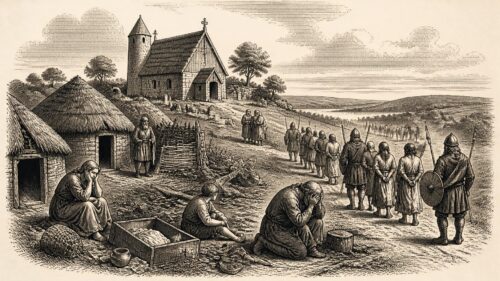
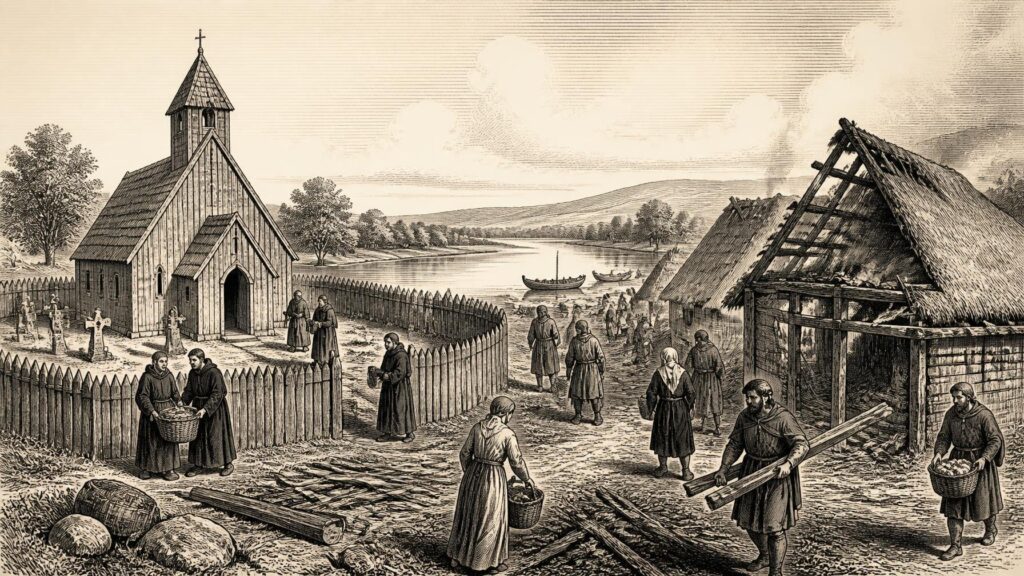
In 731 CE, the most direct Irish annalistic notice is stark: Cúl Raithin, usually identified with Coleraine on the River Bann, was burned. The record supplies neither the attackers’ names nor the occasion, and it does not permit a reconstruction of a campaign, a casualty total or even certainty about the precise buildings lost. Yet the entry matters. In an Ireland without towns in the later medieval sense, a major ecclesiastical settlement on a navigable northern river was a place of worship, learning, production, food storage and local lordship. Its burning was therefore more than an isolated blaze. It was a disruption to a community whose religious and economic life reached beyond its enclosing banks and ditches.
A Date Preserved Unevenly
The evidence for this year needs careful handling. The Annals of Tigernach place the burning of Coleraine under 731, alongside a cluster of events in northern Britain. The Annals of Ulster preserve substantially the same sequence under an annal-number whose internal chronology runs one year behind the modern date supplied by editors. A later compilation, the Fragmentary Annals, independently places the deaths of Colmán úa Littáin and Eochaid son of Colcu in 731. These converging but not identical traditions allow the year to be treated with reasonable confidence, while warning against claims of an exact day, season or causal chain that no source gives.
This is not merely a technical difficulty for modern readers. Irish annals were compiled, copied and rearranged over centuries. Their brief notices often preserve early material, but the surviving manuscripts are later, and their chronological systems do not always align perfectly. For 731, the responsible picture is consequently a narrow one: a recorded destruction at Coleraine; several deaths among religious and secular elites; and events across the North Channel that show how closely Irish affairs were entangled with Dál Riata, Pictland and Northumbria.
Fire on the Bann
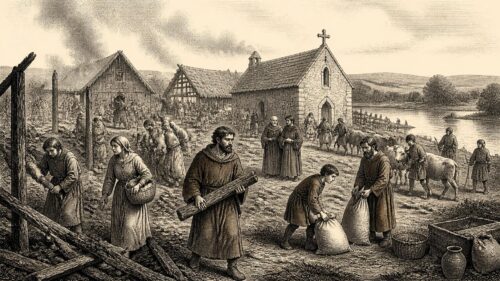
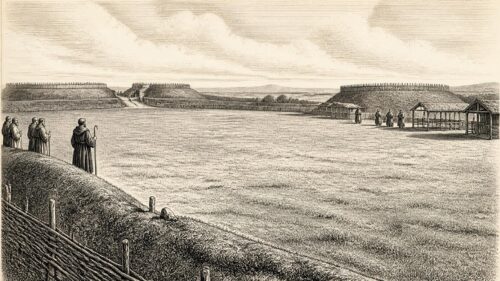
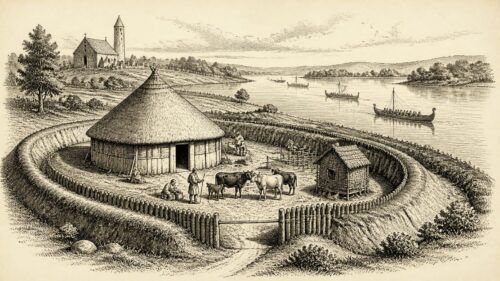
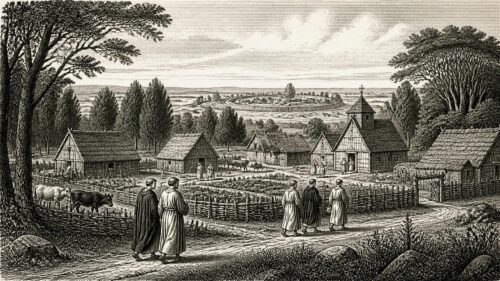
Coleraine’s importance derived from position as much as from sanctity. The Bann provided access between the Atlantic-facing north and inland districts, while the surrounding lowlands supported agriculture and movement. The annal calls the place Cúl Raithin, a name associated with the later Coleraine area, but does not describe its layout in 731. It would be unsafe to imagine the later town transferred bodily into the eighth century. What can be said is that early Irish churches commonly stood within substantial curving enclosures and formed the focus of clustered settlements. Their churches, dwellings, workshops, stores, gardens and livestock were vulnerable when fire was deliberately set.
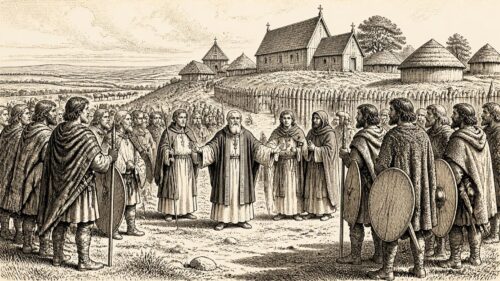
Such a settlement was not simply a retreat of isolated monks. Ecclesiastical communities depended upon tenants, craftworkers, food renders and relationships with local dynasties; they also offered worship, education, commemoration and hospitality. Manuscripts and liturgical objects were precious, but so were ordinary necessities: grain, tools, timber structures, animals and boats. The annals do not say that any particular object or person perished at Cúl Raithin. The wider archaeological and historical context nevertheless explains why a chronicler judged the burning worthy of entry. Damage to a church-centred settlement could interrupt both sacred routines and the practical means that sustained them.
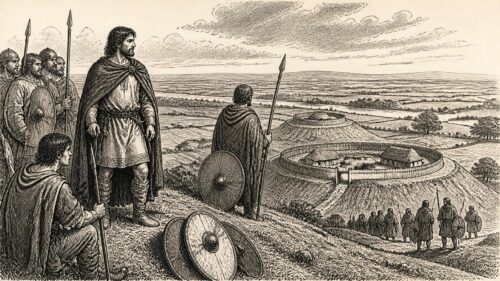
No perpetrator is named. It is tempting to attribute the attack to one of the northern Irish peoples, to rivals within the Columban ecclesiastical world, or to conflict arriving by river or sea. None of those explanations can be demonstrated from the 731 notice. The discipline required by the source is valuable: this was a year in which Coleraine burned, not a year for which the annals reveal a fully narrated war.
Deaths and Ecclesiastical Authority
The same annalistic sequence records the death of Colmán úa Littáin, called a doctor religionis, a ‘teacher of religion’. The phrase is unusually revealing. It marks learning and religious authority rather than noble descent or military rank, and reminds us that the intellectual life of early medieval Ireland was carried by people whose work is otherwise largely invisible. The annals also describe Faeldobur Bec of Fore as learned. These notices are brief memorials, but they point towards networks of teaching, biblical study, ecclesiastical law and writing that linked religious houses across the island.
Eochaid son of Colcu died in the same year. Here the sources preserve different emphases: the Fragmentary Annals call him abbot of Armagh, while the Annals of Ulster call him an anchorite of Armagh. The variation should not be flattened into a false certainty. Either title identifies him with Ireland’s most influential Patrician church, but they evoke distinct aspects of clerical life: institutional leadership on one hand, ascetic devotion on the other. Armagh’s standing rested on its association with Patrick, its landed interests, its learned personnel and its ability to project ecclesiastical influence through client churches and allied rulers. The death of a prominent man there was accordingly an event of wider consequence, even though the annals do not record a successor in this entry.
Other deaths reinforce the impression of a clerical landscape made up of many centres rather than one national church governed from a single headquarters. Colmán of Teloch Ualann and Brec of Berba are said to have ‘fallen asleep’, the conventional Christian language of repose. Cobblaith, daughter of Cellach of Cualu, also died. Such entries preserve women as members of politically important kindreds, although they do not reveal her role or age. The record is selective, but it shows how religious commemoration, dynasty and locality were woven together in the annalists’ understanding of public life.
Across the North Channel
731 also belongs to the shared Irish Sea world. The annals report that Dúngal burned Tairpert Boitir, a place usually understood within the Dál Riata sphere, though the entry itself gives no explanation. They then record a battle between the Cruithin, meaning Picts in this context, and the Dál Riata of In Muirbolg, in which the Picts were defeated. Another conflict followed between the son of Óengus and the son of Congus: Bruide defeated Talorcan, who fled. These were not internal Irish battles, but they were directly relevant to Irish history because Dál Riata’s Gaelic-speaking political world extended across the channel, and people, church connections and maritime routes joined north-east Ireland to western Scotland.
The sources do not licence the conclusion that Coleraine’s burning was part of these Scottish struggles. Their juxtaposition reflects the interests of annalists who treated the northern seas as a connected historical zone. The same channels that carried raiders and war-bands also carried clerics, books, news, tribute, gifts and travellers. Conflict in Dál Riata or Pictland could alter the security of routes and alliances on the Irish side without producing an immediately visible entry in Irish local records.
Northumbria in Turmoil
The Irish annals also note that the son of Cuthwine, king of the Saxons, was imprisoned; Tigernach’s wording is compressed, but it corresponds to the crisis of Ceolwulf of Northumbria. A Northumbrian annal appended to Bede’s Ecclesiastical History states that King Ceolwulf was seized, tonsured and returned to his kingdom in 731. Bede himself, writing at the close of his history in that year, had already described Ceolwulf’s reign as troubled by great commotions and conflicts. For Irish observers, instability in Northumbria was not remote foreign news. Northumbrian, Irish and Iona-linked churches had long exchanged people, texts and ideas, while political tensions around the Irish Sea could affect ecclesiastical patrons and seaways.
Nevertheless, 731 should not be presented as a single island-wide crisis. The annals do not record a new high-kingship, a general assembly or a decisive battle in Ireland proper. Flaithbertach son of Loingsech remained the leading Uí Néill ruler in the north, while powerful kings such as Cathal son of Finguine in Munster and Fáelán in Leinster operated within their own shifting regional political worlds. The absence of a spectacular Irish royal confrontation in the surviving notices does not prove tranquillity; it chiefly demonstrates that annalistic survival is uneven.
What the Year Reveals
The year’s surviving evidence is therefore modest but meaningful. Coleraine’s burning exposes the vulnerability of an important church-centred settlement. The deaths of Colmán úa Littáin and Eochaid of Armagh show how learning, ascetic reputation and institutional authority were recognised in public memory. The clashes involving Dál Riata and the Picts, together with turmoil in Northumbria, place Ireland within a maritime northern world rather than apart from it. Beneath these recorded events, most people continued the seasonal work that sustained communities: tending cattle, cultivating grain, repairing timber buildings, fishing rivers and coasts, producing cloth and ironwork, and meeting obligations to churches and lords. Their names rarely entered the annals, but their labour made the ecclesiastical and political landscape of 731 possible.
Primary Sources
- The Annals of Ulster, Year U731
- The Annals of Tigernach, Annals T728–T742
- Fragmentary Annals of Ireland, Annals FA 201–220
- CELT Project: The Annals of Ulster
- CELT Project: The Annals of Tigernach
- CELT Project: Fragmentary Annals of Ireland
- The Annals of Ulster, Year U730
- The Annals of Ulster, Year U733
- Bede’s Ecclesiastical History of England, Book V, Chapter 23
- The Continuation of Bede
- Anglo-Saxon Chronicle, Manuscript A (Parker Chronicle)
- The Annals of Inisfallen
- The Annals of the Four Masters
- Exploring the Irish Annals
- Irish Annals: from chronicles to histories
- Early Christian Monasteries
- Churches and Ecclesiastical Enclosures / Shéipéil agus Ráthanna
- Irish Field Monuments: Ringforts
- Early Medieval Farmsteads
- The Early Medieval Columban Monastery in Derry
- A New Jerusalem ‘At the Ends of the Earth’: Interpreting Charles Thomas’s Excavations at Iona Abbey 1956–63