Findabair and Áed Cualann719 CE
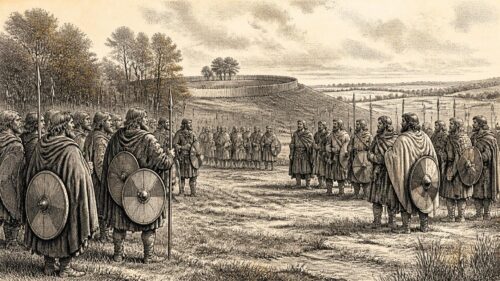
In 719, Leinster suffered internal conflict after the death of overking Cellach Cualann. At Findabair, probably Fennor in Meath, his son Áed was killed in an encounter among the Leinstermen, though sources do not identify combatants or circumstances. Murchad of Uí Dúnlainge held Leinster’s overkingship amid rivalry with Cellach’s Uí Máil kin. Uí Néill forces devastated Leinster five times, reflecting pressure associated with Fergal of Cenél nÉogain and foreshadowing later campaigns. Other annals record killings, violence affecting Armagh, an ecclesiastical death, and a Dál Riata sea-battle. A possibly dry summer compounded raiding’s threat to farming, cattle, lordship and vulnerable communities.
Dateline
In 719 CE, Leinster endured a year of internal bloodshed and repeated pressure from the Uí Néill, the powerful dynastic confederacy whose leading branches competed for supremacy across much of Ireland. The annals record an encounter among the Laigin, or Leinstermen, at which Áed son of Cellach was killed: the battle of Findabair. A related annal states that the Uí Néill laid waste Leinster five times in the same year. These terse notices do not yield a continuous campaign narrative, but together they make 719 a revealing moment. A provincial succession dispute, a dynastic killing, and recurrent incursions exposed how vulnerable Leinster had become after the death of its former overking, Cellach Cualann, only four years earlier.
A Battle Named Findabair
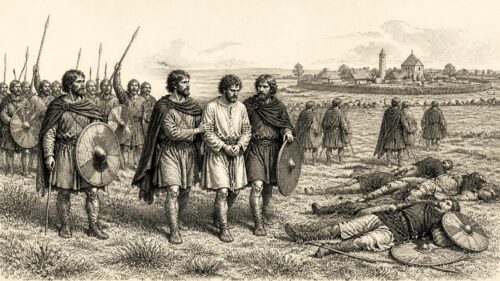
The most firmly dated Irish event is the battle or “meeting” at Findabair, in which Áed mac Cellaig fell. The Annals of Tigernach and Chronicon Scotorum place it under 719, and the former calls it specifically the battle of Findabair. The Annals of Ulster preserve an equivalent entry, although their early eighth-century chronological headings are displaced by a year. This is a useful warning: medieval annals are indispensable evidence, but their year-numbers must be compared rather than accepted mechanically. For calendar 719, the agreement of Tigernach and Chronicon Scotorum makes Áed’s death secure, while the fuller circumstances remain uncertain.
Findabair is often connected with Fennor in County Meath, south of the Boyne, though the identification cannot be treated as beyond dispute. The sources do not describe the ground, name the troop leaders, or say whether combat followed negotiation, a raid, or an attempted settlement. “Encounter” is deliberately spare language. It tells us that armed political business had reached a fatal conclusion, not how many men fought or how the killing was accomplished.
Áed was a son of Cellach Cualann, the Uí Máil ruler who had held the overkingship of Leinster until his death in 715. Cellach’s sobriquet linked him to Cualu, around modern north Wicklow and south County Dublin. His family had been prominent in Leinster, but it did not command the province without rivals. Áed’s death therefore mattered beyond one battlefield: it removed one of the adult sons through whom Uí Máil could defend their position. In subsequent years, his brothers Crimthann and Étarscél also died in conflict, while the Uí Dúnlainge dynasty consolidated its position in Leinster.
Leinster’s Divided Leadership
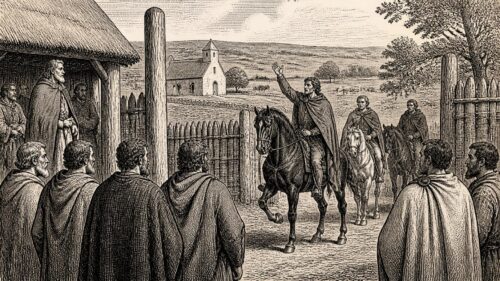
By 719, Murchad son of Bran Mút of Uí Dúnlainge had emerged as Leinster’s overking. His political connection to the displaced Uí Máil was intimate as well as contentious: he had married Coinchenn, a daughter of Cellach Cualann. Such unions were not signs of modern-style national unity. Marriage created ties, obligations and potential claims, but it also placed relatives on opposite sides when succession was contested. The killing of Áed occurred within this tense field of Leinster politics. The annals do not state that Murchad ordered it or fought at Findabair, and that must not be invented. Yet the conflict plainly benefited the wider rearrangement of power after Cellach’s death.
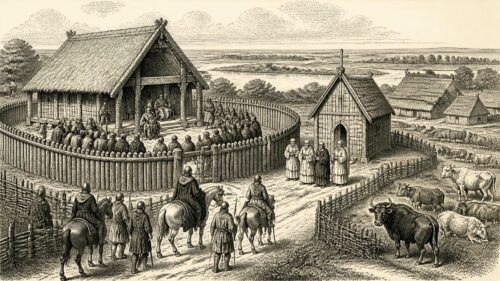
Leinster was not a single, tightly administered state. Its overking had to maintain influence among several regional dynasties, including Uí Dúnlainge in the north and Uí Máil in the east, as well as more southerly powers. Authority rested on personal lordship, kinship, clientship, military followings and the capacity to collect renders. A contested succession could therefore draw fighting men from several small kingdoms and turn a local confrontation into a provincial crisis. The annals’ concise phrase “among the Leinstermen” may point to precisely this kind of internal struggle.
It also opened Leinster to outside intervention. Chronicon Scotorum records five devastations of Leinster by the Uí Néill during 719. The verb implies destructive incursions rather than five set-piece battles: herds driven off, food stores seized, crops or buildings damaged, and dependants intimidated or carried away were all possible consequences of such warfare. The record does not list particular places or losses, so none can responsibly be supplied. Its significance lies in the repetition. A single raid might signal retaliation; five in one year announced sustained pressure.
Fergal’s Southern Pressure
The chief political beneficiary of Leinster’s weakness was Fergal son of Máel Dúin of Cenél nÉogain, then the dominant claimant to the kingship of Tara and the wider primacy later described as the kingship of Ireland. Modern scholarship associates the Uí Néill pressure of 719 with Fergal and identifies his southern offensive with fighting at Fennor. The contemporary-style annal entry itself names the Uí Néill rather than Fergal personally, so this attribution should be understood as a well-supported reconstruction rather than an explicit statement by every source.
Fergal’s power was formidable but not absolute. The title “king of Ireland” in annalistic usage did not mean rule over a united country with fixed borders, officials and a capital. Tara was a paramount kingship: an ambition to precedence, tribute, hostages and military obedience, constantly tested by rival dynasties. Fergal’s Cenél nÉogain base lay in the north-west, while other Uí Néill branches controlled important territories in the midlands and Brega. To exact submission from Leinster required repeated movement of armed forces into the province and the cooperation, or acquiescence, of intermediate rulers.
The pressure of 719 was a prelude rather than a conclusion. In 721, the annals say that Fergal invaded Leinster, imposed the cattle-tribute known as the bórama, and secured Leinster hostages. In December 722 he led a large Uí Néill army to the battle of Almu, near the Hill of Allen in County Kildare, where he was defeated and killed. Those later events should not be folded into 719, but they show why the raids and Findabair conflict mattered. The struggle over Leinster had already become a central contest between a northern claimant to paramount authority and a province unwilling, or unable, to accept his terms.
Violence Beyond Leinster
The year’s annalistic notices reveal insecurity in several regions. Airmedach son of Tadc and Críchán, king of Uí Meic Uais, were killed, as was Erthuile son of Fergus Goll. Tuibride grandson of Dúnchad was also slain. The texts provide no narrative linking these deaths, and it would be wrong to turn them into a single national war. Instead, they demonstrate the normal political fragmentation of early medieval Ireland, where kingship existed at many levels and changes of leadership could be lethal.
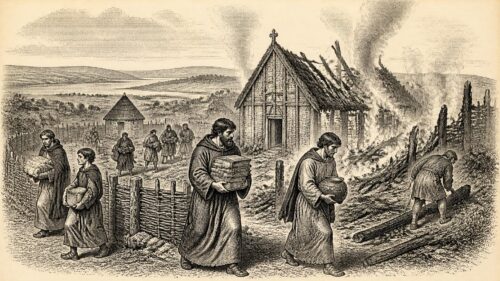
At Ard Macha, the ecclesiastical community or household of Suibne was killed. The annals do not specify whether this was an attack on clerics, dependants, a kin-group attached to a church, or a wider community under Suibne’s protection. What is clear is that Armagh was not insulated from secular violence. Major churches held land, dependants, learning and prestige; their people and resources were enmeshed in local and dynastic politics. Drostán of Dairthech also died at Ard Brecáin, another reminder that monastic and ecclesiastical centres formed a connected landscape across the island.
Across the North Channel, a sea-battle at Ard Nesbi was fought on 2 October according to the Annals of Tigernach. Dúnchad Bec and Cenél nGabráin defeated Selbach and Cenél Loairn, with notable men falling. This was a contest within Dál Riata, the Gaelic kingdom spanning western Scotland and part of north-eastern Ireland. It was not an Irish provincial event, but it was directly relevant to Ireland’s maritime world. Sea routes linked the north-eastern coast to Argyll, Iona and wider political networks; Irish kings and churches did not inhabit an isolated island realm.
Land, Livelihood and the Limits of the Record
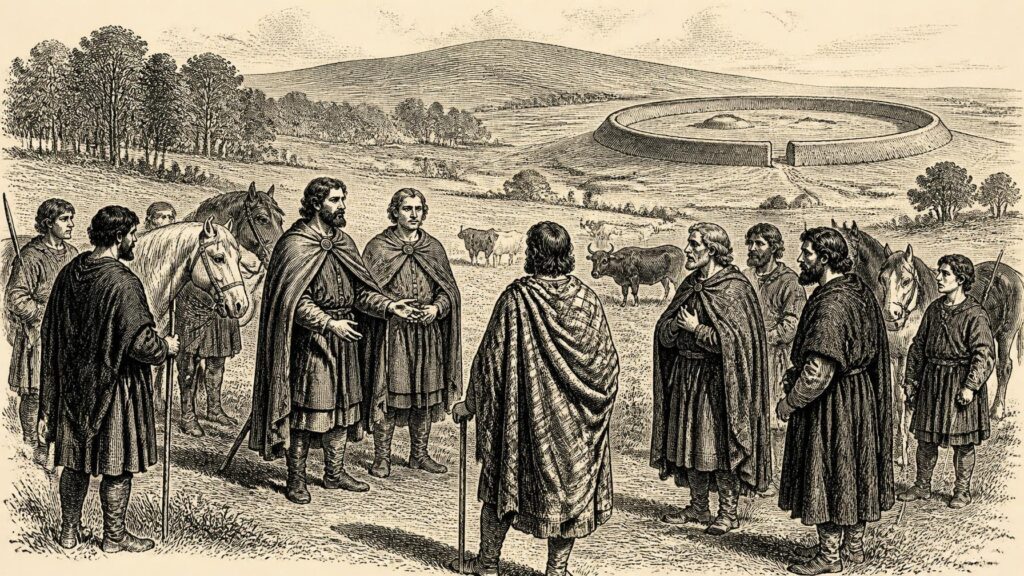
The Annals of Ulster associates its corresponding entry with a dry summer. Because the alignment of its annal headings at this point is problematic, it is prudent to treat this as evidence for conditions around 719 rather than claim a precisely documented drought within the calendar year. Even that guarded notice matters. Most people lived in dispersed farming settlements, commonly enclosed ringforts of earth or stone, relying on cattle alongside cereal cultivation. A dry season could alter grazing, water access and harvest prospects; repeated military incursions could compound those pressures by taking animals and disrupting work at the very time households needed to protect stores.
Cattle were both food producers and a principal measure of wealth. They underpinned tribute, compensation and political bargaining. This helps explain why warfare against Leinster was more than a clash between royal names. Raiding struck at the material basis of lordship: the ability of a king to reward followers, compensate allies, feed a household and meet obligations to churches. For ordinary people, the practical consequences were likely felt in threatened herds, interrupted cultivation and demands for labour or provisions, even though their individual voices do not survive in the annals.
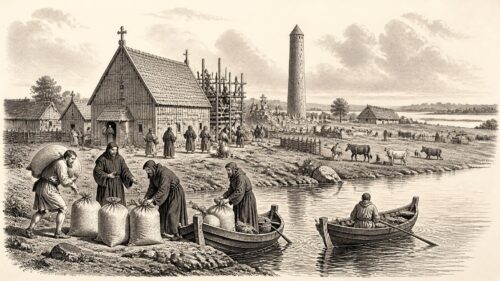
Churches offered another kind of continuity. The island had long possessed networks of monasteries, churches, schools and estates, and scribes were producing the learned culture from which annalistic recording emerged. The Law of Adomnán, promulgated in Ireland in 697, had asserted protection for women and non-combatants in war. Its existence does not prove that violence in 719 was restrained; the killings and devastations recorded that year show the opposite danger. But it demonstrates that Irish rulers and churchmen already had a public language in which warfare could be judged, limited and condemned.
Thus 719 should not be represented as a year in which a single ruler remade Ireland. Its importance is more precise. At Findabair, Áed son of Cellach died amid Leinster’s unresolved succession struggles. Across the province, Uí Néill forces devastated territory repeatedly. At Armagh and elsewhere, deaths recorded in a few words hint at the human cost of competing lordships. The year captures an Ireland of vigorous regional powers, ecclesiastical institutions and interconnected sea routes, but also of fragile settlements and political authority repeatedly won, lost and tested by force.
Primary Sources
- The Annals of Tigernach, Annal T719
- Chronicon Scotorum, Annal CS719
- The Annals of Ulster
- Annals of the Four Masters, Annal M719
- Fragmentary Annals of Ireland
- Annals of Inisfallen
- Fergal
- Murchad
- Cellach Cualann
- Fogartach
- Cináed Cáech
- Írgalach
- Dúnchad
- Caintigern (Kentigerna)
- Condal
- Chronological Synchronisation of the Irish Annals
- Exploring the Irish Annals
- Farming and Archaeology
- Traditional Buildings of Irish Farms: The Rural Settlement Pattern
- National Monuments Service: Monument Class and Scope Notes
- The Archaeological Survey