Ecgberht at Iona716 CE
In 716, Northumbrian priest Ecgberht persuaded Iona to adopt the Roman Easter calculation and clerical tonsure, ending its adherence to the older 84-year cycle. Confirmed by Bede and Irish annals, this change affected the Columban network across Ireland, Scotland and Northumbria, requiring new tables, learning and acceptance among dependent houses. Fáelchú assumed Columba’s seat on 29 August, amid uncertain leadership arrangements before Abbot Dúnchad’s death in 717. In Ireland, Fogartach of Síl nÁedo Sláine regained power in Brega, though authority remained contested. The death of Clones’s abbot illustrates monastic networks embedded within rural, agrarian society and their dependence on labour.
Dateline
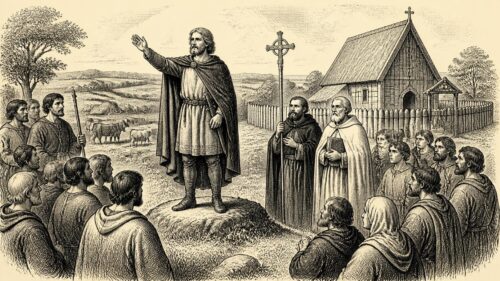
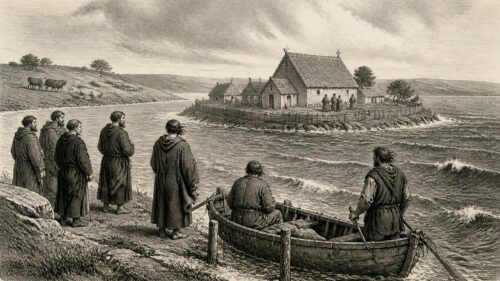
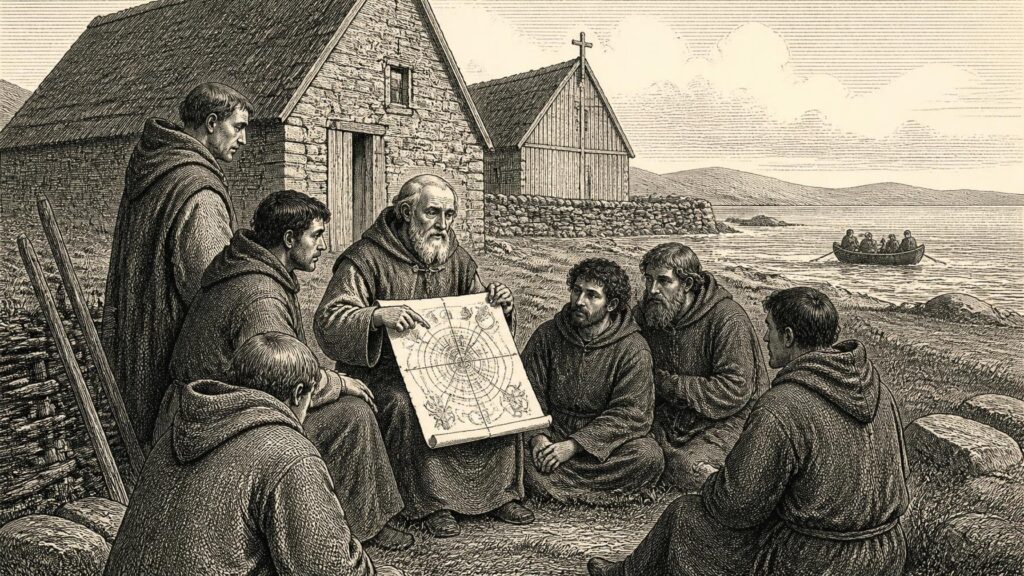
In 716 CE, an event on the small island monastery of Iona reshaped an Irish religious network that extended far beyond its Hebridean shore. The Northumbrian priest Ecgberht, who had long lived in Ireland, arrived at Iona and persuaded its community to adopt the Roman, or Dionysiac, calculation of Easter and the Roman form of clerical tonsure. The decision is independently anchored to this year by Bede, writing within a generation, while the Irish annals record that “the date of Easter” was changed in the monastery of Í, the Irish name for Iona. This was not a change of creed: Iona was already thoroughly Christian. It concerned the calendar by which the central festival of the Christian year was calculated, and the visible marks by which clerics identified themselves. Yet its significance was international. Iona stood at the head of a Columban familia linking Irish, Scottish and Northumbrian churches through saints’ cults, learning, travel and patronage.
A Monastery Changes Its Calendar
The Easter controversy had run through the churches of Ireland and Britain for decades. It turned on competing systems for identifying the proper Sunday on which to celebrate Christ’s Resurrection. The older Irish and Ionan practice employed an 84-year cycle; Rome and churches aligned with it used a 19-year cycle. To modern eyes, this may look like a technical argument. In the seventh and eighth centuries it was a question of ecclesiastical communion, authority and order. Different Christian communities could mark Easter on different dates, despite sharing the same faith and scriptures.
Iona was especially important because of its history. Founded by Columba in 563, it had supplied missionaries and churchmen to northern Britain, most famously Aidan of Lindisfarne. Its influence rested not upon a single territorial diocese but on kinship, religious memory, dependent foundations and travelling personnel. An alteration made at Iona therefore mattered to communities in Ireland as well as to those in Dál Riata, Pictland and Northumbria. Bede presents the result in emphatically harmonious language: Ecgberht was received with honour, taught patiently, and brought the monks and dependent houses into canonical observance.
His account should not be read uncritically as a simple story of one outsider correcting an isolated community. Bede was a vigorous advocate for Roman calculation and wrote the history as an argument for church unity. The Irish annal, however, confirms the essential fact without Bede’s rhetoric: a change occurred at Í in 716. Together, the sources make this one of the clearest developments securely connected to the year. They also show how Irish Christianity was embedded in an archipelago-wide world. Ecgberht was English by origin, but his formation and religious career were deeply connected with Ireland; Iona itself was a Columban house created by an Irish saint and governed within an Irish ecclesiastical tradition.
Faelchú and Columban Leadership
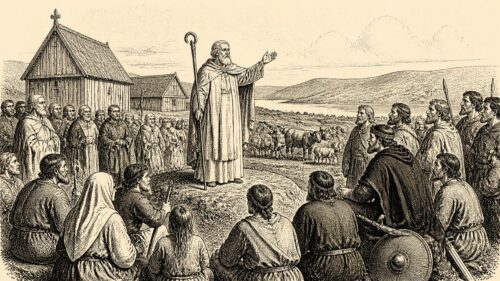
The same annalistic cluster records a change in Iona’s leadership. Fáelchú, son of Dorbbéne, “assumed the see of Columba” on 29 August. The phrase does not mean a bishop’s throne in the later diocesan sense. In an Irish monastic setting, Columba’s cathedra denoted the headship or principal seat of his community. The precise day is unusually valuable, but other details require caution. The Annals of Ulster give Fáelchú’s age as seventy-four, while the Annals of Tigernach preserve eighty-seven; such disagreement demonstrates why even apparently exact annalistic notices must be handled carefully.
Fáelchú’s elevation also complicates any assumption that leadership passed cleanly from one abbot to another. Dúnchad son of Cenn Fáelad was still remembered as abbot of Í and died in 717. Modern scholarship has consequently considered whether Iona experienced coexisting office-holders, contested successions, delegated authority or a period of internal tension around the Easter question. The evidence does not permit a confident reconstruction of factions. What can safely be said is that 716 was a year of institutional transition: the community adopted a new reckoning and Fáelchú took Columba’s seat before Dúnchad’s death in the following year.
The change brought practical work as well as symbolic submission. Easter tables had to be obtained, copied and understood. Clerics had to calculate lunar dates according to the new cycle, while communities dependent on Iona needed to hear and accept the decision. Manuscript culture was central to this process. Tables, computistical explanations and biblical learning belonged to the everyday intellectual equipment of major monasteries. Iona’s acceptance of the new calculation therefore represents a revision in how knowledge was organised, reproduced and authorised, not merely a new feast day in a single year.
Fogartach Returns to Power
In Ireland itself, the annals associated with 716 state that Fogartach grandson of Cernach “reigns again”. Fogartach was a leading member of the Síl nÁedo Sláine, the southern Uí Néill dynasty dominant in Brega, the rich central region north of the Liffey and Boyne. The short notice is frustratingly spare: it does not identify precisely which kingship he recovered, describe a ceremony, or establish that every rival accepted his authority. It should not automatically be turned into an uncontested restoration as king of Tara.
Nevertheless, the entry illuminates the unsettled politics of the Irish midlands. Fogartach had been displaced by conflict involving Murchad son of Bran, ruler in Leinster, and he returned after Murchad’s death. His renewed position brought him into an already crowded political field. Fergal son of Máel Dúin of Cenél nÉogain was king of Tara in this period, while different branches of Síl nÁedo Sláine competed within Brega itself. “Ireland” was not a unified kingdom administered from one capital. Power consisted of overlapping claims: local lordship, provincial overkingship, control of clients and hostages, access to tribute, and the ability to draw armed followers together.
Fogartach’s restoration is consequently best understood as a development in a continuing contest, rather than the neat beginning of a settled reign. It also warns against forcing later events back into 716. The Annals of the Four Masters place the battle of Cenannas, near Kells, and the killing of Conall Grant two months later under 716. The earlier surviving annalistic traditions place those notices later, and their chronological systems are not always aligned. The conflict certainly belongs to the same Bregan struggle, but its exact calendar placement remains disputed. It cannot responsibly be presented as an unquestioned event of 716 CE.
Churches, Households and Work
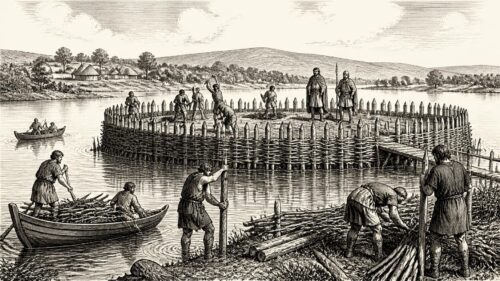
The annals also note the death of Céile Tighearnaig, abbot of Clones in modern County Monaghan. This brief obituary is evidence of the density of Irish ecclesiastical life rather than a full biography. Clones was one among many churches and monasteries whose heads linked local communities to wider networks of learning, prayer, landholding and aristocratic patronage. Such institutions did not stand apart from secular society. Their communities required food, labour, livestock, timber, metalwork, books and protection; their leaders negotiated with kings and noble families, and their churches offered spiritual prestige to patrons.
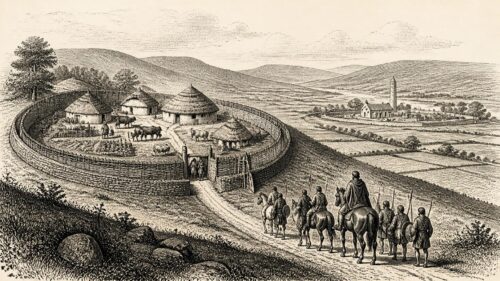
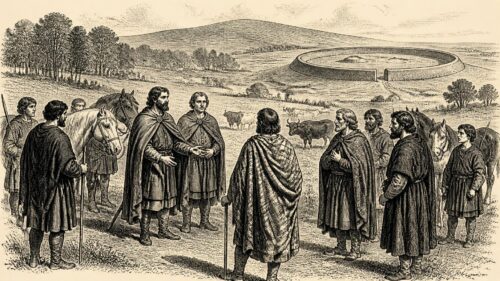
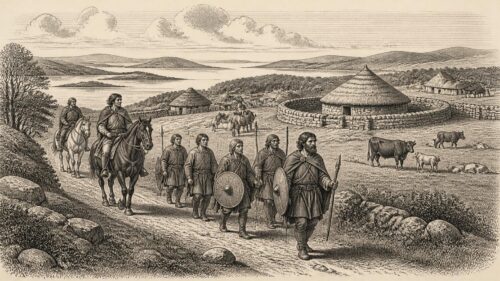
For most people in 716, however, life was shaped above all by household farming. Across Ireland, extended families lived in and around enclosed farmsteads now commonly called ringforts or raths: circular spaces defined by earthen banks and ditches, containing timber or wattle-built houses, byres, working areas and stores. Cattle were fundamental measures of wealth, but communities also relied on crops, dairying, pigs, sheep, fishing and seasonal labour. The annals do not report a nationwide harvest failure, epidemic or environmental disaster for this year. It would be misleading to invent one simply to fill a category. The durable evidence instead points to a rural landscape in which production, status and security were closely connected.
Monasteries formed part of that landscape. Their enclosures could contain churches and burial grounds, dwellings for religious personnel, workshops, guest spaces and agricultural resources. They preserved Latin learning while also recording Irish genealogies, saints’ traditions and political events. The very fact that we can trace the changes at Iona and Clones rests on the habits of record-keeping cultivated in such settings. At the same time, the surviving record is selective. It tells us much more readily about abbots, kings and calendar debates than about women’s work, children, unfree people, craftspeople or the ordinary cultivators who sustained both royal households and churches.
A Year Defined by Connection
The most important thread running through 716 is connection across boundaries. Ecgberht’s arrival at Iona joined an English-born cleric, Irish religious experience, a Columban monastery in the Hebrides and debates shared with Rome and Northumbria. Fáelchú’s installation shows the institutional machinery of Columba’s familia adapting at the same moment. Fogartach’s return demonstrates that political authority in Ireland remained competitive and regional, especially in Brega, rather than being fixed in a single high-kingship. The death at Clones reminds us that lesser-recorded religious centres also mattered.
Thus 716 CE was not marked by a single Irish battle or royal proclamation. Its firmest development was quieter but far-reaching: Iona’s adoption of a new Easter reckoning. That decision helped close one of the most persistent divisions in Insular Christian practice and confirmed that Irish ecclesiastical communities, however distinctive their traditions, participated fully in the religious and intellectual currents of early medieval Europe.
Primary Sources
- The Annals of Ulster
- The Annals of Ulster, Year U718
- The Annals of Tigernach
- Annals of the Four Masters
- Annals of Inisfallen
- Annals of Inisfallen: Bibliographical and Manuscript Details
- CELT: List of Published Texts
- Bede, Ecclesiastical History, Book V, Chapter 22
- The Ecclesiastical History of the English Nation
- Ecgberht
- Fogartach
- Fergal
- Fáelán Amlabar [Fillan the Mute, Fáelchú mac Dorbéni, St Fillan]
- The Chronology and Sources of the Early Irish Annals
- Easter Cycles and the Equinox in the British Isles
- The Annals of Ulster and the Clonmacnoise-group: A Textual Relationship?
- Proceedings of the Society of Antiquaries of Scotland, Volume 127
- Early Christian Monasteries
- Ringforts / Ráthanna
- Patrician and Early Christian Architecture
- Sceilg Mhichíl Visitor Guide
- A Concise History of Ireland: Early Medieval Ireland Extract