Tethba’s Cattle Mortality700 CE
In 700, Irish annals recorded a cattle mortality beginning on 1 February at Mag Trega in Tethba, an event of major significance in a rural economy dependent on livestock for food, labour, wealth and tribute. Sources differ slightly in chronology and detail, but associate the outbreak with Ireland-wide loss and memories of famine and pestilence. Chronicon Scotorum also reports exceptional frost, without proving a causal link. Political instability continued: Fiannamail of Dál Riata was killed and Aurthuile of Cenél nÉogain expelled to Britain. Ecclesiastical institutions remained influential, while later narratives framed crisis through Christian ideas of protection, providence and judgement.
Dateline
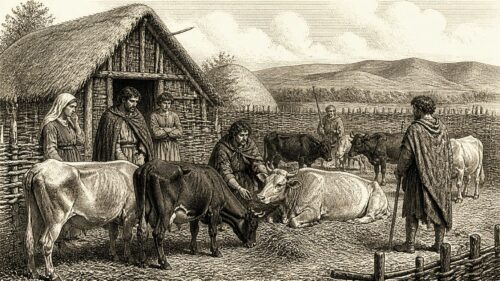
In 700 CE, Ireland’s annalists placed an alarming agricultural disaster at the centre of their record: a mortality among cattle that began on the Kalends of February, 1 February, in Mag Trega, the plain of Tethba in the Irish midlands. The entry is unusually precise in both date and place, and it matters because cattle were not merely food animals. They were a principal measure of wealth, a source of milk, meat, hides, traction and tribute, and a means by which households, monasteries and rulers sustained dependants. A disease or other large-scale loss among herds could therefore unsettle subsistence, exchange and political obligation at once. The surviving annals are terse and were copied long after the events they describe, but three related chronicles preserve the cattle mortality under 700. Their agreement makes the outbreak the safest starting point for this year’s Irish history.
A Date, a Place, and a Problem of Chronology
Early Irish annals do not always align neatly with the modern calendar. The Annals of Tigernach and Chronicon Scotorum place the outbreak in their annal for 700; the Annals of Ulster preserve much the same notice in an entry which its modern edition labels AD 699, reflecting a known chronological offset in this stretch of the text. For a calendar-year account, 700 CE is consequently the responsible conventional placement, while the underlying source difficulty should not be concealed. What can be said firmly is that an annalistic notice associates the onset of cattle mortality with 1 February and Mag Trega in Tethba. It does not name the disease, quantify losses, or explain how quickly it spread. Any modern diagnosis would be speculation.
Mag Trega lay in and around the region later associated with north-western Meath and Longford. Its appearance in the record is revealing. The annals often name localities only when an event carried wider significance: battlefields, royal centres, churches, or places from which an emergency radiated. The phrasing may mean that the first recognised outbreak occurred there, rather than that Tethba alone suffered. The chronicles call it a mortality “in Ireland”, and a later, more literary annalistic compilation presents it as a devastation of herds throughout Ireland and beyond. That larger claim should be treated cautiously, yet it preserves an important contemporary horizon: Irish writers understood animal disease as something capable of crossing provincial and even insular boundaries.
When Cattle Meant Wealth
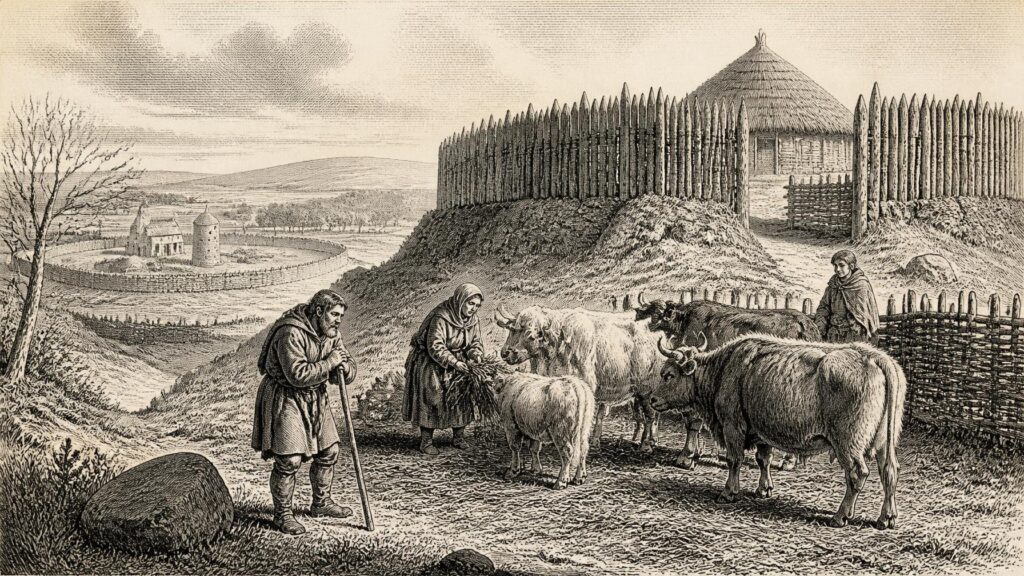
The potential shock was profound. Ireland in 700 was not a country of towns and coin-based markets. Most people lived in dispersed rural communities, many centred on enclosed farmsteads now known as ringforts or raths. Within and around such settlements, families cultivated grain, kept cattle, sheep and pigs, worked leather and iron, spun and wove, and stored food against winter and uncertainty. Cattle were especially important in legal valuations and elite gift-giving. A lord’s ability to feed a following, reward clients, furnish hospitality or pay compensation depended heavily upon access to livestock. Monastic communities also held land and animals, received renders, and maintained agricultural households alongside their religious specialists.
For ordinary families, the loss of cows was more than a loss of future beef. It threatened milk, butter and cheese, calves, manure, hides and the capacity to rebuild a herd. Oxen could be vital for ploughing and haulage. The consequences would have varied sharply according to status and locality: a powerful kindred or church could redistribute stock and food; a small household with few animals had little margin. None of the sources permits a reconstruction of a particular farmstead in Tethba, and no evidence justifies claiming universal ruin. But the annalists’ decision to record the mortality indicates that it was judged exceptional enough to enter an island-wide historical record.
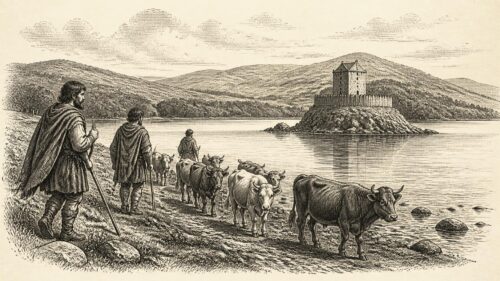
Chronicon Scotorum adds another environmental detail: a great frost froze Irish lakes and rivers, and even the sea between Ireland and Scotland, permitting travel on ice. This dramatic notice belongs to its annal for 700, but it is not repeated in all parallel accounts. It should therefore be reported as that chronicle’s testimony, not as an independently verified national weather report. If accurately remembered, severe cold would have compounded difficulties of movement, fodder and survival among weakened animals. It cannot, however, be used to prove that frost caused the cattle mortality. The sources establish coincidence in the annalistic sequence, not causation.
Famine in the Annalists’ Memory
The same annalistic cluster looks forward to graver hardship. It states that famine and pestilence prevailed in Ireland for three years, using an extreme formula that says people ate people. The Fragmentary Annals likewise links cattle loss with a following human plague and then famine. This is evidence that later medieval historians remembered the opening of the eighth century as a prolonged crisis. It is not evidence that every stage of the catastrophe happened during 700 itself. The careful conclusion is narrower: the cattle mortality of 700 was remembered as the beginning, or one early element, of a multi-year sequence of scarcity and disease.
The Fragmentary Annals surrounds this remembrance with a portent: three shield-like forms seemed to contend across the sky on the night of the Ascension. One was white, one fiery and one bloody, and the chronicler explicitly interpreted them as signs of the evils to come. This should not be turned into an assured observation of a comet, aurora or other phenomenon. The text is a later compilation with a strongly moral and narrative style, and its celestial imagery is inseparable from its retrospective interpretation. Yet it shows how Christian historical writing made sense of disaster. Environmental events, disease, famine, political conduct and divine judgement could be joined within one meaningful history.
Kingship Across the Irish Sea
The year’s political notices are brief but point to a world of competing regional powers rather than a single Irish state. Loingsech son of Óengus of Cenél Conaill had been king of Tara since 695 and was styled king of Ireland in important contemporary and near-contemporary traditions. That title expressed exceptional overlordship, not direct administration of the whole island. Provincial kings, powerful Uí Néill branches, church federations and smaller peoples retained their own interests. The crisis of livestock and food would have tested networks of tribute and protection precisely because kingship rested on extracting and redistributing such resources.
Under 700, the annals report the killing of Fiannamail, grandson of Dúnchad, described in the Annals of Ulster as king of Dál Riata, alongside Flann son of Cenn Fáelad. Dál Riata connected north-eastern Ireland with western Scotland, and the notice is a reminder that the North Channel was a political corridor, not a hard frontier. The sources are not wholly consistent: one tradition’s wording has led scholars to debate Fiannamail’s precise identity and authority. His violent death is secure as an annalistic report; the circumstances, place and political motive are not.
A further notice says that Aurthuile, grandson of Crunnmael, was expelled from kingship and went to Britain. The Annals of Tigernach identify him as king of Cenél nÉogain, the northern Uí Néill people whose power-base lay around later Tyrone and Donegal. Exile to Britain was entirely plausible in this sea-linked political world, where kinship, monasteries, mercenaries and rival dynasties operated on both sides of the channel. The entry nevertheless tells us no more than expulsion and departure. It cannot responsibly be expanded into a campaign, alliance or permanent migration.
Churches, Learning and Protection
Religious life was woven through this political landscape. The annals record the death or “repose” of Áed of Sléibte, called an anchorite in some versions and a bishop in another. Such variation warns against overly precise biography, but the commemoration itself reflects the standing of ecclesiastical figures and places. Churches and monasteries were centres of worship, burial, learning, writing, craft production and landholding. They were also communities of lay workers, tenants and dependants, not isolated colonies of monks.
The legal and moral background to 700 had been shaped only three years earlier by Adomnán, abbot of Iona. At Birr in 697, his Cáin Adomnáin, or Law of the Innocents, was promulgated with the support of leading ecclesiastical and secular figures from Ireland and Britain. It sought, through fines and religious sanction, to protect women, children, clerics and churches in warfare. A later narrative places a dispute between Adomnán and Írgalach of Síl nÁedo Sláine in 700, alleging that Niall, under Adomnán’s protection, had been killed. The tale is valuable evidence of the ideals later attached to sanctuary and clerical authority, but its elaborate curse-and-prophecy narrative should not be treated as a verbatim report of a dated encounter. The killing itself belongs to the subsequent annalistic year in the main chronological sequence.
A Year Recorded at the Edge of Crisis
For Ireland, 700 CE is therefore best understood not as a year dominated by a famous battle or royal succession, but as the documented opening of a material emergency. A cattle mortality began in the midlands on 1 February, according to the annalists; one chronicle also remembered exceptional frost; and related records connected the disaster to years of epidemic and hunger. At the same time, killings and expulsions among rulers of Dál Riata and Cenél nÉogain show that political rivalry did not pause. Monasteries and clerics remained vital institutions, recording losses and offering a language of law, protection and providence. The sources leave many silences, especially about the experience of non-elite households. Even so, they allow a clear impression: in a cattle-based rural society, the failure of the herds was an event of national consequence.
Primary Sources
- The Annals of Ulster
- Part 270 of The Annals of Ulster
- The Annals of Tigernach
- CELT Project: Annals of Tigernach
- Chronicon Scotorum
- Part 71 of Chronicon Scotorum
- Fragmentary Annals of Ireland
- Part 8 of Fragmentary Annals of Ireland
- Annals of the Four Masters
- Annals of Inisfallen
- Loingsech
- Adomnán
- Cáin Adomnáin and Canones Adomnáni
- The Guarantor List of Cáin Adomnáin, 697
- Adomnán’s ‘Law of the Innocents’: Cáin Adomnáin
- Cáin Adomnáin and the Laws of War
- The Iona Chronicle, the Descendants of Aedán mac Gabráin and the Kingship of Dál Riata
- Adomnán, Plague and the Easter Controversy
- Early Christian Monasteries
- Early Irish Monasticism
- Irish Field Monuments
- Early Medieval Farmsteads
- Animals and the Economy of Medieval Ireland: A Zooarchaeological Analysis of the Faunal Remains from Caherconnell Cashel, Co. Clare
- Kingship, the Church, and Silver in Ireland