Loch Key’s Cattle Plague1321 CE
In 1321, Irish annals recorded an unprecedented cattle murrain across Ireland, corroborated in Connacht, Ulster and Munster, where famine was also noted. The disease, of unknown cause, destroyed vital sources of food, labour, wealth and political obligation, exposing fragile recovery after earlier war and subsistence crises. Conflict nevertheless continued: Cathal Ó Conchobair destroyed the Rock of Loch Key and rivals were killed; Oriel endured dynastic mutilation and assassination involving Dundalk; Meath forces defeated Offaly chiefs; and a Munster hosting sought castles and hostages. These events reveal local, interwoven Gaelic and settler politics, but cattle mortality remained the year’s island-wide calamity.

Dateline
The clearest fact about Ireland in 1321 is not a coronation, parliament or pitched battle. It is a disaster among cattle. The Annals of Connacht recorded a cattle-plague across Ireland, declaring that nothing like it had been known before. The northern Annals of Ulster independently noted the same widespread “cow-destruction”, while the Munster-centred Annals of Inisfallen, under its entry for 1321, coupled a murrain among Ireland’s cows with a great famine. These terse notices make 1321 an unusually revealing year: political violence continued from Connacht to Oriel and Offaly, but the more universal danger was the sudden loss of animals on which food, labour, wealth and lordship all depended.
Evidence and Its Limits
The year must be handled carefully. Medieval Irish annals are invaluable contemporary or near-contemporary records, but they are selective, sometimes terse and not always synchronised with one another. The Annals of Ulster, for example, place several events also entered under 1321 in Connacht and the later Annals of the Four Masters in a differently numbered chronological sequence. For the calendar year 1321, the closely dated Connacht and Four Masters entries provide the most useful framework, with the Inisfallen notice offering important southern corroboration for the cattle mortality and hunger. Where the record is damaged, especially in the Inisfallen account of Munster, certainty has to yield to cautious description.
Nor should the year be reduced to a simple contest between “Irish” and “English”. The annals distinguish Gaels and Galls, but their politics show alliances, conflicts and calculations at a local level. Gaelic dynasties fought one another; settler lords and urban communities acted through their own interests; and family, clientship, hostages, fortified places and access to livestock shaped power. In 1321, these arrangements were strained at precisely the moment when cattle themselves were dying in exceptional numbers.
A National Cattle Disaster
The annalists’ geographical spread matters. A Connacht writer’s statement that the plague reached throughout Ireland could be rhetorical, but it is reinforced by the Ulster and Inisfallen records. This was therefore not merely a local outbreak in the west. The cause cannot be securely identified from the surviving evidence: it is responsible to call it a cattle murrain or panzootic, not to name a particular modern disease. The Ulster annalist called it Maeldornnaigh, but the term does not supply a diagnosis.
Its consequences would have extended far beyond the loss of beef or milk. Cattle were stores of movable wealth, sources of dairy produce, hides and manure, and a means of meeting obligations between lords and dependants. Oxen also mattered for cultivation and haulage. A depleted herd could make a household poorer immediately and diminish its capacity to sow, transport grain, furnish food-rents, pay compensation or sustain followers later. In a society where cattle-raiding, tribute and gifts remained central to political language and practice, heavy mortality could also alter the balance between rival kindreds.
The Inisfallen annalist’s accompanying reference to famine makes the human implications explicit. Ireland had recently endured the extreme weather, harvest failures and warfare associated with the great subsistence crisis of 1315–18 and the Bruce invasion. But it would be unsafe simply to extend that crisis without interruption into every later year. What can securely be said is narrower and more important: one annalistic witness placed both bovine murrain and severe hunger in 1321, while others confirmed the animal disaster. The recovery of farms, herds and food reserves after the previous decade’s devastation was plainly precarious.
Loch Key and Connacht Rivalries
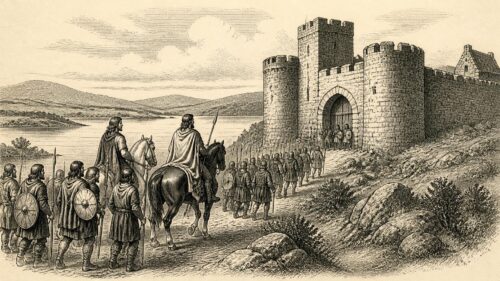
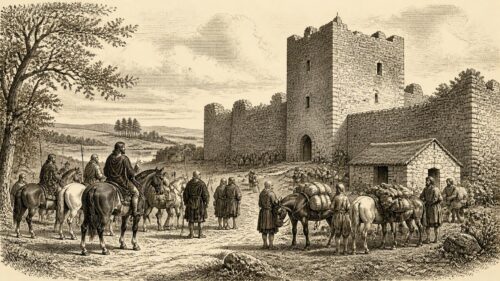
Connacht supplies the year’s most vivid local political events. Cathal, son of Domnall Ó Conchobair, demolished the Rock of Loch Key, the defended island site in Moylurg, now County Roscommon. The Rock had long been associated with the Mac Diarmata rulers of Moylurg and was a place of exceptional strategic value: water and steep rock offered natural protection, while its enclosure and buildings made it both residence and stronghold. Archaeological work has confirmed the island’s importance as a high-status medieval fortified site. To destroy such a place was not incidental vandalism. It was an attack upon a rival lordship’s security, prestige and capacity to hold prisoners, goods and retainers.
The same Connacht annal records the treacherous killing of Ruaidrí na Fed, an Ó Conchobair claimant, by Cathal, son of Aed, son of Eogan. It also records the death of Gráinne, daughter of Mac Magnusa and wife of Maelruanaid Mac Diarmata. The sources do not explain her death or connect it directly to the destruction at Loch Key. Yet the placing of these notices together gives a sense of a region in which the Ó Conchobair and Mac Diarmata worlds were closely entangled through rivalry, marriage and lordship. Elite women appear only intermittently in the annals, but when named they are usually identified through both natal and marital kin, a reminder that dynastic relationships were political as well as personal.
There is no warrant for presenting Connacht as a single unified kingdom in 1321. The recent collapse of stable authority, intensified by the Bruce wars and earlier contests among the Ó Conchobair, had left a landscape of competing branches and local rulers. Fortified islands, routes through Moylurg and control of stock were practical instruments of that competition. The destruction of the Rock should therefore be read alongside, not apart from, the cattle plague: security and political influence rested partly on resources that disease could suddenly erase.
Oriel, Dundalk and Offaly
In Oriel, the annalists preserved a brutal sequence of intra-dynastic violence. Magnus Ó hAnluain, king of Oriel, was blinded and castrated by his kinsman Niall, son of Cú Uladh Ó hAnluain, on Spy Wednesday, the Wednesday of Holy Week. The religious dating is unusually precise even though the annal gives no fuller narrative. Mutilation was a political act as well as a personal cruelty: bodily wholeness could be bound up with eligibility for kingship and public authority. Soon afterwards, Niall Ó hAnluain, now styled king of Oriel, was himself treacherously killed by the Galls of Dundalk.
The surviving notices do not tell us whether the men of Dundalk acted at another lord’s direction, nor do they allow a simple moral tale in which an outside force settled a purely Gaelic quarrel. What they do show is a borderland in which a succession dispute within the Ó hAnluain kindred intersected with the military reach of the Anglo-Irish town and lordship at Dundalk. Violence could move quickly between kin-group politics and wider regional power.
Further south, Andrew Mac Feorais Bermingham and the “English of Meath” inflicted a major defeat on the sons of the chiefs of Offaly. The annals do not name the battlefield or give a casualty figure, so the scale and immediate settlement are unknown. Still, the event shows that the colonial lordship in Meath retained the ability to mobilise armed men against neighbouring Gaelic rulers. It also demonstrates that 1321 was not a post-war calm after Edward Bruce’s death in 1318. The end of the Scottish campaign had removed one destabilising army, not ended territorial conflict.
Munster, Lordship and Daily Insecurity
A damaged Inisfallen entry gives a southern counterpart. It describes a large hosting by fitzThomas and Donnchad Mac Carthaig against the Uí Chairpri, apparently compelling the construction of a castle and the giving of hostages. The text then indicates that the Uí Chairpri fought back and that many followers of the expedition were killed; its gaps prevent a more confident reconstruction. Even in its fragmentary state, the passage illustrates the familiar mechanics of power: a hosting assembled men and provisions, a castle sought to impose a durable presence, and hostages attempted to secure obedience. Resistance could undo such arrangements at once.
For most people, however, the cattle mortality was likely more immediate than these elite manoeuvres. A herder watching animals weaken, a household losing milk, or a cultivator deprived of draught beasts did not need to know the details of a lordly feud to feel its consequences. Hunger also narrowed choices. It made rents and dues harder to meet, increased dependence on better-provisioned neighbours and lords, and made recovery after raiding or displacement more difficult. The annals do not provide a general social survey, but their combination of famine, animal disease, raids, demolitions and killings points to a year in which ordinary resilience was under intense pressure.
A Year of Fragile Recovery
Religion enters the record chiefly through the Christian calendar that fixed Spy Wednesday and through the monastic and learned communities that preserved the annals themselves. There is no securely dated major ecclesiastical foundation, synod or intellectual achievement to attach to 1321, and it would be wrong to manufacture one. Yet the very survival of records from Connacht, Ulster and Munster is significant: different learned centres registered the cattle disaster as an event of island-wide consequence.
Thus 1321 stands as a year of fragile recovery rather than resolution. At Loch Key, Oriel, Dundalk, Offaly and Munster, political actors still pursued fortresses, hostages and revenge. Across the island, however, the cattle murrain threatened the material basis on which those ambitions depended. The annalists’ stark emphasis is justified. In an Ireland still marked by famine and war, the death of the herds was a national calamity.
Primary Sources
- Annála Connacht: Annal 1321
- Annála Connacht: Annal 1322
- Annála Connacht
- Annals of the Four Masters: Annal M1321
- Annals of the Four Masters
- The Annals of Ulster
- Annala Uladh: Annals of Ulster Otherwise Annala Senait
- Annals of Inisfallen: Annal AI1321
- Annals of Inisfallen
- Annals of Inisfallen: Bibliographic Information
- Annals of Loch Cé
- Annales Hiberniae
- From Boom to Bust: The Lordship of Ireland and the European ‘Commercial Revolution’
- A Cattle Panzootic in Early Fourteenth-Century Europe
- Climate, Disease and Society in Late-Medieval Ireland
- Inside a Medieval Gaelic Castle
- Medieval Lough Cé
- Rock of Lough Key, Rockingham Demesne, Roscommon: Excavation Report 2023:265
- Irish Exchequer Payments, 1270–1326
- The Administration of Ireland 1172–1377
- Inquisitions and Extents of Medieval Ireland
- Calendar of Ormond Deeds, Volume II, 1350–1413
- Registrum de Kilmainham