Domnall Ruad’s Last Winter1302 CE
In 1302, Ireland experienced political change, conflict and widespread cattle mortality. Domnall Ruad Mac Carthaig, king of Desmond, died in February after a long reign and was succeeded by his son, Domnall Óc. His Franciscan burial at Cork reflected both dynastic status and penitential religious culture. Donn Carrach Mag Uidir of Fermanagh, several prospective heirs, and leading churchmen also died, creating important vacancies. Raids in Mag Céidne demonstrated continuing competition among Connacht elites. Annals described severe disease among cattle throughout Ireland, threatening rural wealth, food supplies, tribute and lordly power. Chronological differences between sources require caution over some associated events.
Dateline
In 1302, Ireland’s annalists recorded a year in which political loss, violence and disease touched several regions at once. The most consequential firmly dated development was the death of Domnall Ruad Mac Carthaig, king of Desmond, in February. His passing ended a long and hard-won reign in the south-west. Elsewhere, a major mortality among cattle was said to have affected all Ireland, while raids in north Connacht and a cluster of deaths among bishops, kings and prospective rulers exposed how closely lordship, religion and ordinary material security were connected.
The evidence is unusually rich but requires care. The Annals of Connacht, Annals of Loch Cé and Annals of the Four Masters place several events explicitly under 1302. The Annals of Inisfallen, however, place Domnall Ruad’s obituary under 1301, despite giving a February date which modern reference works assign to 1302. Such variation is a reminder that medieval annalistic year-headings do not always align perfectly with the modern calendar. Where the sources agree on the event but differ in arrangement, the event can be placed in 1302 with confidence, but not every reported detail can be assigned to a particular day.
The Death of Domnall Ruad
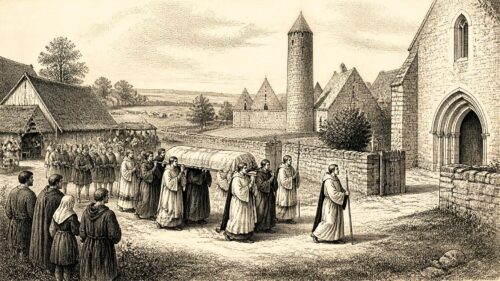
Domnall Ruad Mac Carthaig died in February 1302 and was buried in the Franciscan friary at Cork. He had ruled as king of Desmond from the early 1260s, during a period when the Mac Carthaig lordship had to contend both with rival branches of its own dynasty and with powerful Anglo-Irish neighbours, especially the FitzGeralds. His authority had never meant unchallenged control over all Munster. Rather, it was built through negotiated overlordship, warfare, agreements with subordinate lords and, increasingly in later life, practical dealings with royal government.
The annals’ praise is therefore significant, even allowing for the conventions of aristocratic obituary. They call him generous, valiant, formidable and triumphant among the Gaels of Ireland, and say that he died after a ‘victory of repentance’: the ideal Christian ending to the life of a warrior ruler. The Annals of Inisfallen, written in the Munster world over which he had presided, add that he had been buried in a Franciscan habit in the friars’ choir at Cork. That detail connects dynastic prestige to the rapidly developing mendicant religious culture of Irish towns. A king’s burial in a Franciscan house displayed penitence, but it also tied his memory to an institution with urban, ecclesiastical and international connections.
Domnall’s son Domnall Óc succeeded him. Nothing in the surviving notices allows a detailed reconstruction of the succession itself: there is no safely dated account of an inauguration, assembly or settlement with rival kindreds. Yet the transfer mattered. Domnall Ruad had survived decades of competition within Desmond; the new ruler inherited both the title and the unresolved pressures that had shaped his father’s reign. The later instability of Desmond should not be projected backwards as an event of 1302, but the death marked a genuine change in the political balance of the south-west.
Cattle Mortality Across Ireland
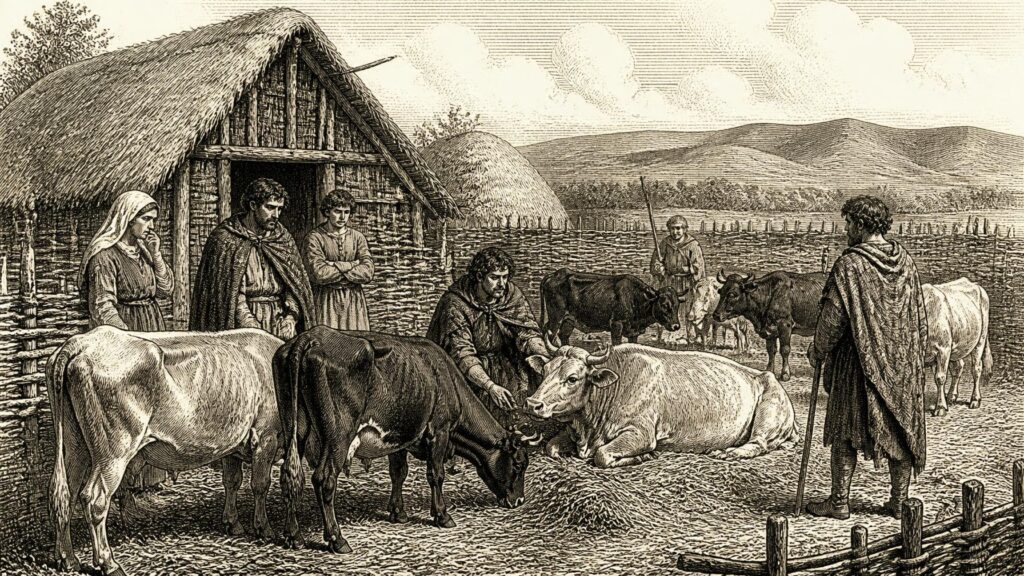
The most striking social and environmental notice for the year is blunt: the Annals of Connacht report ‘great plague and destruction among the cattle of all Ireland’, while the closely related Annals of Loch Cé speak of great destruction of cows and mortality among all cattle. Neither source identifies a cause, symptoms, season or precise geographical limits. It would be wrong to attach a modern diagnosis to the outbreak, or to assume that every district suffered equally. Nonetheless, the annalists considered it grave enough to describe in island-wide terms.
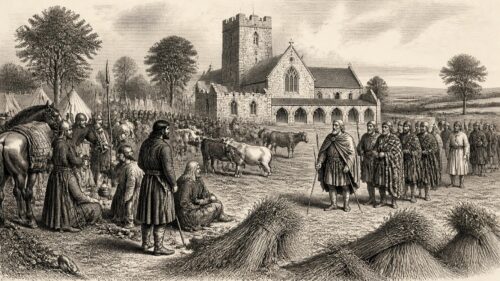
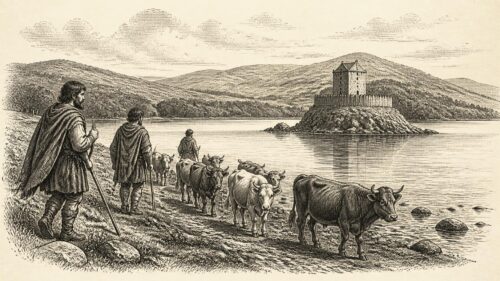
For rural households, this was no minor loss. Cattle were stores of wealth, sources of milk and meat, providers of hides and manure, and a principal measure in tribute, compensation and lordly exactions. They were also central to the raiding economy repeatedly visible in the annals. A serious mortality could therefore affect diet, dairy production, obligations between tenants and lords, and the ability of political communities to recover from conflict. The record does not permit figures for losses or prices, and it does not prove famine among people. What it securely reveals is contemporaries’ sense that animal disease had become a national condition, not merely a local misfortune.
This mattered especially in a landscape where agriculture combined tillage with pastoral resources. The same year’s notices of raids and political deaths show that herds were vulnerable not only to disease but to seizure and dispersal. In 1302, environmental shock and human conflict belonged to the same material world: both could diminish the livestock on which households and lordships depended.
Raiding in Mag Céidne
Conflict continued in Connacht. The annals report major raids by Aed, son of Cathal Ó Conchobair, against Tadc, son of Andrias Ó Conchobair, and Sitrec, son of Cairnech Mac Flannchaid, in Mag Céidne. The Annals of Connacht translator cautiously identifies the raider as probably Aed Brefnech, a member of the wider Ó Conchobair dynastic world; the identification should remain provisional because the entry itself gives only his patronymic.
The location lay in north Connacht, in the wider region of modern County Mayo. The entry does not describe a set-piece battle, a conquest or a change of kingship. It does, however, make clear that organised raiding remained a central instrument of political competition. Such expeditions aimed at prey and damage, but they also advertised a lord’s ability to mobilise followers, challenge rivals and punish communities allied to them. The annals do not provide a tally of animals taken, people displaced or buildings damaged. Their language nonetheless points to a conflict broader than a private quarrel, involving figures from leading Connacht families.
The fact that the raid is preserved alongside the cattle mortality is revealing. Cows appear in the year both as victims of disease and as the practical substance of armed competition. In a society where wealth was portable and livestock could be driven away, a successful raid could rapidly alter the resources available to a rival lord, his clients and dependent households.
Deaths, Succession and the Church
1302 also brought the deaths of important rulers beyond Desmond. Donn Carrach Mag Uidir, king of Fermanagh, died and was succeeded by his son Flaithbertach. Donn had established the Maguires as the dominant family of Fir Manach, and later tradition remembered him as a protector of poorer people and a patron of poets and learning. His obituary in the annals, like that of Domnall Ruad, stresses generosity and prowess: qualities expected of a ruler who maintained followers through protection and hospitality as much as through force.
Ruaidri Ó hEgra, an eligible prince of Leyney, also died. The wording matters. Medieval Irish annalists often recorded not only reigning kings but men considered suitable heirs or contenders. Their deaths could narrow a lineage’s choices before any formal succession occurred. In Muinter Eolais, Cathal Mag Ragnaill, described as an heir to the chieftainship, was killed by his cousin Fergal Mag Ragnaill. This was a local killing, but it shows the lethal stakes of kin-based politics.
Church leadership changed markedly as well. Stephen Ó Brácáin, archbishop of Cashel, died in 1302, probably during the summer. Miles, bishop of Limerick, and the bishop of Cork, Mac Donnchada, were also recorded as dead; the latter had previously been a grey monk. William Ó Finnén, abbot of Kilbeggan and later bishop of Clonmacnoise, died too. These notices illuminate the breadth of ecclesiastical life: metropolitan archbishops, urban diocesan bishops and monastic heads all belonged to networks that linked Gaelic and Anglo-Irish society. Their deaths created vacancies in offices that carried spiritual authority, landed resources, legal influence and connections to the crown and papacy.
A Year of Connected Vulnerability
It is tempting to treat the death of a king, a raid and livestock disease as separate kinds of history. The records for 1302 instead show their interdependence. Lordship rested on the capacity to protect dependants, reward followers, collect renders and sustain religious patronage. Raiding could undermine that capacity; disease could weaken it without any enemy’s intervention; and the death of an established ruler could expose the arrangements holding a territory together.
Some entries sometimes associated with this period cannot responsibly be made events of this calendar year. The Annals of Ulster preserve a cluster headed ‘1302–6’, including the death of Toirdelbach Ó Briain of Thomond and a major Connacht conflict. Because that source explicitly signals a multi-year chronological problem, those developments should be treated as belonging to the early years of the decade rather than assigned confidently to 1302 alone. The firmer record is compelling enough: in Ireland, 1302 was marked by the loss of senior rulers and churchmen, continuing rivalry in Connacht, and a cattle disaster that reached into the economy of everyday life.
Primary Sources
- Annála Connacht
- The Annals of Ulster
- The Annals of Ulster, Year U1302
- Annals of Loch Cé A.D. 1014–1590
- Annals of Loch Cé, Part 13
- Annals of the Four Masters
- Annals of the Four Masters, Part 14
- Annals of Inisfallen
- Annals of Inisfallen, Part 81
- Annales Hiberniae
- MacCarthy (Mac Carthaig), Domnall Ruad
- Maguire (Mág Uidir), Donn Óc (‘Donn Carrach’)
- The Medieval Irish Plea Rolls – An Introduction
- Rotulorum Patentium et Clausorum Cancellariæ Hiberniæ Calendarium
- Patent Roll 31 Edward I (1302–1303), Item 20
- Calendar of Ormond Deeds, Volume I, 1172–1350
- Calendar of Documents Relating to Ireland, 1171–1307
- Fasti Ecclesiae Hibernicae: The Succession of the Prelates and Members of the Cathedral Bodies in Ireland
- Who Was Who in Medieval Limerick City
- Bishops Through the Ages
- Irish Script on Screen: MS 1301 (Annals of the Four Masters)
- Exploring the Irish Annals
- Calendar of the Patent Rolls Preserved in the Public Record Office: Edward I, A.D. 1301–1307