Ulaid Kinslaying647 CE
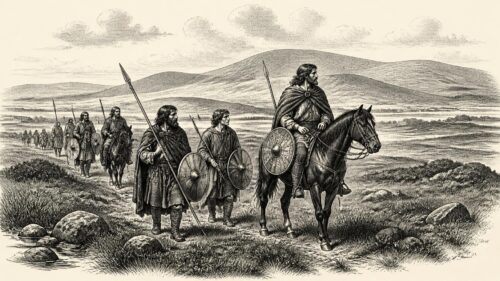
In 647, Máel Cobo son of Fiachnae, overking of Ulaid and a member of Dál Fiatach, was killed by his nephew Congal Cennfhota. Annalistic sources support this date despite differing manuscript chronologies. The killing exposed tensions within a dynasty recently strengthened after Dál nAraide’s defeat at Mag Roth. Congal did not immediately gain the kingship; Máel Cobo’s son Blathmac succeeded and ruled until 670. The event illustrates the vulnerable, kin-based nature of early Irish kingship. Bangor was an important regional religious centre, while most people lived in rural farmsteads dependent on livestock, crops and local craft production.
Dateline
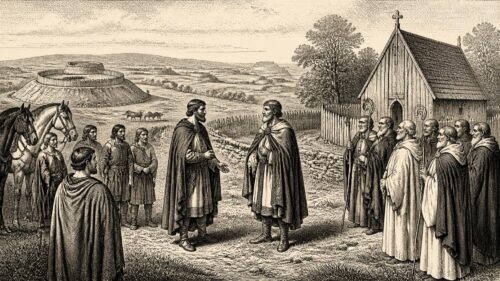
In 647 CE, Máel Cobo son of Fiachnae, overking of Ulaid, was killed by his nephew Congal Cennfhota son of Dúnchad. The notice is brief, but it preserves a decisive act of dynastic violence in north-east Ireland. Máel Cobo belonged to Dál Fiatach, one of the competing royal kindreds of Ulaid; Congal belonged to the same dynasty and was the son of Máel Cobo’s brother Dúnchad. This was not an invasion or a clash between distant peoples. It was a killing within the ruling family, at a point when possession of the overkingship of Ulaid could turn on the survival, alliances and adult sons of a single lineage.
A Firmly Dated Killing
The strongest evidence for the event comes from the annalistic tradition. Chronicon Scotorum, under 647, states that Máel Cobo, king of Ulaid, was killed by Congal Cennfota. The Annals of Inisfallen also place Máel Cobo’s death in 647 and name Congal as the killer. The surviving text of the Annals of Ulster records Máel Cobo’s killing in its entry numbered U647, although the manuscript’s accompanying AD heading reads 646. Such apparent contradiction is a feature of early Irish chronology, not evidence for two separate deaths: the calendars and later editorial year-numbers of related annals do not always align. Modern synchronisation of the annalistic evidence supports 647 CE as the appropriate calendar year for the killing.
The Annals of the Four Masters, compiled much later, puts Máel Cobo’s death under 646 and gives a different, Leinster-related killing under its 647 heading. It is therefore important not to transfer that later compiler’s 647 entry wholesale into this year. The safely dateable development is the death of Máel Cobo in 647. The annals do not name the place, describe a battle, explain a legal charge, or identify the men who fought beside either party. Any reconstruction of an ambush, a royal feast or a formal succession meeting would be invention.
Ulaid After Mag Roth
Máel Cobo’s death mattered because Ulaid was a major northern overkingdom, not because it was a single, settled kingdom in the modern sense. Its leading dynasties competed for precedence over a region extending across much of present-day north-east Ireland. Dál Fiatach had its core in eastern County Down, while Dál nAraide, associated especially with areas of Antrim and the Cruthin, was its principal rival. Their competition had repeatedly shaped Ulster politics.
Only a decade earlier, in 637, Congal Cáech of Dál nAraide had been defeated and killed at Mag Roth, near modern Moira in County Down, in the wider struggle involving the Uí Néill and Dál Riata. That defeat damaged Dál nAraide’s position and enabled a Dál Fiatach recovery. Dúnchad and then his brother Máel Cobo held the overkingship. The killing of Máel Cobo in 647 was thus an internal rupture in a dynasty that had recently regained an advantage over its longstanding competitors. It did not automatically restore Dál nAraide power, but it exposed how precarious Dál Fiatach control remained.
A Succession Not Secured
Congal’s motive cannot be proved. The Irish Dictionary of Biography reasonably interprets the killing as an attempt to secure the kingship for himself, but the annals do not spell this out. What happened next is revealing. Máel Cobo’s son Blathmac, rather than Congal, succeeded as overking of Ulaid in 647. Congal had eliminated his uncle, yet did not at once obtain the prize. In a political culture in which kingship circulated within a restricted royal kindred, seniority, military following, local support and the claims of several branches all mattered. Killing a ruler could open a succession; it did not settle it.
Blathmac’s accession also cautions against treating a king’s death as the collapse of his people. Dál Fiatach retained sufficient cohesion to advance Máel Cobo’s son. Blathmac would rule until 670 and is described in later historical assessment as having had a comparatively peaceful reign, apart from a late conflict with Dál nAraide. Congal remained an important contender, eventually becoming overking after Blathmac’s death. The immediate outcome in 647, however, was continuity through Máel Cobo’s son, not Congal’s triumph.
The same annalistic year contains further, much less intelligible notices: the killing of Dúnchad grandson of Rónán and a battle associated with Colgu son of Crunnmáel Bolg Luatha, king of Uí Chennselaig in Leinster. Neither surviving notice supplies enough detail to connect it directly with the northern succession. Their presence is nevertheless useful. They show that Ireland’s politics consisted of many overlapping local contests, not a simple contest for a national throne. A death in Ulaid, a conflict in Leinster and the manoeuvres of Uí Néill dynasties in the midlands belonged to the same broad political world without necessarily being parts of one campaign.
Bangor and the Northern Church
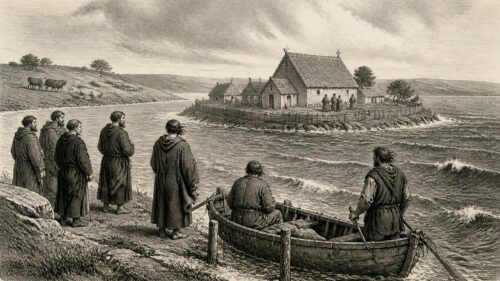
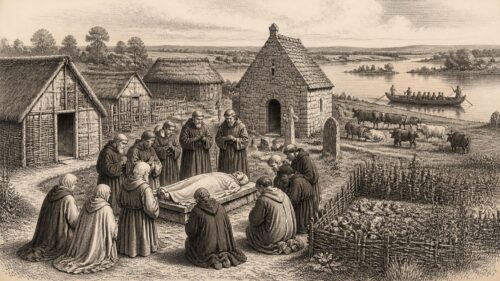
Royal politics and ecclesiastical life were closely interwoven in the region, though no source says that Bangor intervened in Máel Cobo’s death. The monastery of Bennchor, modern Bangor on Belfast Lough, lay within the northern sphere in which Dál Fiatach and Dál nAraide competed. Founded by Comgall around 558, it had become one of Ireland’s foremost religious communities by the mid-seventh century. Its authority rested on people, land, patronage, liturgy and learning, as well as on spiritual reputation.
The annals place the repose of Mac Laisre, abbot of Bennchor, in 646 in Chronicon Scotorum and the corresponding Ulster sequence; the Annals of Inisfallen enters it under 647. That discrepancy should not be converted into a confidently dated event of 647. It does, however, place Bangor at a moment of leadership change immediately before or around the year of Máel Cobo’s killing. The community was not a remote hermitage. Later evidence, including the seventh-century Antiphonary of Bangor, confirms the high literary and liturgical standing of the monastery’s milieu. In 647, such centres supplied prayer, education, writing and institutional memory, while also requiring protection and endowment from secular elites.
Life Beyond the Annals
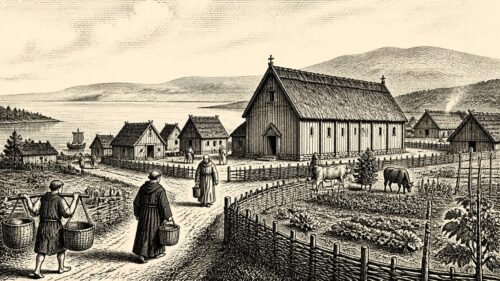
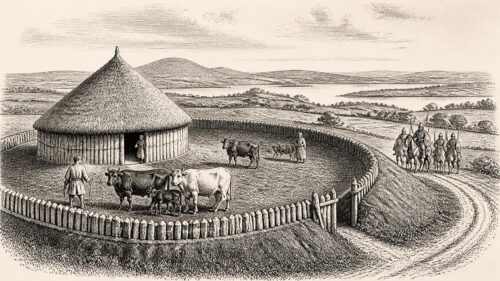
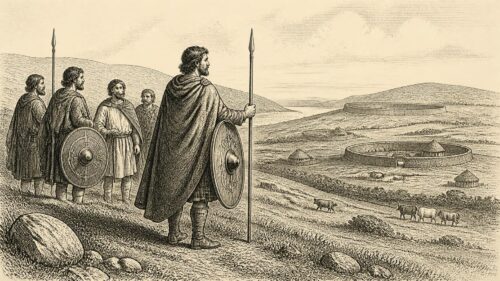
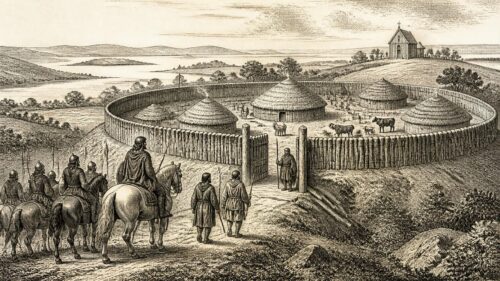
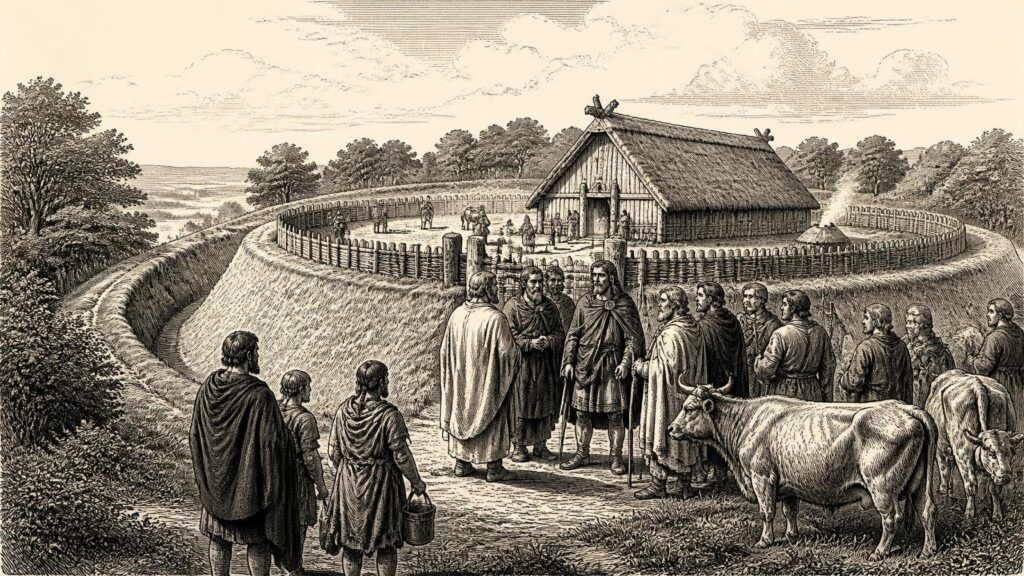
The annals name kings, abbots and killings because these were events worth recording to their compilers. They reveal far less about the majority who made northern society function. Archaeology provides the necessary wider setting, although it cannot date an individual household precisely to 647. Much of early medieval rural Ireland was organised around enclosed farmsteads now known as ringforts or raths: circular spaces marked by earth banks and ditches, or by stone walls in rockier districts. They enclosed dwellings, stores and places for animals, and expressed both practical security and social standing.
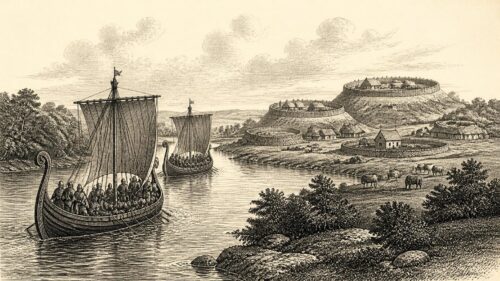
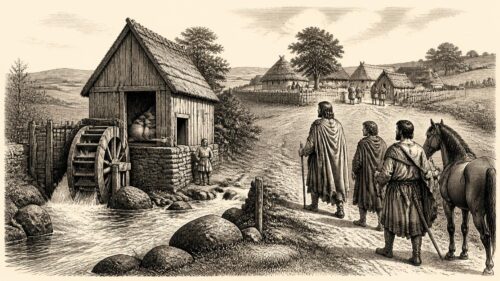
For families living in and around such settlements, cattle were central to wealth and food, while cereals had to be grown, dried, ground and stored. Finds and excavated sites indicate work in weaving, leather-working, iron-working, butchery and food preparation. Small boats and coastal routes connected the shores of Strangford Lough and Belfast Lough with other Irish Sea communities. These ordinary activities continued despite a dynastic killing. Yet the risks of political conflict were real: livestock, stores, labour and allegiance were all resources that kings and their followers could demand, seize or protect.
What the Year Can Bear
647 CE should therefore be remembered principally for a sharply documented killing and an unsettled succession in Ulaid. Máel Cobo’s death at Congal Cennfhota’s hands demonstrates that early Irish overkingship was personal, kin-based and vulnerable. Blathmac’s immediate succession shows that dynastic murder did not necessarily produce direct inheritance by the killer. Around this political crisis stood established religious institutions such as Bangor and a densely worked rural landscape of farms, enclosures and local communities. Those broader conditions belong securely to mid-seventh-century Ireland; the drama at the centre of the year is the death of a king whose family did not permit his nephew to inherit at once.
Primary Sources
- The Annals of Ulster
- Chronicon Scotorum
- Part 62 of Chronicon Scotorum
- Part 21 of Annals of Inisfallen
- Part 48 of Annals of the Four Masters
- Congal Cennfhota
- Blathmac
- Congal Cloen (Cáech)
- Comgall
- Domnall Brecc
- The chronology and sources of the early Irish annals
- Chronological Synchronisation of the Irish Annals
- Annals Chronology and Synchronisms
- Exploring the Irish Annals
- Irish Texts at CELT
- Bangor Abbey, Down: 2007 Excavation Report
- Bangor, Down: 2011 Excavation Report
- Malachy’s Wall, Bangor Abbey
- Ringforts / Ráthanna
- Early Medieval Farmsteads
- Earthen Banks and Broken Walls
- Patrician and Early Christian Architecture
- High Crosses