
Deveney Surname
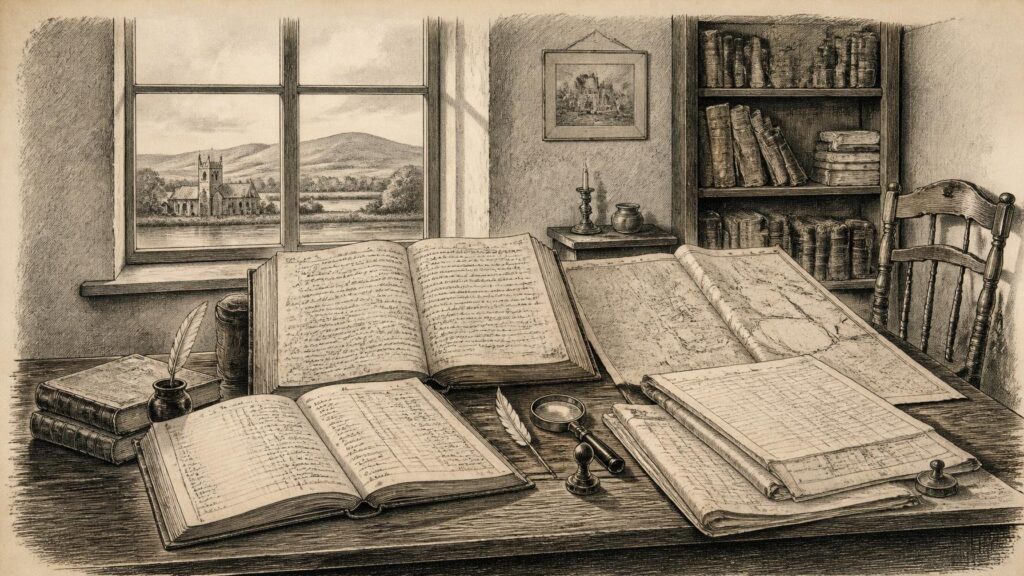
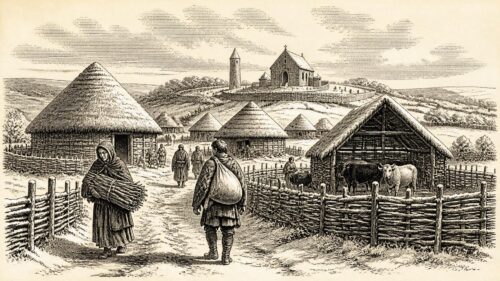
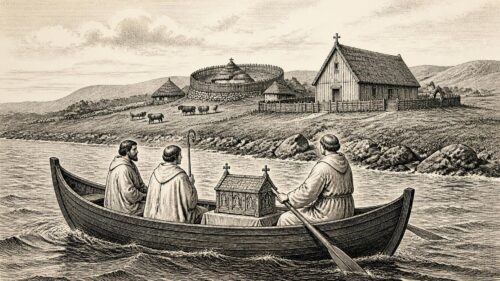
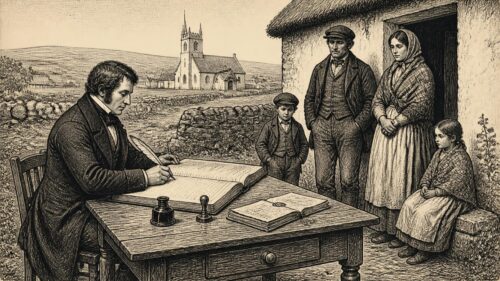
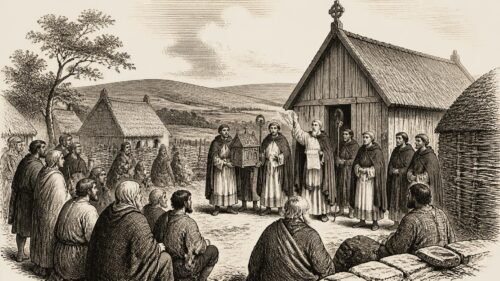
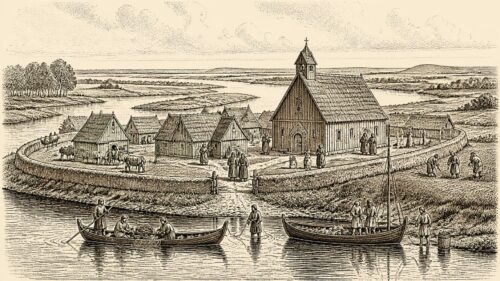
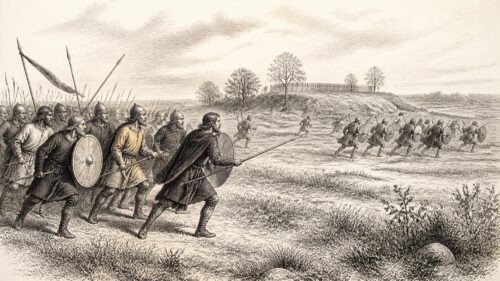
AI generated historical illustration, not a contemporary photograph.
At a Glance
Names Matter
Deveney is a small name with a large historical caution attached to it. It has a real and documented Irish pedigree, but it is not a single uncomplicated badge of descent. In surviving Irish historical sources, closely related spellings—O’Devenie, O’Devany, Devaney, Devanny, Devenny and others—can point towards more than one Gaelic form. The history of Deveney is therefore best understood not as the history of one provable clan moving intact through time, but as a record of language, locality, religion, administration and family memory.
The spelling Deveney is particularly instructive because it sits at the meeting-point of Irish speech and English record-keeping. A person bearing the name may have inherited it from ancestors whose surname was written in Irish, whose parish priest or civil registrar spelled it phonetically in English, or whose family adopted a preferred spelling after migration. The modern eye tends to treat surnames as fixed labels. Irish records show that they were often anything but fixed. In the case of Deveney, the variation is not merely a nuisance to a genealogist; it is historical evidence in its own right.
Patrick Woulfe’s Irish Names and Surnames, published in 1923, is central to this question. Under Ó Duibheannaigh he listed such English forms as O Devenie, Devanny, Devaney, Devany, Devenny and Divenney. That list does not supply the exact modern spelling Deveney, but it makes the relationship highly plausible. More importantly, Woulfe warned that the anglicised forms could not be distinguished from those of another Irish name, Ó Duibheamhna. That scholarly warning should govern any historical treatment of the surname. A Deveney in a nineteenth-century register cannot automatically be assigned to one medieval family or one named territory simply because a later dictionary supplies an attractive origin story.
The subject is suitable for Irish history precisely because the uncertainty is documented. The name belongs to the wider history of Gaelic patronymics, English-language transcription, the transformation of Ulster after the Tudor conquest, the survival of Catholic institutions, and the patchwork of records through which Irish families are now reconstructed. It also provides a useful corrective to the commercial tendency to promise every surname a singular origin, a coat of arms and an uninterrupted line of descent. The surviving evidence supports something more interesting: several connected historical possibilities, bounded by what can and cannot be proved.
Gaelic Roots
The prefix Ó, conventionally rendered O’ in English, denotes descent or membership in a kin group. It did not mean that every later bearer could demonstrate a direct, documented descent from a single named individual in the modern genealogical sense. It was a hereditary surname form, rooted in Gaelic social organisation and passed through families over generations. Irish surnames developed in a setting where kinship, territory, lordship and ecclesiastical networks all mattered; the meanings assigned to them must therefore be handled with linguistic care rather than reduced to a modern slogan.
Woulfe gave Ó Duibheannaigh as “descendant of Dubheannaigh”, offering the cautious suggestion that the personal name may have meant something like “Black of Eanach”, with Eanach understood as a place-name. His qualification—“perhaps”—is important. It marks an etymological interpretation, not a recovered fact about a particular ancestral individual. The element dubh, commonly translated “black” or “dark”, occurs frequently in Irish personal names and surnames. In early and medieval naming it could refer to colouring, appearance, character, a descriptive byname or an inherited name-form whose original nuance had long ceased to be transparent. It should not be treated as a biographical description of every family bearing a related surname.
The second possible source identified by Woulfe was Ó Duibheamhna, “descendant of Dubheamhna”. He associated it with Eamhain near Armagh and described its bearers as an Ulster family formerly chiefs of Uí Breasail in County Armagh. The forms look close to one another in English because English spelling had difficulty consistently representing Irish sounds, particularly when names passed orally between Irish speakers, English-speaking officials and clerks accustomed to different habits of writing. The disappearance of the Ó prefix, changes in vowels and the interchange of final sounds were predictable outcomes of that encounter.
The historical conclusion is not that Deveney has two wholly separate origins in every instance. Rather, the evidence requires that both possibilities remain open until a particular family is placed in time and place. A Deveney household in County Down may warrant investigation beside Ó Duibheannaigh; a family rooted in County Armagh may invite comparison with Ó Duibheamhna. Yet county alone does not settle the question. People moved, marriages crossed parish and county boundaries, and record-keepers sometimes wrote names according to their own ear. A surname dictionary gives a starting point. It cannot substitute for a chain of records.
Ulster Connections
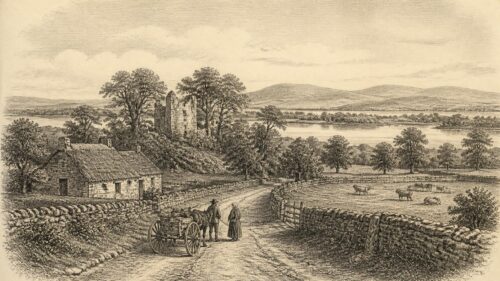
The strongest historical association for the related name-forms lies in Ulster. Woulfe described Ó Duibheannaigh as the name of a County Down family and linked it to Conor O’Devany, bishop of Down and Connor. His entry for Ó Duibheamhna located another associated family in County Armagh, where it was said to have been anciently connected with the chieftainship of Uí Breasail. Those statements give Deveney an authentic regional setting: not an abstract “Celtic” past, but the historically distinct counties and lordships of eastern Ulster.
That setting should not be romanticised. Medieval and early-modern Ulster was neither ethnically uniform nor politically static. Gaelic lordships, church jurisdictions, towns, Scottish settlement, English government and later plantation all shaped the region. The diocese of Down and Connor itself crossed areas which modern readers may too readily divide between a northern past and a southern past. Before partition, the whole island’s civil and ecclesiastical records belonged to overlapping historical jurisdictions, and the surname’s story must be approached on that all-Ireland basis.
Woulfe’s use of the phrase “anciently chiefs” is best read as a statement about a learned tradition of territorial association, not as evidence that all later Deveneys were members of a ruling household. By the time a name appears in nineteenth-century administrative records, it may be borne by tenant farmers, labourers, tradespeople, clergy, servants or urban residents with no recoverable connection to a medieval chiefly line. The distance between a surname’s earliest recorded associations and the lived conditions of a later household can be many centuries wide.
Nevertheless, regional memory matters. Surnames endure partly because they remain usable in local communities, even when their original genealogical structures have dissolved. The association of Deveney-type spellings with Down and Armagh points to an Ulster linguistic landscape in which Gaelic forms remained meaningful long after English became dominant in official documentation. It also suggests why related spellings may appear in church registers, land records and censuses beyond the neat boundaries imagined by a surname map. A family’s name could travel while its spelling changed; conversely, a similar spelling could emerge from a different Gaelic form.
Recorded Bishop
The best-known historical bearer connected with the name is Conor O’Devany, called in Irish Concobhar Ó Duibheannaigh. His significance does not prove the descent of later Deveney families, but it firmly establishes the name-form within seventeenth-century Irish history. The Annals of the Four Masters, a major Irish annalistic compilation, records him as “Conor O’Duibheannaigh O’Devany”, bishop of Down and Connor, and says that he had first been a Franciscan friar of the convent of Donegal before election to episcopal office.
The annal’s narrative is emphatically Catholic and devotional. It describes imprisonment, efforts to induce O’Devany to conform to the established religion, his refusal, and his execution in Dublin. The entry is placed beneath the annalistic heading M1611, while the execution is dated there to 1 February. Modern reference traditions generally give the event as 1 February 1612; the apparent discrepancy reflects the annalistic chronology and the complexities of dating in early-modern sources. The secure point is that the source preserves both his Irish and English name-forms and places his death in the period of intensified pressure upon Catholic clergy after the collapse of Gaelic resistance in Ulster.
The language of the annal cannot be read as a detached court record. It calls O’Devany a martyr, portrays his death in religious terms and recounts popular reverence for his remains. Such passages are invaluable historical testimony to the outlook of the annalists and to Catholic memory, but they are also partisan religious writing. The execution itself and O’Devany’s identity as bishop are documented historical facts; the account’s interpretation of sanctity belongs to confession, commemoration and belief. Distinguishing those levels does not diminish the source. It allows it to be read properly.
O’Devany’s presence in the annals gives the surname an unusually clear early-modern anchor. Yet it also demonstrates why names must be read in their political setting. The rendering “O’Devany” was not a mere decorative variant. It was an English-facing transcription of an Irish ecclesiastical figure whose identity was shaped by Gaelic learning, Franciscan formation, Catholic reform and the coercive structures of Tudor and Stuart government in Ireland. A modern Deveney spelling carries no automatic inheritance of that experience, but it descends from the same historical field of translation and adaptation.
Changing Spellings
The route from Ó Duibheannaigh or Ó Duibheamhna to Deveney was not a single act of anglicisation performed on one date. It was a prolonged social process. Names were spoken before they were written; writers varied in familiarity with Irish pronunciation; families may themselves have used more than one form; and the same person could appear under different spellings in different institutions. O Devenie, O’Devany, Devanny, Devaney, Devenny and Deveney can therefore be historically adjacent without being interchangeable in every record.
The loss of the apostrophe and prefix is a conspicuous feature of many Irish surnames. In some lines the prefix disappeared under official usage; in others it was retained, revived or adopted as a declaration of Irish identity in later periods. The absence of O’ from Deveney is not evidence that a family was less Irish, nor does its presence guarantee medieval continuity. It is a matter for the documents of an individual family: baptismal entries, marriage records, civil certificates, leases, valuation books, memorial cards, gravestones, passenger lists and household returns.
Pronunciation complicates matters further. English orthography has several ways of representing a vowel sound, and the spelling chosen by a clerk may tell more about the clerk’s conventions than the family’s own preferred form. The final y, ey, ie or ny can fluctuate. In handwriting, especially in nineteenth-century registers, letters that appear distinct in print may be difficult to separate. Transcription introduces an additional stage at which Devany, Deveney and Devenny may be confused. Digital indexes are powerful tools, but a search result is not the original record; where possible, the manuscript image must be examined.
This is why Woulfe’s warning has continuing value. He explicitly stated that the anglicised forms of Ó Duibheannaigh could not be distinguished from those of Ó Duibheamhna. His point was linguistic and historical, not merely technical. A researcher who selects a Gaelic form solely because it resembles the desired English spelling risks creating an ancestry that the evidence does not support. The responsible formulation is conditional: a particular Deveney family may derive from one of these forms, and the likelihood can be tested against location, associated relatives, religious affiliation, local naming patterns and the earliest surviving documents.
Administrative Evidence
The nineteenth century brought records that make many Deveney histories more traceable, though never effortless. The Tithe Applotment Books, compiled between 1823 and 1837, recorded occupiers of agricultural land liable for tithes to the Established Church. They are useful for locating rural households before the Great Famine, but they are not a census. They omit people who held no qualifying land, do not provide complete household structures and should never be used to claim that a surname was absent from a parish merely because it does not appear.
Griffith’s Valuation, the Primary Valuation of Ireland, offers a second major framework. Published between 1847 and 1864, it listed occupiers, immediate lessors, property descriptions and valuations across the island. Its great value lies in place: a Deveney entry can be tied to a townland, parish, barony or poor-law union, and then traced through maps and revision materials. Its limitation is equally important. It records property occupation, not kinship. Two Deveneys in the same townland may be closely related, distantly connected or unrelated; a married daughter and her children may be absent under a husband’s surname; and a labouring family may leave a faint record.
The National Archives of Ireland preserves and explains the wider valuation record series, including field books, house books, tenure books and revision documents. These materials can sometimes reveal changes of occupancy over long periods. Such evidence is especially valuable where a family remained in one locality and where a later civil certificate identifies the same townland. Yet the records should be read as administrative documents created for taxation and valuation. Their categories were not designed to answer every question a descendant might ask.
Civil registration adds another layer. Non-Roman Catholic marriages were registered from 1845, while general civil registration of births, marriages and deaths began in 1864. A Deveney birth certificate may name parents, residence and occupation; a marriage entry may establish a father’s name and occupation; a death record may lead to a later household. But spelling remains unstable. The Irish Genealogy service itself notes that original records may contain surnames differently spelled from a family’s preferred form. A search strategy confined to Deveney alone can therefore miss Devany, Devaney, Devenny, Deviney or other locally used renderings.
Census Windows
The census returns of 1901 and 1911 are among the most valuable surviving sources for the study of Deveney households. They cover all thirty-two counties of Ireland and preserve original household forms, a remarkable survival by international standards. The 1901 return records names, ages, occupations, marital condition, religion and birthplace; the 1911 return adds information including years married, children born and children living for married women. Used together, they can reveal a household’s composition, movements, literacy, language and changing circumstances.
These returns must be handled with the same caution as every other record. Ages can be approximate, names can be misread or misspelled, and birthplace is not proof of ancestral origin. A Deveney household in Dublin, Belfast, Glasgow, Liverpool or New York may have come from Ulster, Connacht or elsewhere; a surname concentration at one date may result from recent migration rather than ancient settlement. Census evidence is strongest when linked backwards to civil records and land records and sideways to neighbouring households, sponsors, witnesses and recurring given names.
The richness of the surviving 1901 and 1911 returns is made more poignant by what has been lost. Most nineteenth-century Irish census manuscripts no longer survive. The National Archives explains that 1861 and 1871 returns were destroyed after statistical use, 1881 and 1891 returns were pulped during the First World War, and most earlier returns were destroyed in the 1922 fire at the Public Record Office. Only fragments remain for certain places and years. This archival destruction means that silence in the records is often a fact about survival, not a fact about a family.
For the Deveney surname, that loss has a particular consequence. It is tempting to build a seamless account from a seventeenth-century bishop to a twentieth-century household, but the documents usually do not permit it. The disciplined alternative is a locality-based reconstruction. Begin with the latest known individual; obtain civil certificates; locate the family in 1901 and 1911; consult valuation records and revision books; examine parish registers; then pursue earlier material where it exists. At each stage, record the spelling exactly as found rather than silently normalising it to Deveney.
Family Memory
Irish family history often preserves oral statements: that the family was “from Down”, that the name once had an O’, that an ancestor was related to a bishop, or that a spelling changed on arrival in America or Britain. Such memories should be respected, but they need classification. They are not worthless because they are unproven; they are leads, expressions of identity and sometimes compressed accounts of real movement. They become historical conclusions only when supported by contemporary or near-contemporary records.
The Conor O’Devany story has naturally attracted later devotional and family interest. The Annals of the Four Masters offers a vivid account of his death, while Woulfe connected the County Down surname directly with him. It is entirely reasonable for descendants of a Deveney-type surname to investigate that connection. It is not reasonable to claim descent merely on the basis of shared spelling. The documentary burden grows heavier across centuries, particularly when the name was borne by more than one Gaelic family and when so much archival material has vanished.
Folklore can also attach meaning to the name itself. “Black” is an inviting translation, and dark-haired ancestors are easily imagined into a surname’s history. But etymology does not establish appearance, status or character. Woulfe’s proposed interpretation for Ó Duibheannaigh was cautious, while the related Ó Duibheamhna was linked to Eamhain near Armagh. The historical value of these suggestions lies in illuminating the Irish language from which the name emerged. They do not authorise a portrait of a founding ancestor, still less a claim that one bloodline has remained unchanged since the remote past.
Careful Conclusions
Deveney belongs in Irish historical study because the name is securely connected to documented Gaelic surname forms and to the historical landscapes of Ulster. The evidence is strongest for its relationship to the variant cluster represented by Ó Duibheannaigh and Ó Duibheamhna, for the County Down and County Armagh associations recorded by Woulfe, and for the seventeenth-century bishop Conor O’Duibheannaigh O’Devany. The name also survives as an instructive example of the difficulties produced when Irish pronunciation met English administration.
What cannot responsibly be claimed is equally clear. There is no basis for saying that every Deveney descends from Conor O’Devany, that all Deveneys belong to one medieval sept, or that a modern spelling uniquely identifies one original Gaelic surname. Nor does a surname alone establish a family’s county of origin. These are not disappointing limitations. They are the conditions under which sound history is made.
The lasting significance of Deveney lies in the traces it leaves: an Irish patronymic in a learned surname dictionary; an Ulster regional association; a bishop recorded in Irish annals; altered spellings in later records; and households recoverable, in favourable cases, through valuation books, civil certificates and census forms. To follow those traces is to encounter the broader history of Ireland—not as a pageant of fixed clans, but as a country in which language and identity repeatedly adapted to changing power, belief, migration and record-keeping.
What makes the Deveney surname especially compelling is that its changing spellings can serve as evidence of historical contact rather than merely frustrating genealogical noise. The article shows that forms associated with County Down and County Armagh may overlap in English-language records, while Conor O’Devany anchors one name-form in seventeenth-century Catholic Ulster. This means a family history should be reconstructed from locality, kinship, religion and documents, rather than an attractive origin story. When assessing a particular Deveney family, how should researchers balance spelling patterns against parish connections, land records and migration evidence across generations when considering its possible Gaelic origins?