
Restoration Settlement
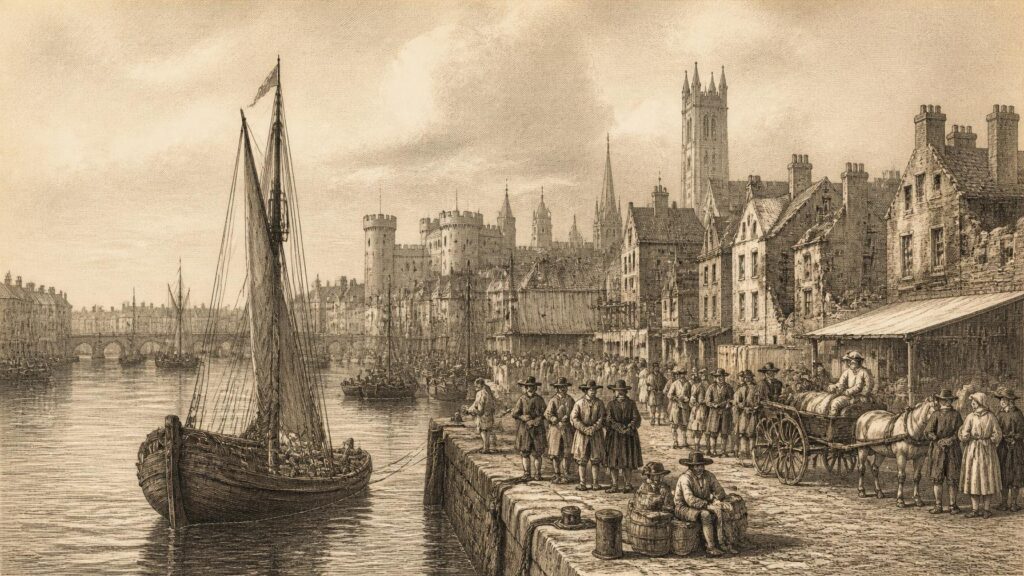
AI generated historical illustration, not a contemporary photograph.
At a Glance
When Charles II returned to his thrones in 1660, Ireland did not simply resume an interrupted royal order. It entered a prolonged reckoning over conquest, land, religion and loyalty. The Restoration promised repair after two decades of rebellion, civil war and Cromwellian rule, but its most durable Irish achievement was not reconciliation: it was the legal consolidation, with limited exceptions, of a revolutionary transfer of property and political power.
Royal Return
The word ‘Restoration’ commonly describes the return of Charles II to the crowns of England, Scotland and Ireland in 1660, after the execution of his father, Charles I, the republican Commonwealth and the protectorates of Oliver and Richard Cromwell. In Ireland, however, the term carries a particular weight. The king was restored, but the kingdom he recovered was profoundly unlike that which his father had governed before the rebellion of 1641. War had devastated communities, uprooted owners and tenants, rearranged local authority, damaged towns and churches, and brought a vast quantity of land into the hands of soldiers, financiers and Protestant settlers connected to the Cromwellian conquest.
Charles was proclaimed in Dublin in May 1660. The formal recovery of monarchy was welcomed by many people who associated the Commonwealth with military government, religious disruption and confiscation. Yet rejoicing did not dissolve the conflicts accumulated since 1641. Irish Catholic proprietors hoped that a Stuart king, indebted in sentiment and sometimes in personal obligation to royalist supporters, would restore estates taken during the 1650s. Protestant settlers, including former parliamentarian soldiers and the ‘adventurers’ who had financed war through subscriptions secured upon Irish land, feared that royal mercy might dispossess them. Protestant royalists who had opposed the king’s enemies had claims of their own. So too did officeholders, municipal corporations, widows, creditors and those whose titles had become entangled in a decade of improvised wartime transactions.
The Restoration therefore arrived in Ireland not as a blank slate but as an argument over which past should count. The preceding wars had involved shifting allegiances. Some Irish Catholics had fought for the Confederate Catholic association; some later accepted a royalist alliance; others had tried to preserve families and estates amid forces beyond their control. Protestant interests were equally diverse. The language of loyalty was powerful, but it did not eliminate competition between veterans of the Cromwellian army, English financiers, established Protestant landowners and royalist claimants. Every proposed remedy created another group with something to lose.
Contemporary official language did not neutrally describe these divisions. The preamble to the 1662 Act of Settlement represented the rising of 1641 as an ‘unnatural insurrection’ and a general rebellion by Irish Catholics. That wording was politically consequential. It helped make forfeiture appear the lawful consequence of treason, while obscuring the complicated succession of wars, negotiations and alliances through which Ireland had passed. The statute is invaluable evidence of the state’s intentions, but it is not an impartial account of the conflict it invoked.
Interpretation must therefore begin with a distinction. The Restoration was undeniably a restoration of the Stuart monarchy and of some older institutions. It was not a restoration of the pre-war distribution of land, nor of Catholic political influence. Its Irish settlement sought order by reconciling incompatible claims only partially. In practice, it preserved the central result of the Cromwellian conquest: a greatly enlarged Protestant interest in Irish property and government.
Broken Kingdom
The crisis inherited in 1660 had its roots in the rebellion that began in October 1641 and in the wars that followed across the Three Kingdoms. Violence, rumour and atrocity narratives deepened confessional fear. The Confederate Catholics of Ireland established their own political and military organisation, while royalist, parliamentarian, Scottish and local forces pursued overlapping and changing objectives. Charles I’s defeat and execution transformed the struggle. Cromwell’s campaign in Ireland from 1649, followed by the defeat of organised resistance by 1652–53, placed the country under a victorious English parliamentary regime.
That regime treated land as both punishment and payment. The 1652 settlement provided for the forfeiture of the estates of many Catholics according to categories of presumed responsibility, while adventurers and soldiers were to be satisfied from confiscated land. Transplantation westward, most famously associated with Connacht and Clare, was part of a wider programme of security, social control and property redistribution. The familiar phrase ‘To hell or to Connacht’ captures later popular memory of this process, but it should not be treated as a simple contemporary slogan explaining every removal. The documentary reality was extensive, coercive and uneven: people were transplanted, exempted, protected, returned, or left in precarious possession according to status, labour needs, patronage, local arrangements and administrative capacity.
By the late 1650s, the new land order was already deeply rooted. The Down Survey, directed by William Petty, furnished a remarkably ambitious cartographic and statistical basis for confiscation and redistribution. It did not merely record a settled countryside; it helped make settlement administratively possible. Maps, acreage, valuations and denomination names gave the government means to assign property to claimants, distinguish profitable from unprofitable land, and calculate compensation. The physical landscape of Ireland was thereby translated into a fiscal and legal resource for the conquerors.
The Restoration government could not ignore this reality even had it wished to do so. Undoing all transfers would have displaced a large armed and politically important Protestant population, reopened uncertainty in titles and threatened the public finances. Charles II also needed the cooperation of powerful men in England and Ireland. His government therefore faced what later historians have described as a problem of managing conquest rather than reversing it. A settlement that offered general restitution to Catholics was politically impracticable; a settlement that gave them nothing risked alienating subjects whose loyalty the monarchy claimed to value.
This helps explain the central paradox of Restoration policy. The king’s declarations held out hope to several constituencies, but the machinery eventually constructed gave decisive protection to existing Protestant possession. The language of grace and repair was real, especially in individual cases, yet it operated inside a framework designed to secure the fruits of conquest. That was not simply hypocrisy. It was the outcome of a state attempting to stabilise a kingdom in which military victory, legal title and moral claims pointed in different directions.
Competing Claims
The chief instrument of settlement was Charles II’s declaration for Ireland of November 1660, followed by the Irish Act of Settlement of 1662 and the Act of Explanation of 1665. Together they are often called the Restoration land settlement. They were not a single moment of decision but a drawn-out legal and political process. The declaration attempted to identify classes of persons entitled to security, compensation or restoration. The subsequent statutes supplied the legal apparatus, qualifications and procedures through which these promises and protections could be applied.
The categories themselves reveal the difficulty. Adventurers had advanced money for the parliamentary war on the expectation of Irish land. Cromwellian soldiers had claims for arrears and grants. Protestant royalists sought reward for service to Charles I or Charles II. Catholics who could show that they were ‘innocent’ under statutory definitions hoped to regain estates. Others, including persons named for royal favour, had particular claims. A settlement capable of fully satisfying all of them would have required more land than the state controlled. The issue was never merely whether a claimant had suffered; it was whether the government could provide redress without unsettling someone already in possession.
The Act of Settlement confirmed the importance of possession on 7 May 1659, a date used as a benchmark for numerous claims. Its provisions made clear that lands affected by the rebellion and war were vested in the Crown for disposition under the scheme. It also created routes by which some Catholics might be judged innocent and restored. However, innocence had a narrow statutory meaning rather than a broad moral one. Applicants had to navigate rules concerning participation in the rebellion, residence, conduct, and the changing military and political alignments of the previous twenty years. Many Catholic landowners were excluded, whether because they could not meet the legal tests, could not produce persuasive evidence, or fell into categories that Parliament and government considered ineligible.
The Court of Claims sat in Dublin from 1662. Its proceedings gave the appearance of adjudication and supplied a forum in which evidence could be heard, but they were embedded in an overtly political settlement. A claimant’s success could produce a new crisis: if a Catholic proprietor was restored to an estate occupied by a soldier or adventurer, the occupier required ‘reprisal’, or equivalent land elsewhere. The availability of such land was finite. The court’s work soon generated anxiety among Protestants who believed that too many Catholic claimants were being found innocent, and the first court was stopped before all claims could be resolved.
The surviving legislation and records are an important corrective to any simple picture of either wholesale Catholic restitution or automatic Protestant triumph. Individual Catholics did regain land, sometimes through legal success and sometimes through personal favour or purchase. Equally, the aggregate outcome remained heavily weighted towards the Protestant interest. Scholarly estimates differ according to methods and dates, but the broad direction is clear: Catholic ownership declined drastically between 1641 and the later seventeenth century. The restoration of selected persons did not restore the old Catholic landed order.
The Act of Explanation of 1665 was intended to make a difficult settlement workable. It required many soldiers and adventurers to surrender a third of their holdings, creating land for reprisal and compensation, though exemptions and practical complexities mattered greatly. It also clarified disputed elements of the 1662 legislation. The title ‘Explanation’ can sound technical and modest; in reality, it was essential to converting a mass of competing expectations into enforceable titles. By the end of the process, legal uncertainty had not disappeared, but a new distribution of property had received the authority of Crown and Parliament.
Ormond Authority
James Butler, duke of Ormond, dominated Irish government in the early Restoration. A member of an old Anglo-Irish family, a Protestant and a prominent royalist, Ormond had served Charles I and spent years in exile around the Stuart court. He returned as lord lieutenant with unrivalled experience of Irish affairs, extensive landed interests and a strong belief in royal authority. Yet he governed within limits imposed by London, the Irish revenue, local Protestant anxieties and the fraught land settlement.
Ormond’s political significance lay partly in his ability to act as intermediary. He had to communicate Irish conditions to the king and English ministers while persuading Irish elites that government was capable of protecting their interests. His task was not to represent an undivided ‘Ireland’, for no such unified political constituency existed. Rather, he attempted to preserve a Protestant governing order, secure the revenue, restrain disorder and prevent Catholic hopes or Protestant fears from destabilising the kingdom.
The restored Irish Parliament met in 1661 and proved a vehicle for establishing this order. It passed the Act of Settlement and legislation concerning religion, revenue and administration. The Parliament’s composition and outlook reflected the altered balance of power. Catholics, despite being the majority of the population, had no comparable presence within the institutions that determined the land settlement. This exclusion was structural, not incidental. It helped ensure that Catholic petitions for redress were addressed from outside the decisive political arena.
Ormond has sometimes been cast either as a pragmatic protector of Catholics or as the architect of Protestant domination. Both images contain fragments of truth but can mislead if made absolute. He could counsel moderation, support particular Catholic claimants and oppose measures he considered imprudent. He also defended the settlement that established Protestant property and authority. His policies were shaped by royal service, family interest, security concerns and his conviction that the new order must stand. In an age of patronage, no sharp line separated public policy from networks of obligation and influence.
Government depended upon the army, courts, revenue officers, local magistrates and municipal corporations. The 1660s did not abolish the militarisation inherited from the Interregnum. Instead, the administration sought to place force under restored royal command and make it serve a durable political settlement. Fear of renewed rebellion or foreign invasion remained powerful. Such fears were often amplified by religious prejudice, but they were not invented from nothing: Ireland had experienced repeated war, and European rivalries made the island strategically important. The result was a political culture in which Catholic organisation could readily be construed as a security threat.
Religious Limits
Religious policy exposed the limits of Restoration accommodation. Charles II’s own preferences and diplomatic circumstances sometimes encouraged hopes of greater toleration. Irish Catholics, including clergy and religious orders, had reason to believe that their former services to the Stuart cause might be recognised. Those hopes were qualified from the start by the dominance of Protestant officeholders, the anti-Catholic temper of much English and Irish political opinion, and enduring association of Catholicism with rebellion and foreign intervention.
The Church of Ireland recovered its position as the established church. Bishops, clergy, church property and ecclesiastical structures were rebuilt or reasserted after the disruptions of the civil wars. The recovery was neither effortless nor uniform. Parishes had suffered population loss and material damage; ministers varied in education, security and local acceptance; and the institutional church had to operate in a country where most people were not adherents. Nevertheless, establishment gave the Church of Ireland access to law, patronage and tithes that no Catholic institution enjoyed.
The Catholic Church survived but did so under constraint. Priests and bishops continued their ministry, sometimes openly enough to attract official attention and sometimes discreetly. Religious orders were especially vulnerable because officials associated them with continental Catholic powers and papal influence. The pattern was not one of uninterrupted persecution nor of settled toleration. There were intervals of relative latitude, personal protections and local forbearance, followed by proclamations, expulsions or renewed restrictions. This unevenness matters. It explains why Catholic communities could maintain sacramental and devotional life while still lacking secure legal status.
One revealing episode was the Remonstrance controversy. Peter Walsh, a Franciscan, promoted a declaration of Catholic loyalty to Charles II that denied papal temporal authority in Ireland. Walsh and his allies believed that a public assurance of civil loyalty might make space for Catholic relief. Opponents saw the formula as compromising church teaching or conceding too much to a hostile state. The dispute shows that Irish Catholic political thought was not monolithic. Catholics differed over the value of accommodation, the nature of allegiance and the proper relation between religious authority and temporal government.
Protestant dissent also complicated the Restoration’s confessional landscape. Presbyterians, Quakers and other nonconformists did not share the established church’s privileges, even though many were Protestants and some had been important under the Commonwealth. The state’s pursuit of ecclesiastical uniformity could therefore alienate people who were otherwise part of the broader Protestant population. Yet the basic political division remained stark: Catholicism was not simply dissent from an established church but was often treated as an inherited political danger, connected in official imagination to the memory of 1641 and to Catholic Europe.
It would be misleading to explain all political conflict by religion alone. Land, office, credit, family and local rivalry mattered constantly. But religion gave these disputes a language of existential danger. A contest over an estate could become a question of whether Protestant security would survive. A Catholic procession, school or convent could be read as evidence of an international conspiracy. Such interpretations were not neutral observations; they were political acts that justified exclusion.
Urban Renewal
Restoration Ireland was not only a countryside of claims and confiscations. Dublin, the seat of government, Parliament, courts and principal administration, became a conspicuous setting for the restored regime. Its expansion during the later seventeenth century reflected the concentration of political power, the activity of merchants and landlords, and the development of an increasingly confident Protestant elite. The city’s growth should not be mistaken for prosperity evenly shared across the island, but it demonstrates that the Restoration brought construction and commercial change as well as legal consolidation.
Ormond favoured a capital that could project order and grandeur. New streets, houses and institutions helped alter the city beyond its older medieval core. The rebuilding and embellishment of Dublin had practical purposes—accommodation, administration, trade and defence—but it also had symbolic value. A restored monarchy required visible settings in which authority could be performed. Elite residences, public buildings and improved urban spaces communicated confidence after an era of war.
Commerce presented a more ambiguous picture. Dublin benefited from its proximity to Britain and from its central place in customs and government. Manufacturing, especially textiles, developed in and around the city. At the same time, Irish producers were vulnerable to English legislation regulating trade and colonial commerce. The cattle acts of the 1660s, which restricted imports of Irish cattle and later other livestock into England, were deeply resented. They revealed the subordinate position of Ireland within the king’s composite monarchy: the same Crown ruled both kingdoms, but English parliamentary interests could shape economic policy to Ireland’s disadvantage.
The response encouraged adaptation rather than simple collapse. Some landowners and merchants turned towards alternative markets, including the export of salted beef, butter and provisions. Linen production acquired increasing importance in later decades, though its major eighteenth-century prominence should not be projected backwards too easily. Urban growth also relied on migration. Protestant refugees from continental Europe, including Huguenots after the revocation of the Edict of Nantes in 1685, contributed skills, capital and congregational diversity to Irish towns.
These changes had social as well as economic consequences. A city shaped by government and Protestant commercial networks could appear remote from the predominantly Catholic rural population. Dublin was the kingdom’s political heart, but it did not represent society in proportion to numbers or property traditions. The Restoration state was thus visible in the capital’s streets and institutions while remaining unevenly rooted beyond them.
Gathering Crisis
The apparent stability of the Restoration began to fray in the later 1670s and 1680s. International conflict, anti-Catholic panic in England, rumours of plots and disputes over the succession all affected Ireland. The possibility that Charles II’s openly Catholic brother, James, duke of York, would inherit the throne sharpened fears among Protestants who believed that the land settlement and established church might be endangered.
These fears were not merely speculative in Irish terms. The settlement of the 1660s had created a Protestant property order that depended upon laws passed after Catholic dispossession. A Catholic king with a programme of religious toleration and administrative change might reopen questions that had supposedly been settled. Conversely, Irish Catholics could view James’s accession in 1685 as an opportunity to recover influence, worship more openly and seek remedy for inherited losses. The contrasting expectations show how incomplete the Restoration’s reconciliation had been.
James II appointed Richard Talbot, earl of Tyrconnell, as lord deputy. Tyrconnell pursued changes that increased Catholic participation in the army and civil administration. Protestant opponents regarded these measures as proof that the kingdom was being prepared for the reversal of the Restoration settlement. Supporters could present them as overdue correction of a regime that had excluded the Catholic majority. Both readings were political interpretations, but the rapid remodelling of officeholding was real and deeply alarming to those whose position had rested on the old arrangements.
The Revolution of 1688 in England transformed this tension into war. William of Orange displaced James in England, but James retained substantial support in Ireland and arrived in Dublin in 1689. For a brief period, Ireland became the principal theatre in which the deposed king attempted to recover his crowns. The Dublin Parliament of 1689, often called the Patriot Parliament, repealed the Act of Settlement and Act of Explanation and sought to reverse major elements of the earlier property order. Its measures were momentous precisely because the Restoration settlement had been so central to Protestant security.
The Williamite war of 1689–91 cannot be reduced to an ancient, unchanging struggle between peoples or religions. It was connected to a European war involving France, the Dutch Republic, England, Scotland and wider dynastic interests. Yet in Ireland it also became a struggle over land, office, religion and memory. The sieges of Derry and Limerick, the Battle of the Boyne, the Treaty of Limerick and the subsequent Jacobite forfeitures created another decisive reordering. The Restoration’s unresolved inheritance helped make this conflict so intense.
Lasting Legacy
The long-term significance of the Restoration in Ireland lies in the political and proprietorial order it stabilised. The seventeenth-century transfer of land was not completed in a single act, and later forfeitures would alter ownership again. Still, the settlement of the 1660s confirmed that the return of monarchy would not mean the return of the Catholic landed elite to its former position. It created legal foundations for a Protestant governing class whose power would become more pronounced after the Williamite victory.
Its legacy was also constitutional. The Irish Parliament survived and could legislate, but it was a Parliament shaped by Protestant qualification and closely bound to English governmental priorities. The Restoration restored the forms of monarchy and parliamentary government after the Commonwealth, while embedding them in a colonial and confessional structure of unequal participation. The later eighteenth-century Irish political nation emerged from this framework, not from an inclusive restoration of all subjects’ rights.
Memory of the period has often been sharpened into moral fable. Protestant narratives could depict the Restoration as necessary deliverance from rebellion and Catholic threat. Catholic narratives could depict it as the betrayal of loyal subjects and the ratification of conquest. Both traditions preserve important experiences, but neither alone captures the full historical record. The state did reward some Catholic royalists and restore some estates; it also set strict limits on restitution and protected a new Protestant landed order. Protestant settlers did face genuine uncertainty and had reason to fear a complete reversal; their political rhetoric nevertheless often turned that insecurity into a blanket justification for Catholic exclusion.
Folklore and inherited phrases have their place in understanding how communities remembered dispossession, transplantation and conquest. They are not substitutes for the statutory record, court proceedings, surveys and correspondence through which the settlement was made. Conversely, official documents are not self-explanatory truth. Their formal language encoded the priorities of rulers, victors and legislators. Read together, the evidence shows a society in which law was not separate from power: law distributed the consequences of war and gave them durability.
‘Restoration’ is therefore an inadequate word if it suggests a return to what had been. In Ireland, 1660 restored Charles II but instituted a new equilibrium born of civil war and conquest. That equilibrium offered security to many who had acquired land and office under the previous regime, narrow avenues of relief to selected Catholics, and no general reconciliation between the kingdom’s major religious communities. The settlement endured because it converted military outcomes into titles, institutions and expectations. Its vulnerabilities endured as well. When James II and Tyrconnell challenged it in the 1680s, the political world constructed after 1660 was revealed not as a settled peace, but as a peace whose terms had never been accepted by all those compelled to live under it.



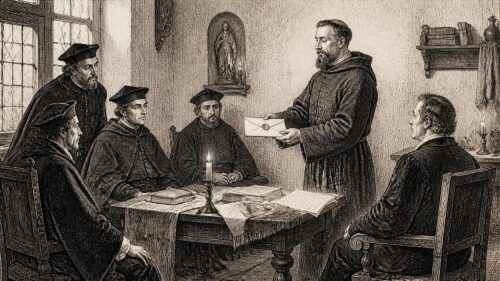


Most striking is the Restoration settlement’s paradox: it employed courts, statutes and the language of redress, yet largely converted Cromwellian conquest into secure Protestant ownership and political authority. The Court of Claims offered some Catholic proprietors a route to restitution, but each successful case threatened dispossession of soldiers or adventurers, revealing how legal judgement was constrained by finite land and security fears. This raises questions about whether the settlement was reconciliation, pragmatic stabilisation, or sanctioned Catholic exclusion. How should we assess the Court of Claims and settlement Acts: limited mechanisms of repair, or instruments legitimising a new order for Ireland?