

Oxmantown’s Blue-Coat Opening1674 CE
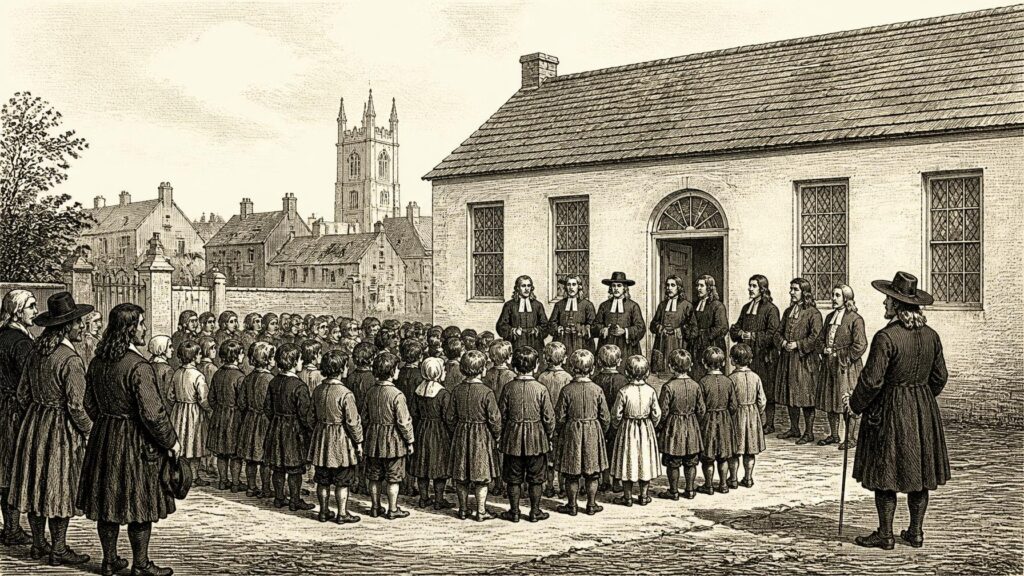
On 5 May 1674, the Hospital and Free School of King Charles II opened at Oxmantown, Dublin, admitting sixty poor children, including three girls, and combining education, clothing, food and Protestant instruction. Its civic charity symbolised Restoration order amid poverty and uneven urban recovery. Lord Lieutenant Essex sought administration despite disputed land settlements, financial arrears, unpaid troops and Dublin Castle, where he built lodgings. Government reinforced Protestant authority by expelling Catholic clergy, though worship persisted covertly. Grain restrictions revealed concern over supplies and prices, especially in Ulster, despite peace with the Dutch. Proclamations against robbers and Redmond O’Hanlon exposed insecurity.
Dateline
On 5 May 1674, a new charitable institution opened at Oxmantown on Dublin’s north side: the Hospital and Free School of King Charles II, later known as the King’s Hospital or Blue Coat School. The occasion was modest beside the great upheavals Ireland had endured since 1641, yet it was consequential. Sixty pupils entered, among them three girls. The school joined education, clothing, religious instruction and relief in one institution, giving practical form to the restored regime’s ideal of ordered Protestant civic charity. In a country marked by dispossession, confessional division and persistent poverty, its opening offers a useful point of entry into 1674: a year in which government attempted to regulate belief, food, security and public authority, while Dublin slowly acquired institutions and buildings meant to signal stability.
A School and Hospital at Oxmantown
The word “hospital” did not chiefly mean a place of medical treatment in the modern sense. The new foundation was intended as a charitable home and free school for poor children, modelled in part on English urban charities. Its establishment had taken years. Dublin’s civic elite, churchmen and officials had raised subscriptions from the later 1660s, and the building was nearing completion early in 1674. Earlier plans were ambitious: accommodation was envisaged for as many as 350 residents. The opening intake of sixty therefore reveals both a real achievement and the limits imposed by money, building costs and the practical task of maintaining children as well as teaching them.
The institution belonged to the Church of Ireland world which dominated the kingdom’s formal government. Governors, donors and clergy understood education as an instrument of discipline and Protestant formation as well as benevolence. Children received food, clothing and schooling, with the distinctive blue clothing that gave the school its later popular name. That three girls were included is noteworthy, although it should not be read as evidence of equal educational opportunity. Their small number indicates the strongly gendered assumptions of charitable provision. Still, the admission list shows that the foundation was not conceived solely for boys.
The opening also illuminates the changing shape of Dublin. The city was expanding after the devastation and stagnation of the mid-seventeenth century. Merchants, officials, soldiers, artisans and servants clustered around an increasingly important administrative and commercial capital. Yet prosperity was uneven. Charitable schools answered a visible urban problem: children whose families could not securely provide food, apprenticeship, literacy or supervision. The school’s royal title expressed loyalty to Charles II; its civic funding demonstrated that local officeholders and wealthy inhabitants were expected to sustain the social order which royal government claimed to protect.
Essex and the Work of Government
Ireland was governed for Charles II by Arthur Capel, earl of Essex, lord lieutenant since 1672. Essex was an energetic administrator, wary of powerful local interests and determined to make authority at Dublin Castle more effective. His government inherited unresolved questions from the Restoration land settlement: who possessed confiscated property securely, which claims could still be pressed, and how a state dependent on the army and the revenue could meet its obligations. Those questions did not disappear in 1674 merely because the wars were over. They shaped officeholding, lawsuits, patronage and local allegiance throughout the country.
Finance was especially troubling. The Irish revenue had been placed under the management of the earl of Ranelagh and associated revenue farmers, who promised the Crown a fixed return while collecting income from customs, excise and other sources. Essex had been instructed to scrutinise the arrangement. A surviving letter of 17 March 1674 to the secretary of state, Lord Arlington, shows his anxiety about arrears connected with Ranelagh’s partners and the danger of discontent among troops if they went unpaid. He also judged Dublin Castle’s fabric ruinous and expensive to repair. Thus the government’s impressive ceremonies and proclamations rested on fragile accounts, a poorly maintained administrative headquarters, and an army whose loyalty depended in part on regular payment.
Building nevertheless carried political meaning. A later description of Dublin Castle identifies a substantial addition made by Essex in 1674: private lodgings and associated rooms within the castle precinct, marked with the royal arms and his own. This was more than domestic comfort. The castle was the centre of executive power, military supply and high administration. Improving the lord lieutenant’s accommodation advertised the permanence of royal rule in a kingdom where the memory of civil war, Cromwellian conquest and rapid changes of regime was still close.
In London, too, Ireland was being examined. In February the English House of Commons appointed a committee to inspect the state of Irish revenue, religion, militia and armed forces. Such attention reflected English political and religious anxieties rather than Irish consent. It also reminds us that the kingdom possessed its own institutions but remained tied to decisions made across the Irish Sea. Dublin Castle had room to administer, negotiate and adapt; it did not control the broad direction of Stuart policy.
Religion Under Proclamation
That dependence was stark in religious affairs. Most inhabitants of Ireland remained Roman Catholic, while the established Church of Ireland held public authority, much of the ecclesiastical property and the support of the state. The Restoration had at times permitted Catholic worship and clerical organisation to function with a degree of latitude. But that latitude was insecure. An earlier proclamation of October 1673 had ordered Catholic prelates and regular clergy out of the kingdom. On 27 April 1674, Essex and the Irish council issued a further proclamation expelling Archbishop Peter Talbot and clergy exercising ecclesiastical jurisdiction derived from Rome, while ordering the suppression of Catholic religious foundations.
The proclamation’s language was sweeping, but its operation was uneven. Peter Talbot, Catholic archbishop of Dublin, had already left Ireland in 1673 and was abroad when he issued a pastoral letter to his diocese in May 1674. Elsewhere, clergy relied on discretion, movement and lay protection. Patrick Duffy, bishop of Clogher, had travelled in disguise through his diocese during the winter of 1673–74; in a letter written in May 1674 he said he could not appear openly for fear of persecution. Such evidence cautions against imagining either an openly tolerated Catholic Church or its complete disappearance. The year’s policy was coercive, but Catholic religious life continued through personal networks and local support.
The April order also shows how authorities treated church organisation as a question of security. Bishops, vicars-general, religious houses and priests were not simply theological opponents in official eyes; independent jurisdiction seemed politically suspect. The boundary the regime tried to enforce was therefore not merely between private belief and public worship, but between a state-recognised church and structures of allegiance linked to Rome. For ordinary Catholics, the result was renewed uncertainty about ministers, sacraments, schooling and the safety of gatherings.
Grain, Peace and Scarcity
Food supply became another conspicuous concern. On 18 May the lord lieutenant and council issued a proclamation against engrossers, forestallers and exporters of corn and grain: terms used for those accused of buying up provisions, manipulating supply or sending food away for profit. On 5 October they prohibited the transport of corn, grain and meal out of Ulster. A further proclamation of 14 December again enforced restrictions concerning grain, corn and malt. These measures should not be treated as a precise statistical proof of famine across all Ireland. They do, however, firmly show official alarm about provisioning and prices, particularly in Ulster, and an effort to keep staples available in local markets.
The problem arose in a wider setting of difficult conditions during the Dutch wars. The conflict had interrupted trade and heightened uncertainty in Atlantic and Irish Sea commerce. When England and the Dutch Republic made peace in February 1674, contemporaries in Cork expected an improvement: a letter dated 16 February 1673/4, using the old-style year then current in the British Isles, reported that hopes of peace had revived spirits and that prices of country commodities were beginning to rise. Peace could reopen commercial expectations, but it could not by itself fill a poor household’s store or guarantee an adequate harvest. The food proclamations later in the year reveal the limits of any such optimism.
For labourers, tenants, smallholders and town consumers, grain policy was immediate rather than abstract. Oats, barley, wheat and meal were staples; an export restriction could affect what reached a local market, while an accusation of forestalling exposed traders to official scrutiny. Government intervention also acknowledged a practical truth: political legitimacy could be weakened if people believed that merchants profited while food became dear. Yet proclamation was an imperfect tool. Its success depended on local magistrates, port officials, market authorities and communities whose interests did not always coincide.
Outlaws and Local Insecurity
Security remained similarly uneven. On 2 March the government offered rewards for named robbers and burglars. On 14 December it proclaimed Redmond O’Hanlon of Tandragee, County Armagh, and others as rebels and traitors, offering a reward for their capture. This is the first clear appearance of O’Hanlon in official records. He would become the best-known Ulster outlaw of the later 1670s, leading a band that preyed on property and challenged local authorities. In 1674, however, it is important not to project his later notoriety backwards: the December proclamation marks the beginning of his documented public career, not the culmination of a fully formed insurgency.
The contrast between Oxmantown’s newly opened school and the proclamation against O’Hanlon captures the divided texture of the year. Dublin’s governors promoted charity, schooling, improved official lodgings and regulation. In Ulster, they worried about grain leaving the province and about armed men beyond effective control. Across Ireland, the Restoration state was consolidating itself after catastrophe, but consolidation did not mean social peace, religious equality or secure subsistence. In 1674 its most durable new landmark was a school for poor children; its most revealing records were proclamations that exposed how much still had to be policed, provisioned and contained.
Primary Sources
- The Foundation of the Hospital and Free School of King Charles II, Oxmantown Dublin: Commonly Called the Blue Coat School
- Capel, Arthur
- Talbot, Peter
- Duffy, Patrick
- O'Hanlon, Redmond
- Jones, Richard
- Jervis, Sir Humphrey
- By the Lord Lieutenant and Council: Proclamation Expelling Catholic Clergy, 27 April 1674
- By the Lord Lieutenant and Council: Grain Proclamation, 14 December 1674
- Statute Law Revision Act 2015
- Draft Letter by the King to the Lord Lieutenant, 27 March 1674
- Orrery Papers: Calendar of the Manuscripts of the Earl of Orrery
- Stowe MS 200–217: Essex Papers
- The History and Antiquities of Dublin Collected from the Most Authentic Memoirs
- History on Your Doorstep, Volume 4
- Dublin: Taming the Dangerous Bay
- The Intrigue to Deprive the Earl of Essex of the Lord Lieutenancy of Ireland
- The Irish Viceroyalty in the Restoration Period
- Book of Survey and Distribution, 1636–1703, Volume I: County Roscommon
- CAPELL, Arthur (1632–83)
- Movement of British Settlers: 1670–1700
- Ireland Under the Stuarts, Volume III