

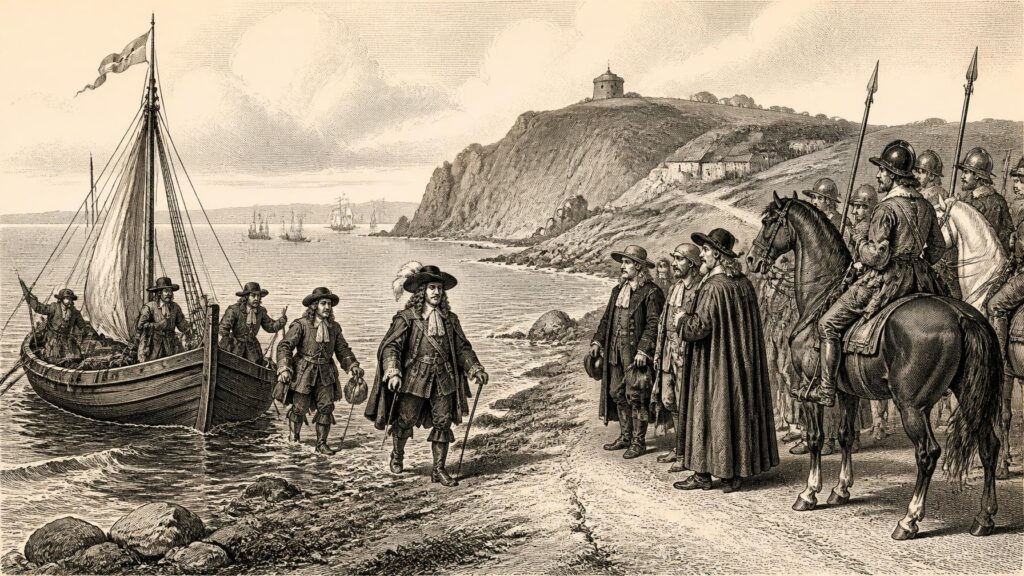
Robartes at Howth1669 CE
In 1669, John, Lord Robartes replaced the duke of Ormond as lord lieutenant, reflecting English court politics and concern over Irish revenue and military administration. Arriving quietly at Howth, Robartes inherited a Protestant-led settlement founded on confiscation, unequal landholding and Catholic exclusion. Catholic leadership revived through appointments of Peter Talbot, James Lynch and Oliver Plunkett, consecrated abroad under continuing constraints. Protestant charitable education expanded through Erasmus Smith’s schools and Dublin’s proposed King’s Hospital. George Fox and William Penn documented active Quaker networks, persecution and petitioning. These developments revealed a pacified but unreconciled Ireland, divided by property, religion, power and taxation.
Dateline
A Change at Dublin Castle
In 1669, Irish government changed hands, though not in a manner that promised a clean break. On 14 February Charles II announced his intention to remove James Butler, duke of Ormond, from the lord lieutenancy. Ormond had been the dominant figure in Restoration Ireland since taking office in 1662: an exceptionally well-connected Protestant magnate, a royalist survivor of the wars, and the architect of much of the practical settlement that followed them. His replacement was John, Lord Robartes, formally appointed lord lieutenant on 3 May. The transfer matters because it exposed a central fact of Restoration rule: Ireland was governed from Dublin, but decisive political calculations were made at the English court.
Ormond’s removal followed prolonged intrigue rather than an Irish rebellion or a parliamentary defeat. Court rivals had attacked his administration, especially its handling of revenue, while a commission examined Irish finance in 1668–69. Charles’s motives were wider than accounts alone. The king was loosening his dependence on the Anglican-cavalier interest associated with Ormond, considering a more accommodating policy towards religious nonconformists, and conducting diplomacy that would culminate in a closer French alignment. Ireland’s viceroy was therefore displaced amid English and European manoeuvring. It would be misleading to present the dismissal as a verdict on conditions in Ireland alone.
The government did not simply stop in the interval. Ormond’s eldest son, Thomas Butler, earl of Ossory, had been acting as lord deputy since 1668 and remained an important figure during the transition. The political inheritance was substantial: the Restoration land settlement had redistributed ownership after the upheavals of the 1640s and 1650s, secured many Protestant purchasers and soldiers in their estates, restored some former proprietors, and left large numbers of Catholics excluded from land and power. By 1669 the fighting was long over, but its results defined everyday authority, tenancy, local status and access to office.
A Deliberately Quiet Arrival
Robartes reached Ireland on 18 September, landing at Howth before proceeding to Dublin. A contemporary tradition recorded an elaborate reception in preparation: guards, militia, civic officers and a ceremonial welcome were expected. Robartes waived the display. He travelled to Dublin Castle with minimal formality and met Ossory and the council privately. The decision suited a man with a reputation for austerity, but it also announced a new administrative tone. The incoming lord lieutenant had few personal roots in Ireland and had been chosen partly for his reputation as a diligent manager.
Finance stood at the heart of his commission. The crown wanted the Irish establishment, especially its army and civil government, to be maintained with less assistance from England. In August a severely critical report on Irish revenue reached the English council. This did not mean that an ordinary farmer, trader or labourer experienced 1669 chiefly as a technical fiscal inquiry; rather, it meant that assessments, arrears, customs, excise and the costs of the army were again at the centre of high politics. Revenue was never merely bookkeeping. It sustained garrisons, paid officials, underwrote the restored Protestant order and gave London a measure of Ireland’s usefulness to the Stuart monarchy.
Robartes’s arrival therefore brought scrutiny as well as ceremony. His instructions required attention to the army’s effective strength and to the oaths of allegiance and supremacy among officers and soldiers. Such demands show that the Crown still regarded the armed establishment as essential to security. Yet the country was not in open war. The more characteristic tensions of the year were administrative, confessional and proprietary: who controlled offices, whose churches could function, how taxes were collected, and which interests could secure the ear of Dublin Castle or Whitehall.
Three Catholic Archbishops
1669 was an important year for the recovery of the Roman Catholic hierarchy. The appointments were made abroad through the papal system, and the bishops’ consecrations took place in the Spanish Netherlands rather than openly in Ireland. That geography is significant. Catholic organisation had survived the Cromwellian period and could draw on Irish colleges and continental networks, but its senior clergy still operated under legal and political constraint.
Peter Talbot was appointed Catholic archbishop of Dublin on 11 January. He was consecrated at Antwerp on 9 May in the New Style calendar then used on the Continent, equivalent to 29 April in the Old Style still used in the three kingdoms. Talbot was not an obscure cleric suddenly raised from isolation. A Jesuit by earlier formation and a former court figure, he was brother to Richard Talbot and had moved within the politics of Charles II’s exile and Restoration court. He reached Dublin in the autumn. His appointment was facilitated by the changed political atmosphere following Ormond’s dismissal, but it should not be mistaken for a legal restoration of Catholic equality. The established Church of Ireland remained privileged, while Catholic worship and clerical administration depended heavily on official tolerance and local discretion.
James Lynch, a Galway-born priest educated in Spain and a missionary priest, was nominated to the archbishopric of Tuam early in the year and consecrated at Ghent on 6/16 May. The paired dates reflect Old and New Style usage. His elevation gave Connacht a senior Catholic churchman with deep links to the Atlantic and Iberian worlds in which many Irish clerics had been trained. In July, the Congregation of Propaganda Fide appointed Oliver Plunkett to Armagh, the primatial see. Plunkett, then in Rome, was consecrated at Ghent late in November; he did not return to Ireland until March 1670. Thus, 1669 was a year of appointment and preparation, not yet the year in which he began his Irish pastoral work.
Together these changes reveal neither simple toleration nor an uninterrupted persecution. Instead, Catholic leadership was being rebuilt in a narrow and unstable political space. Talbot’s later conflict with Plunkett over primatial precedence was still ahead, as were the harsher measures of the 1670s. In 1669 the immediate reality was more provisional: three major sees were being filled, continental consecrations supplied a hierarchy for Irish dioceses, and the authorities in Dublin watched closely.
Schools, Charity and Protestant Order
Education was another field in which the post-war order became institutional. On 26 March a royal charter reorganised the charitable foundation associated with Erasmus Smith, a London merchant whose Irish lands financed schools. The charter incorporated the governors of the schools and settled a programme centred on grammar schools at Galway, Drogheda and Tipperary. It also envisaged free teaching for poor children connected to Smith’s estates and, where funds allowed, clothing, apprenticeships and exhibitions for further study.
This was charitable provision, but it was also confessional and social policy. The grammar-school masters were to be licensed within the Church of Ireland framework, and education in English, accounts, grammar and catechism equipped selected pupils for an English-speaking Protestant public world. It did not constitute universal schooling, nor should its language of poverty conceal the fact that eligibility and institutional control were closely tied to estate, church and settler interests. Still, the charter provided a durable legal basis for schools whose histories would extend far beyond the seventeenth century.
Dublin Corporation also advanced the project that became the Hospital and Free School of King Charles II, later known as the King’s Hospital or Blue Coat School. Work on the Oxmantown site began on 28 May 1669, and subscriptions were being gathered before the institution received its royal charter in 1671 and opened its school in 1674. The distinction is worth preserving: 1669 marks the beginning of the civic charitable enterprise and building work, not the opening of a completed school. Its intended beneficiaries were children of poor Dublin freemen and artisans, particularly those left vulnerable by a father’s death. The project joined relief, discipline, education and apprenticeship in a specifically urban response to hardship.
Friends on the Road
Religious life was not confined to the two largest churches. George Fox, the English founder of Quakerism, travelled in Ireland during the summer of 1669. His visit connected communities already present in Ulster, Leinster and Munster, while his own journal records preaching, meetings and disputes. Quakers rejected oaths, tithes and many customary marks of deference, positions that could bring them into collision with magistrates and clergy. Their experience demonstrates the limits of any broad claim that Restoration Ireland had become religiously settled.
William Penn’s surviving journal gives an unusually immediate view of the movement’s later-year activity. Sailing from Bristol on 24 October, Penn reached Cork Harbour the next day, visited imprisoned Friends in Cork on 26 October, and travelled through Munster and Leinster to Dublin. At Rosenallis on 31 October he attended a Leinster general meeting; on 5 November, a national meeting in Dublin considered reports of Friends’ “sufferings”, including imprisonment and other penalties. Penn and fellow Quakers then petitioned both the mayor and the lord lieutenant for relief. His diary is partisan, but its daily detail makes clear that dissenters were organised across regions, travelled by road and ferry, maintained meetings and burial grounds, and used petitions as well as preaching to defend their position.
Penn also noticed the practical economy around him. Travelling from Cashel towards the midlands, he passed ironworks at Mountrath; in Dublin he recorded an estimate of the kingdom’s revenue. These are brief observations, not a complete survey, but they fit the wider picture of a country whose towns, ports, estates and extractive works were being reconnected after decades of war. Roads remained demanding, journeys depended on inns, private houses and local hosts, and wealth was unevenly distributed. Yet travel between Cork, Cashel, the midlands and Dublin was sufficiently regular to bind religious networks, elite business and government together.
An Unfinished Settlement
By December, no single dramatic event had transformed Ireland. The importance of 1669 lies instead in the convergence of changes. A new lord lieutenant entered Dublin Castle with orders to examine revenue and military administration. The Catholic hierarchy acquired new archbishops, though its future security was far from assured. Protestant charitable institutions gained firmer foundations in schools and urban relief. Quaker travellers revealed both the reach of dissenting communities and the persistence of coercion against them.
These developments belonged to a society still living with the consequences of conquest, confiscation and restoration. The public language of order concealed unresolved claims to land, unequal access to political power, and enduring religious divisions. Robartes’s restrained landing at Howth was therefore more than a personal preference for modesty. It marked an attempt to administer a kingdom that had been pacified, reorganised and taxed, but not fully reconciled.
Primary Sources
- Why was Ormond dismissed in 1669?
- Butler, James
- Robartes, John
- ROBARTES, John (1606–85)
- Talbot, Peter
- Lynch, James
- St Oliver Plunkett
- My Irish Journal, 1669–1670
- Autobiography of George Fox
- The Journal of George Fox
- Faithful to Our Trust
- The Abbey School, Tipperary
- State Policy in Irish Education, A.D. 1536 to 1816
- Dublin’s King’s Hospital School Celebrates 350th Anniversary
- The Foundation of the Hospital and Free School of King Charles II, Oxmantown Dublin
- The Catholic Interest in Irish Politics in the Reign of Charles II
- The Proclamations of Ireland 1660–1820, Volume I: Preview
- Berkeley, Sir John
- Boyle, Roger
- The Commonwealth and the Restoration
- Ireland Under the Stuarts, Volume 3
- The Editio Princeps of Fox’s Journal