
Reading’s Six Coastal Lights1665 CE
In 1665, Ireland’s Restoration government strengthened its political, economic and institutional framework. The Act of Explanation addressed competing land claims after conquest, requiring many Cromwellian grantees to surrender interests while restricting Catholic restitution. Ormond supervised this fraught settlement, while Michael Boyle’s appointment as lord chancellor reinforced Protestant authority. Dublin’s mayor became lord mayor, reflecting the capital’s growing administrative importance. Charles II authorised Sir Robert Reading’s six coastal lighthouses, linking navigation, commerce and royal privilege during the Second Anglo-Dutch War. Land insecurity affected wider society, investment and local life. These measures established enduring structures while leaving conflict, inequality and uncertainty unresolved.
Dateline
In 1665 Ireland’s most consequential change was made not on a battlefield but in statute. In late December, the Irish parliament passed the Act of Explanation, the difficult companion to the Restoration settlement of 1662. It sought to turn the vast upheaval in landholding caused by the Confederate wars and Cromwellian conquest into a durable, if deeply unequal, order. In the same year, Charles II authorised a chain of privately maintained coastal lights, Dublin’s mayoralty acquired the higher style of lord mayor, and Michael Boyle became lord chancellor. These were distinct developments, but together they show a kingdom being refitted: estates were to be recorded and secured, institutions remade, and coasts made more legible to trade and royal authority.
A Settlement Explained
The Act of Settlement of 1662 had attempted to reconcile claims that could not all be met from the land available. Cromwellian soldiers and financial ‘adventurers’ had received Irish estates after the 1650s conquest. Protestant royalists who had lost out during the Commonwealth also expected recompense. So did some Catholic proprietors who had remained loyal to the Stuart crown, qualified under earlier peace agreements, or could establish legal ‘innocence’ under the exacting post-war rules. Each claim rested on a different account of service, suffering and loyalty; all competed for the same confiscated land.
The Court of Claims had exposed the problem rather than resolved it. Its proceedings could recognise some Catholic claimants as innocent, yet restoring them required finding equivalent lands for those then in possession. The original programme became unworkable. The Act of Explanation, passed on 23 December 1665, imposed a political arithmetic on that impasse. Adventurers and soldiers, with significant exceptions and technical qualifications, were to surrender a third of the lands or interests confirmed to them, providing a pool from which necessary reprisals and restorations could be made. At the same time, it shut the door on many Catholic claimants who had not already secured a favourable adjudication. The measure was therefore a compromise in form, but its limits were decisive.
It is important not to mistake the word ‘explanation’ for mere administrative tidying. This was a further redistribution of security, credit and power. A landed estate meant rents, local influence, a household, the ability to support dependants, and a place in county society. For a proprietor seeking return, delay could mean continuing exile, tenancy, or dependence on a successful neighbour. For an officer, adventurer, purchaser or settler already established on former Catholic land, the prospect of surrendering a third brought immediate uncertainty. Contemporary accounts of the parliamentary debates convey the intensity of these fears; the eventual statute did not heal the antagonisms created since 1641.
Nor did it restore a pre-war world. The legal language and procedures of the settlement treated land principally through titles, qualifications, surveys, certificates and patents, while the human consequences reached far beyond the named litigants. Tenants, labourers, servants and smallholders could not control the great settlement, but they lived with its consequences: new landlords, altered rents and estate management, changed parish and market connections, and the continuing presence of soldiers and migrants who had made homes on redistributed land. The act laid down rules that would shape Irish tenure for generations, even though its implementation still required years of surveys, allotments, lawsuits and grants.
Ormond, Boyle and the Machinery of Rule
James Butler, duke of Ormond and lord lieutenant, stood at the centre of this process. A great Irish landowner, an old royalist and Charles II’s trusted servant, Ormond had to preserve the Restoration government’s Protestant base while making enough provision for other interests to prevent a permanent constitutional grievance. His position made him indispensable and suspect in equal measure. Catholic petitioners could hope for his favour, while many Protestants worried that he might concede too much; in practice, the scope for large-scale Catholic recovery was tightly constrained by the prior promises made to those in possession.
In July, following the death of Sir Maurice Eustace, the Church of Ireland archbishop of Dublin, Michael Boyle, was appointed lord chancellor of Ireland. Boyle was not chosen as a specialist lawyer in the modern sense. The chancellorship was a major political office as well as the headship of Chancery, and his appointment joined ecclesiastical standing to the administration of the Restoration settlement. The Church of Ireland was woven into government, education and local authority; Boyle’s promotion was a reminder that public power in the kingdom rested upon a Protestant establishment even as Catholics remained the large majority of the population.
The year also mattered for learning. The Act of Explanation included provision affecting the charitable endowment associated with Erasmus Smith. It did not mean that a network of schools appeared overnight in 1665. Rather, legal security for land was the essential preliminary to the later educational work of the trust. This is characteristic of the year: apparently technical clauses concerning estates could carry long social consequences, determining which institutions possessed an income and which communities had resources to sustain schools, clergy or charitable purposes.
Dublin’s Altered Civic Style
Charles II elevated the office of mayor of Dublin to that of lord mayor in 1665, and Sir Daniel Bellingham became the first holder of the new title at Michaelmas. The alteration was ceremonial, but it was not empty. Dublin was becoming the leading centre of administration, finance, consumption and overseas connection in the kingdom. Its corporation was dominated by Protestant merchants and office-holders, and its standing mattered in a Restoration state concerned with loyal urban government.
Municipal change also belonged to the land settlement’s wider logic. The Restoration statutes explicitly valued English Protestant settlement in corporate towns as a source of trade, manufacture and peace, while limiting the return of dispossessed Catholics to property within those towns. Such language reveals official priorities rather than an impartial description of urban life. Dublin, Cork, Waterford, Youghal, Limerick and Galway retained older commercial and religious complexities, but the direction of policy was clear: secure corporations considered politically reliable, and make them instruments of order and revenue.
Lights, Shipping and a War at Sea
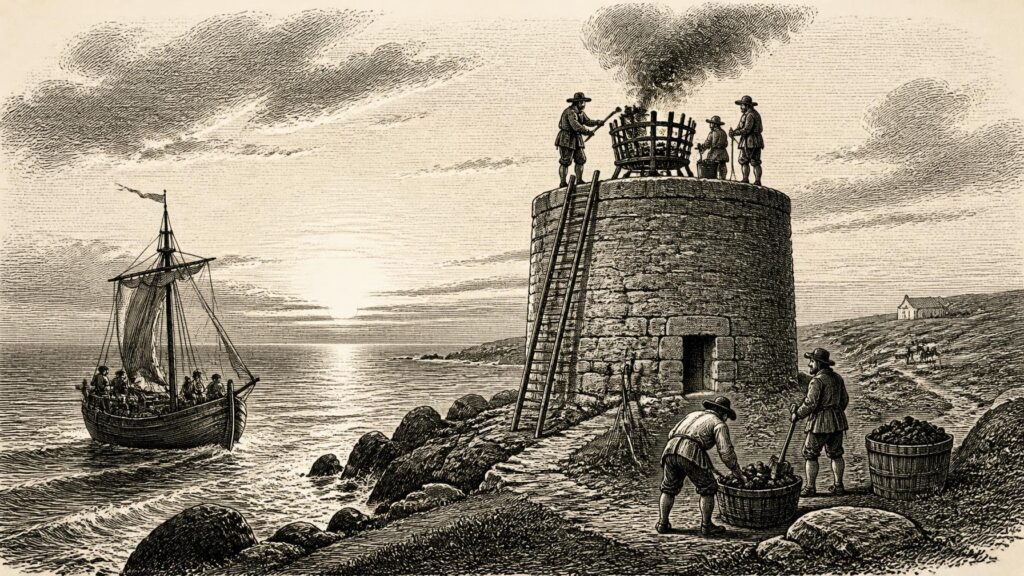
In 1665 Charles II granted Sir Robert Reading letters patent to erect six lighthouses on the Irish coast. The authorised sites were two at Howth, one at the Isle of Magee near Carrickfergus, one at the Old Head of Kinsale, one near Barry Oge’s castle in Cork Harbour, and one at Hook Head in County Wexford. The patent was a commercial venture as well as a public service: Reading was to build and maintain lights and recover costs through dues on shipping. Construction and the practical operation of individual lights extended beyond the calendar year, so 1665 should be understood as the year of authorisation rather than the completion of a fully functioning network.
The choice of headlands and harbour approaches was revealing. These were points on routes linking Dublin, Belfast Lough, the Irish Sea, the south coast and Atlantic-facing ports. Hook Head already possessed its medieval tower, but the Restoration scheme proposed a new beacon arrangement suited to growing traffic. A coal fire on an exposed tower was a modest technology by later standards, yet it could be a vital sign of safety to a vessel approaching shore in darkness or poor weather. The patent connected coastal labour, capital, navigation and royal privilege in a single enterprise.
Maritime security mattered especially because England and the Dutch Republic were at war. The Second Anglo-Dutch War began in 1665, disrupting the commercial world in which Irish ports operated. Ireland did not become a principal theatre of the conflict, but merchants could not treat a naval war as distant. Continental routes became more hazardous, while Irish cattle, sheep and provisions remained closely tied to English demand. In October, debate in the English House of Commons over Irish livestock imports showed how politically charged that dependence had become. The permanent English prohibition on importing Irish cattle was still two years away; in 1665 it was a contested prospect, not an accomplished fact.
The war also took an Irish life of high rank. Charles MacCarthy, Viscount Muskerry, son and heir of Donough MacCarthy, earl of Clancarty, was killed fighting for the English fleet at the Battle of Lowestoft on 3 June in the English calendar then in use. His father, a leading Catholic royalist whose career had run through the Confederate and Cromwellian wars, died that August. The double loss placed the Muskerry inheritance in the hands of an infant grandson. It was a sharp reminder that the Restoration settlement reached Irish families not only through acts and claims, but through service to a Stuart monarchy engaged in wider European conflict.
A Year of Frameworks
For ordinary people, 1665 offered no single, island-wide event that can safely be made into a universal experience. Evidence is much stronger for laws, offices, patents and elite correspondence than for the daily voices of rural households. Later seventeenth-century estimates confirm the continuing importance of tillage, cattle and sheep, domestic wool work and small-scale local production, but they should not be treated as a census of this particular year. What can be said with confidence is that insecurity over land touched the wider economy: investment, leases, rebuilding and improvements all depended on knowing who truly owned an estate.
Thus 1665 was a year of frameworks rather than finality. The Act of Explanation made a settlement possible while excluding many who had hoped for restitution. Dublin acquired a civic dignity that reflected its rising political weight. Boyle’s appointment strengthened the interlocking authority of church and state. Reading’s patent imagined safer, more regular movement around Ireland’s coasts. None ended conflict or uncertainty. Yet each helped establish the institutional landscape through which Restoration Ireland would be governed, traded with and contested in the decades ahead.
Primary Sources
- Act of Settlement [1662] and Act of Explanation [1665]
- Books of Survey and Distribution, 1636–1703, Volume I: County Roscommon
- Restoration Ireland, 1660–88
- The Restoration Land Settlement in County Dublin, 1660–1688: A History of the Administration of the Acts of Settlement and Explanation
- State Formation in Seventeenth-Century Ireland: The Restoration Financial Settlement, 1660–62
- Economic Trends, 1660–91
- The Anglo-Irish Livestock Trade of the Seventeenth Century
- History of the Commercial and Financial Relations between England and Ireland from the Period of the Restoration
- Butler, James (1610–88)
- BUTLER, James (1610–88)
- Boyle, Michael
- History of the Office
- Lord Mayors of Dublin, 1665–2025
- Hook Head
- The Commonwealth and the Restoration
- A Jacobite Narrative of the War in Ireland
- Confiscation in Irish History, Chapter VI
- State Papers Ireland 1509–1782: Government Papers on Irish Affairs
- Arlington to Ormond, Oxford: 5 December 1665
- The Proclamations of Ireland 1660–1820, Volume 1 Preview
- Faithful to Our Trust: A History of the Erasmus Smith Schools
- Political Anatomy of Ireland
- Holdings: Letters Patent to Donogh MacCarty, 4th Earl of Clancarty, Quoting the Will of Donough McCarty, 1st Earl of Clancarty, 29 July 1665
- Statute Law Revision Act 2015