Belfast Agreement
At a Glance
Turning Point
On 10 April 1998, the Belfast Agreement, widely known as the Good Friday Agreement, established a new framework for governing Northern Ireland and managing relationships across Ireland and Britain. It did not require unionists and nationalists to adopt the same national identity or abandon their constitutional aspirations. Instead, it offered democratic arrangements through which competing aspirations could coexist. Its importance lies in this combination of constitutional consent, shared government and recognition of different identities. Understanding the settlement requires looking beyond a single announcement to the negotiations, public votes, institutions and difficult implementation that gave it practical meaning.
The Northern Ireland Office identifies three central principles: respect between the main communities, consent concerning Northern Ireland's constitutional status, and recognition of the right of the people of Northern Ireland to identify as British, Irish or both. The agreement also addressed policing, security, weapons and prisoners. These were connected parts of a settlement whose success would depend on implementation as well as the wording agreed in Belfast. Peace was a process to be sustained, rather than an administrative condition automatically produced by signing a document.
Negotiating Peace
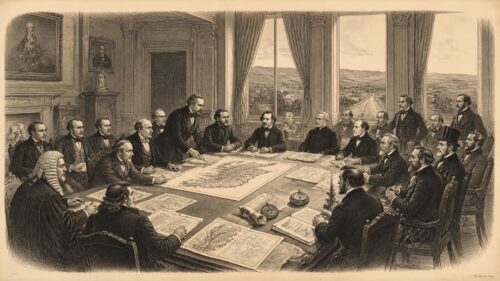
The peace process had no single uncontested starting point. Ulster University's CAIN archive describes successive efforts to end conflict and find a political settlement, including discussions between John Hume and Gerry Adams. Their meetings from 1988 onwards, renewed discussions in 1993, and the subsequent Hume–Adams initiative formed part of the background to the Downing Street Declaration. These developments demonstrate that the negotiations of the later 1990s rested on earlier attempts to identify grounds for agreement.
The IRA ceasefire of August 1994 opened a new phase, but progress was neither continuous nor secure. The Canary Wharf bombing in February 1996 was a serious setback. Nevertheless, political efforts continued. The eventual settlement followed approximately two years of talks and should not be presented as the inevitable consequence of one meeting or one leader's intervention. An important historical distinction separates the announcement of a ceasefire, participation in negotiations and acceptance of a final constitutional settlement. Each involved different decisions, and a setback in one area did not necessarily extinguish all possibilities in the others.
Political Choices
The agreement involved the British and Irish governments and most, rather than all, of Northern Ireland's political parties. The Ulster Unionist Party, led by David Trimble, and the Social Democratic and Labour Party, led by John Hume, were central participants. Sinn Féin, Alliance and the Progressive Unionist Party were among the other parties involved. Their participation brought different political traditions into negotiations without erasing the differences between them.
The Democratic Unionist Party opposed the settlement. It had withdrawn from the talks over participation by Sinn Féin and loyalist parties while paramilitary weapons remained an unresolved issue. Consequently, describing the agreement as unanimously accepted would misrepresent the political landscape. Supporters had to persuade their own constituencies that compromise offered a better future, while opponents questioned the terms and safeguards. The settlement's significance is therefore not that disagreement disappeared. It is that substantial political support was assembled for a framework within which disagreement could continue through democratic institutions rather than political violence.
Agreement Structure
The expression Good Friday Agreement commonly refers to a settlement containing two connected agreements. One was the Multi-Party Agreement involving the governments and participating Northern Ireland parties. The other was the British-Irish Agreement, an international agreement between the two sovereign governments. Keeping these elements distinct helps explain why the settlement required action in more than one legal and political system.
The House of Commons Library describes the institutions through three strands: government within Northern Ireland, North–South relationships on the island, and East–West relationships across the islands. None can adequately explain the whole settlement alone. The Assembly concerned local democratic authority; the North–South arrangements recognised interests connecting the two jurisdictions; and the East–West bodies supplied a wider framework for consultation and co-operation. The settlement therefore combined internal government with external relationships. Its provisions on rights and identity sat alongside this institutional structure, showing that the negotiations addressed how authority should be exercised as well as where that authority should lie. The agreement came into force on 2 December 1999, after the necessary steps towards implementation.
Constitutional Consent
The original agreement recognised the legitimacy of the choice made by a majority in Northern Ireland about its constitutional status. It acknowledged the existing majority preference for remaining within the United Kingdom while providing a peaceful basis for constitutional change if the required democratic consent emerged. Irish unity was neither imposed nor ruled out permanently.
The settlement also recognised that a united Ireland would require consent freely and concurrently expressed North and South, subject to agreement by a majority in Northern Ireland. The governments accepted obligations to give effect to such a choice if made on that basis. These provisions matter because they separate political aspiration from the authority to impose an outcome. They allowed the Union and Irish unity to remain legitimate objectives while establishing consent as the means of deciding between them.
Majority consent must not be confused with unanimous consent. Nor should the constitutional principle be confused with every voting rule used inside the Assembly. The agreement contains different safeguards for different purposes; those distinctions are essential to an accurate account of its constitutional design.
Popular Verdict
The settlement was put to voters on 22 May 1998 in separate referendums held on the same day. In Northern Ireland, the question asked whether voters supported the agreement reached in the multi-party talks. CAIN records 676,966 votes in favour and 274,879 against, representing 71.12 per cent and 28.88 per cent respectively of valid votes. These were decisive figures, but they also show that opposition remained substantial.
In the Republic of Ireland, voters considered the Nineteenth Amendment of the Constitution Bill. The recorded result was 1,442,583 in favour and 85,748 against, approximately 94.4 per cent and 5.6 per cent. The two electorates were not casting one combined vote on an identical ballot. Their decisions were related, but the constitutional questions and legal consequences differed.
The overall Northern Ireland count cannot, by itself, establish exactly how every community voted. CAIN notes that the referendum was counted as a single constituency. Claims about precise unionist or nationalist support therefore require evidence beyond the published overall result. Electoral approval gave the settlement authority without proving that every political division had been resolved.
Constitutional Change
The Republic's referendum was necessary because changes to the Constitution required the approval of the electorate. The Electoral Commission's account of previous referendums identifies the Nineteenth Amendment as allowing the State to consent to the British-Irish Agreement and providing for further constitutional changes, notably to Articles 2 and 3, when that agreement entered into force. A negotiated political commitment thus required a distinct democratic and constitutional procedure.
This helps explain why the vote cannot be reduced to a general opinion poll about peace. It authorised changes with legal consequences for how the State understood its relationship with Northern Ireland and the institutions created through the settlement. The referendum connected international agreement, domestic constitutional authority and popular consent.
For historians, the important point is the relationship between these stages. Negotiators could propose the settlement, but the proposal did not remove the need for the public decision required by the constitutional system. The agreement's legitimacy depended on that relationship between negotiation and ratification, rather than on diplomatic agreement alone.
Devolved Authority
Devolution means transferring powers from central government to institutions exercising authority within a particular region. The agreement provided the framework for a Northern Ireland Assembly and Executive to make laws and govern in transferred policy areas. The Assembly's education service identifies health, education, roads and housing among the subjects affecting everyday life for which devolved institutions take responsibility.
The distinction between the Assembly and Executive is important. The Assembly is the legislature, while the Executive consists of ministers exercising governmental responsibilities. The two are related but are not interchangeable names for one body. Their operation places public policy within a local framework of representation, scrutiny and ministerial decision-making.
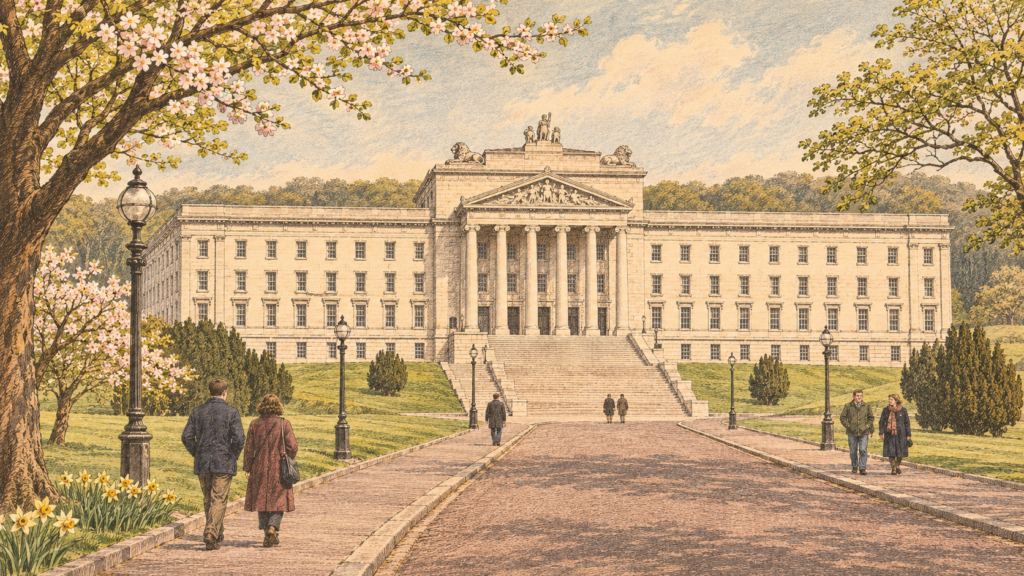
Devolution also has limits. Certain matters remain the responsibility of Westminster, including areas affecting the United Kingdom as a whole. Establishing institutions at Stormont did not make Northern Ireland an independent sovereign state. The settlement instead created arrangements for government within the continuing constitutional framework, while connecting those arrangements to the wider North–South and East–West relationships established elsewhere in the agreement.
Shared Government
The agreement's model was intended to prevent government becoming the exclusive possession of one political community. Power-sharing brought parties from different traditions into the Executive, linking access to office with electoral representation. It was a deliberate response to the problem of governing a divided society in which ordinary majority rule could leave a substantial community feeling permanently excluded.
The Assembly's education service explains the connected offices of First Minister and deputy First Minister as having equal powers. The title deputy does not indicate that one office is simply subordinate to the other. Their interdependence is a central feature of the system. The d'Hondt method distributes ministerial opportunities according to party strength, while proportional representation through the Single Transferable Vote shapes election to the Assembly.
These rules do not guarantee agreement about policy. They establish a structure in which representatives with different constitutional positions must participate in shared institutions. Its democratic ambition involves both representation and co-operation: election supplies a mandate, but that mandate must be exercised within arrangements designed to accommodate more than one tradition.
Community Safeguards
Some Assembly decisions require support across the principal political designations, rather than an ordinary numerical majority alone. Members may designate as unionist, nationalist or other. The purpose is to make certain important decisions depend on support extending beyond one bloc, including decisions connected with institutional rules and financial arrangements.
The education service distinguishes parallel consent from a weighted majority. In the latter arrangement, support must reach 60 per cent overall and include at least 40 per cent within each of the unionist and nationalist designations. These mechanisms should not be collapsed into a vague claim that every decision requires unanimity. Different decisions engage different procedures.
Safeguards also create difficult questions. Members outside the two principal designations can object that a system organised around those identities does not give equal weight to their position in sensitive votes. A device intended to prevent domination may also obstruct decisions with substantial wider support. Understanding that tension is part of understanding the settlement: protecting communities and enabling effective democratic government are related aims, but institutional rules do not automatically reconcile them in every case.
Three Relationships
The agreement's three-strand design reflected the fact that Northern Ireland's political difficulties could not be understood only as an internal administrative dispute. Relationships within Northern Ireland, relationships across the border and relationships between Britain and Ireland were connected. Institutions addressing one relationship were therefore placed alongside institutions addressing the others.
Strand One provided the Assembly and Executive. Strand Two established North–South arrangements, including the North/South Ministerial Council and implementation bodies. Strand Three established the British-Irish Council and British-Irish Intergovernmental Conference. The Assembly's account describes these as means of developing co-operation and improving relationships across different political settings.
The historical importance of this design lies in its breadth. A settlement limited to one elected chamber would not have addressed every relationship at issue. Equally, consultation between the two governments could not replace representative government within Northern Ireland. The architecture attempted to connect these levels without pretending they were identical. Readers should therefore distinguish an institution's particular membership and responsibilities from the larger political purpose of the settlement as a whole.
Northern Cooperation
The North/South Ministerial Council provides a framework for ministers from Northern Ireland and the Irish government to work on matters of shared interest. Its own account explains that the agreement envisaged at least twelve areas for co-operation and implementation, with some work carried out separately through existing arrangements and other work undertaken through cross-border or all-island implementation bodies.
The Council is supported by a joint secretariat in Armagh, staffed from the two civil services. It meets in several formats, including plenary and sectoral meetings. Northern Ireland participation is arranged on a cross-community basis. These details show how a broad political commitment was translated into structures for regular administration.
It is useful to distinguish co-operation from constitutional merger. Working together on a shared problem does not, by itself, dissolve the jurisdictions involved. The Council's arrangements created organised ways of addressing interests extending across the border while maintaining defined governmental responsibilities. In that sense, the settlement made room for practical joint activity within an unresolved wider constitutional debate. It sought benefits from co-operation without requiring every participant to agree on Ireland's ultimate constitutional future.
Eastern Relationships
The British-Irish Council widened the institutional picture beyond relations between Belfast and Dublin or between the two sovereign governments alone. Established in 1999 under Strand Three, it brings together eight member administrations: the governments of the United Kingdom and Ireland, the Northern Ireland Executive, Scotland and Wales, and the governments of the Isle of Man, Jersey and Guernsey.
Its stated purpose concerns practical and positive relationships across the islands. Its first summit took place in London in December 1999. Meetings and work sectors provide settings for consultation, exchanging experience and developing co-operation on matters within the participating administrations' responsibilities.
The Council should not be mistaken for a parliament exercising a single sovereignty over all its members. It is an intergovernmental forum connecting administrations with different constitutional positions. Its place in the settlement illustrates an effort to recognise overlapping relationships without forcing them into one political identity. Alongside the British-Irish Intergovernmental Conference, it gave institutional expression to the East–West dimension that complemented the North–South arrangements and government within Northern Ireland.
Human Rights
The settlement also helped create institutions concerned with the treatment of individuals, not only the allocation of political office. The Northern Ireland Human Rights Commission began in 1999 following the agreement and the Northern Ireland Act 1998. In its twenty-fifth-anniversary account, the Commission describes work advising governments, challenging incompatible laws and public-authority actions, investigating systemic problems and promoting understanding of human rights.
This institutional role matters because a peace settlement can establish representative bodies while still leaving questions about how those bodies exercise power. Rights protection supplies standards against which official action can be assessed. It concerns people whose interests cannot be reduced to the fortunes of a particular political party or designation.
The Commission also describes cross-border work with its counterpart in Ireland through a joint committee. That provides another example of the settlement's attention to relationships across jurisdictions. The historical development should not be simplified into a claim that establishing a commission immediately resolved every rights question. It created a continuing institutional responsibility to examine, advise and challenge, rather than declaring the work finished.
Equality Protection
The Equality Commission for Northern Ireland was established on 1 October 1999 under the Northern Ireland Act 1998. Its role concerns promoting equality and challenging discrimination. Its public information addresses areas including employment, education, services and the duties of public authorities. The institution illustrates how the settlement's implementation extended beyond the formation of an Assembly and Executive.
Equality protection is significant in a society where political participation and confidence in public institutions cannot be separated from people's treatment in ordinary life. Access to work, education or services may shape the experience of citizenship as directly as constitutional debate. Institutional recognition of those concerns brought practical questions of fairness into the wider project of political reconstruction.
The Commission's existence should not be taken as proof that discrimination disappeared in 1999. A body established to challenge discrimination necessarily has continuing work to do. Historically, its creation marks the assignment of defined responsibilities and mechanisms through which problems can be raised. That is a more precise description than treating equality as either a completed achievement or a purely rhetorical promise within the peace process.
Weapons Security
Decommissioning, the removal of paramilitary weapons from use, was among the most contentious questions surrounding implementation. The Assembly's account records the commitment to encourage decommissioning and the role of independent monitoring. For unionist participants, the relationship between shared government and progress on IRA weapons was a particularly difficult issue. A political agreement could not simply assume that the mistrust created by armed conflict had disappeared.
Security normalisation was a related but distinct matter. The settlement envisaged reducing the military presence as a more peaceful situation developed. Decommissioning concerned paramilitary weapons; normalisation concerned changes in security arrangements and the experience of everyday life. Combining the two under a single label can obscure the different actors and responsibilities involved.
The early difficulties over weapons demonstrate why implementation belongs at the centre of the agreement's history. Participants could accept broad institutions while disagreeing about the sequence and adequacy of steps needed to make them workable. Those disagreements did not make the text meaningless, but they exposed how much depended on confidence, verification and practical action after the negotiations ended.
Policing Reform
The Independent Commission on Policing, chaired by Chris Patten, presented its report on 9 September 1999. Patten's statement described fifteen months of work, public meetings throughout Northern Ireland, written submissions and examination of experience elsewhere. The exercise followed the agreement's commitment to a new approach capable of securing broad community confidence in policing.
The statement stressed effectiveness, impartiality, accountability, representativeness and respect for human rights as measures against which proposals should be judged. Those aims explain why policing reform was a central part of the settlement's implementation rather than a minor administrative addition. A political system asking communities to resolve disputes peacefully also needed policing arrangements capable of commanding confidence across those communities.
Patten acknowledged the sensitivity of the task and the political history surrounding the police. The significance of the commission was that it investigated how policing might be transformed through defined recommendations. Its report should be read as a programme for change, distinct from the later question of which recommendations were implemented and how successfully. That distinction prevents proposals, legislation and practical outcomes being treated as a single event.
Prisoner Releases
The accelerated release of prisoners was another difficult element of the settlement. The arrangements were not an unrestricted release of every prisoner, nor a general declaration that the offences concerned had never occurred. The Sentence Review Commissioners' explanation sets out eligibility conditions, including qualifying offences, the length and nature of sentences, and conditions concerning support for specified organisations and the risk of further involvement in terrorism.
Release under the statutory arrangements involved licences and continuing conditions. The Commissioners' account also explains provisions for suspension or revocation where licence conditions were breached or were likely to be breached. These features matter when distinguishing a conditional early-release scheme from a blanket amnesty.
The historical controversy cannot be understood solely by listing administrative rules. For supporters, prisoner arrangements formed part of the effort to secure a transition away from armed conflict. For those affected by the crimes, early release could carry a profound personal meaning. Explaining the scheme accurately therefore requires attention both to its actual conditions and to why it remained one of the most emotionally charged parts of the political settlement.
Implementation Difficulties
Elections to the new Assembly took place on 25 June 1998, but establishing working devolved government took longer. The settlement's implementation involved disputes over weapons, confidence and the terms on which parties would share power. It is important not to merge the agreement in April, public endorsement in May and the later transfer of governing powers into a single date.
The House of Lords Library's historical account records repeated suspensions in the early years and the return to direct rule following the suspension in October 2002. Subsequent negotiations, including the St Andrews talks of 2006, addressed obstacles to restoring devolved government and changes to institutional operation. Later arrangements at Hillsborough concerned the devolution of policing and justice powers.
These developments show the agreement as a framework within which further negotiation remained necessary. Its implementation was neither uninterrupted nor simply abandoned whenever institutions ceased functioning. The historical question is how the settlement's principles and structures shaped attempts to resolve later crises. That approach recognises serious institutional failures without assuming that every suspension erased the constitutional and diplomatic changes already made.
Historical Significance
The award of the 1998 Nobel Peace Prize to John Hume and David Trimble recognised their efforts towards a peaceful solution. The Nobel account emphasises Hume's sustained pursuit of dialogue and Trimble's decision to negotiate and persuade a majority within his party to support compromise. Their recognition captures an important feature of the settlement: leadership involved bringing supporters towards agreement across deeply established divisions.
The achievement was nevertheless wider than two individuals. The Northern Ireland Affairs Committee's 2023 inquiry drew attention to earlier negotiations, the work of both governments, international support, civil society and women's groups. It warned against treating the successful conclusion of negotiations as inevitable. The agreement emerged from accumulated efforts and choices whose outcome could not safely have been assumed in advance.
Its enduring historical importance is the framework it created for pursuing political objectives peacefully while respecting consent and different identities. That achievement should neither be diminished by later difficulties nor inflated into a claim that every conflict or injustice ended in April 1998. The Belfast Agreement changed the terms of political life. Sustaining its promise required, and continued to require, work beyond the document itself.