Annal Year634 CE
The surviving Irish annals for 634 CE are uneven and must be read with caution. The Annals of Inisfallen preserve a short cluster of notices for that year, including deaths and a slaying, while the Annals of the Four Masters attach a fuller set of notices to 634, notably the battle of Magh Rath and related deaths. The Annals of Tigernach survive for this period but show a different chronological alignment and, for 634, no substantive entry in the preserved fragment. The result is not a single coherent narrative, but a layered annalistic record that mixes secure year notices with chronology that shifts between texts.
Dateline
Year Frame
For 634 CE, the safest starting point is the annalistic year itself rather than any attempt to build a continuous event story. The surviving Irish annals do not present a modern narrative; they list brief notices under year headings, and the preserved evidence for this year is uneven across texts. In the Annals of Inisfallen, the entry for 634 contains three short notices: the repose of Mo-Bae moccu Alldae, the death of Rónán son of Fergus, and the slaying of Catluan. In the Annals of the Four Masters, the equivalent year also preserves several notices, including deaths and battles, but the relationship between different annal traditions must always be checked rather than assumed.
The main historical problem is how to compare notices placed under similar year headings in different annals. The published Annals of Tigernach do contain two notices under T634: Edwin, king of England, is defeated, and Cinaed, king of the Picts, dies. These concern Britain and Pictland rather than events situated within Ireland. The shared year heading therefore does not imply a shared event list. The notices must be read in their own annalistic sequence, with attention to the places and people actually named.
Inisfallen Notices
The Annals of Inisfallen provide the clearest compact picture of 634 within the evidence set. Under AI634 they record the repose of Mo-Bae moccu Alldae, the death of Rónán son of Fergus, and the slaying of Catluan. The text itself does not explain the circumstances of these events, nor does it connect them to one another. Their value lies in their secure placement under a single annal year, not in any fuller narrative that the source does not supply.
Inisfallen also shows that annal years do not always align neatly with modern year numbering. Elsewhere in the same text, a notice for AI636 about the death of Ailill son of Aed in Loch Trethle is explicitly glossed with another annal tradition's date, and the following notices are likewise cross-referenced to other systems. That internal apparatus is a reminder that the compiler or later editor was aware of chronological variation. For 634 itself, the Inisfallen notices are therefore best read as one local or regional annalistic placement rather than as proof of exact synchronism with every other Irish annal.
Battle Cluster
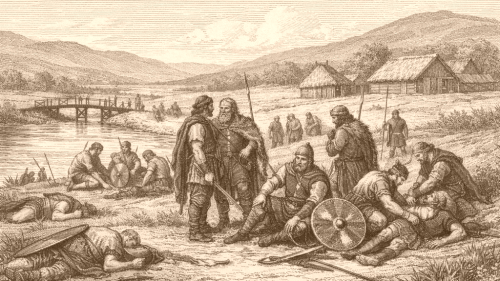
The strongest battle narrative attached to 634 appears in the Annals of the Four Masters. Their entry for M634 records the battle of Magh Rath, won by Domhnall son of Aedh and the sons of Aedh Slaine over Congal Claen, son of Scannlan, king of Ulidia; it also states that Congal, the Ulidians, and foreigners fell there. In the same year the Four Masters record the battle of Saeltire, won by Conall Cael son of Maelcobha over the Cinel Eoghain. These are precise annalistic notices, but they remain annalistic notices: they tell us what the compilers chose to place under 634, not everything that happened in that year.
The later Tigernach tradition helps explain why historians must distinguish secure year notices from wider period context. In Tigernach's surviving fragment, Mag Rath appears under 639 rather than 634, and Saeltire appears on the same year heading. This does not mean that the event 'belonged' only to 639 in any absolute sense; it means the annalist's chronology differs from that of the Four Masters. For 634, the evidence therefore supports a careful conclusion: the battle cluster is real in the annals, but its exact year depends on the text and on the chronology adopted.
Chronology Offset
Chronological offset is central to reading these records. The published Tigernach text places Edwin’s defeat and Cinaed’s death under T634. It then records a battle involving Osualt, the battle of Áth Abla, and the foundation of Lindisfarne under T635. Its T636 heading includes the battle of Áth Goan and two notices of repose. This sequence shows why the contents of each numbered annal year need to be identified directly: the heading alone cannot substitute for reading the entries beneath it.
The CELT presentation of the Tigernach material is itself relevant because it makes explicit that the edition is a scholarly reconstruction from manuscript witnesses and later chronological correction. The background notes identify the surviving manuscript base and state that the dates in the electronic edition follow chronology supplied through editorial work. That does not settle 634 for us, but it does show why the year cannot be treated as a neutral datum in the annals. It is a product of transmission, editing, and synchronization.
Monastic Record
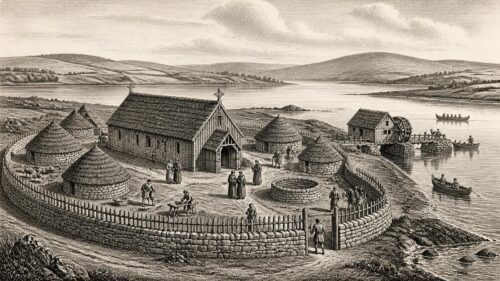
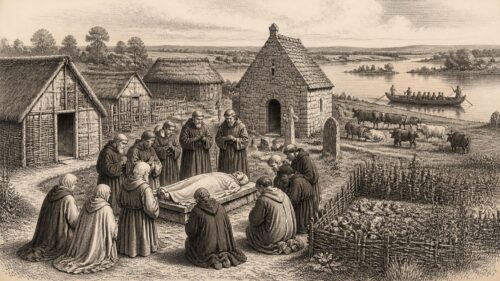
The year 634 also sits within a monastic and ecclesiastical record of deaths that the annals preserve in compressed form. In the Four Masters, the year includes the death of St. Eochaidh, abbot of Lis Mor, on 17 April, and the death of St. Finntan son of Telchan on 21 October. In Inisfallen, Mo-Bae moccu Alldae is said to repose under AI634. These notices are important because they show how annals can register clerical deaths beside military events, without supplying explanation or causation.
Across the same wider decade, Tigernach preserves comparable monastic obits: the resting of Munnu, the death of Mac Laisre abbot of Bennchor, and other clerical notices near the relevant sequence of years. These do not prove anything specific about 634, but they provide the broader context in which the annalists were writing: a world where ecclesiastical deaths, royal deaths, and battlefield deaths all belonged in the same chronological register. That is part of the evidence for 634 even when the year itself is sparsely attested in one annal.
Regional Balance
The notices attached to 634 are distributed across several regions and political groupings rather than confined to one kingdom. In the Four Masters, Magh Rath involves Ulidia, Domhnall son of Aedh, and the sons of Aedh Slaine; Saeltire is a conflict involving the Cinel Eoghain. In Inisfallen, the deaths and slaying are reported without fuller regional framing. This unevenness is typical of annals: they preserve the fact of a notice while withholding the narrative texture that a later historian might wish for.
The broader early seventh century context helps explain why these notices matter, but it should not be overdrawn. Nearby Tigernach entries show a landscape of repeated elite conflict, royal deaths, and shifting victors in the years around 630 to 641. The year 634 therefore belongs to a period of political instability and military competition, yet the evidence does not justify making every notice into a large-scale causal story. The safer interpretation is that 634 records part of an ongoing annalistic rhythm of conflict and commemoration.
Secure Limits
The secure statement about the annal headings is modest. Inisfallen places three notices of death and slaying under AI634; the Four Masters place deaths and a battle cluster under M634; Tigernach includes British and Pictish notices under T634. These are different event lists preserved in different works. Comparison must retain those differences instead of assuming that every record bearing the number 634 provides an identical account of Ireland in one securely synchronized calendar year.
What cannot be done responsibly is to fill the gap with invented continuity. The evidence does not justify claiming that every death under 634 in one annal occurred in the same absolute year as every battle under 634 in another. Nor does it justify choosing one tradition and erasing the rest. The best historical reading keeps the year open: 634 CE is the annalistic point at which scattered deaths, a slaying, and major battles are preserved, but the exact alignment of those notices remains partly uncertain.
Historical Reading
Read historically, these notices provide a window into the variety of the Irish annalistic record. Inisfallen, the Four Masters and Tigernach preserve differing selections of deaths and conflicts under their numbered headings. Tigernach’s T634 notices also show that the record extends beyond Ireland to Britain and Pictland. The notices deserve to be compared carefully, with each work’s actual wording and sequence kept in view. Their differences are part of the surviving evidence, rather than a reason to replace them with a uniform event list.
The broader value of the year lies in its balance of event and silence. Where the annals speak, they speak in compressed formulae about a repose, a death, a slaying, and battles. Where they are silent, that silence is not failure but a characteristic feature of the genre. Ireland in 634 CE is therefore best understood as an annalistic cross-section: a year of remembered deaths and conflicts, recorded unevenly, and preserved through traditions that must be weighed against one another before any narrative can be written.