Ireland Remembered632 CE
The surviving annalistic evidence for 632 CE in Ireland is narrow but clear. Two battles, Fid Eoin and Dún Cethirn, anchor the year in the Annals of Tigernach, together with named deaths associated with those conflicts. Comparative notices in the Four Masters and Inisfallen help confirm the historical memory of the events, while also showing that medieval chronicle dating could vary. The year therefore offers a disciplined case study in how to separate secure dating from broader context, and how to resist filling annalistic silence with conjecture.
Dateline
Year Evidence
For 632 CE, the safest starting point is the annal entry itself. In the Annals of Tigernach, the year is marked by a compact cluster of notices: the battle of Fid Eoin, the death of Eochaidh Buidhe son of Aedán, the battle of Dún Cethirn, and another death notice. Because annalistic dating is terse and often compressed, these entries form the secure core for the year. Anything beyond them depends on comparison and caution rather than direct statement.
The broader annalistic landscape shows why restraint is necessary. Nearby years in the same tradition continue to list battles, deaths, and rulership notices, while the Four Masters and Inisfallen preserve comparable material in different chronological arrangements. Those parallels do not prove that every notice belongs to the same campaign, but they do show that the record survives through abbreviation, repetition, and occasional displacement. For 632, the evidence is specific, yet it remains embedded in a manuscript tradition that demands careful reading.
Fid Eoin
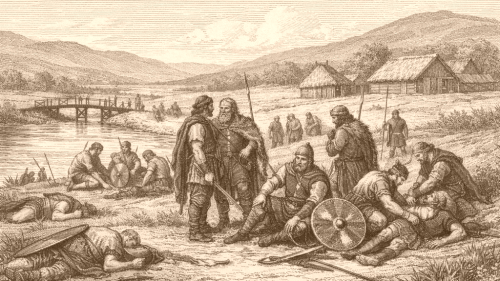
The clearest military event securely linked with 632 in Tigernach is the battle of Fid Eoin. The entry states that Mael Caith son of Scannal, king of the Cruithni, was victorious, while Connadh Cerr king of Dál Riada fell. It also records the deaths of Dicuill son of Eachach, king of Cenél Cruithne, and the nephews of Aedan. The notice is unusually full for annalistic prose, naming participants and outcome without elaborating motives or tactics.
This battle belongs to a northern political world in which named rulers and kin-groups appear repeatedly in conflict. The evidence does not allow a reconstruction of alliances or causes, but it does show that the year’s memory was organized around elite casualties and victory claims. The safest interpretation is limited to what the record says: Fid Eoin was a remembered confrontation involving kings and kin leaders, and the annal preserves it as a dated event rather than as a narrative of strategy or consequence.
Dun Cethirn
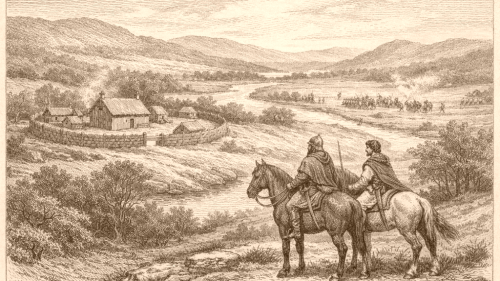
The second major event in Tigernach’s 632 is the battle of Dún Cethirn. The entry says that Congal Caech fled and that Domhnall son of Aedh was the victor, while Guaire Gaillsech son of Forannán fell. That combination of flight, victory, and named casualty marks the entry as a significant remembered conflict. Even so, the annal does not explain the size of the engagement, the reasons for fighting, or the relationship between this battle and others in the same year.
A parallel tradition in the Four Masters preserves the same battle under another chronology, with Domhnall son of Aedh victorious over Congal Caech and Guaire Gaillsech among the slain. This overlap is useful because it confirms that the battle belonged to wider historical memory, not just one annalistic line. Yet the comparison must remain modest. The records converge on the event and its broad shape, but they also show that dating could vary between manuscript traditions and compilations.
Political Setting
The named participants in 632 show that the year belonged to high politics rather than to local skirmishing alone. Domhnall son of Aedh appears in nearby annal entries as a dominant ruler of the period, while Congal Caech recurs across surrounding years as a major opponent in northern conflicts. Fid Eoin and Dún Cethirn together reveal a world of kingship in contest, but the annals themselves do not spell out the scale of authority or the internal politics behind each clash. The evidence supports significance, not full explanation.
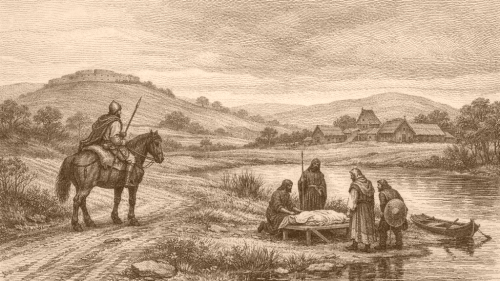
The casualty lists matter because annals often preserve political change through the deaths of named men. Eochaidh Buidhe son of Aedán is one such figure, and the battle at Fid Eoin removed several leaders from the record. Yet the texts do not identify alliances, motives, or the consequences of those deaths. A careful reading can say that the year records elite violence and royal loss; it cannot say more without moving beyond the evidence and into reconstruction.
Church Silence
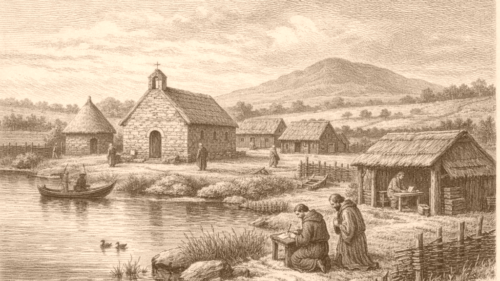
The annals for 632 are striking for what they do not say. In Tigernach, the year contains battle and death notices, but no church foundation, monastic death, or saintly repose. That silence should not be overread as evidence that ecclesiastical life paused. It means only that the surviving entry for this year is concentrated on violence and elite mortality. The record is selective, and its selectivity is part of the evidence rather than a defect to be corrected by invention.
Nearby years show that other annal entries could include abbots, bishops, monasteries, and religious deaths. The Four Masters record foundations and clerical obits in adjacent years, and Inisfallen does the same in a different sequence. This comparison helps explain the 632 gap, but it does not fill it. For this year, the historian should keep the silence visible: it is evidence of what the record preserves, not of what must have happened but went unrecorded.
Chronicle Reading
Reading 632 responsibly means separating secure dating from plausible inference. Securely dated are the battles and deaths attached to Tigernach’s annal heading. Plausible, but less secure, is the inference that these notices belong to a single season of conflict rather than to unrelated episodes. The annalistic form compresses time, so historians should resist smoothing the evidence into a continuous narrative. What survives is a compact record of violence, not a full account of movements, negotiations, or causes.
That restraint matters because later chroniclers sometimes arrange similar material differently. The Four Masters and Inisfallen both show that adjacent notices could be reassigned to other years or placed in another sequence. This does not make the annals unreliable; it means they preserve a layered chronology shaped by copying and compilation. For 632, the historian should privilege the securely attached Tigernach notices while recognizing that the wider manuscript tradition complicates exact calendrical alignment.
Regional Horizon
Even though 632 itself is narrow in scope, it belongs to a wider Irish world in which royal struggle remained central. Nearby annals repeatedly record battles, deaths, and shifts in kingship among regional rulers. The evidence therefore places 632 within a durable political pattern rather than a unique crisis. Its notices reveal how the compilers remembered power: through named victories, named losses, and the movement of authority among competing dynasties. The year is small, but it is not isolated from its century.
The broader horizon also shows that annalistic evidence is a record of selection. Some years preserve battles and deaths; others add church notices; still others compress several kinds of event into a few lines. For 632, the surviving evidence securely attests two battles and several deaths, but nothing more. That limitation is not a weakness of the analysis. It is the historical boundary imposed by the annals themselves, and careful reading should keep that boundary visible rather than forcing it open.
Historical Balance
A balanced reading of 632 begins with the year’s evidential core and ends with its limits. The core consists of the battle of Fid Eoin, the battle of Dún Cethirn, and the associated deaths named in Tigernach. Those notices can be compared and situated within a northern political landscape, but comparison should not be mistaken for explanation. Beyond them, the evidence thins quickly. Nothing in the surviving annals for this year permits a fuller narrative without conjecture, and conjecture would blur the record rather than improve it.
What 632 offers, then, is not a dramatic turning point but a disciplined example of annalistic history. The year is best understood as a moment when rivalry among dynasties was made visible through compressed notices, and when later manuscript traditions preserved that memory with slight chronological variation. For the historian, the task is not to fill the gap, but to respect it: to identify what is certain, to mark what is probable, and to leave the rest unsaid.