Guarding Neutrality
At a Glance
Legal Basis
The legal framework was framed in wartime terms rather than by any explicit statutory language of neutrality. The Emergency Powers Act, enacted on 3 September 1939, states that it made provision for securing public safety and the preservation of the state in time of war, and in particular for maintaining public order and controlling supplies and services essential to community life. Those words place the state’s wartime response inside a legal structure of emergency administration.
The same year’s statute list places the Emergency Powers Act among other 1939 Acts of the Oireachtas, including the Defence Forces (Temporary Provisions) Act, the Treason Act, the Offences Against the State Act, and the Air-Raid Precautions Act. That list shows the Emergency Powers Act as part of a dense wartime legislative year. It does not explain policy arguments, but it does document a cluster of wartime enactments on the statute book.
Coast Watching
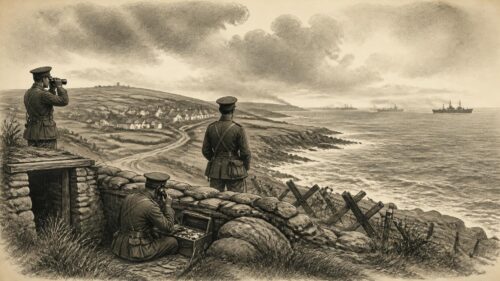
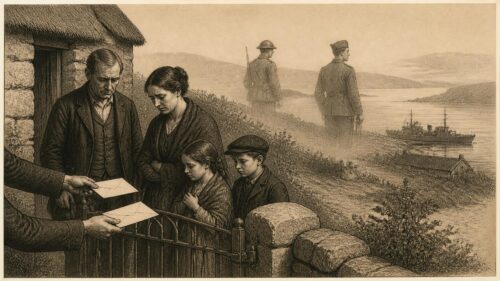
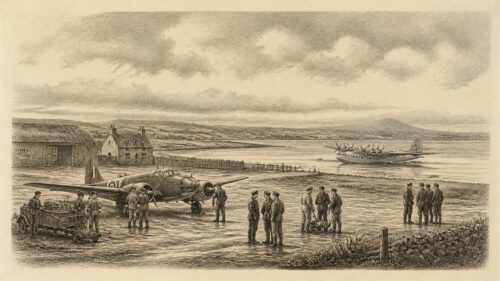
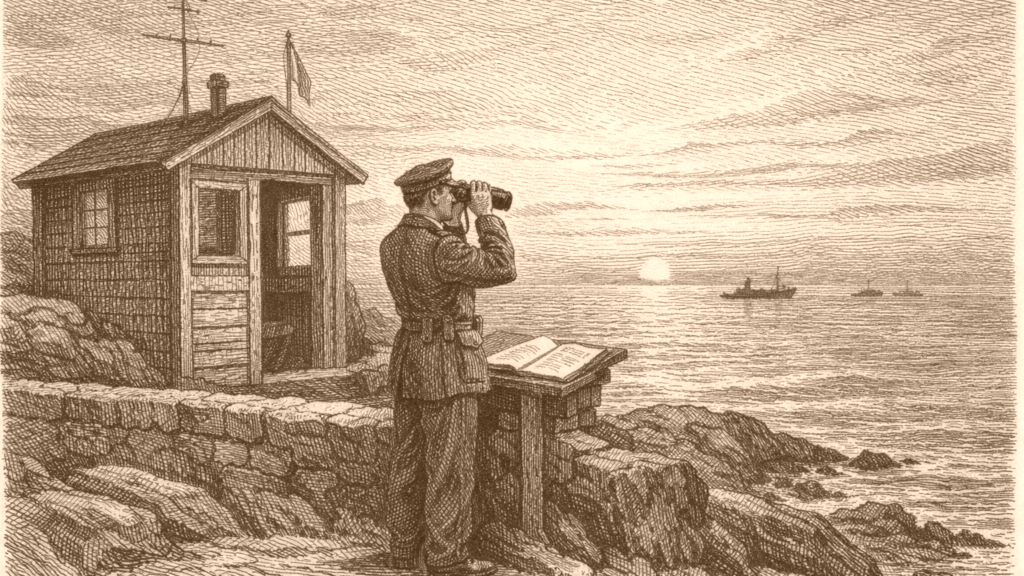
The Military Archives description presents the Marine and Coast Watching Service as a wartime response to Irish coastal waters being largely unprotected after the handover of the Treaty Ports in 1938. It says the service was established in 1939 and created a network of 83 lookout posts around the coast of Ireland, manned by members of the Local Defence Force. The evidence here is precise about location, number, and staffing.
The same archive note says the coastwatchers were responsible for identifying and reporting shipping and aircraft movements and communications between ship and shore. It also says the logbooks record the name of the post, the date, the time, and details of incidents sighted in the air or at sea. These are practical records of observation, and the description makes clear that the collection preserves repeated, timed entries rather than a single narrative account.
Shoreline Reports
Four Courts Press describes the Coast Watching Service as Ireland’s Second World War frontline troops and says that, from 1939 to 1945, they maintained a continuous watch along the Irish shoreline. The summary adds that they reported incidents in the seas and skies to Military Intelligence, G2. This establishes a chain from watch posts to military intelligence, with the coastline as the first point of observation.
The same summary says G2 used those reports to assess the direction of the Battle of the Atlantic off Ireland and to report belligerent threats to the Chief of Staff of the Defence Forces, the Cabinet, the Taoiseach, and the Minister for External Affairs, Eamon de Valera. The passage gives a specific reporting route, but it does not describe every decision made from those reports. Its value lies in showing how coastal observation entered senior state channels.
Intelligence Links
The publisher’s summary says the history can be told locally along the coast of Ireland and at national and international levels in Dublin, London, Berlin, and Washington. It also says the study reveals a secret relationship between Irish military and diplomats and British Admiralty Intelligence. These are direct statements about connected wartime spheres, but they are presented as part of the study’s account rather than as a full documentary record of every exchange.
The same summary states that coast watching service reports were passed on to the RAF and Royal Navy in Britain in the hunt for German u-boats and aircraft in the Atlantic. This shows that information gathered in Ireland moved beyond Irish military channels. The sentence does not spell out the diplomatic terms of that transfer, but it does directly indicate wider wartime use for the reports.
Archive Record
The Military Archives pages identify the Lookout Post Logbooks collection as spanning September 1939 to June 1945. They say it comprises 55 boxes of 481 bound volumes and contains the log books recorded by men serving in 83 lookout posts around the coast. The archive description therefore fixes the surviving record to the wartime years and to a defined body of documentary material.
The archives also note that the collection is open to the public and that a sample of log books is available through an online map, while the reading room page explains that researchers can browse online finding aids and view original records by appointment. The record is therefore both accessible and partial: some material is online, some is only in person, and the archive notes that two lookout posts are missing from the collection.
Documented Practice
Taken together, these records show a documented wartime system of law, observation, and reporting. The Emergency Powers Act provided emergency powers for public safety and supply control; the lookout posts supplied local observations of air and sea movement; and G2 formed a channel from the coast to the state’s senior offices. The passages do not spell out a complete strategy, but they do align in showing how guarding the state was carried out in practice.
What these passages do not show is also important. They do not provide a full operational history of every lookout post, every report, or every government decision. They do not directly explain motive, debate, or long-term political consequence. What they do establish consistently is that Ireland’s neutrality was guarded through observable wartime procedures: emergency legislation, coastal surveillance, logbooks, and intelligence reporting.