
Gaeilge GAA
At a Glance
Origins Revival
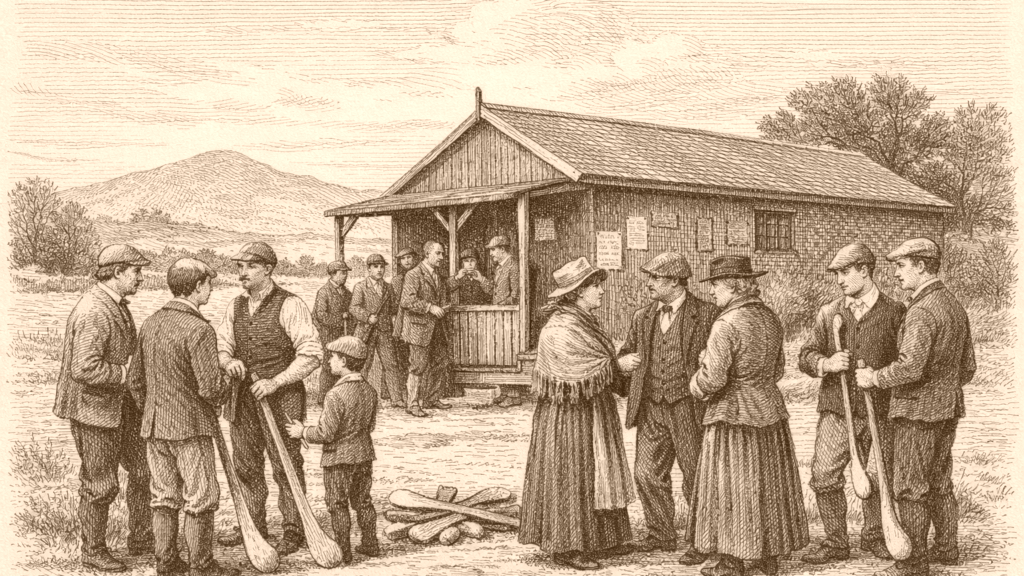
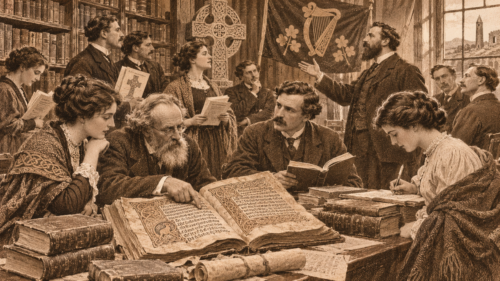
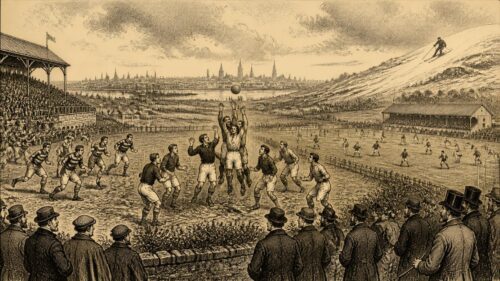
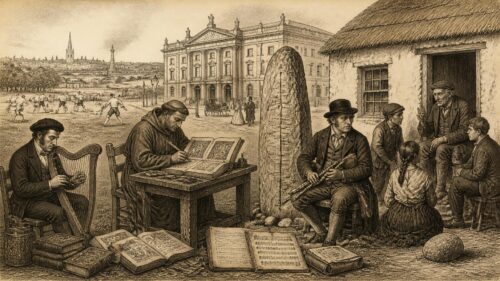
The earliest links in these passages place Gaelic games beside the Irish language revival. Michael Cusack is described as a prominent figure in that revival before the Gaelic Athletic Association was founded in 1884, and the founding story sets the Association’s origin in Thurles within a wider effort to revive native sport. The same account says Cusack and Maurice Davin wanted to revive hurling and Irish football while setting their organisation apart from rival athletics bodies. [3]
Another passage makes the connection more explicit by showing Cusack as an early language activist and treasurer of the Gaelic Union in 1882. It also says he established two clubs in late 1883 and wrote that one was the club out of which the Gaelic Athletic Association sprang. On that evidence alone, language revival and the organisation’s earliest club culture appear intertwined, though the excerpt does not explain every step between those activities. [3]
Ulster Leaders
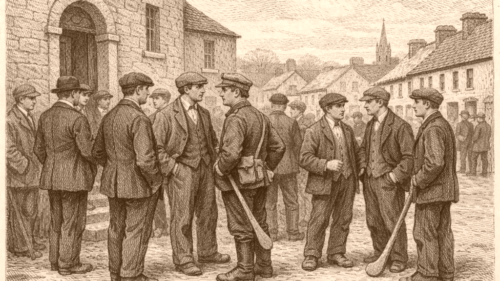
In Ulster, the evidence shows individuals moving between the language movement and GAA administration. Michael V. O Nolan joined Conradh na Gaeilge and, according to the account, spent nights teaching Irish before becoming involved in GAA work in Strabane district. The same passage says he helped revive Gaelic games there, especially hurling, and later held offices as Leas-Uachtarán, county board chairman, and provincial president. [6]
George Martin provides a second Ulster example. He first joined the GAA through the Tír na nÓg club, described as an offshoot of a Conradh na Gaeilge branch, and then became an officer after the foundation meeting of Comhairle Uladh in 1903. The excerpt presents him as an active official rather than a player, with duties that included meetings, refereeing, and county administration across several years. [6]
County Work
The county-level material suggests that support for Irish was not confined to one generation. A current Fermanagh page states that the county offers Gaeltacht scholarships for members, both young and adult, and asks applicants to use as much Gaeilge as they can. It also presents a 2022–23 and 2023–24 language course for GAA members in Ulster, showing organised, practical language provision within the county structure. [2]
The same page also describes an Ulster GAA and Ulster University partnership that supports a Diploma in Irish, and it says the scheme offers financial support and a pathway to proficiency in the language. The evidence here is promotional rather than historical narrative, but it still demonstrates that county and provincial GAA bodies continue to frame Irish as a live part of club culture. [2]
Club Culture
A club-based Irish-language page from Ardoyne Kickhams gives a direct statement of identity. It says Gaeilge is a living part of the club, treats promoting and protecting it as a core principle, and cites Rule 4 of the GAA Official Guide as requiring clubs to support Irish culture. It also notes beginner and intermediate courses for members, parents, supporters, and the wider public. [5]
That club page adds that upcoming courses are advertised through the website and social media, and that the aim is to keep Gaeilge part of everyday club life. The phrasing is contemporary and promotional, but it clearly shows Irish language activity organised at club level rather than only at county headquarters or in formal schools. [5]
Finals Speech
At the championship level, the excerpts focus on Irish being heard and seen at All-Ireland finals. Joe Connolly’s 1980 speech is presented as a celebrated example of a captain speaking as Gaeilge, and later captains such as John Fenton, Páidí Ó Sé, Dara Ó Cinnéide, Seán Óg Ó hAilpín, and Lester Ryan are listed as others who delivered speeches in Irish. The page also notes that the tradition remains visible in Croke Park. [4]
The same article says the GAA has a duty to promote the Irish language and that Irish appears in stadium announcements, signage, match programmes, and commissioned writing. It even mentions a club manifesto printed in Irish on the back page of a publication. These details show Irish functioning as a visible match-day language, not only as a ceremonial one. [4]
Continuity Today
A National Museum exhibition broadens the picture by presenting GAA influence through social history, design, and popular culture. Its text says the organisation was formally established in 1884 and includes objects from the fifteenth century to the present day, including a medal made in New York and a camogie dress from the 1960s. The exhibition therefore frames the GAA as a long-running cultural presence, though not specifically as a language institution. [1]
The combined evidence does not show one single policy or campaign that explains the whole relationship between Irish and the GAA. Instead, it shows repeated overlap: founders linked to revival movements, Ulster administrators active in Conradh na Gaeilge, clubs running classes, counties funding scholarships, and finals giving Irish public prominence. The continuity is visible, but the passages leave gaps between these moments. [3] [6] [5] [2] [4]
Source References
Hover over a number to see the source. Select it to open the source.

- [1] GAA: People, Objects & Stories | Decorative Arts & History | National Museum of Ireland
- [2] Irish Culture | Fermanagh GAA
- [3] 1 November, 1884: The birth of a sporting revolution
- [4] All-Ireland Final day and the Irish language
- [5] Irish Language | Ardoyne Kickhams
- [6] Founding Fathers Honoured - Cumann Lúthchleas Gael Uladh
How did the Gaelic Athletic Association foster the Irish language through its origins, county structures, clubs, and match-day practices?