Ahoghill: historical settlement, church, and revival
Ahoghill is securely established as both a parish and a village in County Antrim, with the place-name authority listing Achadh Eochaille for the parish and the settlement, and placing both within County Antrim; the parish spans the historic baronies of Antrim Lower, Toome Lower, and Toome Upper, while the village itself lies in Antrim Lower, Toome Lower, and Toome Upper boundaries in the historical record 1. Samuel Lewis described Ahoghill in 1837 as a parish “chiefly in the barony of Lower Toome, county of Antrim,” with a village population and an already old landscape marked by forts, tumuli, and human bones, suggesting a locality long occupied before the nineteenth century 2.
Dateline
Early settlement and the medieval church
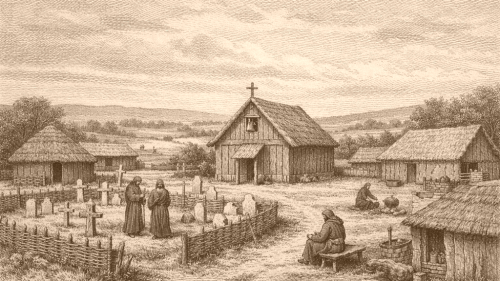
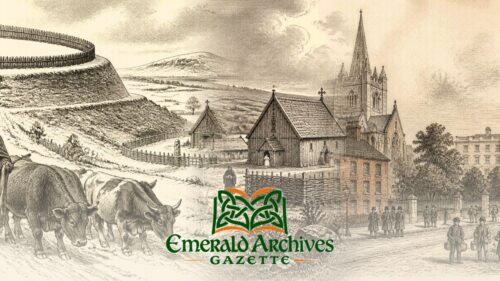
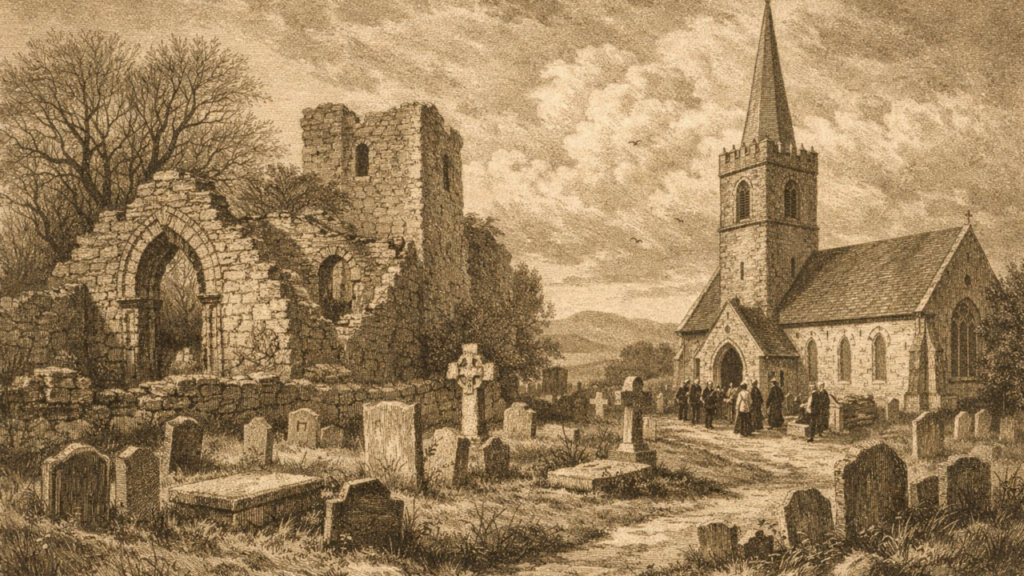
Ahoghill is securely established as both a parish and a village in County Antrim, with the place-name authority listing Achadh Eochaille for the parish and the settlement, and placing both within County Antrim; the parish spans the historic baronies of Antrim Lower, Toome Lower, and Toome Upper, while the village itself lies in Antrim Lower, Toome Lower, and Toome Upper boundaries in the historical record 1. Samuel Lewis described Ahoghill in 1837 as a parish “chiefly in the barony of Lower Toome, county of Antrim,” with a village population and an already old landscape marked by forts, tumuli, and human bones, suggesting a locality long occupied before the nineteenth century 2. Local heritage interpretation, preserved in a Mid and East Antrim museum church trail, identifies Ahoghill’s old churchyard as the site of a very early ecclesiastical foundation and says the place was traditionally regarded as the fourth oldest church in County Antrim 5.
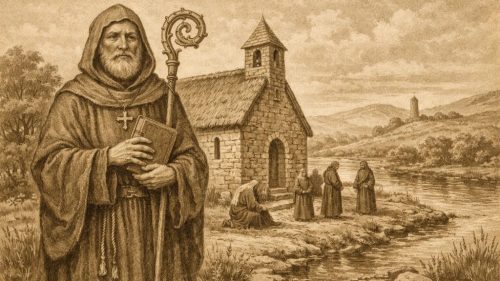
The same church-trail source states that the site was believed to have been founded in the late sixth century by Colmanell, nephew of Columba, and that the medieval and post-Reformation ruins visible in the churchyard represent successive rebuildings of an important parish church 5. The trail also notes that Ahoghill was the largest parish in the diocese of Connor, and that it originally included the neighbouring parishes of Craigs and Portglenone until those were detached in the early nineteenth century 5. This accords with Lewis’s description of Ahoghill as a large parish rather than a mere village, and with the settlement’s long ecclesiastical centrality in north-east Antrim 2.
Historical spellings and the place-name
The Irish-language form used by the official place-name authority is Achadh Eochaille, paired with the English form Ahoghill for both parish and settlement 1. The same authority’s historical dossiers preserve older written forms that show the name’s long documentary life, including Aghigohelle and Aghiyoghell in 1659, Aghayoghill in 1668, and later variants such as Agheohil in Lewis’s 1837 dictionary record for the related place-name tradition 21. Those forms are important because they demonstrate that Ahoghill was not a modern invented village-name but an inherited local place-name whose spelling fluctuated in early-modern administration before stabilising in the Anglicised form now used 1.
The placename evidence also shows that Ahoghill’s ecclesiastical identity was older than the modern village streetscape. The museum trail’s account of the old churchyard, together with the authority’s parish-and-settlement listing, indicates a place whose name attached to a central church settlement and parish unit first, and only later to the mapped village core 15. That pattern is consistent with many Ulster settlements where the church, graveyard, and parish were the oldest organizing features, and where the village later grew around them 5.
Land, conflict, and parish life before the revival
Lewis gives a compact but revealing portrait of eighteenth-century Ahoghill. He says the district had been “the scene of much early warfare,” then adds episodes from the Williamite War, the invasion scare of 1760, and the violence of the “Steel Men” or “Hearts of Steel” around 1771 2. These references place Ahoghill within the contested landscape of north Antrim, where routeways, fords, and the Bann corridor mattered strategically 2. Lewis’s account is not local folklore alone: it reflects the way the parish was remembered in nineteenth-century topographical writing as a place of repeated disruption, defence, and agrarian unrest 2.
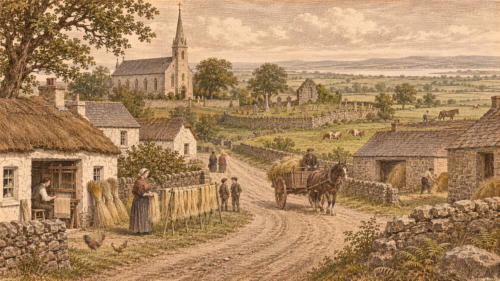
By the time of Lewis’s survey, Ahoghill had developed into a substantial parish settlement with a village at its heart, but still one whose identity was closely tied to the parish rather than to urban growth 2. The village existed within a wider rural tract, and its population was concentrated around religious institutions and market-oriented roads rather than industrial streets. That ecclesiastical focus would shape the next great episode in the settlement’s history: the 1859 revival 24.
The 1859 revival and Ahoghill’s wider reputation
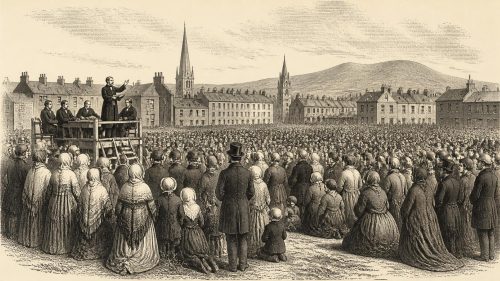
Ahoghill became one of the most important sites in the Ulster revival of 1859. The University of Edinburgh thesis by Alfred Russell Scott, available through Trinity College Dublin’s repository, identifies Ahoghill as a major episode in that movement and quotes the best-known contemporary narrative of how the revival spread there 34. Scott’s thesis records that by the middle of February 1859 “the whole of Ahoghill and the adjoining parish of Dromaul had been overwhelmed by the revival,” and that 14 March 1859 became a memorable date when a gathering estimated at over 3,000 people experienced the intense physical and spiritual manifestations for which the revival became famous 4.
Scott’s account also shows that Ahoghill was not merely a passive recipient of revival enthusiasm. He writes that if Connor was the “cradle” of the movement, Ahoghill became its “herald to the world,” and that the revival’s intensity there lasted longer than in most other places 4. That distinction matters historically. Ahoghill’s role was not secondary or decorative; it helped shape the public narrative of the 1859 movement in print, testimony, and later scholarship 34. The settlement’s Presbyterian churches became central meeting places, and the revival’s momentum turned a local parish into a name recognised across Ulster religious history 4.
The Ulster-Scots Agency’s Ower the Tuppenny reinforces the local memory of this episode by preserving a heritage plaque at Ahoghill Old Church Yard. The plaque text, reproduced in the publication, states that the present St Colmanell’s Church of Ireland was erected nearby in 1865, following the Ulster Religious Revival of 1859, and that the old church yard surrounds the site of an early medieval church rebuilt several times 6. This is valuable because it connects the medieval ecclesiastical landscape, the nineteenth-century revival, and the architectural aftermath in one local narrative 6.
From ecclesiastical centre to remembered place
Ahoghill’s history is therefore best understood as a long continuity of church settlement, parish authority, and revival memory. The official place-name record anchors the place in County Antrim and preserves its Irish form and earlier spellings 1. Lewis shows a parish that was already historically dense with memory, conflict, and rural social unrest by the 1830s 2. Modern scholarship on the 1859 revival confirms that Ahoghill was one of the movement’s key local theatres, not because it was large in an urban sense, but because its churches, congregations, and public gatherings made it an early and influential centre of revival activity 34.
That combination of medieval church, early-modern documentary variants, eighteenth-century turbulence, and nineteenth-century evangelical intensity is the historical core of Ahoghill. The settlement’s importance lies not in later tourism or generic county history, but in the long persistence of a parish place whose religious institutions repeatedly shaped its public identity 1256.
Historical Sources
- Fo-aonaid de chuid: Aontroim/Antrim | logainm.ie
- AHOGHILL, a parish – Topographical Dictionary of Ireland (1837)
- The Ulster revival of 1859 | TARA (Trinity College Dublin)
- Prayer-meetings now began to multiply in the district (PDF thesis excerpt)
- AHOGHILL Fourth oldest church in County Antrim | Mid-Antrim Museum church trails
- OWER THE TUPPENNY | Ulster-Scots Agency PDF