Ballycastle
Ballycastle is a long-established town on the north Antrim coast, recorded in historical gazetteers as a town in the parish of Ramoan, barony of Carey, County Antrim. Samuel Lewis described it as a “sea-port, market and post-town” in County Antrim, and noted that the Irish form was “Ballycashlain,” explaining the name as “Castletown,” derived from a castle built there in 1609 by the Earl of Antrim 1. Modern Irish place-name authority gives the standardized Irish form as Baile an Chaistil, alongside the English Ballycastle, and places it in county Aontroim/Antrim, barony Cathraí/Cary, civil parish Ráth Muáin/Ramoan 2.
Dateline
Settlement and name
Ballycastle is a long-established town on the north Antrim coast, recorded in historical gazetteers as a town in the parish of Ramoan, barony of Carey, County Antrim. Samuel Lewis described it as a “sea-port, market and post-town” in County Antrim, and noted that the Irish form was “Ballycashlain,” explaining the name as “Castletown,” derived from a castle built there in 1609 by the Earl of Antrim 1. Modern Irish place-name authority gives the standardized Irish form as Baile an Chaistil, alongside the English Ballycastle, and places it in county Aontroim/Antrim, barony Cathraí/Cary, civil parish Ráth Muáin/Ramoan 2.
Seventeenth-century origins
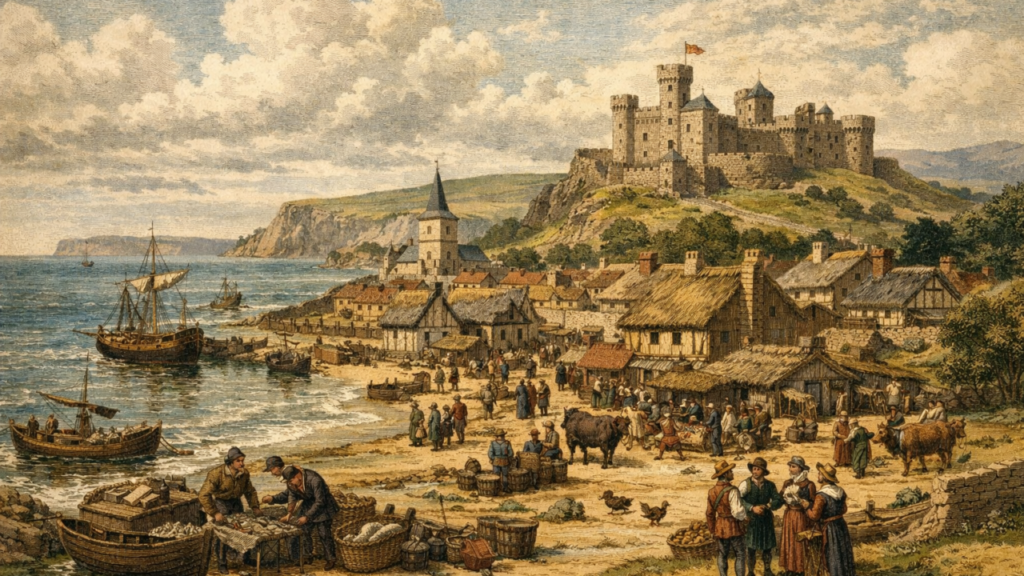
The town’s historical development is closely tied to the Antrim castle from which it took its name. Lewis’s early nineteenth-century account preserves the tradition that the settlement’s name comes from a castle erected in 1609 under the direction of James I, with Randal MacDonnell, Earl of Antrim, associated with the foundation 1. A later county directory likewise repeats the settlement’s origin story, stating that the name arose through the erection of a castle here by the Earl of Antrim in 1609 3. These references are important because they show that Ballycastle was not merely a modern seaside resort, but a place whose town identity crystallized around an early modern fortified site and the market settlement that grew beside it 13.
Historical spelling forms
The sources also preserve variation in spelling and language form. Lewis gives the Irish as “Ballycashlain,” while the modern authoritative form is Baile an Chaistil 12. The coexistence of these forms reflects the history of anglicisation in Ulster place-names: older English and Irish renderings were often phonetic or interpretive, while modern place-name scholarship standardizes the Gaelic original and its English counterpart 2. In the historical record, the settlement is consistently identifiable as Ballycastle in County Antrim, but its naming history shows a shift from older descriptive and phonetic forms toward the present standardized Irish and English forms 123.