Factional Legacy
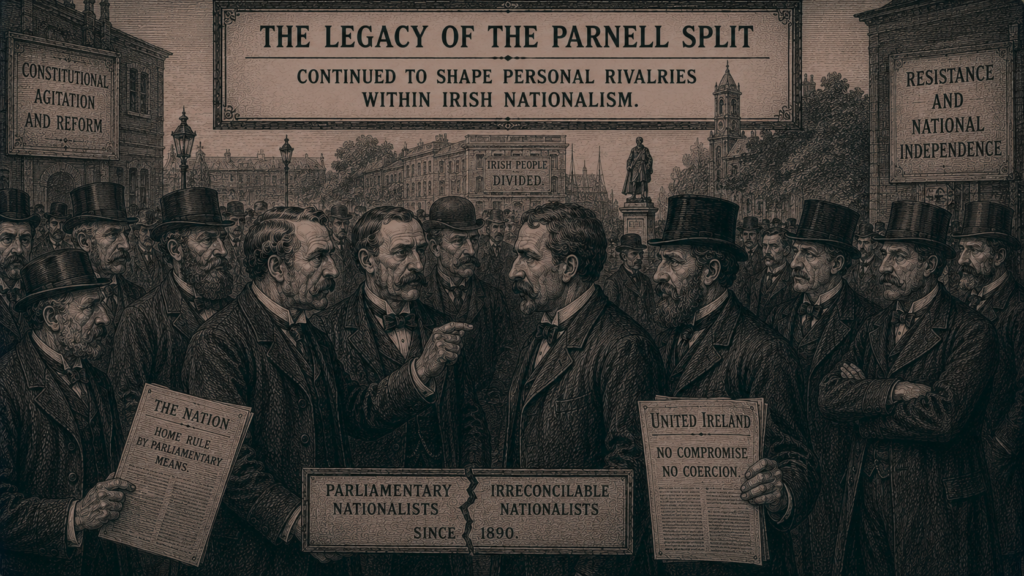
The legacy of the Parnell split continued to govern personal relationships within Irish nationalism nearly a decade after the parliamentary rupture of December 1890. Charles Stewart Parnell’s refusal to surrender the party leadership during the O’Shea divorce crisis divided former colleagues into Parnellite and anti-Parnellite camps. Political argument became inseparable from accusations of loyalty, betrayal, clerical interference and personal ambition. Parnell’s death in October 1891 removed the leader around whom the conflict had formed, but it did not reconcile the men who had defended or rejected him. Those memories endured within parliamentary factions, newspapers, constituencies and private correspondence.
John Redmond became leader of the principal Parnellite group, while John Dillon emerged as the dominant figure among the anti-Parnellite majority. Timothy Healy, who had attacked Parnell with unusual force during the crisis, later broke from Dillon’s leadership and developed a separate following shaped by clerical, local and personal loyalties. Even Redmond’s supporters divided when Timothy Harrington disagreed with him over reunion. By the late 1890s, Irish parliamentary nationalism had fragmented into several rival bodies. Disputes over organisation, election funds and political strategy repeatedly carried the emotional force of the original split, making compromise difficult even when policy differences appeared negotiable.
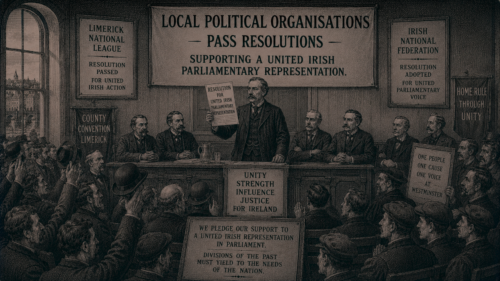
William O’Brien’s United Irish League attempted to rebuild national organisation from outside the divided parliamentary groups. Its expansion after 1898 placed growing pressure upon leaders who feared that local branches might challenge sitting MPs and redirect nationalist funds. Reunion became politically necessary, yet negotiations exposed continuing mistrust. Redmond feared domination by former opponents, Dillon wanted central discipline, Healy guarded his independence, and O’Brien insisted that parliamentarians should remain answerable to organised opinion in Ireland. The League could compel rival leaders to discuss unity, but it could not erase the insults, broken friendships and competing ambitions accumulated throughout the previous decade.
Limerick’s connection to the split was embodied by William Abraham, a nationalist MP born in the city who had represented West Limerick. Abraham supported the anti-Parnellite cause and played a notable part in the parliamentary revolt against Parnell’s continued leadership. His career showed how the national quarrel entered local representation, forcing Limerick electors and political organisers to choose between competing bodies claiming the same nationalist inheritance. The division weakened coordinated advocacy for Home Rule, land reform and local interests at Westminster. Even after formal reunion, older loyalties continued to influence how politicians, newspapers and voters judged leadership and party discipline.
The Irish Parliamentary Party formally reunited in January 1900, with Redmond chosen as chairman of the reconstructed organisation. The settlement ended the visible existence of separate parliamentary factions, but it did not recreate the authority Parnell had once exercised. Redmond was obliged to balance Dillon’s influence, Healy’s independence and O’Brien’s control of a growing popular organisation. Personal rivalries continued to shape disputes over candidates, funds, policy and the relationship between MPs and the United Irish League. Irish nationalism entered the new century under one parliamentary name, yet the emotional inheritance of the Parnell split remained deeply embedded within its leadership.
- Frank Callanan, The Parnell Split, 1890–91, Cork: Cork University Press, 1992.
- Philip Bull, “The United Irish League and the Reunion of the Irish Parliamentary Party, 1898–1900,” Irish Historical Studies, vol. 26, no. 101, May 1988, pp. 51–78.
- F. S. L. Lyons, The Irish Parliamentary Party, 1890–1910, London: Faber and Faber, 1951.
- T. M. Healy, Letters and Leaders of My Day, 2 vols, London: Thornton Butterworth, 1928.
- William O’Brien, An Olive Branch in Ireland and Its History, London: Macmillan, 1910.
- John Dillon Papers, Trinity College Dublin Manuscripts, IE TCD MSS 6455–6909; Irish Parliamentary Party anti-Parnellite minute books, MSS 6500–6502.
- John Redmond Papers, 1878–1918, National Library of Ireland, Collection List No. 118.
- Patrick Maume, “Abraham, William,” Dictionary of Irish Biography, Royal Irish Academy.
- The Times, 31 January 1900, report of the reunion of the Irish Parliamentary Party.