Ladysmith Assault
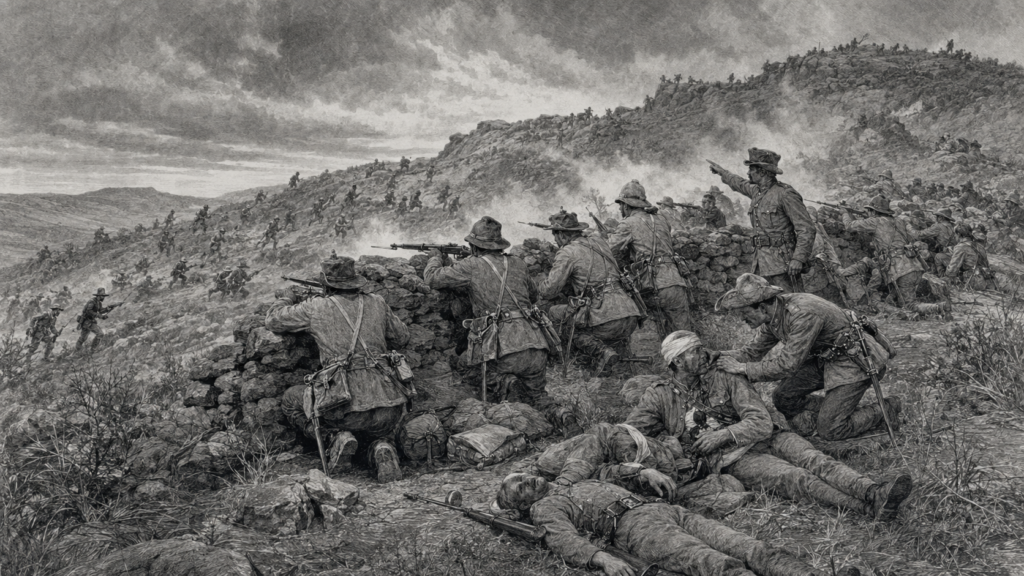
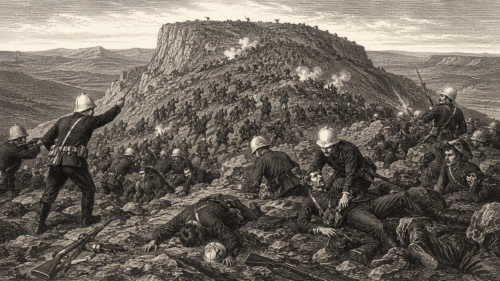
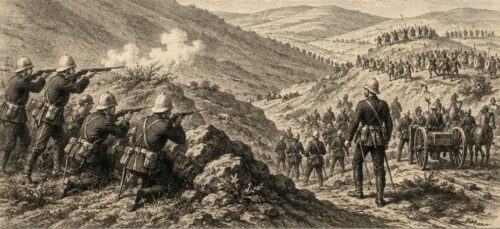
Boer commandos launched a major assault upon the British defensive line south of besieged Ladysmith before dawn on 6 January 1900. Their principal targets were Wagon Hill and Caesar’s Camp, two positions on the ridge known locally as the Platrand. Advancing through darkness and broken ground, the attackers surprised several forward posts and gained parts of the crest before the defenders could organise effective resistance. Confused close-range fighting followed, with British and colonial troops struggling to distinguish friend from enemy among rocks, scrub and unfinished defensive works.
The battle continued throughout the day as reinforcements were sent towards the threatened ridge. Fighting was particularly severe around Wagon Hill, where Boer riflemen repeatedly challenged troops of the Imperial Light Horse, Royal Engineers, King’s Royal Rifle Corps, Gordon Highlanders and other units. At Caesar’s Camp, British and colonial defenders prevented the attackers from turning the position. Rain and hail swept across the battlefield late in the afternoon, but the struggle continued until a bayonet charge by the Devonshire Regiment finally helped clear the remaining Boer fighters from Wagon Hill.
The garrison retained possession of the Platrand, but the victory came at a heavy cost in killed and wounded men. The assault demonstrated that the Boer forces surrounding Ladysmith remained capable of mounting a determined attack upon the town’s defences. Although the attempt to storm the perimeter had failed, the siege was not broken. Food supplies were declining, disease was increasing and horses were eventually slaughtered to supplement rations. Ladysmith remained isolated until General Redvers Buller’s relieving army finally reached the town at the end of February.
Irish soldiers were involved in the wider defence and relief of Ladysmith. The 1st Battalion Royal Irish Fusiliers had entered the town during October 1899 and remained within the besieged garrison, while the Royal Dublin Fusiliers and other Irish regiments served with the forces attempting to break through from the south. The surviving evidence does not identify a particular Limerick unit as having fought upon Wagon Hill itself. Nevertheless, Limerick families with relatives serving in Natal would have followed reports of the assault closely while waiting for casualty lists, military correspondence and letters from individual soldiers.
The news carried a complicated emotional force in Limerick and elsewhere in Ireland. Many nationalists sympathised with the Boer republics and condemned Britain’s expansion in South Africa, yet thousands of Irishmen wore British uniforms and depended upon military pay. Political satisfaction at a British setback could therefore exist beside intense fear for a son, husband or brother trapped inside Ladysmith. The Platrand battle brought those conflicting loyalties into sharp focus. A distant imperial campaign was experienced locally through newspaper reports, interrupted wages, anxious households and the possibility that a familiar Irish name might appear among the dead or wounded.
- Major-General Sir Frederick Maurice, History of the War in South Africa, 1899–1902, vol. II, London: Hurst and Blackett, official military history covering the siege of Ladysmith and the fighting of 6 January 1900.
- National Army Museum, “The Boer Attack on Caesar’s Camp: A Hot Corner with the Border Mounted Rifles,” collection record concerning the assault of 6 January 1900.
- National Army Museum, “Boer War,” historical account of the siege, attacks upon Caesar’s Camp and Wagon Hill, and the relief of Ladysmith.
- Royal Dublin Fusiliers Association, Dublin Fusiliers in South Africa, regimental account of the attack upon Wagon Hill and Caesar’s Camp.
- Royal Irish Fusiliers Museum, “Under Siege at Ladysmith,” account of the 1st Battalion Royal Irish Fusiliers during the South African War.
- G. W. Steevens, From Capetown to Ladysmith: An Unfinished Record of the South African War, Edinburgh: William Blackwood and Sons, 1900.
- H. W. Nevinson, Ladysmith: The Diary of a Siege, London: Methuen, 1900.
- Luke Diver, Ireland and the South African War, 1899–1902, PhD thesis, Maynooth University, 2014.