Divided Loyalties(c.1900s)
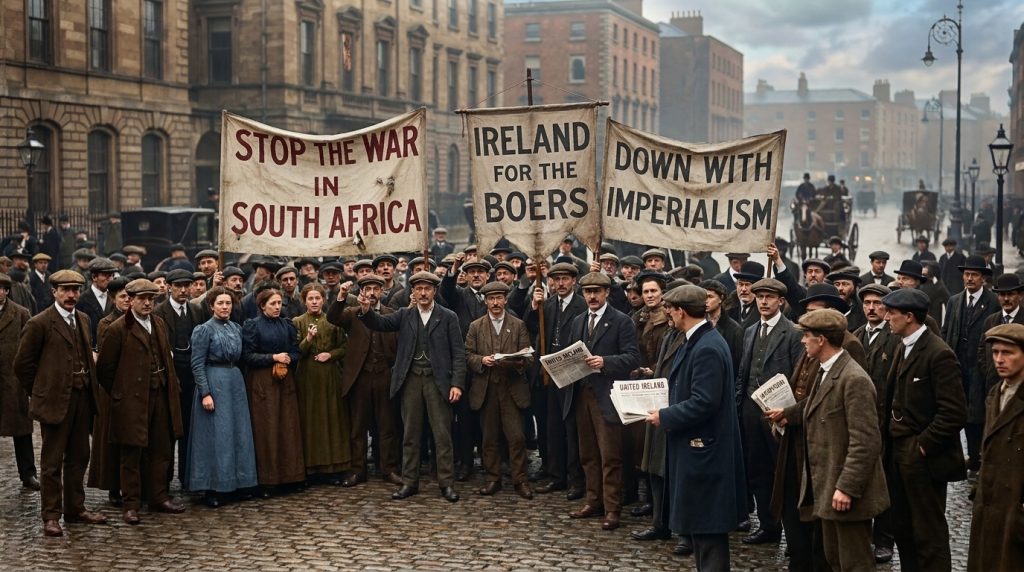
Irish public opinion during the South African War was divided in a manner that exposed the complicated relationship between nationalism, empire and military service. Nationalist newspapers and political organisations frequently expressed sympathy for the Boer republics, presenting their resistance to British expansion as a struggle resembling Ireland’s own opposition to imperial rule. Boer victories were sometimes welcomed as humiliations for a government that continued to deny Irish self-government. Public meetings, songs, newspaper commentary and street demonstrations gave the pro-Boer cause considerable visibility, making Ireland one of the strongest centres of anti-war and pro-Boer feeling in Europe.
That political sympathy existed alongside substantial Irish participation in the British Army. Estimates differ, but historians agree that tens of thousands of Irishmen served on the British side during the conflict. Some were long-service regular soldiers, while others were reservists, militiamen or new recruits attracted by employment, pay, family tradition and the social standing associated with military service. Irish regiments fought in many of the campaign’s principal operations, even as nationalist newspapers criticised the policies those soldiers were ordered to enforce. The contradiction was not exceptional: opposition to the war could coexist with pride, anxiety and loyalty towards Irishmen serving within it.
The Royal Munster Fusiliers gave the conflict an immediate connection to Limerick. Its recruiting district included Cork, Limerick, Kerry and Clare, and its depot was at Tralee. The 1st Battalion served throughout the South African War, while the 2nd Battalion arrived during its later stages. Men from Limerick city and county entered the regiment through established recruiting networks, family connections and previous military service. The regiment consequently linked South African battlefields with streets, farms and barracks throughout Munster. Casualty reports or delayed letters could bring a distant imperial campaign directly into households that otherwise shared little enthusiasm for British political objectives.
Economic necessity complicated political feeling still further. Regular army wages were modest, but military employment provided food, clothing and a dependable income that could help support parents, wives and children. Reservists recalled to the colours left civilian jobs, while public bodies and private employers had to decide whether their positions would remain open. In working-class districts and rural communities, criticism of imperial policy did not remove dependence upon soldiers’ earnings. Families might sympathise with the Boers while praying for the safety of a son or husband wearing a British uniform. Such households experienced the war through separation, remittances, uncertainty and fear rather than through simple ideological loyalty.
The conflict therefore resisted any easy division between pro-British soldiers and anti-British civilians. Irishmen joined the army for many reasons, and relatives could honour their courage without accepting the justice of the campaign. Nationalist politicians likewise risked alienating soldiers’ families if opposition to recruitment became contempt for the men already serving. In Limerick and across Munster, the South African War revealed overlapping identities shaped by poverty, employment, regiment, family and national politics. Sympathy for the Boers and concern for the Royal Munster Fusiliers were not mutually exclusive; they were two parts of the painful reality through which many Irish communities understood the war.
Note:
The conflict is called the Boer War because it was fought between the British Empire and the Boers, descendants of Dutch, French and German settlers in southern Africa. The First Boer War occurred in 1880–1881, followed by the Second Boer War in 1899–1902. Both arose from British efforts to control the region, intensified by diamonds and gold. The Boers fought to preserve the Transvaal and Orange Free State. Irish involvement occurred on both sides: many served in the British Army, while nationalists supported the Boers and some joined brigades, seeing their struggle as resistance to British imperial rule.
- Military Archives of Ireland, Information Document on the Irish Regiments of the British Army, entry for the Royal Munster Fusiliers, identifying Tralee as the regimental depot, Cork, Limerick, Kerry and Clare as its recruiting counties, and South Africa among its pre-1914 theatres of service.
- National Army Museum, “The Royal Munster Fusiliers,” regimental history confirming that the 1st Battalion served throughout the South African War and the 2nd Battalion arrived in South Africa in December 1901.
- National Army Museum, “‘Royal Munster Fusiliers — A Bristling British Front,’ 1899,” collection record documenting the regiment’s South African service and wartime casualties.
- Luke Diver, Ireland and the South African War, 1899–1902, PhD thesis, Maynooth University, 2014.
- Donal P. McCracken, The Irish Pro-Boers, 1877–1902, Johannesburg: Perskor, 1989.
- Thomas Denman, “‘The Red Livery of Shame’: The Campaign Against Army Recruitment in Ireland, 1899–1914,” Irish Historical Studies, vol. 29, no. 114, November 1994, pp. 208–233.
- Stephen Lynn, Global Irish Nationalism and the South African War, 1899–1902, PhD thesis, University of Toronto, 2022.
- War Office, The Monthly Army List, January 1900, entries for the Royal Munster Fusiliers and Irish regimental establishments.