Estates Reorganised(c.1900s)
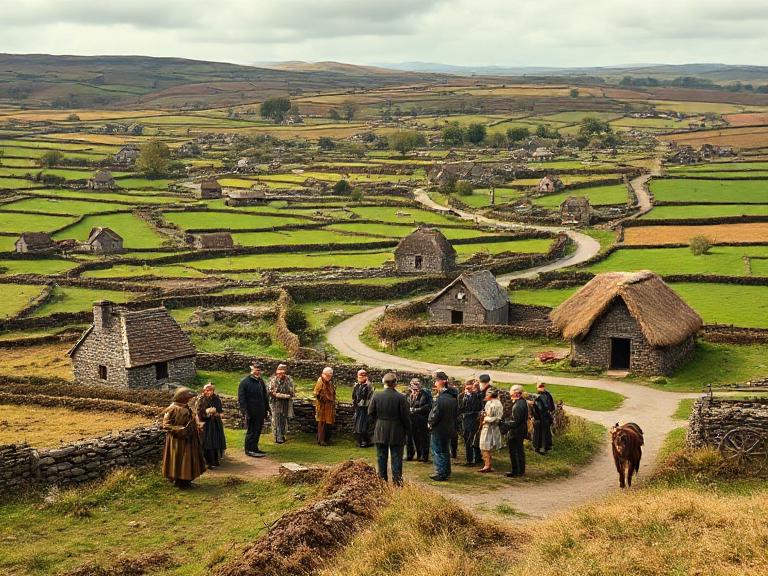
The Congested Districts Board is continuing its efforts to purchase and reorganise estates in the poorest districts of western Ireland. Created in 1891 to relieve chronic rural poverty, the Board has increasingly turned towards land purchase as a means of enlarging uneconomic farms, combining scattered plots and moving selected families from overcrowded districts onto more productive ground. Its work is concentrated principally in Connacht and the western counties, where generations of subdivision have left many households dependent upon holdings too small or infertile to provide a secure living.
The Board’s method involves acquiring an estate, examining the condition of its tenants and then rearranging the land before reselling improved holdings. Boundaries may be altered, fragmented plots consolidated and additional grazing ground attached to farms that cannot support their occupants. Drainage, fencing, roads and houses may also be provided before the tenants assume responsibility for repayment. The policy therefore extends beyond transferring ownership from landlord to occupier. It attempts to reshape the physical organisation of rural communities so that families receive holdings capable of sustaining them without continuous dependence upon seasonal migration, shop credit or assistance from relatives abroad.
One of the Board’s largest undertakings followed its purchase in 1899 of the Dillon estate, extending across parts of Counties Galway and Roscommon. The property contained numerous impoverished tenants living upon wet, divided or inadequate holdings. Its acquisition offered the Board an opportunity to carry out drainage, improve roads and redistribute land on a scale beyond its earlier experiments. The Clare Island and French estates had already demonstrated that carefully reorganised holdings could improve tenants’ circumstances, encourage regular repayment and reduce dependence upon credit. Supporters now argue that these experiments justify a much wider programme throughout the congested western districts.
Progress remains restricted by finance and by the Board’s dependence upon voluntary sales. Although legislation permits it to borrow purchase money from the Irish Land Commission, the expense of improving and rearranging estates must still be met from limited annual funds. Board officials must therefore balance the cost of land against drainage, construction, agricultural assistance, fisheries and local industries. Nationalist representatives complain that deserving districts remain neglected while negotiations continue slowly. Landlords may refuse acceptable terms, and the Board cannot yet compel the sale of estates whose acquisition might relieve surrounding congestion.
The programme is closely watched in County Limerick, where the contrast between large grazing farms and small or insecure holdings has also encouraged demands for redistribution. The western estates present the most severe examples of congestion, but the principle involved reaches across rural Ireland: ownership alone cannot rescue a family when the land purchased remains scattered, exhausted or too small. By combining estate purchase with physical reorganisation, the Congested Districts Board is testing whether public intervention can replace inherited poverty with viable farms. Its achievements remain limited in scale, yet they have strengthened demands for a broader settlement of the Irish land question.
- Congested Districts Board for Ireland, Report for the Year Ending 31 March 1900, Parliamentary Papers, presented to Parliament on 2 July 1900. Consult the sections concerning land purchase, migration, estate improvement and agricultural reorganisation. Exact command-paper number, page and appendix should be confirmed before formal citation.
- Congested Districts Board for Ireland, Sixth Annual Report, Parliamentary Papers, 1898. The report describes borrowing for land purchases intended for migration or the amalgamation of holdings and explains the financial limitations affecting improvement work. Exact page and appendix should be confirmed before formal citation.
- Congested Districts Board (Ireland) Act, 1899, 62 & 63 Vict., c. 18. The Act strengthened the Board’s position when offering to purchase estates from the Land Judge for resale to occupying tenants.
- House of Commons Debates, “Congested Districts Board (Ireland),” 23 February 1898, vol. 53. The debate reproduces the Board’s explanation of estate purchase, enlargement, improvement and the reorganisation of holdings.
- Ciara Breathnach, The Congested Districts Board of Ireland, 1891–1923: Poverty and Development in the West of Ireland, Dublin: Four Courts Press, 2005. This study examines the Board’s land, agricultural and rural-development programmes.