
Archived: 6 October 2026
Abstract
At 30,171 BCE, Ireland experienced unstable Marine Isotope Stage 3 conditions, a period unsuitable for conventional historical narrative. Growing ice, tundra wetlands and fragmented habitats characterised a varied landscape, later heavily altered by glaciation. Derryvree deposits in Fermanagh preserve sedges, mosses, dwarf willow and aquatic plants from periglacial freshwater environments. Castlepook Cave in County Cork records mammoth, reindeer, giant deer, predators and spotted hyaena, whose bones accumulated over long periods. A marked reindeer bone may indicate human carcass processing around 33,000 years ago, but cannot establish settlement, culture or a specific visit. Evidence reveals environmental change, animal movement and uncertainty.
Read Article

Archived: 24 September 2026
Abstract
30,741 BCE is a modern, imprecise marker for Ireland during late Marine Isotope Stage 3, before the Last Glacial Maximum. Derryvree, County Fermanagh, preserves freshwater sediments between tills, showing an ice-free interval with open, treeless, cold wetland habitats, rather than uniform ice cover. Castlepook Cave, County Cork, contains remains of mammoth, reindeer, giant deer, predators and other cold-adapted fauna, accumulated over time rather than as one community. A modified reindeer femur may indicate Upper Palaeolithic butchery, but lacks secure contextual evidence. Lower sea levels altered coasts, yet cannot establish routes. Evidence documents changing environments convincingly, while human presence remains unproven.
Read Article
Archived: 21 September 2026
Abstract
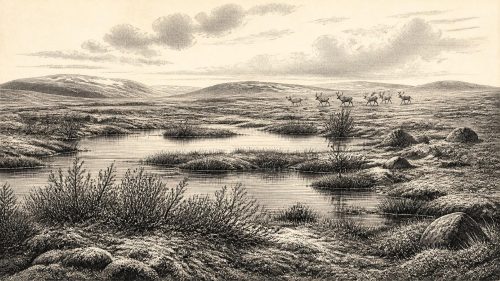
About 30,930 BCE, Ireland’s history is reconstructed from uncertain environmental and faunal evidence rather than dated events. Derryvree, County Fermanagh, preserves freshwater sediments indicating treeless, tundra-like wetlands during a cold pre-maximum glacial interval, although conditions elsewhere remain uncertain. Castlepook Cave, County Cork, contains time-mixed remains of mammoth, reindeer, giant deer and carnivores, demonstrating intermittent cold-stage animal communities. A reindeer femur bearing a possible stone-tool cut mark may indicate brief Upper Palaeolithic butchery, but cannot prove settlement. Subsequent ice expansion destroyed or obscured much evidence, leaving a fragmentary, revisable record of changing Late Pleistocene Ireland across the island over millennia thereafter.
Read Article

Archived: 21 September 2026
Abstract
Ireland around 30,988 BCE is understood only through imprecisely dated Late Pleistocene evidence, not annual history. Derryvree, County Fermanagh, preserves freshwater sediments between glacial tills, indicating an ice-free interval with treeless tundra, wetlands and cold-adapted vegetation. Castlepook Cave, County Cork, contains a complex, long-accumulated fauna including mammoth, giant deer, reindeer, brown bear and spotted hyaena, demonstrating open habitats and active predators. A possibly cut-marked reindeer femur may indicate exceptionally early human contact, but cannot prove settlement. Shifting ice, water and climate repeatedly altered landscapes and survival evidence. No secure contemporary camps, tools, societies or cultural traditions are known there either.
Read Article
Archived: 20 September 2026
Abstract
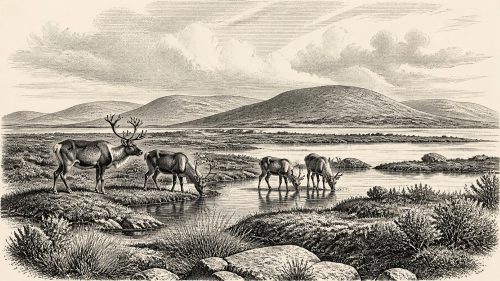
31,102 BCE is a notional date within Marine Isotope Stage 3, not a recoverable Irish year. Radiocarbon and sediment evidence from Derryvree and Greenagho in Fermanagh records ice-free freshwater wetlands between glacial advances, supporting open, cold vegetation and unstable habitats. Castlepook Cave in Cork preserves a complex, long-accumulated fauna including reindeer, mammoth, giant deer, hyaena and Arctic species, indicating intermittent ecological links with Britain and Europe. No secure evidence establishes human settlement, though a possibly worked reindeer bone may indicate a provisional visit. Ireland remained environmentally varied, increasingly glaciated and without recoverable political, social or annual history at this horizon.
Read Article
Archived: 19 September 2026
Abstract
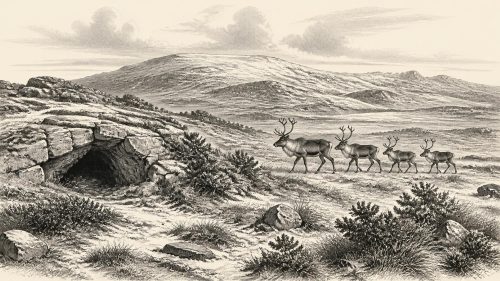
The modern label 31,207 BCE denotes a broad, uncertain MIS 3 horizon rather than a recoverable Irish year. Radiocarbon ranges and cave deposits show that southern Ireland supported, at different times, brown bears, mammoths, reindeer, giant deer, wolves, Arctic foxes, lemmings and spotted hyaenas. Castlepook Cave, County Cork, preserves notable hyaena remains, but mixed sediments cannot establish contemporaneous communities or behaviour. Ireland’s shifting ice, periglacial terrain, low sea levels and variable vegetation connected it intermittently with north-west Europe. Northern organic deposits indicate occasional milder habitats. No secure human occupation dates to this period; a possibly cut-marked reindeer bone remains inconclusive.
Read Article

Archived: 17 September 2026
Abstract
At c. 33.3 ka cal BP, Ireland experienced unstable MIS 3 cold-stage environment rather than a datable year. Derryvree, County Fermanagh, preserves organic wetland sediments between tills, showing ice-free intervals with open, treeless tundra vegetation, freshwater pools and periglacial conditions. Castlepook Cave, County Cork, yielded mammoth, reindeer, giant deer, hyaena and other fauna, demonstrating intermittent ecological links with north-west Europe, though deposits span time and are biased. Revised dating places some fauna earlier than believed. A marked reindeer bone may indicate human butchery around 33,000 years ago but cannot prove settlement. Evidence supports changing landscapes, animals and possible human visits.
Read Article

Archived: 15 September 2026
Abstract
Around 31,688 BCE, a retrospective label rather than a recoverable Irish year, Ireland lay within the climatically unstable Marine Isotope Stage 3, before the Last Glacial Maximum. Castlepook Cave in County Cork preserves bones of mammoth, giant deer, reindeer, bears, wolves, Arctic foxes, lemmings and Ireland’s only known spotted hyaenas, indicating varied cold, open habitats. Disturbed excavations and revised radiocarbon dates prevent treating these remains as a single contemporaneous fauna. Hyaena evidence suggests den use. A marked reindeer femur may indicate Palaeolithic butchery, but no associated tools, settlement, or human remains exist. Environmental change, mobility and uncertainty define deep past.
Read Article

Archived: 15 September 2026
Abstract
31,689 BCE is a modern label for a broad MIS 3 interval, not a datable Irish event. Castlepook Cave in north Cork preserves bones and sediments indicating a cold, open landscape inhabited intermittently by reindeer, mammoth, hyaenas, wolves and other fauna. Hyaenas probably accumulated much material, complicating interpretations of human activity. A marked reindeer femur, dated broadly to MIS 3, may bear a stone-tool incision and suggests a possible early human visit, but lacks secure excavation context or corroborating artefacts. Changing sea levels and approaching ice affected access and preservation. Castlepook therefore illuminates Ice Age ecology while leaving settlement unproven.
Read Article

Archived: 13 September 2026
Abstract
The reference year 31,805 BCE introduces Ireland’s Late Pleistocene animal communities without assigning them to an exact calendar event. Castlepook Cave preserves remains of reindeer, mammoth, giant deer, bear, wolf and spotted hyaena from the wider period. These finds illuminate cold environments before later glaciation. Open habitats could persist locally while ice expanded elsewhere, producing an uneven regional landscape. Later glacial activity erased many earlier surfaces, leaving a fragmentary record. Castlepook studies, Derryvree environmental evidence, museum collections and regional reconstructions provide context. The article explains how surviving animal and sediment evidence informs cautious interpretation of Ireland’s changing Ice Age ecology.
Read Article

Archived: 9 September 2026
Abstract
31,903 BCE is not a securely identifiable Irish year but falls within climatically unstable Marine Isotope Stage 3. Ireland’s changing ice, exposed shelves and open, cold habitats intermittently supported mammals, although later glaciation erased much evidence. Castlepook Cave, County Cork, preserves Ireland’s richest relevant faunal archive, including mammoth, reindeer, giant deer and spotted hyaena, but its disturbed, long accumulated deposits cannot prove contemporaneity or date species precisely to this year. A possibly cut-marked reindeer bone suggests an unconfirmed early human encounter. No settlements, societies or economies are evidenced. The period is understood through fragmented animal remains, cave processes, climatic change.
Read Article

Archived: 9 September 2026
Abstract
Labelled 31,941 BCE, this period represents approximately 33,900 years before present, during the climatically unstable Late Pleistocene. Ireland was not yet wholly ice-covered, but cold, seasonal tundra-steppe supported animals including reindeer, mammoth, giant deer, lemmings, wolves and rare spotted hyaenas. Castlepook Cave, County Cork, preserves disturbed remains from repeated episodes, demonstrating ecological links with north-west Europe. A reportedly cut-marked, dated reindeer femur may indicate human butchery and brief Upper Palaeolithic visits, but cannot prove settlement or continuity. No contemporary Irish camps, tools, hearths, burials, monuments or cultural evidence are securely known. Later ice expansion profoundly reshaped landscapes and obscured evidence.
Read Article

