Castlepook’s Spotted Hyaena30171 BCE
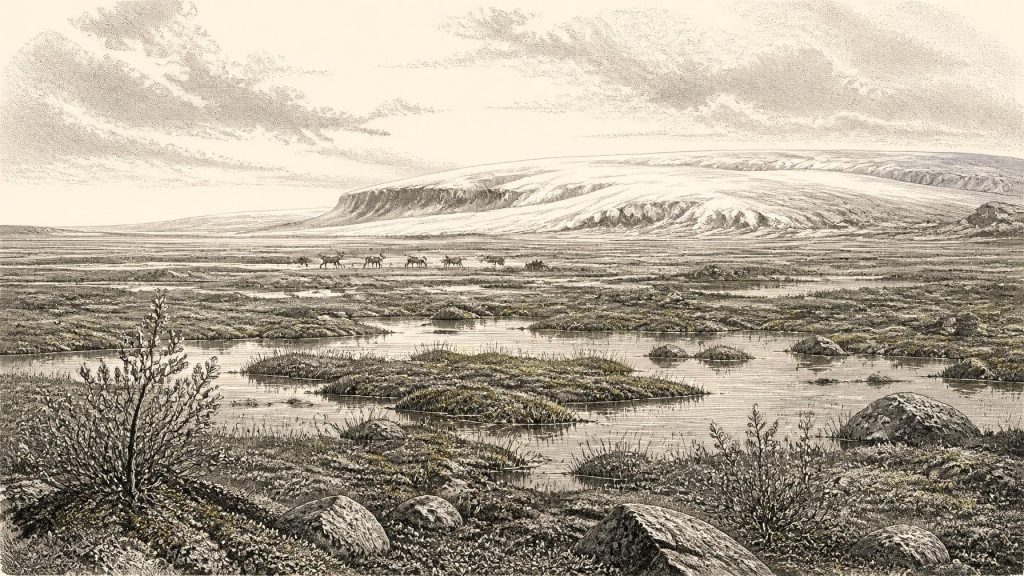
At 30,171 BCE, Ireland experienced unstable Marine Isotope Stage 3 conditions, a period unsuitable for conventional historical narrative. Growing ice, tundra wetlands and fragmented habitats characterised a varied landscape, later heavily altered by glaciation. Derryvree deposits in Fermanagh preserve sedges, mosses, dwarf willow and aquatic plants from periglacial freshwater environments. Castlepook Cave in County Cork records mammoth, reindeer, giant deer, predators and spotted hyaena, whose bones accumulated over long periods. A marked reindeer bone may indicate human carcass processing around 33,000 years ago, but cannot establish settlement, culture or a specific visit. Evidence reveals environmental change, animal movement and uncertainty.
Dateline
30,171 BCE is not a date at which Ireland can be described through an annual chronicle. It is a modern calendar label, roughly 32,000 years before the 1950 reference point conventionally used in archaeological dating, and no surviving Irish evidence can identify an event, person or season with that degree of precision. The responsible historical setting is the later part of Marine Isotope Stage 3, a profoundly unstable interval of the last Ice Age. Evidence from caves, buried sediments and ice-sheet reconstructions can illuminate broad conditions in and around Ireland; it cannot supply a named community, a political episode or a calendar-year narrative.
What emerges is neither an empty landscape nor a conventional human history. Ireland belonged to a changing north-west European world of cold climates, expanding ice, sparse vegetation and mobile animal populations. The island’s later glaciation also destroyed, displaced or buried much of the evidence that might once have survived in open country. The most meaningful history for this notional year is therefore a history of environments, animals and the limits of archaeological knowledge.
Dating an Ice-Age Landscape
Radiocarbon determinations are measurements with statistical margins, not entries in an ancient calendar. They must be calibrated because atmospheric carbon levels have altered through time; deposits can also be moved, mixed or reworked by water, animals, frost and ice. Dates expressed as years before present, or as calibrated ranges, are consequently more useful than a single BCE figure. At this depth of time, even well-dated evidence generally describes intervals of centuries or millennia.
Ireland around c. 32,000 years ago lay close to a major climatic and glaciological transition. The fullest Last Glacial Maximum came later, broadly between 27,000 and 23,000 calibrated years before present, when the Irish component of the British–Irish Ice Sheet covered the island and extended across much of the surrounding continental shelf. Yet ice-sheet growth was already under way, and researchers disagree over the exact timing, thickness and local reach of ice before that maximum. Some reconstructions treat much of Ireland as ice-covered from about 32,000 years ago; other geological records indicate a more complicated pattern of advance, retreat and locally differing ice conditions during Marine Isotope Stage 3.
That uncertainty matters. It would be misleading to picture the whole island either as a single unbroken ice cap or as an entirely open hunting ground in this precise year. The available record instead suggests a changing mosaic: ice margins and uplands, exposed or seasonally severe ground, wind-blown sediments, freshwater hollows and cave refuges for bone deposits. Ireland’s modern shorelines, woodland and farmland offer no useful visual guide to this world.
Treeless Ground and Cold Water
The clearest Irish environmental archive relevant to this broad phase comes from Derryvree near Maguiresbridge in County Fermanagh. Roadworks there exposed organic silts and fine sands trapped between two thick till sheets in a drumlin. The deposit returned a radiocarbon result of 30,500 years before present, with a substantial error range. This is not a direct date for 30,171 BCE, and its radiocarbon age must not be casually converted into an exact calendar year. Nevertheless, it is vital evidence for the kind of cold-stage environment that existed in Ireland during this larger interval.
Plant and animal remains in the Derryvree freshwater series indicate open tundra vegetation and a periglacial climate. Rather than forest, the local landscape supported low, cold-tolerant communities: sedges, mosses, dwarf willow, mountain avens, clubmosses and aquatic plants, including water-milfoil and bogbean. Such evidence points to shallow pools, wet ground and short growing seasons. It does not prove a uniform national biome. It does show that, where conditions allowed organic material to survive, northern Ireland could preserve a treeless freshwater environment within a wider cold world.
The term “tundra” should not be allowed to flatten that landscape into white emptiness. A periglacial wetland could be biologically varied in summer, with insects, aquatic plants and grazing opportunities concentrated around water. Winter would have been a very different proposition: long, severe and exposed to wind. Repeated freezing and thawing disturbed soils, while advancing glaciers later overrode or sealed parts of the earlier terrain. The Derryvree sequence is valuable precisely because it preserves a brief ecological record where most comparable ground has been erased.
The Cave Record at Castlepook
In north County Cork, Castlepook Cave near Doneraile supplies Ireland’s principal window onto pre-Last Glacial Maximum mammals. Its nineteenth- and early twentieth-century excavations produced remains attributed to woolly mammoth, reindeer, giant deer, brown bear, wolf, Arctic fox, mountain hare and spotted hyaena. The cave was not a snapshot of one day or one season. Bones accumulated through natural deaths, carnivore activity, water movement and excavation disturbance over a long span. The fauna must therefore be read as evidence of a changing regional animal community, not as a complete list of species standing together at any one moment.
Recent redating has sharpened both the importance and the difficulty of this archive. Improved methods have shown that some Castlepook specimens are substantially older than earlier radiocarbon results suggested, placing important parts of the fauna in Marine Isotope Stage 3. Giant deer and spotted hyaena may have disappeared locally before the later ice maximum. Red deer from cave sites in south-eastern Ireland also have securely calibrated pre-maximum dates extending across roughly 32,930–29,594 calibrated years before present. These ranges overlap the broad era in question, but none authorises a claim that a particular animal was seen at Castlepook in 30,171 BCE.
Even so, the animal evidence transforms the scale on which this period should be imagined. Mammoth and reindeer indicate access to open, productive cold-climate habitats; predators and scavengers reveal a food web more complex than Ireland’s later, comparatively species-poor fauna. Caves were not necessarily cosy shelters in a human sense. They were also carnivore dens, traps for animals, channels for sediment and exceptional preservers of bone. Their importance to modern research reflects preservation conditions as much as it reflects ancient patterns of occupation.
A Possible Human Trace
Castlepook has attracted particular attention because a reindeer femur fragment has been reported as bearing a deep mark interpreted by palaeozoologist Ruth Carden as having been made on fresh bone by a sharp stone tool during carcass processing. Public accounts associate the specimen with an age of about 33,000 years. If that interpretation and association are upheld through continuing research, it would be an extraordinarily early indication that people handled a reindeer in Ireland during the Late Pleistocene.
It must not, however, be turned into a settled history. The bone does not identify a named people, a permanent population, a camp, a hunting party or a journey in this specific year. Castlepook’s deposits were formed over long periods and were excavated before modern recording standards. Nor has a securely associated stone-tool assemblage, hearth, dwelling, burial or enduring settlement been recovered for this early horizon. The incision is best treated as a significant but still limited clue: possible evidence of carcass processing, not proof of a colonised island.
For the same reason, no responsible account can assign politics, diplomacy or organised conflict to Ireland at this date. There are no polities, rulers, territories or negotiated boundaries in the record. There is likewise no evidence for religion, ceremonial practice, language, art or formal learning on the island. Northern Europe certainly contained Upper Palaeolithic societies with rich cultural traditions, but transferring their beliefs or material culture to Ireland without Irish finds would be speculation.
Life, Movement and Absence
If people did reach Ireland during this broad period, they would have depended on mobility, detailed environmental knowledge and the ability to exploit short-lived opportunities. A reindeer carcass could provide meat, marrow, hide, sinew, bone and antler; that is a reasonable inference from hunter-forager economies elsewhere, not a demonstrated Irish practice at Castlepook. The absence of a tool kit means that no particular technology can be assigned. Nor can trade be demonstrated. Ireland remained separated from Britain by water despite much lower sea levels, so any human arrival would have involved a crossing or travel over and beside ice, but the practical route remains unknown.
The strongest evidence concerns animal movement rather than human society. Mammals had reached Ireland repeatedly during Pleistocene cold stages, probably by combinations of exposed shelf landscapes, ice connections and short sea crossings under changing conditions. Their presence does not prove that humans followed the same paths, nor that every species established long-lived populations. Population sizes may have been small, local extinctions frequent and habitats fragmented as climate fluctuated.
The central development around this date was therefore environmental pressure. Ice was building towards the maximum that would later reshape Ireland’s surface, scour soils and help create the uneven archaeological record now available. The country known in later history did not yet exist: there were no fields, monuments, roads, harbours or communities. But Irish ground, water and caves were already part of a dynamic Ice-Age frontier, inhabited at least intermittently by a remarkable cold-adapted fauna and perhaps, if the Castlepook mark is confirmed, visited briefly by human hands.
Primary Sources
- A Reconsideration of the Radiocarbon Dating of the Marine Isotope Stage 3 Fauna from Southern Ireland
- The Colonization of Ireland: A Human Ecology Perspective
- Middle Midlandian Freshwater Series at Derryvree, Maguiresbridge, County Fermanagh, Northern Ireland
- The Irish Quaternary Fauna Project
- Phylogeographic, Ancient DNA, Fossil and Morphometric Analyses Reveal Ancient and Modern Introductions of a Large Mammal: The Complex Case of Red Deer (Cervus elaphus) in Ireland
- The Timing and Magnitude of the British–Irish Ice Sheet Between Marine Isotope Stages 5d and 2
- Pattern and Timing of Retreat of the Last British-Irish Ice Sheet
- The Deglaciation of the Western Sector of the Irish Ice Sheet from the Inner Continental Shelf to its Terrestrial Margin
- Deglaciation Chronology of the Donegal Ice Centre, North-West Ireland
- Last Glacial Maximum Cirque Glaciation in Ireland and Implications for Reconstructions of the Irish Ice Sheet
- Dimensions and Chronology of the Last Ice Sheet in Western Ireland
- Trimlines, Blockfields and the Vertical Extent of the Last Ice Sheet in Southern Ireland
- Radiocarbon Constraints on the Age of the Maximum Advance of the British–Irish Ice Sheet in the Celtic Sea
- Late Pleistocene Chronostratigraphy and Ice Sheet Limits, Southern Ireland
- Ireland: Submerged Prehistoric Sites and Landscapes
- Palaeoecology: Field Guide No. 16
- Heritage Artefacts of County Cork
- Ireland’s Palaeolithic Archaeology – Fleeting Footprints in a Frozen Land
- Our Ancient Landscapes: Hunter-Gatherers in Ireland
- New Insights on the Fauna of Ireland’s Younger Dryas and Early Holocene from Alice & Gwendoline Cave
- Independent Tephrochronological Evidence for Rapid and Synchronous Oceanic and Atmospheric Temperature Rises Over the Greenland Stadial-Interstadial Transitions Between ca. 32 and 40 ka b2k
- NGRIP and GICC05modelext Ice-Core Data
- Occurrence of Mammalia Relicts at Site Castlepook Cave
- Scientific Dating of Pleistocene Sites: Introduction