Castlepook’s Hyaena Accumulation31689 BCE
31,689 BCE is a modern label for a broad MIS 3 interval, not a datable Irish event. Castlepook Cave in north Cork preserves bones and sediments indicating a cold, open landscape inhabited intermittently by reindeer, mammoth, hyaenas, wolves and other fauna. Hyaenas probably accumulated much material, complicating interpretations of human activity. A marked reindeer femur, dated broadly to MIS 3, may bear a stone-tool incision and suggests a possible early human visit, but lacks secure excavation context or corroborating artefacts. Changing sea levels and approaching ice affected access and preservation. Castlepook therefore illuminates Ice Age ecology while leaving settlement unproven.
Dateline
The label 31,689 BCE is a modern chronological convenience, not a date at which Irish archaeology can identify a particular event. Expressed in the archaeological convention of years before AD 1950, it is approximately 33,600 calendar years ago. No contemporary Irish calendar, written testimony, settlement sequence or annually resolved environmental record exists from which to reconstruct a single year. The responsible approach is therefore to place this nominal point within the fluctuating middle part of the Last Glacial Period, or Marine Isotope Stage 3 (MIS 3), and to use broad calibrated ranges and carefully dated deposits.
For Ireland, the most important evidence relevant to this distant horizon comes not from houses, graves or tools but from caves, fossils, sediments and mineral deposits. The most conspicuous site is Castlepook Cave, also called Mammoth Cave or Doneraile Cave, in north County Cork. Its animal-bone assemblage has made the area central to debates about Ireland’s Ice Age landscape and the possibility of very early human visits. Yet it also demonstrates the limits of the evidence: a cave containing bones is not automatically a human camp, and a radiocarbon date on an animal does not prove people were present when that animal died.
A Date Without a Recorded Year
Radiocarbon measurements are reported in radiocarbon years before present and must be calibrated against changing levels of atmospheric carbon-14 to produce calendar ranges. At more than thirty millennia ago those ranges can be broad. The modern IntCal20 calibration curve is designed for Northern Hemisphere terrestrial samples back to 55,000 calendar years before present, but it does not transform an Ice Age specimen into evidence for a named year. A date written as 31,689 BCE should consequently be read as a point within a much wider span, not as an anniversary in prehistoric Ireland.
The period belongs to MIS 3, conventionally extending from about 59,000 to 29,000 years before present. It was colder than today but was not an unchanging deep freeze. Greenland ice-core records, European pollen sequences and Irish cave calcite all indicate abrupt climatic oscillations on millennial scales. In south-west Ireland, uranium-thorium dating from Crag Cave shows repeated episodes of speleothem growth during the last glacial cycle. Because cave calcite requires liquid water, those phases indicate intervals in which local mean annual temperatures were likely above freezing. Strong late-MIS-3 growth is evidence for climatic amelioration, though it cannot supply a precise weather report for north Cork in one nominal year.
Open Country in North Cork
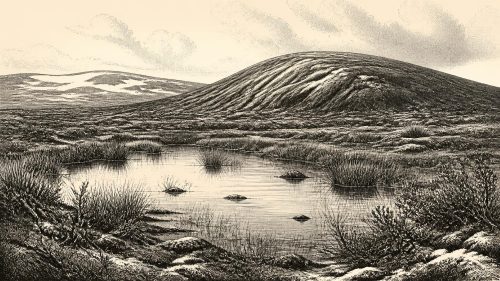
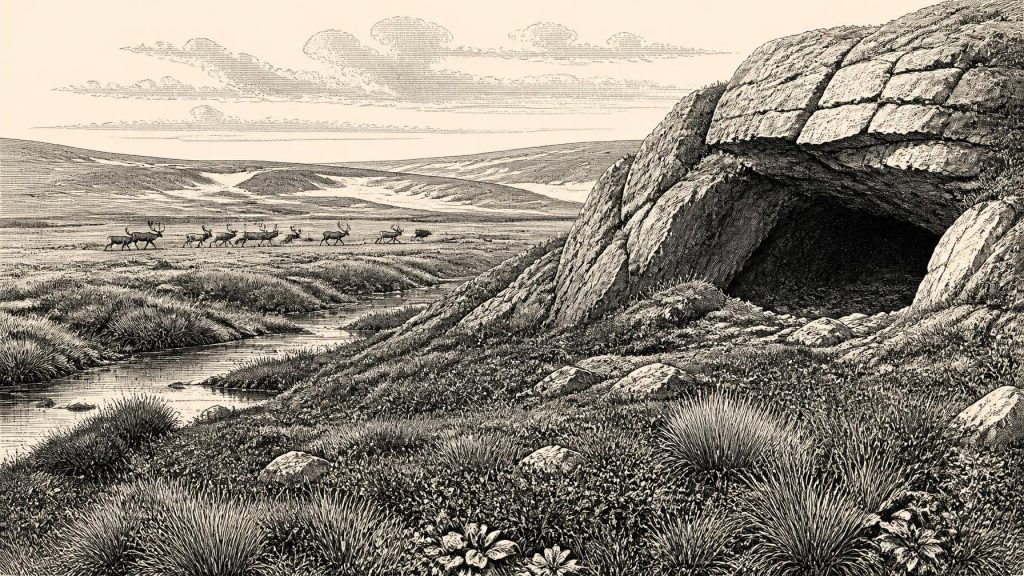
At around this point in the wider glacial cycle, Ireland was not the wooded island familiar today. Direct environmental records are patchy, often disturbed or removed by later ice, but the fauna from Castlepook and other Irish sites indicates a cold, largely open landscape capable of supporting substantial herbivores and their predators. Reindeer, woolly mammoth, giant deer, brown bear, wolf, Arctic fox, hare, lemmings and spotted hyaena are represented among the Castlepook material or related collections. Such animals imply a mosaic of open grassland, herb-rich tundra, dwarf-shrub vegetation, wet ground and sheltered places rather than dense forest.
This list must not be converted into a painted scene in which every species stands together at the cave mouth. The old excavations recovered bones from complex deposits, and the specimens were not all laid down simultaneously. Some have later direct dates, while others can only be assigned broadly by association. The fauna nevertheless establishes an important point: during favourable parts of the last glacial cycle, southern Ireland supported, or at least received, a more diverse cold-stage mammal community than the later island would possess.
Spotted hyaena is especially significant. Castlepook provides Ireland’s best-known evidence for this Ice Age carnivore. Hyaenas are powerful bone accumulators: they can carry carcass parts into dens, gnaw and break bones, and mix material deposited at different times. Their presence makes the cave a record of animal behaviour as well as a possible archive of human activity. It cautions against reading every fracture, scrape or concentration of bone as the result of hunting or butchery.
The Reindeer Bone Question
Modern re-examination of museum collections has altered the chronology of the Castlepook fauna. Research associated with the Irish Quaternary Fauna Project and later work by Ruth Carden and colleagues showed that several earlier radiocarbon results were too young. Direct determinations now place parts of the southern Irish fauna in MIS 3, with individual results from Castlepook and other sites extending across a substantial period rather than forming one single assemblage.
A reindeer femur fragment from Castlepook has attracted particular attention because it bears a deep linear mark interpreted by Carden as consistent with a sharp stone tool used on fresh bone. The bone has been publicised as dating to roughly 33,000 radiocarbon years before present. Calibration turns this into a calendar range of several millennia, principally earlier than the nominal point of 31,689 BCE, rather than a date for a visit in that exact year. The claim is potentially important because, if the mark is confirmed as a human cut or chop mark and is securely related to the bone’s age, it would indicate a human presence in Ireland far earlier than the previously secure Late Upper Palaeolithic evidence.
That conditional language matters. The bone was recovered during early twentieth-century cave investigations, not from a modern excavation with the full spatial, sedimentary and microscopic controls expected today. Its date establishes when the reindeer lived; the diagnosis of the incision is a separate taphonomic judgement. Carnivore teeth, sediment abrasion, breakage and excavation history all have to be excluded. Nor has a securely stratified MIS-3 stone-tool assemblage, hearth, dwelling surface, human bone or burial been published from Ireland. The evidence therefore supports a serious hypothesis of a brief human encounter with a reindeer, not a demonstrated settlement or a population history.
People, If Any, and the Limits of Analogy
Across north-west Europe, Homo sapiens communities of the Upper Palaeolithic hunted, gathered, made sophisticated stone, bone and antler equipment, used fire and maintained long-distance social connections. It is reasonable to say that any people who reached Ireland in MIS 3 would have needed comparable practical knowledge: clothing, fire management, seasonal mobility and an ability to travel through a cold, changing world. It is not responsible to assign them a particular named archaeological culture, language, belief system or homeland from one marked bone.
There is likewise no basis for describing political affairs, diplomacy, organised warfare, trade networks, religion or artistic traditions in Ireland at this date. Such subjects require evidence of communities, repeated occupation, objects or structures; none survives for the nominal year. If people did enter the island or its then-different landmass, their visit may have been short and exploratory, perhaps linked to hunting or scavenging. That is interpretation by analogy with wider European hunter-gatherer life, not an observation recovered from Castlepook.
The distinction becomes clearer when Castlepook is compared with Alice and Gwendoline Cave in County Clare. A butchered brown-bear kneecap from that cave has two consistent calibrated ranges centred around 12,800–12,600 calendar years before present. It is later by more than twenty millennia, but it is stronger evidence because its cut marks, dating and excavated context have been studied in detail. Ireland’s later Upper Palaeolithic visitors cannot simply be projected backwards to make an earlier occupation continuous.
Routes, Water and Approaching Ice
The map was also different. Lower global sea levels exposed areas of the continental shelf, and the Irish Sea basin, Celtic Sea and land connections beyond Ireland changed repeatedly as ice and water volumes altered. It would be misleading, however, to imagine an uncomplicated dry highway from Britain or the Continent. Ice margins, rivers, estuaries, marine channels and seasonal conditions governed movement. The precise accessibility of north Cork at any single moment around 33,600 calendar years ago remains uncertain.
Within several thousand years, the climatic trajectory led towards the Last Glacial Maximum. Marine and terrestrial research shows the British-Irish Ice Sheet reaching major extent across the Celtic shelf roughly 27,000–24,000 calendar years before present, and later ice covered most or all of Ireland. This expansion was consequential for archaeology: advancing ice eroded, buried and rearranged many older land surfaces. The scarcity of Irish MIS-3 sites is therefore not proof that animals or people were absent; it is partly a consequence of poor preservation and survival.
For ordinary life, the clearest history at 31,689 BCE is animal rather than human. Herbivores moved through exposed country; carnivores exploited them; caves offered dens, traps and occasional shelters; water, frost and thaw shaped every route. North Cork’s limestone cavities preserved fragments of that world which open-air sites and soils largely lost. The Castlepook material makes Ireland visible within the wider Ice Age ecology of Atlantic Europe, while its ambiguities prevent the false certainty of a fully peopled prehistoric scene.
Thus this nominal year should be remembered not for a recorded Irish event but for a critical archaeological threshold. Ireland around 33,600 calendar years ago was a dynamic glacial-edge landscape, environmentally capable of supporting reindeer and mammoth as well as hyaenas and wolves. A marked reindeer bone raises the possibility that people briefly entered that landscape. It does not yet demonstrate an Irish society, a settlement, or a dated act in 31,689 BCE. Continued excavation at Castlepook, improved direct dating and microscopic reassessment of bone surfaces are the means by which that narrow but important possibility can be tested.
Primary Sources
- A reconsideration of the radiocarbon dating of the Marine Isotope Stage 3 fauna from southern Ireland
- New insights on the fauna of Ireland's Younger Dryas and Early Holocene from Alice & Gwendoline Cave
- First evidence of a Late Upper Palaeolithic human presence in Ireland
- Episodic speleothem deposition tracks the terrestrial impact of millennial-scale last glacial climate variability in SW Ireland
- Advance and retreat of the marine-terminating Irish Sea Ice Stream into the Celtic Sea during the Last Glacial: Timing and maximum extent
- Early deglaciation of the British-Irish Ice Sheet on the Atlantic shelf northwest of Ireland driven by glacioisostatic depression and high relative sea level
- Maximum extent and dynamic behaviour of the last British-Irish Ice Sheet west of Ireland
- Stratigraphic and palaeo-geomorphological evidence for the glacial-deglacial history of the last British-Irish Ice Sheet in the north-western Irish Sea
- Britain and Ireland: glacial landforms prior to the Last Glacial Maximum
- Quaternary deposits and glacial stratigraphy in Ireland
- European vegetation during Marine Oxygen Isotope Stage-3
- The Irish Quaternary Fauna Project
- Pleistocene vertebrates in the British Isles
- Proceedings: Post-glacial colonisation conference
- 2022:564 – Castlepook Cave, Castlepook South, Cork
- Heritage Artefacts of County Cork
- Figure 6.—The subdivision of the Quaternary Period in Ireland
- Mammoth Cave
- The IntCal20 Northern Hemisphere Radiocarbon Age Calibration Curve (0–55 cal kBP)
- IntCal Publications
- The IntCal20 approach to radiocarbon calibration curve construction: a new methodology using Bayesian splines and errors-in-variables
- The Mesolithic in Ireland: when was it?