Hyaena Hall’s Bone Traffic31688 BCE
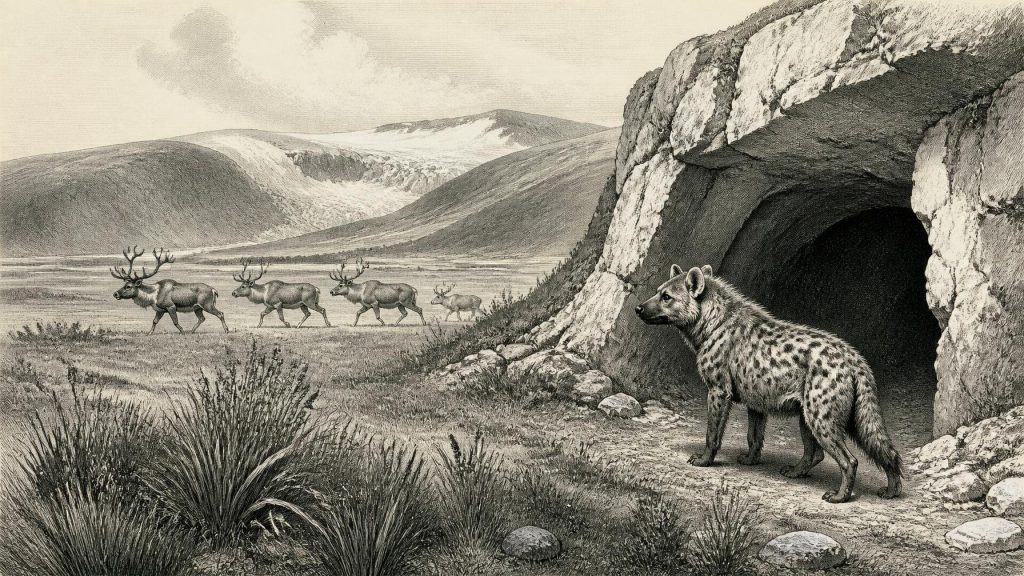
Around 31,688 BCE, a retrospective label rather than a recoverable Irish year, Ireland lay within the climatically unstable Marine Isotope Stage 3, before the Last Glacial Maximum. Castlepook Cave in County Cork preserves bones of mammoth, giant deer, reindeer, bears, wolves, Arctic foxes, lemmings and Ireland’s only known spotted hyaenas, indicating varied cold, open habitats. Disturbed excavations and revised radiocarbon dates prevent treating these remains as a single contemporaneous fauna. Hyaena evidence suggests den use. A marked reindeer femur may indicate Palaeolithic butchery, but no associated tools, settlement, or human remains exist. Environmental change, mobility and uncertainty define deep past.
Dateline
31,688 BCE is not a date that can be recovered from the Irish archaeological record as a single year. It is a modern calendar label, applied retrospectively to a period for which there are no written records, named communities, annual chronologies or securely dated events. Expressed in the conventional archaeological system of “before present” (where present is AD 1950), it sits at roughly 33.6 thousand calendar years ago. That places it within Marine Isotope Stage 3 (MIS 3), a long and climatically unstable part of the Late Pleistocene, rather than within a historically meaningful Irish year. The most responsible account therefore concerns a broad interval around this point, using calibrated ranges where available and separating what fossils demonstrate from what historians may cautiously infer.
An Ireland Before the Ice Maximum
At about 33,600 calendar years before 1950, Ireland had not yet reached the fullest extent of the last British–Irish Ice Sheet. The Last Glacial Maximum lay ahead, principally in the later period around 27,000 to 20,000 years ago, although glacier growth and the precise position of ice margins varied greatly by region and remain subjects of active research. Ireland was consequently neither a uniformly ice-covered blank nor a benign green island. It was part of a northern, cold-stage world in which conditions altered sharply over millennia and sometimes much more quickly. The evidence supports a changing mosaic of ice, exposed ground, river systems, lake or wetland basins, sparse vegetation and local habitats capable, at intervals, of sustaining large mammals.
MIS 3 was marked by repeated abrupt shifts between colder stadial and relatively milder interstadial conditions. That does not allow a historian to state the weather in Ireland in 31,688 BCE, still less to describe a particular season. It does explain why a simple image of an unchanging “Ice Age” is misleading. Habitable areas could expand or contract; plant cover, snow conditions and animal movements could change; and routes across what are now seas could become more or less practicable. Lower global sea levels altered the shape of the Irish Sea basin, but the available evidence does not justify imagining a permanent, straightforward land bridge to Britain or the continent at this exact moment.
Castlepook and the Cave Record
The clearest Irish evidence relevant to this distant interval comes from limestone caves in the south, above all Castlepook Cave, also known as Mammoth Cave, near Doneraile in north County Cork. The cave lies in the Awbeg Valley below the Ballyhoura Hills. Excavations undertaken between 1904 and 1908 recovered a remarkable quantity of animal bone, including material attributed to woolly mammoth, giant deer, reindeer, brown bear, wolf, Arctic fox, lemmings and spotted hyaena. Castlepook is particularly important because it has yielded Ireland’s only known spotted-hyaena remains and because it preserves both pre- and post-Last Glacial Maximum faunal evidence.
Yet Castlepook is not a sealed snapshot of a single landscape or single generation. Much of its material was collected before modern excavation standards: deposits were disturbed, bones were gathered from different chambers and passages, and the fine stratigraphic relationships needed to prove contemporaneity were often lost. Caves are also active filters. Hyaenas can drag carcass parts underground; bears may die in dens; scavengers gnaw bone; water, sediment and roof falls shift material; and later excavators can mix it again. A cave assemblage is therefore evidence that particular animals occurred in the wider region at some stage, but it cannot automatically reveal where every creature lived, died or was killed.
Modern radiocarbon work has made this caution even more necessary. The Irish Quaternary Fauna Project established that a broad range of mammals reached Ireland between at least about 45,000 and 20,000 years ago. Subsequent redating, using improved pretreatment of ancient bone, found that some older determinations from southern Irish caves were substantially too young. At Castlepook, reassessed dates suggested a deeper MIS 3 antiquity for parts of the fauna and raised the possibility that giant deer and spotted hyaena had disappeared locally before the Last Glacial Maximum. Thus a calendar label around 31,688 BCE should not be used to claim that every familiar Castlepook species stood together in the Awbeg Valley at one moment.
Animals, Not a Census
Nevertheless, the fauna offers a powerful view of the ecological possibilities of Pleistocene Ireland. Reindeer and lemmings point towards cold, open settings; Arctic fox and mountain hare reinforce that impression. Woolly mammoth and giant deer indicate that at least some landscapes had enough food and accessible ground for very large herbivores. Brown bear, wolf and spotted hyaena show that predators and scavengers were part of the same wider ecological theatre. In particular, hyaena bones, teeth and coprolites make it likely that Castlepook functioned at least partly as a carnivore den, a place through which prey remains moved rather than a human settlement awaiting discovery.
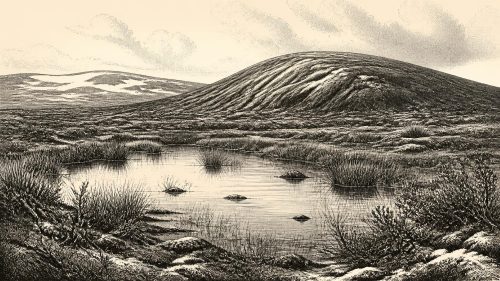
This was not the Ireland of later peat bogs, broad oak woods, farms, monuments or enclosed fields. Treeless or lightly vegetated ground, hardy grasses and herbs, exposed mineral soils, patches of wetland and seasonally severe conditions are more appropriate general terms. Exact local vegetation at 31,688 BCE cannot be reconstructed from a securely dated Irish pollen diagram for that calendar year. The animal record instead supports an interpretation of varied cold-stage habitat, likely changing through time and across short distances. It would have been an environment shaped as much by mobility—of herds, predators, ice and meltwater—as by permanent places.
A Possible Human Trace
The most arresting, but least conclusive, human question concerns a reindeer femur from Castlepook. Ruth Carden identified a deep mark on the bone as consistent with cutting or chopping by a sharp stone implement while the bone was fresh. County Cork’s heritage publication presents the specimen as evidence that Palaeolithic hunters may have butchered reindeer in Ireland around 33,000 years ago. If that interpretation is sustained by further analysis, it would push possible human activity on the island far earlier than the securely established terminal-Pleistocene evidence from County Clare. It would represent a moment of carcass processing, not proof of a village, a population or a continuous settlement.
The distinction matters. A radiocarbon determination dates the death of the animal within a probability range; it does not, by itself, date a mark, a visit to the cave or a named human group. Nor have securely associated stone tools, hearths, dwellings or human remains been recovered from a Castlepook context of this age. The National Museum of Ireland accordingly continues to describe unequivocal Palaeolithic human evidence in Ireland as absent, while research and renewed excavation test the much earlier possibility. The sound conclusion for around 31,688 BCE is not that Ireland was certainly inhabited, but that a potentially significant trace demands careful scrutiny.
No Polities, No Proven Diplomacy
Nothing in the evidence permits political history in the usual sense. There were no recorded kingdoms, leaders, boundaries, alliances, wars, diplomatic exchanges or institutions. Nor can language, ancestry, religious belief, ritual practice, kinship rules or artistic traditions be assigned to Ireland at this point. Even if small groups of Upper Palaeolithic people did reach the island intermittently, the archaeological record does not reveal their names, identities or social organisation. It would be anachronistic to connect them with later Irish peoples, Gaelic culture or any medieval and modern idea of Ireland.
Likewise, there is no direct evidence for an Irish economy of the kind later historical writing recognises: no agriculture, herding, market exchange, metalwork, boats, houses, roads or trade network can be documented for this date. A possible act of reindeer butchery would imply knowledge of animal resources and stone-edged tools, but it cannot establish whether the animal was hunted, scavenged or encountered after death. At most, the wider north-west European context makes seasonal movement by highly mobile hunter-gatherers plausible. That is an interpretation based on comparative archaeology, not a demonstrated Castlepook community.
A Fragile Northern Frontier
The period’s central Irish development was environmental rather than political: the approach to a more severe glacial world. As the British–Irish Ice Sheet expanded towards its later maximum, landscapes able to support mammals and any visiting people became increasingly vulnerable to cold, ice advance and altered coastlines. The subsequent ice sheet also destroyed or buried much evidence. This helps explain why the record is concentrated in caves and scattered deposits rather than open-air sites, and why absence of evidence must not be mistaken too readily for proof of total absence.
For Ireland around 31,688 BCE, then, the responsibly reconstructed scene is one of a changing cold-stage frontier. Castlepook’s bones establish that an unexpectedly rich set of mammals reached this far-western landscape during MIS 3. They show an Ireland connected, at intervals, to wider European ecological processes. The contested reindeer femur offers a tantalising possibility that people also reached it. But the decisive facts remain modest: there is no calendar-year event, no known settlement and no recoverable political or cultural narrative. What survives is a cave archive of animals, movement and uncertainty—and that uncertainty is itself an important part of Ireland’s deepest past.
Primary Sources
- A Reconsideration of the Radiocarbon Dating of the Marine Isotope Stage 3 Fauna from Southern Ireland
- The Irish Quaternary Fauna Project
- New Insights on the Fauna of Ireland's Younger Dryas and Early Holocene from Alice & Gwendoline Cave
- First Evidence of a Late Upper Palaeolithic Human Presence in Ireland
- Growth and Retreat of the Last British–Irish Ice Sheet, 31,000 to 15,000 Years Ago: the BRITICE-CHRONO Reconstruction
- A 10Be-Dated Record of Glacial Retreat in Connemara, Ireland, Following the Last Glacial Maximum and Implications for Regional Climate
- Oscillating Retreat of the Last British-Irish Ice Sheet on the Continental Shelf Offshore Galway Bay, Western Ireland
- Maximum Extent and Readvance Dynamics of the Irish Sea Ice Stream and Irish Sea Glacier Since the Last Glacial Maximum
- The Deglaciation of the Western Sector of the Irish Ice Sheet from the Inner Continental Shelf to its Terrestrial Margin
- Spotted Hyena Skull
- The Exploration of Castlepook Cave, Co. Cork. With 3 Plates.
- Castlepook Caves
- 2022:564 – Castlepook Cave, Castlepook South, Cork
- Heritage Artefacts of County Cork
- Mammoth Cave, Castlepook
- Prehistoric Details
- The IntCal20 Northern Hemisphere Radiocarbon Age Calibration Curve (0–55 cal kBP)
- The IntCal20 Approach to Radiocarbon Calibration Curve Construction: A New Methodology Using Bayesian Splines and Errors-in-Variables
- Dansgaard–Oeschger Events in Climate Models: Review and Baseline Marine Isotope Stage 3 Protocol
- Marine Isotope Stage 3 Sea Level Fluctuations: Data Synthesis and New Outlook
- The Marine δ18O Record Overestimates Continental Ice Volume During Marine Isotope Stage 3
- IQUA Newsletter No. 58, February 2017
- Proceedings of the Royal Irish Academy, Volume XXXIV, Section B