Hyaena Hall’s Deep Archive31102 BCE
31,102 BCE is a notional date within Marine Isotope Stage 3, not a recoverable Irish year. Radiocarbon and sediment evidence from Derryvree and Greenagho in Fermanagh records ice-free freshwater wetlands between glacial advances, supporting open, cold vegetation and unstable habitats. Castlepook Cave in Cork preserves a complex, long-accumulated fauna including reindeer, mammoth, giant deer, hyaena and Arctic species, indicating intermittent ecological links with Britain and Europe. No secure evidence establishes human settlement, though a possibly worked reindeer bone may indicate a provisional visit. Ireland remained environmentally varied, increasingly glaciated and without recoverable political, social or annual history at this horizon.
Dateline
31,102 BCE is not a year that can be recovered from the Irish archaeological record. It is a modern calendar label, roughly 33,050 years before the conventional radiocarbon reference point of AD 1950. No written calendar, annual layer, named community or datable event permits a history of twelve particular months. The responsible setting is instead a broad Late Pleistocene horizon in the latter part of Marine Isotope Stage 3 (MIS 3), during the last Ice Age. Evidence consists of radiocarbon ranges, sediments, cave bones and glacial landforms; interpretation must remain separate from what those traces directly prove.
This notional date falls within a period when Ireland’s environments were cold, volatile and regionally varied, before the fullest expansion of the last British–Irish Ice Sheet. The global Last Glacial Maximum came later, conventionally placed at about 26,500–19,000 years ago. Ireland was therefore not simply a uniformly ice-covered island at this point, but neither was it a familiar green landscape awaiting settlement. Ice margins, open ground, wetlands, river valleys, limestone caves and changing coastlines created a shifting north-western edge of Ice-Age Europe.
A Date Range, Not an Anniversary
Deep-time chronology demands care. Radiocarbon laboratories measure the remaining carbon-14 in once-living material, producing a radiocarbon age rather than an immediately usable calendar year. That age must be calibrated against independently dated records of past atmospheric carbon variation. For samples more than thirty millennia old, the resulting calendar ranges can be broad. Nor does a date on a bone automatically date every animal bone, sediment layer or possible human action nearby.
The key Irish comparison is Derryvree, near Maguiresbridge in County Fermanagh. Roadworks exposed freshwater silts, sands and organic material trapped between two tills: deposits laid down by glacier ice. The sequence provides a clear relative order. Ice formed the lower till; an interval without glacier ice at that locality allowed waterborne and organic sediments to accumulate; then renewed glaciation buried them beneath the upper till. Organic material from the inter-till deposits returned a radiocarbon age of 30,500 ± 1,200 radiocarbon years BP, calibrated in published discussion to approximately 36,900–31,700 calendar years BP.
The nominal date of 31,102 BCE lies within that broad calibrated window, not at a precise point that the Derryvree deposits can identify. Converted approximately, the range spans about 34,950–29,750 BCE. It is evidence that north-central Ireland contained an ice-free freshwater environment during part of that long interval. It is not proof that all Ireland was ice-free, that conditions were identical from Fermanagh to Cork, or that a particular season can be reconstructed for this article’s calendar label.
Wetlands Between the Ice
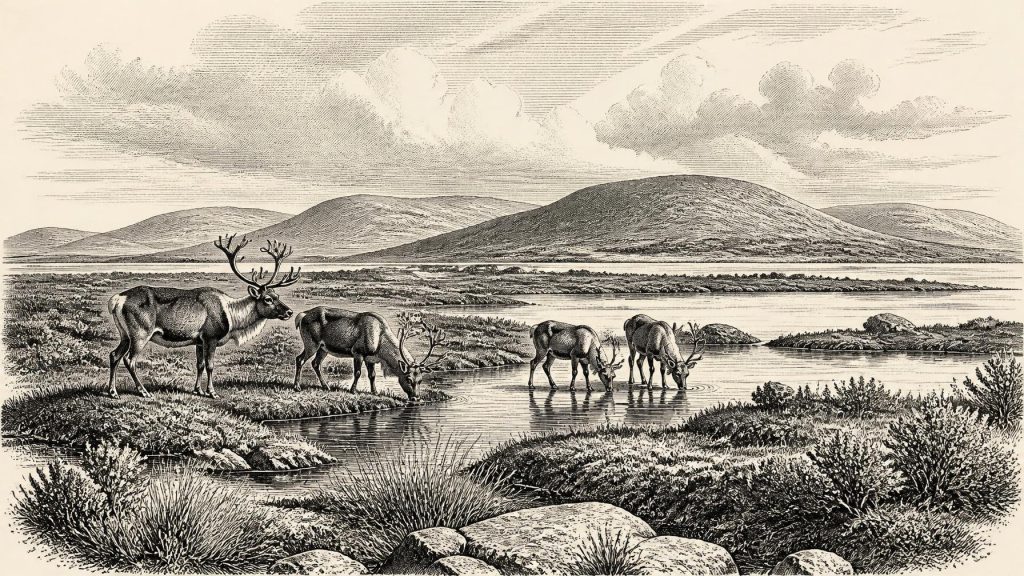
Derryvree matters because it preserves living conditions rather than only the destructive work of ice. Its plant remains indicate open, cold-stage vegetation around standing or slow-moving freshwater. Sedges, aquatic plants, mosses and low-growing tundra or marsh vegetation point to a landscape without closed forest. Such evidence supports an environment of wet hollows and shallow pools amid exposed ground, with local shelter and water even in a generally severe climate.
This was not a stable countryside. The North Atlantic climate of MIS 3 experienced abrupt shifts between relatively milder interstadials and colder stadials, known especially from Greenland ice cores. Irish deposits record the consequences only indirectly and at lower resolution. They should not be assigned confidently to every named Greenland climatic oscillation. What can be said is that the island’s ice, vegetation, drainage and animal habitats changed repeatedly over millennia. At Derryvree, freshwater life survived long enough to leave a delicate archive before advancing ice sealed it away.
Nearby evidence at Greenagho, also in County Fermanagh, includes organic lacustrine deposits beneath till dated to about 37,200–35,700 calibrated years BP. Together, Derryvree and Greenagho show that the advance towards full glaciation was neither instantaneous nor simple. They illuminate a northern interior with habitable patches during parts of MIS 3, while saying little about exactly how far people, if any were present, could have travelled through it.
Castlepook’s Animal World
County Cork provides the other major Irish archive relevant to this period. Castlepook Cave, also called Mammoth Cave or Doneraile Cave, lies in the limestone country of the Awbeg valley. Excavations and collecting there, much of it undertaken before modern archaeological standards, produced an exceptional Pleistocene faunal assemblage. Reindeer, woolly mammoth, giant deer, brown bear, wolf, fox, Arctic fox, mountain hare, lemmings and spotted hyaena are among the animals identified from the cave system.
This is not a census of creatures sharing the landscape in 31,102 BCE. Cave deposits can accumulate slowly; carnivores carry bones into dens; water and sediment move material; and older excavation practices often left imperfect records of context. Modern radiocarbon reassessment has also shown that some Castlepook specimens previously thought much younger were substantially older, strengthening the case that important elements of the assemblage belong to MIS 3. Each specimen must therefore be considered on its own date, condition and find history.
Even with those cautions, Castlepook establishes the broad ecological character of southern Ireland during portions of the period. Reindeer, mammoth and giant deer indicate open country capable of supporting large herbivores. Lemmings and Arctic fox reinforce the cold-climate signal. Spotted hyaena is particularly striking: this species ranged far beyond modern Africa during the Pleistocene and could live in cold, open settings. Bones bearing hyaena damage also show that a cave may have been a den and scavenging place, rather than a human shelter.
The giant deer is often called the “Irish elk”, but that familiar name misleads. Megaloceros giganteus was neither an elk nor an animal restricted to Ireland; it ranged widely across Eurasia. Its presence at Castlepook is important not as a national emblem, but as evidence for the wide ecological connections that linked Ireland to continental and British Ice-Age faunas when routes of dispersal were intermittently available.
The Human Question
There is no securely excavated camp, hearth, dwelling floor, human bone or unequivocal stone-tool assemblage in Ireland dating to around 31,102 BCE. Accordingly, no responsible account can describe an Irish population, political order, conflict, diplomacy, trade network, ritual tradition or language for this time. There is equally no direct evidence for farming, permanent settlement, boat-building, art or formal learning on the island at this date.
A reindeer femur from Castlepook has nevertheless made the cave central to debate. A mark on the bone has been interpreted as a fresh-bone cut or chop made with a sharp stone implement during carcass processing. If that interpretation, its chronology and its context are ultimately sustained, it could represent remarkably early human handling of an animal in Ireland. It would suggest a brief Upper Palaeolithic visit by mobile hunter-gatherers rather than a demonstrated resident society.
That conclusion remains provisional. The bone comes from a complicated old collection, not a modernly excavated occupation surface. A cut-like mark is not by itself a settlement, and the age of an animal does not demonstrate that people were present when it died. Recent work at Castlepook has sought surviving undisturbed sediments and improved contextual evidence, precisely because fresh excavation, microscopic analysis and secure dating are needed to test such a consequential claim.
The contrast with later evidence is instructive. A butchered brown-bear patella from Alice and Gwendoline Cave in County Clare has been independently dated to about 12,810–12,590 calibrated years BP, providing strong evidence of Late Upper Palaeolithic human activity long after the period considered here. The first clear sustained settlement evidence belongs later again, to Early Mesolithic communities after the final retreat of the ice. The gap is not an invitation to invent a lost Ice-Age Ireland; it is a measure of what remains unknown.
Mobility Without Borders
At this depth of time, Ireland had no political geography. There were no Irish kingdoms, territorial boundaries or diplomatic relations in the historical sense. Yet the animals in the cave record demonstrate that the island was part of a wider zone of movement. Lower global sea levels altered the surrounding shelf, but sea level alone did not create a simple, permanent land bridge. Ice barriers, local relative sea-level change, shifting coastlines and the changing configuration of Britain and the Irish Sea all affected access.
For large mammals, successful movement depended on viable habitat as much as dry ground: forage, freshwater, seasonal shelter and routes around ice. The presence of a varied cold-stage fauna shows that such opportunities existed at intervals. Whether people exploited the same routes in MIS 3 is a separate archaeological question. Comparable hunter-gatherer societies elsewhere in Upper Palaeolithic Europe certainly possessed sophisticated knowledge of animals, stone and seasonal landscapes, but it would be speculation to transfer their social arrangements wholesale to Ireland without an Irish settlement record.
An Archive of Change
The most important development around this nominal date was environmental, not political: the approach of a more extensive glaciation across a landscape that still contained local freshwater habitats and mobile animal populations. Derryvree records an ice-free wetland interval in Fermanagh. Castlepook records a far-ranging cold-stage fauna in Cork, accumulated over a long and complicated timespan. Together they replace the crude picture of an island either wholly frozen or fully occupied.
They also set strict limits on historical imagination. Around 31,102 BCE, Ireland can be described as an unstable Ice-Age landscape of open vegetation, freshwater pockets, large herbivores, predators and advancing ice. A human visit is possible but unproven for this precise horizon. There were no recoverable affairs of state, no established Irish society and no annual narrative. What survives is deeper and more fragmentary: silt between tills, teeth and bones in limestone darkness, and a landscape repeatedly remade by ice.
Primary Sources
- A reconsideration of the radiocarbon dating of the Marine Isotope Stage 3 fauna from southern Ireland
- First evidence of a Late Upper Palaeolithic human presence in Ireland
- New insights on the fauna of Ireland's Younger Dryas and Early Holocene from Alice & Gwendoline Cave
- The Irish Quaternary Fauna Project
- Trimlines, blockfields and the vertical extent of the last ice sheet in southern Ireland
- Growth and retreat of the last British–Irish Ice Sheet, 31,000 to 15,000 years ago: the BRITICE-CHRONO reconstruction
- The Last Glacial Maximum
- The IntCal20 Northern Hemisphere Radiocarbon Age Calibration Curve (0–55 cal kBP)
- Reconstruction and 36Cl based geochronology of the deglaciation of central Ireland
- The deglaciation of the western sector of the Irish Ice Sheet from the inner continental shelf to its terrestrial margin
- Prehistoric Details
- Archaeological Heritage of County Cork
- Heritage Artefacts of County Cork
- Quaternary Site Descriptions
- 2022:564 – Castlepook Cave, Castlepook South, Cork
- Mammoth Cave
- Cenozoic: Tertiary and Quaternary
- The Last Glacial Maximum
- IQUA Newsletter 64
- A Marine Isotope Stage 4 age for Pleistocene raised beach deposits near Fethard, southern Ireland